1. State of the art, project management and documentation
References & Inspiration
I spent a long time reflecting on what exactly I want to explore. Smart clothing of the future and creative artistic projects are almost equally attractive to me. Still, my mind is currently more drawn to searching for something new that could, above all, be truly useful for someone — something that meets a real need.
Living in the mountains of Dilijan, I keep thinking about what could be useful specifically here. Throughout the year, there are many clear and sunny days (even in winter), when the sun shines very brightly. That is when I started to explore the idea of integrating solar energy into clothing. For sure, it's especially actual for trackers.
 Photo from https://www.tigermobiles.com/blog/best-portable-solar-chargers/
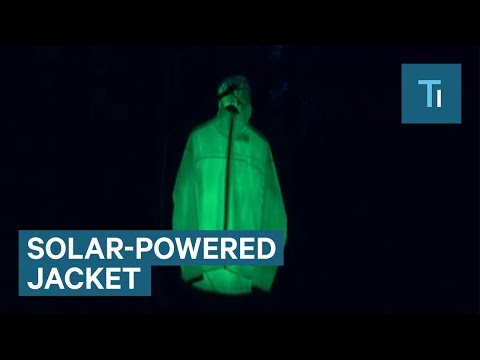
That’s why I was so impressed and inspired by the Solar charged jacket made by Vollebak. Vollebak is a London-based experimental clothing company known for pushing the boundaries of material science and design. They create extreme performance garments that combine advanced technology, functionality, and futuristic aesthetics, driven by their philosophy of designing “clothes for the future.”
In 2018 they presented Solar charged jacket which was named Times’ Best Invention.

 Vollebak/ Sun Lee
What it is and how it works
Vollebak developed two versions of their Solar-Charged outerwear: a lightweight running jacket and a padded puffer. At the core is a membrane infused with a phosphorescent compound that stores light. This membrane is sandwiched between fabric layers: on the outside, it’s protected by an ultra-thin but durable mesh that allows light to pass through while shielding the membrane. Once it gets dark, the stored energy makes the jacket glow. For Vollebak, the focus was not just on making a visually striking piece but on creating something genuinely functional and reliable. The outerwear targets people who venture into extreme environments, outdoor athletes, adventurers, and anyone fascinated by the intersection of technology, utility, and design.
Researchers at Aalto University
Researchers at Aalto University (Departments of Physics and Design) developed a method to embed small rigid solar cells (monocrystalline silicon) between layers of textile, using a water-tight polyurethane (PU) film, making them durable enough to survive many domestic laundry cycles. In tests at 40 °C, five of eight samples retained full efficiency after 50 wash cycles, while the other three showed only about a 20-27 % drop in power output. Importantly, the fabrics remained visually undamaged, preserving both function and aesthetics.
 Photo: Anne Kinnunen/Aalto University.
The goal is not to fully power high-energy devices like smartphones, but rather to harvest enough solar energy to power low-energy wearable components: sensors (temperature, humidity, maybe small indicators) embedded in clothing or even curtains that react to light changes. The project also emphasizes recyclability: using fabrics made of a single fiber material, and making the electronic parts removable (e.g. by heat + mechanical separation), to ease reuse and reduce waste.
Some personal reflection
Thinking about my final project fills me with both excitement and doubt. A part of me dreams of creating something useful, a design that could be scaled up and produced in the real world. But I know that such a challenge calls for technical skills I have not yet fully mastered.
At the same time, I cannot ignore how much I admire the bold and imaginative projects of past graduates. Their work shows that creativity can exist without limits, and this freedom is incredibly inspiring to me.
My true goal in this course is to find the place where these two directions meet — where imagination and practicality coexist. I want my final project to be more than just an idea: something innovative, meaningful, and capable of bridging creativity with reality.
Tools
- Canva
- I love IMG
- Gitlab
- MacOs reciser
Documentation workflow
The task was to set up my personal page on the Fabric Academy site and upload my introduction with Biography, Previous Projects, and Motivation.
Step 1
At first I struggled with GitLab, especially with the sequence of steps for committing and pushing changes. What finally helped was watching Julian’s lecture on my phone while repeating the same actions in parallel on my computer — this way I could follow step by step and understand the workflow.
Here is the way I pass from Gitlab to McDown.
Here is the way I check commits status.


I used the video of Fabricademy 2025-26 Tutorials 2025-09-17 and followed instruction step by step.
For the visual part, I prepared collages in Canva, which allowed me to combine images and text in a clean layout.
Step 2
Though I had all photos and materials for portfolio, if took quit long time to achieve the result I like.
Here are the first options, which i rejected.


I uploaded photos to repository for week01. You can do it either with Upload button pressing or just drug photos to the folder docs-> assignments -> images -> week01

The written content (biography, projects, motivation) I drafted myself and refined with the help of ChatGPT to make the English text smoother and more engaging.
Here are the main codes from McDown which I use.

All photos and screenshots I recised using the Reciser on Mac OS.


Step 3
I wanted to change my web-page colorway, and even asked Chat GPT to help me with explanation and code writing. It definately helped, but the color was completely different from my request. I managed to change to color of top part from 5-th time. And I'm still not sure about the reason of the first 4 fails.
The code which worked is:

I like very much the default code Montserrat, so I desided not to change it.
For assignment icons I used photos made during my trip to Tbilisi (Georgia) in National Fine Art Gallery. All pictures are fragments of the painting of Yuri Berishvily called Egypt.

Step 4
I tryed to change the word Home on the main page and I could not find where to change it. Thanks AI for help. To describe my request I uploaded the Screenshot form my main page. The answer of ChatGPT is below.

I mananged to change Home to About me using the instruction from ChatGPT... But all other pages as Assignment got broken! So do not use instuction above!