Experiments | Biochromic
Expected outcomes: A set of preliminary samples, recipes and process notes documenting differences in color uptake, fiber response and process efficiency.
Experiments conducted
Experiment 1: coffee and wool (tannin micro-bath)
Process
MATERIAL:
- 50 g ground used coffee
- 500 ml Water
- 3 g carded white wool
- 3 g unwashed light-colored wool
-
1 tablespoon alum (Potassium Aluminum Sulfate)
-
glass jars with lids
- pot
- paper coffee filter
- strainer
STEPS:
-
Coffee extraction: place ground coffee inside a paper coffee filter (in my case, I kept the one used for preparing american coffee and close it with a string). Submerge the filter in a pot filled with water. Bring to a gentle boil and let simmer for approximately 15 minutes, allowing the coffee pigments to fully extract into the water. Filter the dye bath.
-
Mordant and fiber preparation (jar method): place 1 tablespoon of alum directly into a clean glass jar (optional as coffee is tannin and mordant is not mandatory). Add 3 g of washed wool into the same jar.
-
Dyeing: pour the hot coffee dye bath over the wool, fully submerging the fibers and close the jar with a lid. Leave the wool immersed in the dye bath at room temperature for at least 60mins (I kept overnight) with no further heating.
-
Rinsing: remove the wool from the jar. Rinse gently using a small amount of clean water, avoiding agitation. No soap was used.
-
Drying: lay the wool flat and allow to air-dry completely at room temperature, away from direct sunlight.


Key observations
The coffee micro-bath did not produce a visible color change on wool. This suggests that coffee is not an effective dye source for protein fibers.
The jar-based micro-bath successfully reduced water use and simplified the process. If effective with other dye sources, combining mordanting and dyeing in the same container could save both time and resources.
 An initial comparison during the drying phase. The upper part of the image shows undyed wool (unwashed on the left, washed on the right), while the lower part shows the coffee-dyed samples (unwashed on the left, washed on the right).
Once fully dry, the visual difference between dyed and undyed wool became almost imperceptible.


Experiment 2: avocado peel + wool (tannin micro-bath)
Objective: To investigate avocado peels as a natural dye source for wool, comparing dye uptake and color stability across three batches: two mordanted with alum and one dyed without mordant.
- Batch A: unwashed wool + avocado dye + alum
- Batch B: washed wool + avocado dye + alum
- Batch C: washed wool + avocado dye without mordant.
Avocado peels were selected because they are rich in tannins and anthocyanins, food waste–based and highly compatible with protein fibers such as wool.
Process
MATERIAL:
- Avocado peels (in my case dried)
- 6g of washed carded wool
- 3g of unwashed wool
- 500 ml water
-
2 teaspoon of Alum (potassium aluminum sulfate)
-
pot
- heat source
- strainer
- glass jars with lids
STEPS:
-
Dye extraction: place avocado peels in a pot. Add water to cover the material. Heat gently to 70–80 °C, avoiding boiling. Maintain temperature for 30–45 minutes, allowing pigments to extract. Strain the liquid to remove solid peel residues and let it cool up to 60 degrees.
-
Dyeing: prepare wool batches by adding wool and the warm dye bath. For Batch A and B, add alum directly to the bath. For Batch C, no mordant was added.
-
Cooling and resting: Allow the wool to cool inside the dye bath. Leave to rest until fully cooled to room temperature, overnight in my case.
-
Rinsing: remove the wool and rinse gently with a small amount of clean water.
-
Drying: air-dry the wool flat at room temperature, away from direct sunlight.
NOTES:
- Avocado peels can dye wool without mordant due to their natural tannin content.
- Alum improves color uniformity and wash fastness but is not chemically required.
- The process prioritizes low water use and low energy input.
- Final dyed wool remains hydrophilic and moisture-sensitive.


Key observations
Avocado peels proved to be a suitable dye source for wool, producing soft pink–beige tones across all batches.
Both washed and unwashed wool absorbed color effectively. The unmordanted sample resulted in a lighter but still visible coloration, confirming that tannin-rich ingredients can dye wool without alum.
Color intensity was likely reduced by the room-cooling process. Maintaining a warmer bath could increase chromatic depth while still preserving low water use.


Experiment 3: contact dyeing (eco-print inspired)
Fiber used: handmade wool sample, previously produced from carded wool, washed and lightly pressed with water and Marseille soap. The fiber was kept damp before the dyeing process. This step replaces the mordant phase, as the fiber already contains soap.
Ingredients: leaves, onion skins, tea, herbal infusions, flowers.
Process
STEPS:
-
Preparation of the fiber: light damp the wool sample to allow better absorption of color and contact with the organic materials.
-
Placement of ingredients: place the ingredients in direct contact with the wool surface, arranging them intuitively to encourage organic pattern formation.
-
Wrapping (Roll Technique): wrap the wool and ingredient into a roll, ensuring close and continuous contact between fibers and natural dyes.
-
Steam exposure: place the rolled bundle in contact with steam for at 30 minutes.
-
Cooling phase: leave the bundle cool slowly, remaining in contact with the warm steam environment until it reached room temperature. This gradual cooling helped fix the pigments and enhance pattern transfer.
-
Rinsing: once fully cooled, gently rinse the wool with water to remove excess residues without disturbing the transferred marks.
-
Drying: the sample was laid flat and left to dry horizontally.
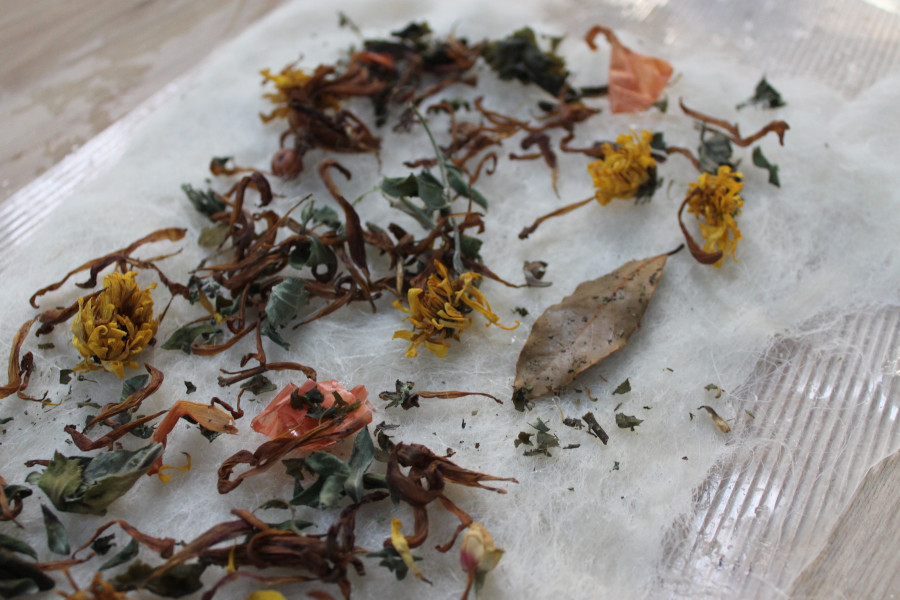

Key observations
Eco-printing results in irregular marks and stratified chromatic patterns, revealing the material dialogue between wool fibers and plant matter.
Botanical residues often remain embedded in the fiber structure, suggesting felted wool as a potentially more controllable substrate for future experiments.


Next steps (planned)
1. Selection of tannin sources
By Jan 27 – Identify and select tannin-rich materials compatible with wool for upcoming low-water dyeing tests.
The focus will be on locally available, natural ingredients, keeping in mind that it is winter and some materials may not be accessible.
2. Low-water dyeing tests with tannin-rich materials
By Feb 4 – Once materials are selected, a series of small-scale dyeing tests will be conducted using minimal fiber quantities.
The experiments will explore color uptake, uniformity, and stability across different tannin sources, prioritizing processes that do not require a separate mordant phase.
2b. Bacterial dyeing exploration (lab-level)
By Feb 5 – As a secondary exploration, small-scale bacterial dyeing tests will be set up using wool in Petri dishes, inspired by Petra Garajová's work. This approach does not require water and will be monitored over approximately a month to observe microbial growth and color uptake on wool.
3. Fermentation as a low-water dyeing approach
Building on historical dyeing practices and recent scientific studies, the project will explore cold fermentation of natural dye baths as a low-water, low-energy coloration method.
In this process, plant-based dyes are allowed to ferment before and during contact with wool fibers. The biologically active bath can enhance pigment availability and interaction with the fiber, often resulting in deeper and more vibrant colors.
References and Inspirations
Images: Martina Muroni unless otherwise stated.