10. Textile Scaffold
Research
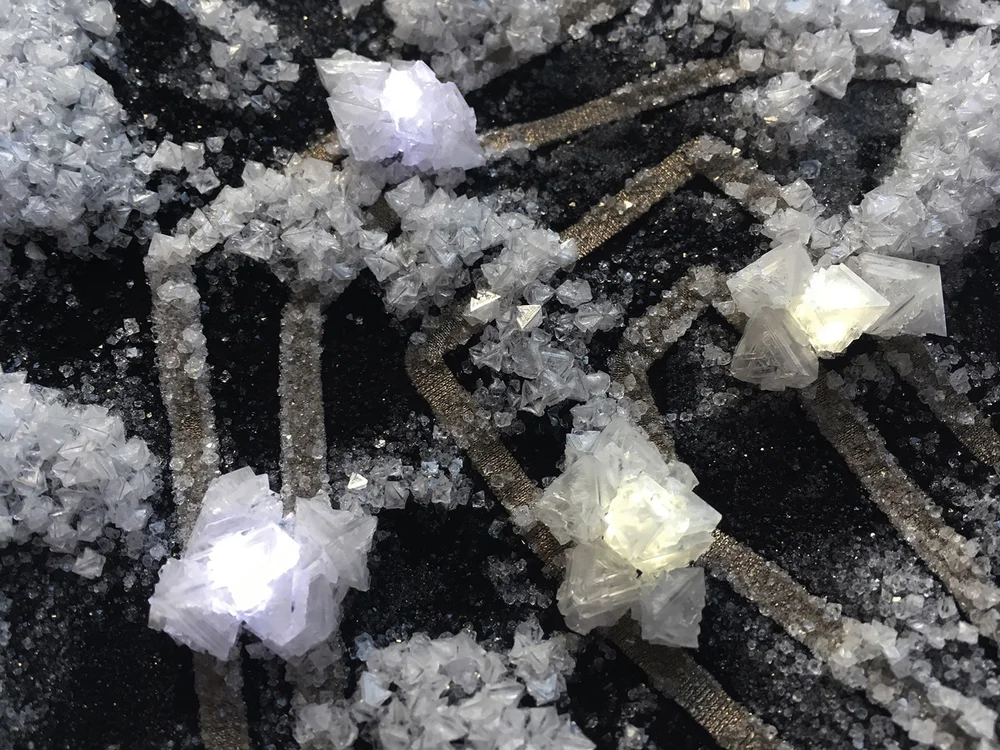

Textile scaffolds are versatile structural fabrics used across a wide range of fields — from biodesign and material research to biomedical engineering, product design, architecture, and performance wear. Designed as foundational substrates, they provide a porous and flexible framework where new materials can grow, adhere, or be reinforced.
Their fibrous network acts as an anchor for biopolymers, gels,crystals, and composite materials, allowing these substances to penetrate, bond, or solidify within the textile architecture. Because textiles naturally offer flexibility, porosity, and mechanical strength, they become an ideal base for creating hybrid materials that blend softness and rigidity, organic and synthetic qualities.
In material experimentation, textile scaffolds often interact with polymers. When combined with biopolymers such as gelatin, alginate, chitosan, or starch-based blends, the scaffold enhances the material’s shape, durability, and surface behavior. These interactions lead to the formation of composites — hybrid materials generated when a polymer matrix binds to the textile structure. In these systems, the scaffold provides reinforcement while the polymer contributes rigidity, transparency, waterproofing, or other functional properties.
By merging fibers and polymers, textile composites unlock new possibilities for sustainable materials, experimental surfaces, and advanced applications across multiple disciplines.
eTextile crystallography by Rachel Freire and Melissa Coleman.
Seizure by Roger Hiorns Croft, L. The blue art of crystallization. Nature Chem 1, 522 (2009). https://doi.org/10.1038/nchem.379
Polymers
The word polymer comes from the Greek roots: * poly (πολύ) meaning “many” * meros (μέρος) meaning “parts” or “units”
Polymer literally means “made of many parts”, referring to its structure composed of numerous repeating units called monomers.
Polymers are large molecules formed by linking these monomers together into long chains. Because of their chain-like architecture, polymers can display a wide range of physical properties — from soft and flexible to rigid and strong.
Polymers can be:
- Natural, such as cellulose, starch, chitosan, gelatin, or DNA
- Synthetic, such as plastics, resins, silicones, or nylons
In material design and biodesign, polymers often act as a matrix: a continuous phase that coats, fills, or binds to other materials — such as textile scaffolds — to create hybrid structures. Their properties can be tuned through composition, additives, and processing methods, making them essential in fields ranging from biomedical engineering to experimental material research.
Composite
A composite is a material which is produced from two or more constituent materials with notably dissimilar chemical or physical properties and are merged to create a material with properties unlike the individual elements. Within the finished structure, the individual elements remain separate and distinct, distinguishing composites from mixtures and solid solutions. Composite materials with more than one distinct layer are called composite laminates.
Typical engineered composite materials are made up of a binding agent forming the matrix and a filler material (particulates or fibres) giving substance:
- Concrete, reinforced concrete and masonry with cement, lime or mortar (which is itself a composite material) as a binder
- Composite wood such as glulam and plywood with wood glue as a binder
- Reinforced plastics, such as fiberglass and fibre-reinforced polymer with resin or thermoplastics as a binder
- Ceramic matrix composites (composite ceramic and metal matrices)
- Metal matrix composites
- advanced composite materials, often first developed for spacecraft and aircraft applications.
Composite materials can be less expensive, lighter, stronger or more durable than common materials. Some are inspired by biological structures found in plants and animals. Robotic materials are composites that include sensing, actuation, computation, and communication components.
Source Wikipedia

Composite Taxonomy, Anastasia Pistofidou
Textile as scaffold means using a textile structure — whether woven, knitted, mesh, felt, or nonwoven — as a structural support for a biological or bio-based material.
Textiles can function as structural, functional, and transformative scaffolds in biomaterial design. Their intrinsic geometry, porosity, flexibility, and fiber composition allow them to act as active agents that shape, reinforce, and interact with the biomaterial, rather than serving as passive substrates.
Main Functions
| Textile Function | Process / Action | Output / Material |
|---|---|---|
| HARDENER-Strength | Impregnation with gelatin/starch bio-resin, Increases the solidity of the final material | Leather molding, stiff composites |
| FORMWORK-Shape | Used as membrane for shaping biomaterials | Structural membranes for molds |
| COMPOSITE-Internal skeleton | Reinforcement in bio-resins | Higher-performance multimaterials |
| GROWTH SUPPORT | Facilitates crystallization or biological development | Crystallization, organic biocomposites, Hosts living materials |
Textile as Hardened Material
When impregnated with bio-resins, textiles can be stiffened into semi-rigid or fully rigid structures.
➤ Example Composite"
| Component | Amount / Notes |
|---|---|
| Solvent | Distilled water |
| Plasticizer | Glycerine |
| Polymer | Gelatin or starch |
| Pigment | Spirulina or natural carbon |
| Scaffold | Tulle, jute, linen, pine needles |
Textile as Formwork
Textiles can behave as membranes for molds, shaping liquid biomaterials as they dry or cure. ➤ Usese
- Creating structural membranes
- Draped, tension-based or stretched geometries
- Experimental casting and free-form surfaces
➤ Why it works
- Capillarity helps distribute liquid biomaterials
- Stretch + tension define controlled or unpredictable morphologies
Textile for Composites & Biocomposites
Textiles act as reinforcement layers, improving performance, strength, and flexibility.
➤ Benefits
- Higher tensile strength
- Reduced cracking
- Multi-material interfaces
- Light yet strong structures
➤ ➤ Example: Starch-Based Biocomposite
| Component | Amount |
|---|---|
| Solvent | 60 mL distilled water |
| Plasticizer | 5 g glycerine |
| Polymer | 5 g potato starch |
| Pigment / Filler | 5 g spirulina |
| Scaffold | Leftover tulle |
Textile as Structure for Growth
Textiles can be used as biological scaffolds, enabling growth, crystallization, deposition, or natural aggregation.
➤ Applications
- Salt crystallization
- Kombucha leather growth patterns
- Mycelium-based materials
- Biocomposites that mineralize or accumulate over time
➤ Why textiles work for growth - Provide anchor points - Porous structure allows fluid exchange - Capillarity spreads nutrients
Why Textile Is an Excellent Scaffold
| Property | Explanation |
|---|---|
| Porosity | Enhances infiltration, controlled evaporation, and fiber anchoring |
| Structural hierarchy | Macro/micro/nano scales → complex hybrid materials |
| Capillarity | Textile absorbs and retains biogel |
| Flexibility | Allows natural deformation and morphing |
| Biochemical compatibility | Works with gelatin, agar, pectin, chitosan, mycelium, bacterial cellulose |
🌿 Compatible Bio-Materials
| Category | Material | Properties / Use / Feature |
|---|---|---|
| Protein-based Bioplastics | Gelatin | Bio-leather, membranes |
| Casein | Rigid sheets, bio-leather | |
| Polysaccharide-based Bioplastics | Agar | Translucent, rigid |
| Alginate | Strong, resilient | |
| Pectin | Transparent, flexible | |
| Starch | Affordable, adaptable | |
| Living Biomaterials | Mycelium | Colonizes fibers and strengthens them |
| Bacterial cellulose | Grows around suspended textiles | |
| Microalgae / yeasts | Natural pigmentation | |
| Natural Resins & Mineral Composites | Gum arabic | Rigid, translucent surfaces |
| Pine resin | Natural waterproofing | |
| Gypsum / lime + fibers | Micro-textured surfaces |
🛠️ Fabrication Techniques and Results
| Technique | Process | Result / Characteristic |
|---|---|---|
| Casting | Pour biogel onto textile and let dry. | Membranes, panels, translucent surfaces. |
| Dip-Coating | Immerse textile in biogel → squeeze → dry. | Uniform, flexible, and resistant material. |
| Biological Laminates | Alternating layers: textile → gel → textile. | Rigid sheets, lightweight structural composites. |
| Moulding with Forms | Textile placed over a mold (preferably wood), then impregnated with biogel. Use small molds (20×20 cm) and clamps for even pressure. | Creation of specific shapes and controlled pressure. |
| Dry Morphing | Biogel shrinks more than textile during drying. | Natural curves, folds, torsions appear. Used for organic sculptures and architectural forms. |
| Textile for “Grown” Materials | ||
| — Mycelium | Interacts with scaffold: Colonizes fibers, increases cohesion. | Increased strength and cohesion. |
| — Bacterial Cellulose | Interacts with scaffold: Grows around suspended textiles. | Growth of a coating around the textile. |
Applications/Advanced Research Areas
| Application | Materials | Result |
|---|---|---|
| Reinforced bio-leather | Cotton + gelatin/glycerine | Soft but strong leather |
| Translucent lamps | Tulle + pigmented agar | Lightweight glowing membranes |
| Acoustic panels | Jute + mycelium | Self-supporting, sound-absorbing panels |
| Self-shaping sculptures | Elastic textile + biogel | Natural, organic 3D forms |
| Bio-grown skins | Textile + SCOBY | Strong semi-gloss sheets |
| Textiles as bioreactors | Growing microbes, fungi, or plants directly on textile | |
| Biomimetic composites | Materials mimicking skin, shells, tendons | Structurally advanced materials |
| Bio soft-robotics | Textiles reacting to water, hydrogels, or humidity | Movement and responsiveness based on environmental stimuli |
Critical Factors
| Factor | Effect |
|---|---|
| Textile density | Tighter weave → less gel infiltration |
| Humidity | Too high → mold; too low → cracks |
| Drying time | Key for stability and finish |
| Chemical compatibility | Some gels do not adhere |
| Gel thickness | Thick layers crack |
| Textile tension | More tension → more rigidity |
Common Problems & Solutions
| Problem | Cause | Solution |
|---|---|---|
| Cracks | Gel too thick | Add glycerine, increase ventilation |
| Gel detaches | Textile too smooth | Use rough or natural fabrics |
| Mold | Slow drying | Ventilation, dehumidifier |
| Unpredictable deformation | Uneven tension | Use frames or clamps |
| Fragile edges | Excessive shrinkage | Laminates or perimeter reinforcements |
References & Inspiration

Textile scaffold Inspiration Moodboard by Carlotta Premazzi
- Rootfull by Zena Holloway gp-award.com
- Ernesto Neto
- Christo & Jeanne-Claude. VALLEY CURTAIN, COLORADO
- Heinz Isler
- P-Wall Matsys Design https://www.matsys.design/p_wall-2009
- CONDUCTIVE CRYSTALLIZED TEXTILES https://sandyhsieh.com/Conductive-Crystallized-Textiles
- A sensory and experimental approach to materials, by MUUNA materialdriven.com
get inspired!
- Knit Candela (textile architectural formwork)
- Neri Oxman, MIT Mediated Matter
- FabTextiles
- Material Driven
- Mycoworks
- Ecovative
-
Cnc material archive - Fatemeh Mollaie - FabLab Armenia
-
Digital crafts - Shahed Jamhour - CPF Makerspace
-
CNC mold - Zahia Albakri - CPF Makerspace
-
Crystallisation exploration - Viviane Labelle - EchoFab
-
Moulds - Lisa Boulton
-
Millinery - Betiana Pavon
Overview material research outcomes
Process and workflow
RESIN E BIORESIN -TEXTILE COMPOSITE
Tools
Tools for Biofabricating Textile Scaffolds
-
1️⃣ Preparation & Mixing 🌡️ Beakers, flasks, graduated cylinders 🌀 Stir bars 🔹 Glass rods, spatulas, mortar & pestle 🍹 Blenders 🧾 Funnels, sieves
-
2️⃣ Heating & Temperature Control 🔥 Hot plates, heating mantles 💧 Water baths ♨️ Ovens / drying cabinets 🌱 Incubators (for fungi, bacteria, algae) 🌡️ Thermometers / thermal probes
-
3️⃣ Casting, Molding & Shaping 🍥 Petri dishes, silicone molds 📏 Sheet casting frames 🖨️ 3D printers (bio-based filament) 💉 Extrusion tools / bio-ink syringes 🔨 Rolling pins / pressing plates
-
4️⃣ Curing, Fermentation & Growth 🏠 Growth chambers / controlled environment boxes 🌡️ Humidity & temperature sensors 🧪 pH meters, hygrometers 🍶 Fermentation jars / vessels 🔪 Mycelium inoculation tools (scalpels, tweezers, loops)
-
5️⃣ Drying & Finishing Drying racks 💨 Vacuum ovens, freeze-dryers Sanding tools / microplanes 🖌️ Brushes, rollers, sponges (coating/dyeing)
-
6️⃣ Testing & Analysis ⚖️ Scales (analytical, balance) 📐 Calipers, micrometers 🧲 Texture analyzers, tensile testers 🔬 Microscopes 🌈 Spectrophotometers (color/pigment)
-
7️⃣ Enhancing & Decoration 💥 Laser cutters / engravers 🖋️ Stencils, stamps, brushes 💦 Spray bottles (coatings/surface treatments) 🗜️ Presses (hot/cold for laminates)
-
8️⃣ Safety & Hygiene 🧤 Gloves, masks, lab coats 🧼 Autoclave / sterilization equipment 🧴 Disinfectants, cleaning supplies
BIO BASED MATERIALS SCAFFOLD
Gelatin-Based Bio-Leather with Mesh Scaffold


🧪 Ingredients
Solvent: 50 mL distilled water Plasticizer: 5 g glycerine Polymer: 10 g gelatin powder Pigment / Filler: 5 g soot, 2 g cuttlefish Additive (Preservative): 5 mL white vinegar
🛠️ Tools
- Glass beaker / lab goblet
- Measuring scale
- Bain-marie setup (Double boiler)
- Stirring rod or spatula
- Sanitized moulds / loops
📝 Recipe
- Measure the materials accurately.
- Choose and sanitize a mould/base; prepare the scaffold (if using).
- Mix all liquid ingredients, by order, together in the glass beaker (lab goblet).
- Cook in bain-marie (double boiler) – medium temperature (approx. 80ºC) for 10 min.
- Keep stirring until you notice a change in texture (it becomes viscous).
- Add filler (soot, cuttlefish) and keep stirring until evenly mixed.
- Pour the mixture into the desired moulds/base immediately.
Gelatin-Based Bio-Leather with Cotton Fabric Scaffold

🧪 Ingredients
Solvent: 50 mL distilled water Plasticizer: 5 g glycerine Polymer: 10 g gelatin powder Pigment / Filler: 5 g soot, 2 g cuttlefish Additive (Preservative): 5 mL white vinegar
🛠️ Tools
- Glass beaker / lab goblet
- Measuring scale
- Bain-marie setup (Double boiler)
- Stirring rod or spatula
- Sanitized moulds / loops
📝 Recipe
- Measure the materials accurately.
- Choose and sanitize a mould/base; prepare the scaffold (if using).
- Mix all liquid ingredients, by order, together in the glass beaker (lab goblet).
- Cook in bain-marie (double boiler) – medium temperature (approx. 80ºC) for 10 min.
- Keep stirring until you notice a change in texture (it becomes viscous).
- Add filler (soot, cuttlefish) and keep stirring until evenly mixed.
- Pour the mixture into the desired moulds/base immediately.
Gelatin-Based Bio-Resin with Pine Neddle Scaffold

 Bioresin Scaffold by Carlotta Premazzi
🧪 Ingredients
Solvent: 48 mL distilled water Plasticizer: 16 g glycerine Polymer: 96 g gelatine Pigment / Filler: 5 g spirulina Scaffold: Pine Needles
🛠️ Tools
- Glass beaker / lab goblet
- Measuring scale
- Bain-marie setup (Double boiler)
- Stirring rod or spatula
- Sanitized moulds / loops
📝 Recipe
- Measure the materials accurately.
- Choose and sanitize a mould/base; prepare the scaffold (if using).
- Mix all liquid ingredients, by order, together in the glass beaker (lab goblet).
- Cook in bain-marie (double boiler) – medium temperature (approx. 80ºC) for 10 min.
- Keep stirring until you notice a change in texture (it becomes viscous).
- Add filler (soot, cuttlefish) and keep stirring until evenly mixed.
- Pour the mixture into the desired moulds/base immediately.
Gelatin-Based Bio-Resin with Linen Scaffold

 Bioresin Scaffold by Carlotta Premazzi
🧪 Ingredients
Solvent: 48 mL distilled water Plasticizer: 16 g glycerine Polymer: 96 g gelatine Pigment / Filler: 5 g spirulina Scaffold: Linen
🛠️ Tools
- Glass beaker / lab goblet
- Measuring scale
- Bain-marie setup (Double boiler)
- Stirring rod or spatula
- Sanitized moulds / loops
📝 Recipe
- Measure the materials accurately.
- Choose and sanitize a mould/base; prepare the scaffold (if using).
- Mix all liquid ingredients, by order, together in the glass beaker (lab goblet).
- Cook in bain-marie (double boiler) – medium temperature (approx. 80ºC) for 10 min.
- Keep stirring until you notice a change in texture (it becomes viscous).
- Add filler (soot, cuttlefish) and keep stirring until evenly mixed.
- Pour the mixture into the desired moulds/base immediately.
Gelatin-Based Bio-Resin with Juta Scaffold

🧪 Ingredients
Solvent: 48 mL distilled water Plasticizer: 16 g glycerine Polymer: 96 g gelatine Pigment / Filler: 5 g spirulina Scaffold: Juta
🛠️ Tools
- Glass beaker / lab goblet
- Measuring scale
- Bain-marie setup (Double boiler)
- Stirring rod or spatula
- Sanitized moulds / loops
📝 Recipe
- Measure the materials accurately.
- Choose and sanitize a mould/base; prepare the scaffold (if using).
- Mix all liquid ingredients, by order, together in the glass beaker (lab goblet).
- Cook in bain-marie (double boiler) – medium temperature (approx. 80ºC) for 10 min.
- Keep stirring until you notice a change in texture (it becomes viscous).
- Add filler (soot, cuttlefish) and keep stirring until evenly mixed.
- Pour the mixture into the desired moulds/base immediately.
Starch-Based Biocomposite with with Tulle Scaffold

 Starch-Based Biocomposite with with Tulle Scaffold by Carlotta Premazzi
🧪 Ingredients
Solvent: 60 mL distilled water Plasticizer: 5 g glycerine Polymer: 5 g potato starch Pigment / Filler: 5g spirulina Scaffold: leftover tulle
🛠️ Tools
- Glass beaker / lab goblet
- Measuring scale
- Bain-marie setup (Double boiler)
- Stirring rod or spatula
- Sanitized moulds / loops
📝 Recipe
- Measure the materials accurately.
- Choose and sanitize a mould/base; prepare the scaffold (if using).
- Mix all liquid ingredients, by order, together in the glass beaker (lab goblet).
- Cook in bain-marie -low temperature (approx. 65ºC) for 5 min, keep stirring until you notice a change in texture
- Keep stirring until you notice a change in texture
- Add spirulina in the not hot mixture
- Pour the mixture into the desired moulds/base immediately.
FABRIC FORMWORK WITH CASTING
Build a Catenary Pottery Printer
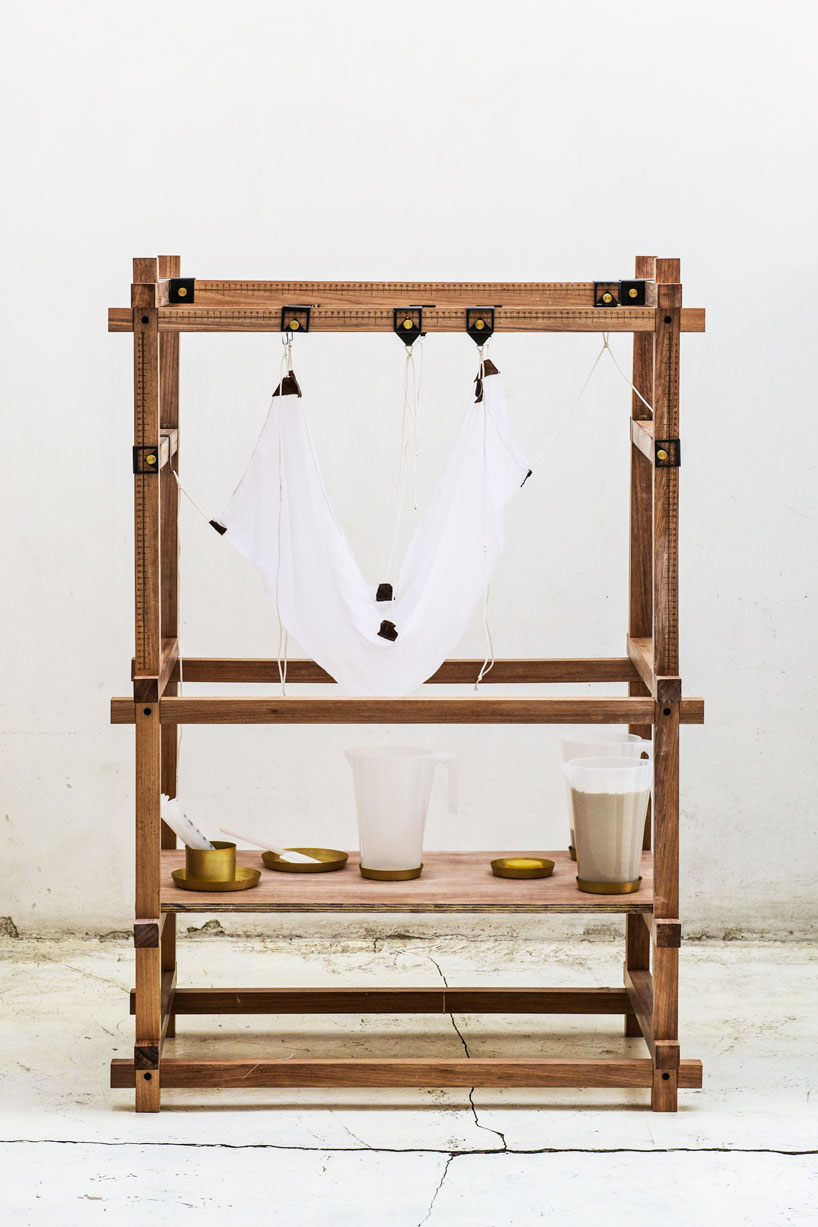
What is a Catenary Pottery Printer
- A machine that uses a suspended fabric to create ceramic forms.
- The fabric forms a catenary curve; slip (liquid clay) is poured over it.
- After drying, the fabric is removed, leaving a ceramic object.
- Parametric yet analog: the shape depends on anchor points, tension, and slip weight.
Catenary Pottery Printer by gt2p gt2p.com
Materials & Components
- Suspension Structure
- Frame: wood, metal, or PVC tubes.
- Anchors: hooks, screws, or adjustable points.
-
Fabric: cotton, lycra, muslin, gauze.
-
Slip (liquid clay)
- Clay mixed with water to the right viscosity.
-
Optional: thickening agents.
-
Filling System
- Bucket or tank for slip.
- Tubes, squeegees, or syringes to pour slip.
-
Optional: suction system to remove excess slip.
-
Adjustment Tools
- Mechanisms to move anchors and change tension.
- Weights to calibrate the catenary curve.
-
Timer/monitor for drying.
-
Post-Process
- Brushes, spatulas, ceramic tools.
- Ceramic kiln for bisque firing.
- Glaze (optional).
Step-by-Step Process
- Design the Project
- Draw a plan of the structure.
-
Decide on frame size, number of anchor points, and fabric shape.
-
Select Parts
-
Gather frame materials, screws, hooks, and fabric.
-
Mark Where to Drill
-
Mark exact positions for screws or bolts on the frame.
-
Assemble Everything
- Drill holes if needed and attach anchors.
- Fix the fabric to the anchors using screws or bolts.
-
Adjust tension to create the desired catenary curve.
-
Prepare the Slip
-
Mix clay with water and thickening agents to desired viscosity.
-
Pour the Slip
- Slowly pour slip over the suspended fabric.
-
Let excess slip drain or remove with a tube/syringe.
-
Drying
-
Allow the object to dry partially until it holds its shape.
-
Remove Fabric
-
Carefully remove fabric to reveal the ceramic form.
-
Finishing
- Refine edges and surfaces with tools.
- Bisque fire in a kiln, then glaze if desired.
Notes / Challenges
- Shape depends on anchor placement and fabric tension.
- Uneven drying may deform or crack the piece.
- Each object will be unique due to analog process.
- Strong and stable frame is crucial.
- Kiln access needed for permanent ceramic objects.
 Build a Catenary Pottery Printer at Biolab, Lisbon. Collective brief and work with Carlos Roques, we used cotton sheet and gypsum (calcium sulfate dihydrate(H2So2))
The scaffold was never removed, as the composite material broke in several other samples, due to the compound being too liquid or to the lab humidity conditions.
Build a Catenary Pottery Printer at Biolab, Lisbon. Collective brief and work with Carlos Roques, we used cotton sheet and gypsum (calcium sulfate dihydrate(H2So2))
The scaffold was never removed, as the composite material broke in several other samples, due to the compound being too liquid or to the lab humidity conditions.
CRYSTALIZATION
Textile as Scaffold through crystallization processes on natural waste textiles and on copper thread waste. The goal is to test how different fibres behave as structural supports for bio-based crystal growth.
ALUM CRYSTALS ON MESH

 Alum powder Crystalization by Carlotta Premazzi at Biolab, Lisbon.
COPPER SULPHATE CRYSTALS ON MESH

 Copper sulphate Crystalization by Carlotta Premazzi at Biolab, Lisbon.
Materials
Liquids
- Tap water (hot: ~100°C)
- Optional: dye bath
- Colorants
- Pigments
- Spirulina powder
- Turmeric
- Charcoal powder
- Bacteria ink
Crystallization Agents
- Alum powder
- Borax powder
- Copper sulphate crystals
- Salt
- Sugar
Tools
- Glass jars (wide mouth, 0.5 L)
- Stove or kettle
- Filter (coffee filter or fabric filter)
- trings, thread or wires
- Chopsticks / hanger bar
- Scissors
- Aluminium foil
Crystallization – General Method
- Heat tap water to boiling or near-boiling temperature.
- Optional: dissolve colorants in the water.
- Add the mineral powder (alum, borax, copper sulphate…) until fully dissolved.
- Filter to remove impurities.
- Prepare your textile structure: tie it to a string or create a suspended form.
- Immerse or hang the textile in the solution.
- Cover the jar with aluminium foil (not sealed – air must circulate).
- Leave the jar 12–24 hours in a dark and undisturbed place.
- Check growth daily. Remove unwanted crystals from jar walls.
- For longer experiments: re-feed solution by adding more saturated mix.
Environmental Variables
- Understanding how environment affects crystal growth.
- Cooling Down
- Slow cooling → larger, more defined crystals
- Fast cooling → fractures, irregular formations
- Air Circulation
- Needed for evaporation
- Accelerates growth
- Contamination Control
- Keep solution covered
- Remove accidental crystals from jar walls
- Competition
- Crystals growing on the jar will compete with the textile.
- Remove them or re-filter the solution.
Step-by-Step Workflow
- Textile Preparation
- Select natural fibre
- Create a 3D or planar structure
- Wash and dry (to remove sizing)
- Solution Preparation
- Heat water
- Add colorants (optional)
- Dissolve crystal powder fully
- Filter
- Setup
- Suspend textile with thread
- Ensure it does not touch jar walls
- Pour filtered solution
- Cover with aluminium foil
- Growth Phase
- Rest 12–24h undisturbed
- Observe morphology
- Add seed crystals if needed
- Drying
- Remove textile slowly
- Let air-dry completely
LEATHER MOLDING
Forming Leather in a Shell M/F Mold
 Leather Seashell & Valcromat MDF.HLS Seashell Mold by Carlotta Premazzi
To shape the leather with precision, we start by creating a 3D scan of the reference object, capturing its exact geometry. Due to the complex curves of the shell, we performed several scans to ensure high fidelity.
The digital model was then adapted to meet our specific needs. This adaptation involved creating a perpendicular bridge connected to the base, matching the overall dimension of the shell.
This new digital model is then used to mill both the positive (male) and negative (female) MDF.HLS mold shells using a CNC machine.
For the first mold piece, we used only the external part of the shell. To derive the second, corresponding mold piece, we offset the geometry by 1 mm. This 1 mm distance accounts for the material thickness and ensures the leather is pressed accurately without being overstretched or damaged, allowing the final form to be preserved without compromising the material's integrity.
These paired molds allow the leather material to be pressed both evenly and accurately to achieve the desired three-dimensional form.
Before forming, the leather is prepared by soaking or thoroughly humidifying it. The moisture softens the fibers, making the material pliable and capable of adapting to complex shapes without cracking. Once the leather reaches the right level of flexibility, it is positioned between the male and female molds.
By pressing the two shells together, the leather is forced into the desired geometry, taking on the contours and volume of the scanned object. After drying completely inside or outside the mold, the leather stabilizes and permanently retains the new shape, resulting in a precise, clean, and professional finish. Ongoing process (waiting for de-mold)
**Tool & Specs **
| Category | Item | Model / Type | Specifications |
|---|---|---|---|
| Material | Material to mold | Leather | Black, 1 mm thickness |
| Material | Mold material | Valchromat MDF.HLS | 29.7 mm thickness |
| Scanning | 3D Scanner | EinScan-SE | Desktop 3D scanner |
| Scanning | 3D Software | EXScan | Shining3D |
| CNC Milling | CNC Machine | OUTPLAN CNC | 3-axis CNC |
| CNC Milling | CAM Software | Autodesk ArtCAM | Toolpath generation |
| CNC Milling | Control Software | UCCNC | Machine control |
| CNC Milling | End mill (roughing) | Flat end mill | 2-flute, Ø 6 mm |
| CNC Milling | End mill (finishing) | Ball End Mill | 2-flute, Ø 6 mm |
3D Scan
 Seashell 3D Scan by Carlotta Premazzi, with Pedro Fablab Lisbon made with EinScan-SE and Shining Software.
Steps 3D scanning the seashell
-
Object Preparation The seashell is placed on a stable (often rotating) platform so it can be captured from all angles. The background is kept dark or neutral to avoid reflections and visual noise.
-
Scanner / Camera Setup A 3D scanner, as suggested by the green light pattern—is positioned in front of the object. The scanning software (visible on the screen, “Shining 3D”) is set up to record the geometry of the shell.
-
Data Acquisition As the platform rotates, the scanner projects light patterns and captures how they deform on the shell’s surface. Multiple passes ensure full coverage, including hidden or complex areas.
-
Point Cloud / Mesh Visualization The software generates a point cloud representing the scanned surface. This point cloud is then converted into a 3D mesh, which appears on the computer screen in the shape of the seashell.
-
Cleaning and Alignment The mesh is cleaned by removing noise, correcting small errors, and smoothing irregularities. The digital model is then aligned, oriented, and scaled if necessary.
-
Exporting the 3D Model Once the scan is clean and complete, it is exported in a standard 3D format (e.g., .obj, .stl).
CAM Software
 CAM Software with Matias Laufer at Fablab Lisbon, by Carlotta Premazzi
CAM Workflow
The CAM workflow was developed in Autodesk ArtCAM to generate the toolpaths for milling the shell mold.
- Import of the 3D shell model (STL).
- Definition of the material size and origin.
- Selection of the milling strategy:
- Roughing pass to remove most of the material.
- Finishing pass to achieve a smooth surface.
- Tool selection for each pass (flat end mill for roughing, ball end mill for finishing).
- Definition of machining parameters:
- Step-over
- Pass depth (step-down)
- Feed rate
- Spindle speed
- Toolpath simulation to verify collisions, surface quality, and machining time before exporting the G-code.
CNC Milling
 CNC montage by Carlotta Premazzi
CNC Milling is a subtractive digital fabrication process where a computer-controlled spindle removes material from a block (wood, MDF, foam, plastics, aluminum, etc.) using rotating cutting tools.
It is commonly used for:
- 2D and 3D prototypes
- Molds and negatives (wood, resin, silicone, biocomposites)
- Furniture and architectural panels
- Mechanical components
- Digital sculptures
- Textured surfaces and reliefs
Compatible Materials
| Material Type | Examples | Notes |
|---|---|---|
| Soft Materials | MDF, plywood, wood, high-density foam, PU foam, bio-foam | Easy to mill; ideal for molds & prototyping |
| Medium Plastics | HDPE, PETG, PLA, ABS | Easy to machine with correct feeds and speeds |
| Hard Materials | PMMA (acrylic), POM (Delrin), aluminum* | Require rigid CNC machines and correct tooling |
| Not Recommended | PVC, fiberglass, carbon fiber | Release toxic fumes or abrasive dust when milled |
Aluminum only on rigid CNC machines with proper spindle, feeds, and cooling.
Required Equipment
| Category | Items |
|---|---|
| CNC Machine | OUTPLAN, ShopBot, BZT, Stepcraft, Roland MDX, etc. |
| Cutting Tools | Flat end mills, ball end mills, single/double flute bits |
| Machine Hardware | Spindle/router, dust extractor, clamps or vacuum table |
| Software | Fusion 360, Segmag, VCarve, RhinoCAM, FreeCAD Path |
| Accessories | Screws, double-sided tape, sacrificial board, Allen keys |
Types of End Mills
| Type of Tool | Uses | Characteristics | Typical Materials |
|---|---|---|---|
| Flat End Mill | 2D cuts, pockets, contours, facing | Flat tip, sharp edges, clean flat surfaces | Wood, MDF, plastics, aluminum* |
| Ball End Mill | 3D milling, molds, smooth reliefs, finishing | Rounded tip, smooth surface finish | Wood, resins, foams, plastics |
| Upcut Bit | Deep cuts, roughing, fast chip removal | Chips pulled upward, clean bottom edge | Wood, MDF, foams |
| Downcut Bit | Visible top surfaces, veneers, laminates | Chips pushed downward, clean top surface | Plywood, MDF, laminated boards |
| Compression Bit | Through-cuts, plywood and MDF panels | Upcut + downcut geometry, clean top and bottom edges | Plywood, MDF, multilayer wood |
| Single-Flute | Plastics, high-speed cutting | One cutting edge, reduced heat buildup | HDPE, PMMA, PETG, PLA |
| Double-Flute | General-purpose milling | Two cutting edges, balanced finish and chip evacuation | Wood, MDF, plastics, light metals |
| V-Bit / Engraving Bit | Engraving, chamfers, fine details | V-shaped tip, sharp angles, decorative cuts | Wood, plastics, soft metals |
| Tapered End Mill | Deep cavities, molds, structural strength | Conical shape, reduced deflection | Wood, foam, resins |
Aluminum only on rigid CNC machines with correct tooling and parameters.

 CNC milling montage by Carlotta Premazzi, working with Matias Fablab Lisbon
CNC Workflow
1) Design or 3Dscan (Check above) 2D → Illustrator / Inkscape 3D → Fusion 360 / Rhino / Blender
2) Export Files 2D → DXF / SVG 3D → STL / STEP
3) CAM Programming
Inside the CAM software, set: * Tool selection * Feed rate (horizontal movement speed) * Spindle speed (RPM) * Pass depth (vertical step-down) * Step-over (for 3D finishing) Toolpaths: * Pocket (engravings / cavities) * Profile (cutting the contour) * Adaptive clearing * 3D roughing * 3D finishing
4) Generate G-code Export as: .nc .gcode .sbp (for ShopBot)
5) Machine Setup Secure the material with clamps, screws, or vacuum table Mount the correct end mill Set the origin (Zero) in: X, Y → front left corner Z → using the calibration plate or manually
6) Air Cut Run the toolpath without touching the material to check for errors.
7) Milling Start the job Monitor the noise, vibration, and chip evacuation Be ready to stop the machine in case of emergency
8) Cleaning & Finishing Vacuum dust Remove tabs Sand edges Seal or coat surfaces if needed
Basic Parameters
| Material | Spindle Speed (RPM) | Feed Rate (mm/s) | Pass Depth | Step-over | Notes |
|---|---|---|---|---|---|
| MDF / Wood | 12,000–16,000 | 40–60 | ½ tool diameter | 40–60% | Good for molds & furniture |
| Foam (HDU) | 8,000–12,000 | 60–120 | 1 × tool diameter | 50–70% | Fast cutting, low resistance |
| Plastics (HDPE, PMMA) | 10,000–14,000 | 20–40 | ⅓ tool diameter | 30–50% | Use single-flute bits to avoid melting |
Safety Rules
- Wear protective goggles
- Tie back long hair
- Never leave the machine unattended
- Keep hands away from the spindle
- Stop immediately if you notice:
- Strange noises
- Excessive vibration
- Burning smell
- Broken end mill
Common Errors & Fixes
| Problem | Cause | Solution |
|---|---|---|
| Burned edges | RPM too high / feed too low | Lower spindle speed or increase feed |
| Tool breakage | Pass depth too large | Reduce pass depth to ≤ ½ tool diameter |
| Rough surface | Wrong bit or high step-over | Use ball end mill + reduce step-over |
| Material lifting | Poor clamping | Add screws, stronger clamps, or vacuum table |
| Melting plastic | Wrong tool or overheating | Use single-flute bit + increase feed rate |
FABRICATION FILES
Documenting and comparing experiments
TEST SERIE BIO-PLASTIC
| Material pic | Material name | polymer | plastifier | filler | emulsifier | scaffold |
|---|---|---|---|---|---|---|
 |
SOOT BIO-LEATHER WITH MESH SCAFFOLD | 10 g gelatin powder | 5 g glycerine | 5 g soot, 2g cuttlefish | 50 mL distilled water | mesh |
 |
BIO-PLASTIC WITH PINE NEEDLE SCAFFOLD | 96 g gelatine | 16 g glycerine | 5 g spirulina | 48 mL distilled water | pine needle |
 |
BIO-RESIN WITH LINEN SCAFFOLD | 96 g gelatine | 16 g glycerine | 5 g spirulina | 48 mL distilled water | Linen |
 |
BIO-RESIN WITH JUTA SCAFFOLD | 96 g gelatine | 16 g glycerine | 5 g spirulina | 48 mL distilled water | Juta |
 |
STARCH BIO-PLASTIC WITH TULLE SCAFFOLD | 5 g glycerine | 5g spirulina | 60 mL distilled water | Tulle | |
 |
ALUM CRYSTALS ON MESH | Alum (potassium alum) | Hot water | mesh | ||
 |
COPPER SULPHATE CRYSTALS ON MESH | Copper sulphate | Hot water | mesh |
 ALUM CRYSTALS ON MESH by Carlotta Premazzi
Lecture on November 17th, 2025, Global Instructors: Anastasia Pistofidou, Local Instructors: Carlos Roque - Local Assistance on Concrete casting and 3D moulding; Carolina Delgado - Local Assistance on Composites and Crystallisation; Matias Laufer @FabLab - Local Assistance on CNC Milling
- **Local Workshops
- Build a Catenary Pottery Printer with Carlos Roque
- Cristalization with Carolina Delgad
- CNC and milling with Matias FabLab
🔗 References & Tutorials
Concept & Inspiration
Tools & Software
Student checklist
- [ ] Document the process including the step-by-step instructions on software, machine, mold making, vaccum forming and textile composites
- [ ] Upload your design and fabrication files, including the 3D model and CAM file when possible
- [ ] Document at least 2 processes from design to prototyping, fabrication, materials used, document your achievements and unexpected outcomes
- [ ] Make a stop motion of your crystal growth or use 3D modeling software to simulate your design (extra credit)