13. Implications and applications
Some Questions Presented During Lecture given by Oscar Tomico Oscar Tomico lecture made open my mind to new ideas, new discoveries and new challenges. Some question made sound on my mind and force me think about my final project. What role do materials play in your project? How can you explore form through generative design? How can you rethinking shape/fit/production? How can you rethink current aesthetics with various fabrication methodologies and what new insights does that bring? The moment you put something on your body, how do you change, how does your relation with people and your surroundings change? The moment you put something on, how does it become social and political?
It really made me think and think . Here's the results!
The Weeks that Most Interested Me:
Since the start of Fabricademy I've been living a roller coaster. I have to say I genuinely found every week challenging in its own way, taking me out of my confort zone but I loved it. Thinking on the subjects where my interests really resides in are wearables, computational couture, biochromes, biofabricating materials and e-textiles. But being honest I would like to use all of them because I really enjoyed them. Crafts of Interest
•   Weaving: Weaving is a craft that has historically expanded for centuries, being rich and impactful y many ways, color, texture, formas, designs, utility. Weaving might honestly be one of the most important crafts especially. I've woven before on a traditional pedal loom and it is an art that looks simply but it isn’t.

•   Parametric Design: This was a new world for me. I am not an expert on Rhino and had no knowledge on Grasshopper, but lookig through all the things you can achieved, made my mind blow away. I learned about computational couture, 3D printing on fabric. Amazing! I’ve learnt that you can take inspiration from Architecture or Nature, create design parametrically, with repeating shapes and geometries. I learned you can make your own clothes, cut patterns on a laser cutter, and 3D print designs on your fabric.

•   Biochromes and Biofabrication: During these weeks we learned to dye and to fabricate our own materials and dyes. It was interesting and I am intrigued an the bacterial like Kombucha. I hope I’m able to use it on my project. Try to adapt different materials and do some Origami or Sashiko embroidery on to them.

•   E-Textiles: Even though I ‘am not familiar at all with electronics and I know it is not something I domain, but I would like to use it on my project, even though I know I would need a lot of help.

•   Past Work + Navigating Ideas: Before Fabricademy came along, all my experience was on making clothes, haute couture, come artisan weaving and innovation on patternmaking, patchwork, but the relation of fashion with the digital technology is completely new for me.
In some sense, I'd like to continue exploring one of those items but in a different form.
Now, I've always struggled with project ideation. But I do know that I have to pay attention on what I stood out and adapt all the other things in an innovation, inspirational and transformative way.
Research & Concept
< "Where the deep breath of the wind meets the rising soul of the water."
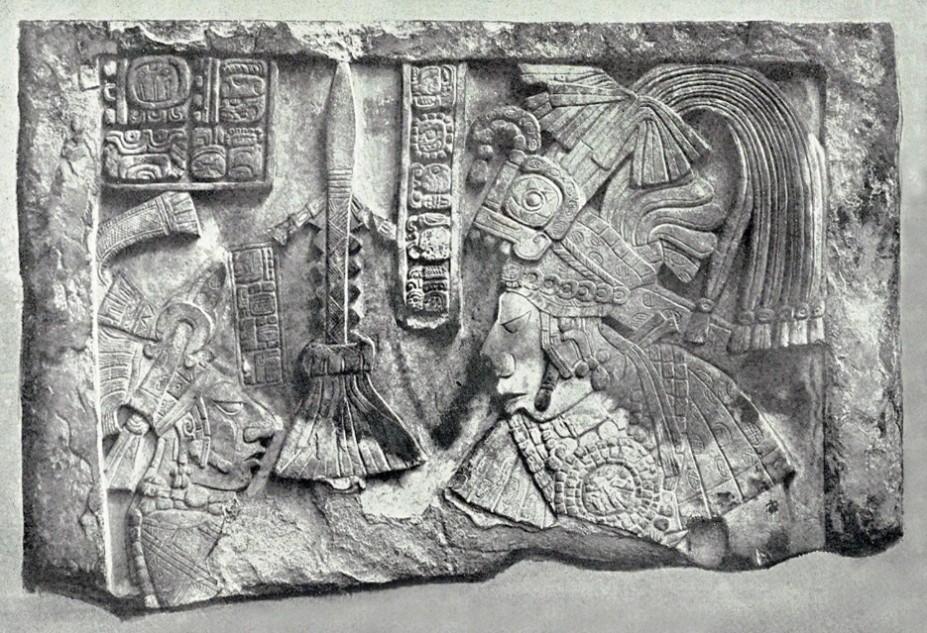
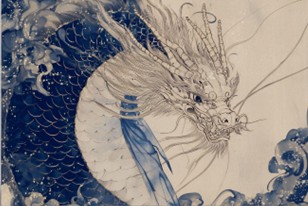
For my project I would like to join two cultures that have a lot of history, that mythological and philosophycally have thinks alike. These cutures are the Mexican and the Japanese. There is the Japanese Dragon (ryū or tatsu) and the Feathererd Serpant (Quetzalcoatl) of Mexico.
I digged into both cultures and I discovered that they have a lot of similarities that can combined perfectly between each other. I made a small presentation trying to anwer the questions: Who, What, Why, How and Where.
Implication and Application Script
“Throughout cultures, mythical creatures help us understand transformation, wisdom, and our connection to nature.”
Project: Quetzal Flow Subtitle: The Wisdom of Duality in the Age of Digital Craft
Throughout cultures, mythical creatures help us understand transformation, wisdom, and our connection to nature. In my project, I explore the meeting point between two powerful symbols: the Japanese dragon and the Mexican feathered serpent, Quetzalcóatl. My goal is to translate their shared qualities—fluidity, change, and spiritual strength—into a contemporary garment. These two figures serve as metaphors for movement, transformation, change, and learning — values that deeply resonate in me with the experience of this course itself.
• Both creatures navigate sky and earth, water and air, embodying fluidity. • They represent wisdom, transformation, and protection. • They are visually rich: o Japanese dragon: elongated, flowing movement, scaled textures, elemental control. o Quetzalcóatl: feathers, spirals, vibrant colors, sacred geometry.
My goal is to merge these two mythologies into a contemporary male outfit that carries their essence. Not as a costume, but as a wearable: something fluid, adaptive, and symbolic. An outfit that not only references them visually but behaves like them, changing, adapting, and responding. Exploring these main themes:
- Fluidity — Movement
- Transformation— change
- Duality— softness & structure.
- Tradition & technology.
The meeting point between two mythical powerful symbols of two distant but spiritually connected cultures: the Japanese dragon and the Mexican feathered serpent, Quetzalcóatl.
• WHO:
It is for the students to encourage them to do and experiment different things. To visualize that fashion is much more than just clothes. That there is a universe of creativity, innovation, technology and sustainability to explore ethics and sostenibility.
I want to be able to create a garment exploring an aesthetic language. My central goal is to try to integrate as many skills adquired during the course as possible:
- parametric patterns
- reused clothes
- circularity
- Biomaterials: dye and bioplastics
- 3d printing
- embroidery patterns
- wearability and interaction
Developed within the Fabricademy ecosystem, the project bridges the cultural space between Mesoamerican iconography (Quetzalcoatl) and global dragon archetypes, placing the interaction directly on the human body as a living site of mediation.
During the next months I will try to achieve a "Age of Synthesis," addressing the urgent need for circularity, sustainability, social responsability and ethics, embrazing the ancestral embroidery techniques and the new digital technology working together.
All this to demonstrate that true design wisdom lives in the "Tension of Opposites." Move beyond fast fashion toward "Narrative Wearables" carring a philosophical weight, environmental responsibility, and technological intelligence.
Quetzal Flow is a testament to the designer as a "Master of Thresholds." It concludes that the future of fashion lies not in the choice between technology and craft, but in the masterful flow between them.
Hope you like it!
Final Portafolio de Escuela Diseño
The project is made for the students to visualize all the alternatives possible within the Fashion Industry and all the new things accesible for them. After the feedback of my mentors, the project is going to be with the interaction with the students, working together in oder to achieved new knowledge, developed new skills and learn how to work in an interdisciplinary team.
During this project there will be no one else involved, later one we will think in working with artisans and different associations. The primary idea is to continue working and developing this kind of projests to enreached the knowledge and skills involving students from different areas like, Graphic design, Industrial Desigan, Multimedia Design, Arquitecture, and maybe Engineering, making a multidisciplinary workshop.
Hopefully we can make it every year and involved each time more students and if all goes we will exhibit the final results at the University community and look for next year a spot on a Gallery, a Fashion Exhibition or an Competition to show the work of the students and encourage more people to join us for further projects.
FINAL PROJECT de Escuela Diseño Application and Implications
At the end of the presentation you can find all the references.
References
Briceno, Rafael.The Multifaceted Applications of Origami
Ryujin Press
Tenko.fr
Japan Avenue Magazine
Saprrow Find in Japan
Secretos de Japón
Enciclopedia britannica
Orozco, Chela; Mayan-Aztec history
Orozco Chela, Spanich School UNINTER
World History:Colors of Mexico
Reddit:Aztec Construction
Accademia Education, The Dragon and the Serpant
Petlevych, Nataliya, The collector
The Feathered Serpent