Process: Material Research
About sound
The acoustics industry uses synthetic materials such as mineral wool, fiber glass, open cell foam, covered by poliester fabrics. These materials are not biodegradable. Wool has proved to have acoustic properties due to the fiber's natural porous composition. The Thones & Marthod breed specifically is a great candidate for a base material since its coarseness af around 40μ creates air pockets that trap sound.
The absorption of sound by panels can be affected by:
- Wall spacing: it is better to place a gap of around 5cm from the wall
- Material density: a happy midpoint should be dense but not compact as it will reflect sound.
- Material porosity: airpockets help abosrb sound hence why it cannot be compact
- Material volumes: "peaks and valleys" help absorb sound waves better rather than flat surfaces.
- Material surface finish: a completely sealed surface will cause reflections.
The focus of this exploration is to find ways of using wool in combination with other biomaterials to obtain a range of finishes, behaviors, looks and techniques that can be used for acoustics and for architecture/interiors in general.
I started by defining 3 types of materials to explore recipes: bioplastics (films, sheets, flexible skins), structural additives (reinforcement, porosity), expansion/porosity materials.
Bioplastics (Film / Sheet / Flexible Skin)
- Binders: Starches, alginate, agar, cellulose, glycerin, gum arabic
- Behavior: Flexible or rigid depending on plasticizer. Low porosity. Good for surface-finishes. Diffuse sound rather than absorbe it.
- Look: translucent or opaque depending on the wool to binder ratio
- Feel: smooth or textured depending on casting moulds and wool to binder ratio.
- Considerations: Can shrink depending on wool to binder ratio (more wool=more stability). Using the heat press after drying allows for more even surface.
-
Applications
-
Lampshades
-
Light diffusers
-
Surface skins over acoustic cores
-
Decorative wall membranes
-
Cabinet inlays
-
Temporary partition films
-
Wall covering panels
-
Material: Papery Film (success)
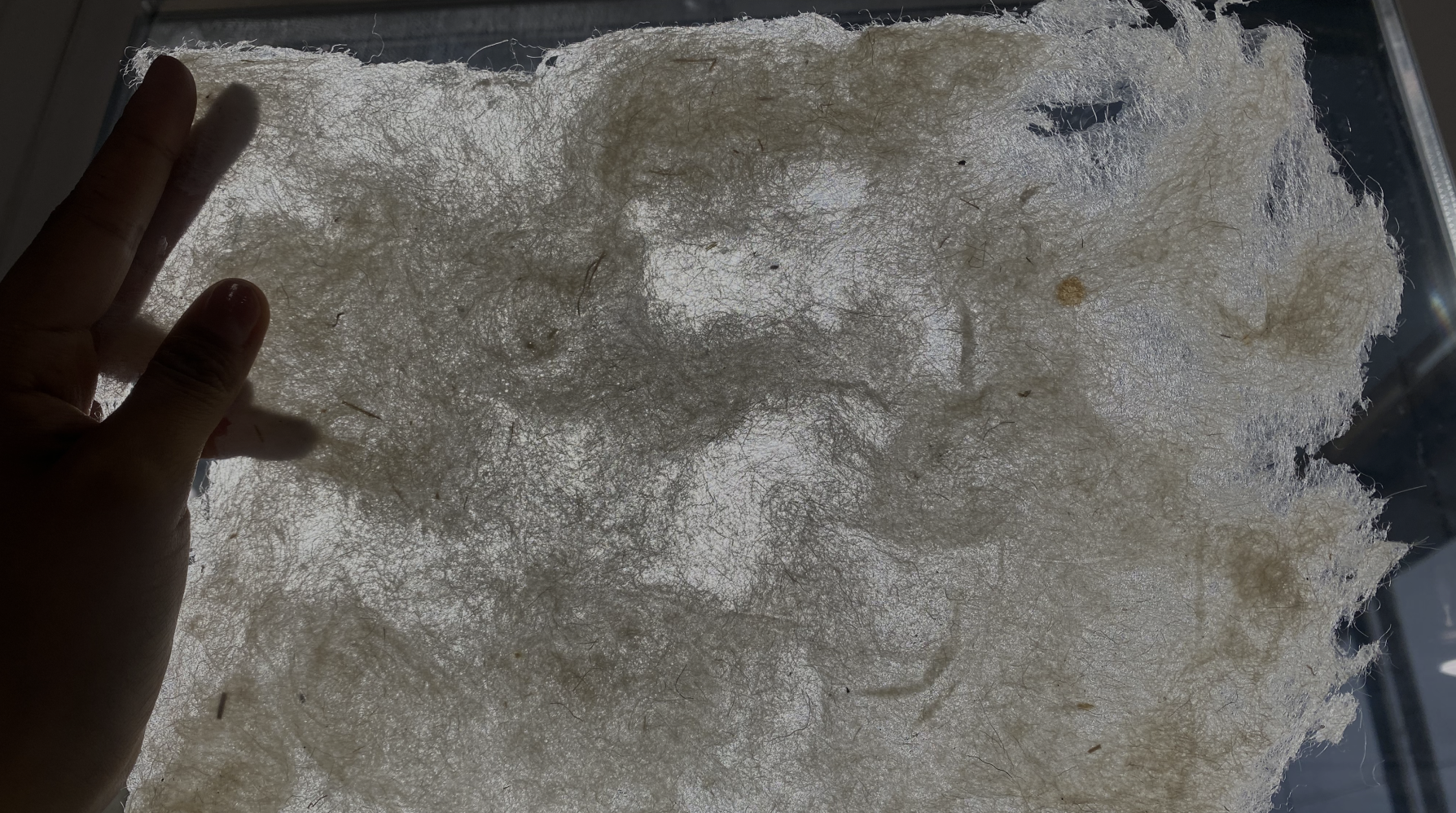
- Expectations: Wool paper look and feel.
- Outcome: A soft leathery finish when dried after a few days. Strong paper like feel after using heat press, even plastic-like when casting thicker sheets.
- Observations: Wool density affects opacity. Heat press helps improve surface evenness, more polished. Heat press renders a dry more brittle material. A varnish could be added or brush surface with more glycerine to prevent breakage (although the texture would change from paper to plastic-like). Very interesting and versatile results.
* 40g rice starch
* 5g cellulose powder (MCC)
* 10g glycerine
* 300ml water
* 10-15g of white carded wool finely chopped.
* pots
* stove
* spatula
* scale
* molds
* Measure the ingredients (except wool) and add to a pot
* Add the liquids last and stir, use the mixer to make a paste.
* Add wool and incorporate into mixture (it helps to spray wet the wool beforehand so it's easier to integrate)
* Put on medium heat. Do not boil
* Once a sticky consistency is achieved, remove from heat.
* Pour into molds. Use a silicone spatula to spread evenly. Cast into 3mm sheets. The starch will lose volume once dried.
* Let dry for a couple of days or use dehydrator.
* Once dry you can heat press for 20s at 180C to achieve a more even surface. The heat will leave the material drier/stiffer and more brittle.
Variant 1: replace MCC celulose for CMC
Material: Wool Bioyarn
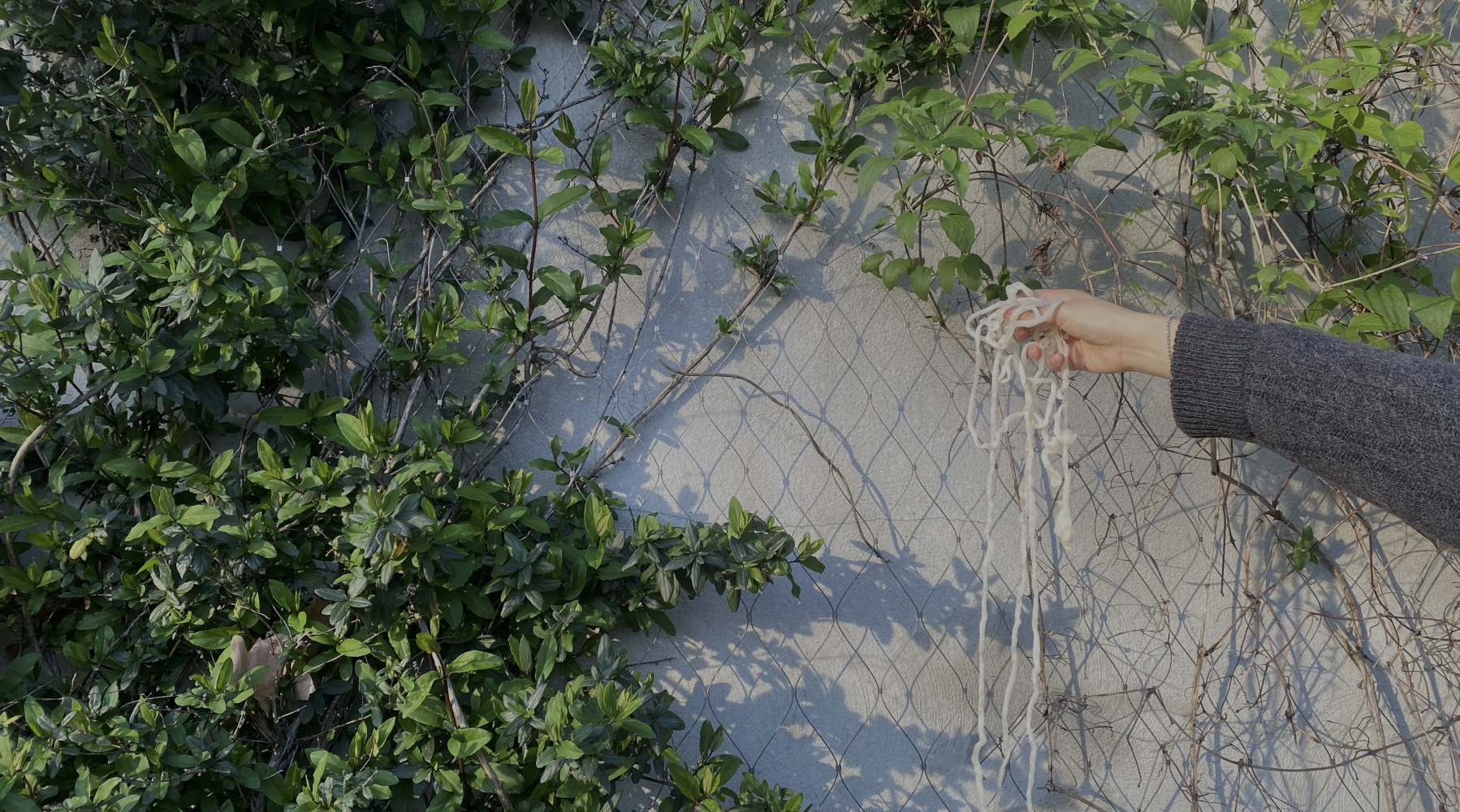
- Expectations: Long stable yarn thread.
- Outcome:
- Observations: Wool % helps stabilize the yarn and control shrinkage however, higher wool % makes it harder to extrude.
* 12g alginate
* 20g glycerine
* 400ml water
* 25g finely chopped wool (20g recommended for syringe extrusion)
* pots
* stove
* spatula
* scale
* molds
* syringe or squeeze bottle
* Measure the ingredients (except wool) and add to a pot
* Add the liquids last and stir, use the mixer to make a paste.
* Add wool and incorporate into mixture (it helps to spray wet the wool beforehand so it's easier to integrate)
* Put on medium heat. Do not boil
* Once a sticky consistency is achieved, remove from heat.
* Pour into molds. Use a silicone spatula to spread evenly. Cast into 3mm sheets. The starch will lose volume once dried.
* Let dry for a couple of days or use dehydrator.
* Once dry you can heat press for 20s at 180C to achieve a more even surface. The heat will leave the material drier/stiffer and more brittle.
Structural Additives (Reinforcement / Porosity)
- Binders: cellulose powder (MMC, CMC), starches, alginate,agar agar.
- Behavior: Dense. Good for structure.
- Look: Compact.
- Feel: Smooth edges, rougher texture.
- Considerations: Since it has higher amomount of wool and lower water/wet binder ratio, the shrinkage is less and is a more stable material. Heavier weight.
- Applications
- Acoustic cores
- Blocks
- Insulating boards
- Structures
Material: Agar Glass (Failed)
- Expectations: hard brittle glass alternative (translucent).
- Outcome: opaque material unless <1mm cast. Soft/jelly like if cast is thicker. Depending on cast thickness and wool density can also feel like a foam (thin casting, wool dense).
- Observations: Wool density affects opacity. Super thin casts will wrinkle and shrink as they dry with a brittle paper like feel.
* 6g agar agar
* 300ml water
* 15g glycerine
* 3-5g wool (short and long fiber)
* pots
* stove
* spatula
* scale
* molds
* Measure the ingredients (except wool) and add to a pot
* Add the liquids last and stir, use the mixer to make a paste.
* Add wool and incorporate into mixture (it helps to spray wet the wool beforehand so it's easier to integrate)
* Put on medium heat. Do not boil
* Once a sticky consistency is achieved, remove from heat.
* Pour into molds immediately.
* Let dry for a couple of days or use dehydrator.
Material: Fiber Block (Success)
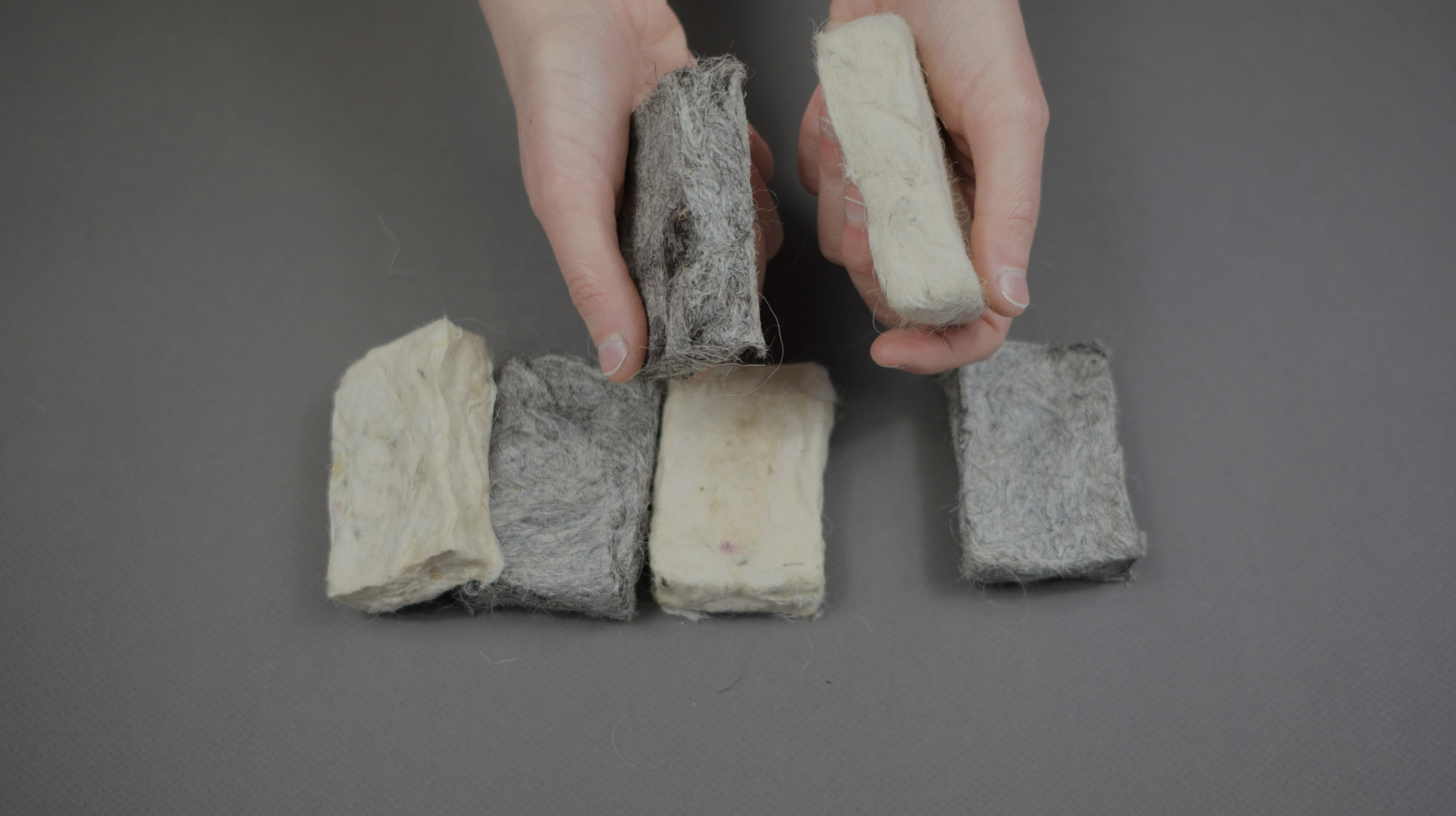
- Expectations: dense fiber structural material.
- Outcome: dense material. Some white coloring from the starch.
- Observations: No shrinkage due to high fiber content.Press firmly when casting to reduce air bubbles. Good for casting thicker samples. Fiber lenght affects look and feel, acoustics, density. More binder paste will "encapsulate" the fibers giving a more sleek feel but less acoustic absorption due to sealing the pores of the surface.
* 6g agar agar
* 300ml water
* 10g cellulose (MMC)
* 30g wool (short or long fiber)
* pots
* stove
* spatula
* scale
* molds
* Measure the ingredients (except wool) and add to a pot
* Add the liquids last and stir, use the mixer to make a paste.
* Add wool and incorporate into mixture (it helps to spray wet the wool beforehand so it's easier to integrate)
* Put on medium heat. Do not boil
* Once a sticky consistency is achieved, remove from heat.
* Pour into molds immediately.
* Press firmly to reduce air bubbles.
* Let dry for a couple of days or use dehydrator.
Variation 1: +8g CMC and 30g of white wool finely chopped.
Material: Bioclay (Success)
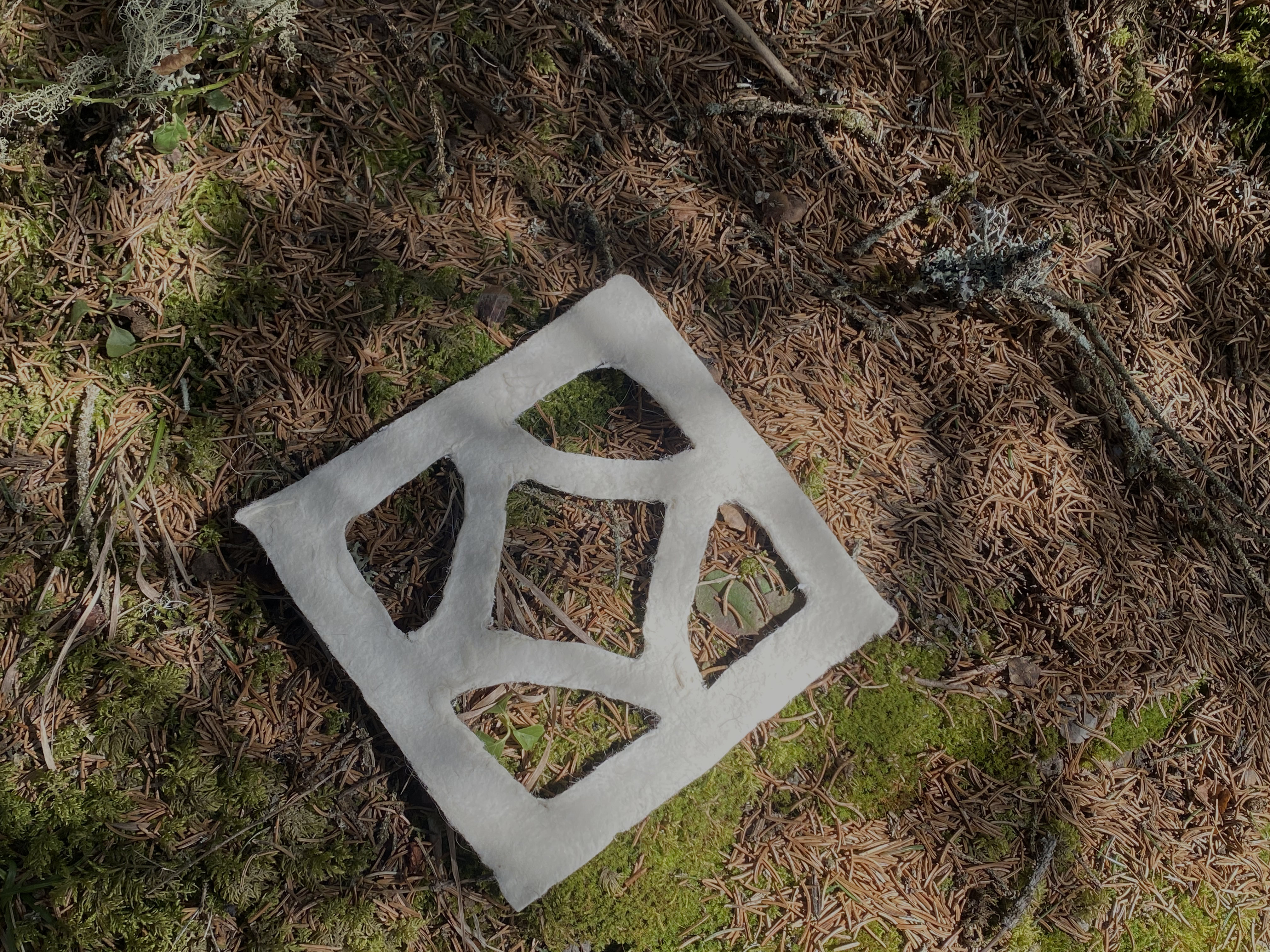
- Expectations: moldable clay like material.
- Outcome: natural moldable clay with added strenght.
- Observations: The fibers add structure and results in a harder, denser material. It is reccomended to wet the wool to make it easier to incorporate. Dry wool will make clumps in the clay. Wool can be incorporated by molding it into the paste after the cooking but it is harder to measure the ammount that acturally gets integrated. Once wool is added into the paste, it is harder to manipulate (mould, cut).
* 125g sodium bicarbonate
* 62g corn starch (also works with other starches)
* 88ml water
* ??ml glycerine for flexibility.
* ??g wool (short fiber)
* pots
* stove
* spatula
* scale
* molds
* Measure the ingredients (except wool) and add to a pot
* Add the liquids last and stir, use the mixer to make a paste.
* Add wool and incorporate into mixture (it helps to spray wet the wool beforehand so it's easier to integrate)
* Put on medium heat. Do not boil
* Once a sticky consistency is achieved, remove from heat.
* Mould with your hands to sculpt. Use a roller and cookie cutters for flat shapes.
* Let dry for a couple of days.
Expansion / Porosity Agents
- Binders: starches
- Behavior: Porous, sound absorbent
- Look: Compact with holes
- Feel: spongey, porous
- Considerations:
- Applications
- Foam alternative
- Lightweight acoustic tiles
- Diffusive surfaces
Prototypes
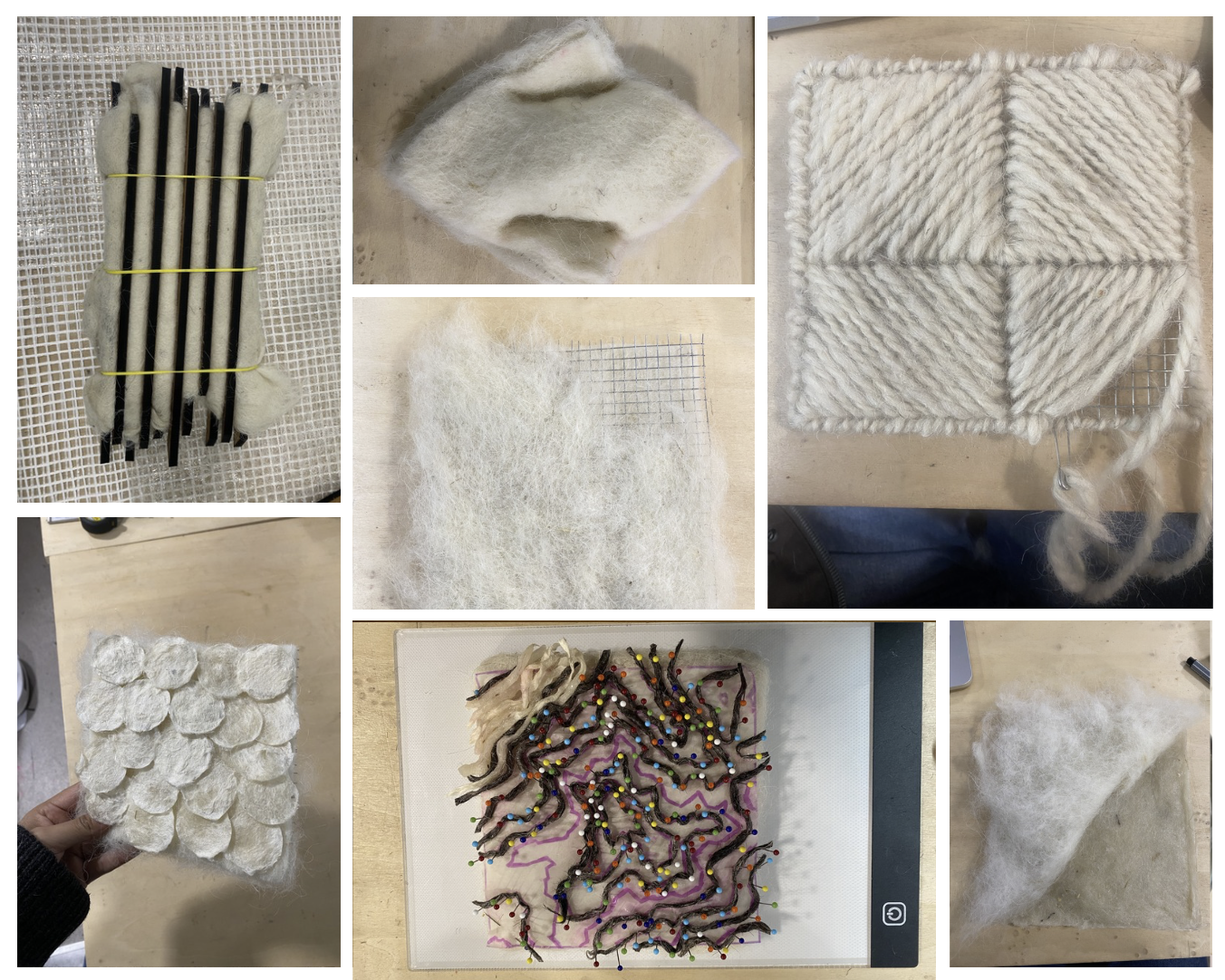
Mentoring notes & past presentations
December
-
keep the two contexts in mind in your material experimentation to create circular material flows. - Oscar
-
I think making bio-acoustic panels is a great idea - we have a similar problem in jordan with the local wool and using the fibers to reinforce structures seems to be the best way to reuse this wasted material - nice presentation! - Claudia
-
You can first identify all the wool properties, and them choose the main to focus on the applications. Crossing the needs and applicaations. For exemple water-repealing, sound-proff, resistance, etc. - Carolina
-
Fabricademy Alumna Margaret have worked a lot with wool too i think https://class.textile-academy.org/2023/margret-guttormsdottir/ in case you want to reach her out - Porpla
Midterm
-
Actually i love the interactive part fo your proposal!! it is incredible to show how it works, i definitely like the idea of being able to compose your own panel, like a recipe, choose the back, the middle and the front. I love how the projection ( it should be a top vertical projector or led adressable from the back if you do not find a vertical projector, and you color this wall with LIGHT! - Anastasia
-
Very interesting exploration of materials and integration, what is the size of those modules? I suggest you testing the soundproofing of the tiles soon so that you can validate the idea and apply the findings to the other ones. - I did one time and there is a couple of apps in your phone and an empiric test to do for measuring noise levels like recording the space noice before and after mounting the panels while repeating the same sounds.
-
https://blog.burtonacoustix.com/soundproof/fundamentals/test-soundproofing. - Claudia