Table of Contents
On This Skin and Beneath
My final project explores how emotional memory, shaped by personal, social, and cultural history, can be translated into a wearable that maps these traces onto the body.
Here is my project proposal:
And you can download it here
Installation Overview
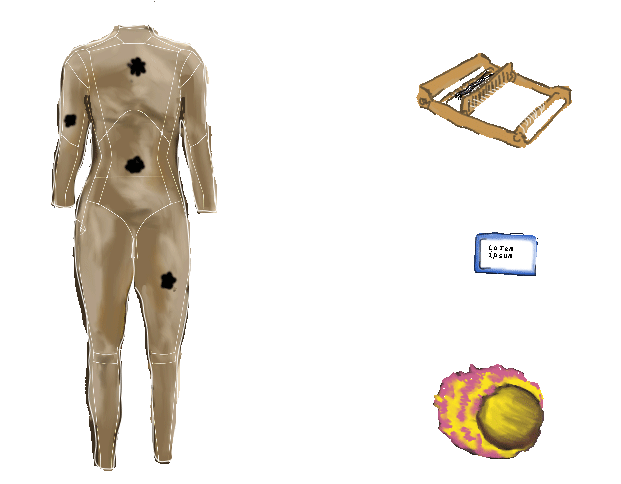 My idea is to create a bodysuit using biomaterials, biochromes and embedded with skin electronics. The design of the suite will be inspired by emotional mapping and body mapping. There could be a parallel between the characteristics of biomaterials and memories/emotions, as they both can be fragile, reactive, layered, composite, and change over time. These ideas will be reflected in the design of the suite, using different consistency, transparency, porosity, composite and colours.
I also intend to expand into the space with tokens. These objects will represent a memory-feeling, expanding the narrative space of the installation. For example, I could give the memories that my hands retain of my father. My mum always says that my sister and I have his same hands (and feet). I don’t remember him, but my body keeps this memory. How can I represent the empty space left by my father’s hands? Which traces would they leave on my hands?
I’m also interested in working with skin electronics. I’m planning to explore different kinds of reactions (heat, vibration, sound?) and see how these could be used, maybe as an activation tool or a reminder of where and how we feel
Where and When
The projects is designed for an installation space. It is a moment of an on going research that I want to undertake over the body, emotioanl memory and emotional mapping.
Why
The projects intends to explore and reflect on how memories are inherited, stored and activated. It reflects on embodiement and body awerness. As this bodysuit, designed for my body, takes place in the echibition space, it also becomes the body of someone else.
What
I intend on making a biomaterial bodysuit with touch sensor and create a interactive installation. The body present itself as both archive and interface
How
I chose biomaterials because they behave like memories — they age, they react, they are composite and unstable. Electronics will help me with interactivity and engage the public through touch-based interactions
Who
Body Mapping, Emotional Mapping and Embodied Experience as Design Tools
- Emotional Mapping helps capture the associations between emotional states and bodily regions.
- Body Mapping refers to the process of creation - through the use of graphic tools such as drawing, painting, collage, etc - and reflection of one's complex embodied experience.
Artistic References
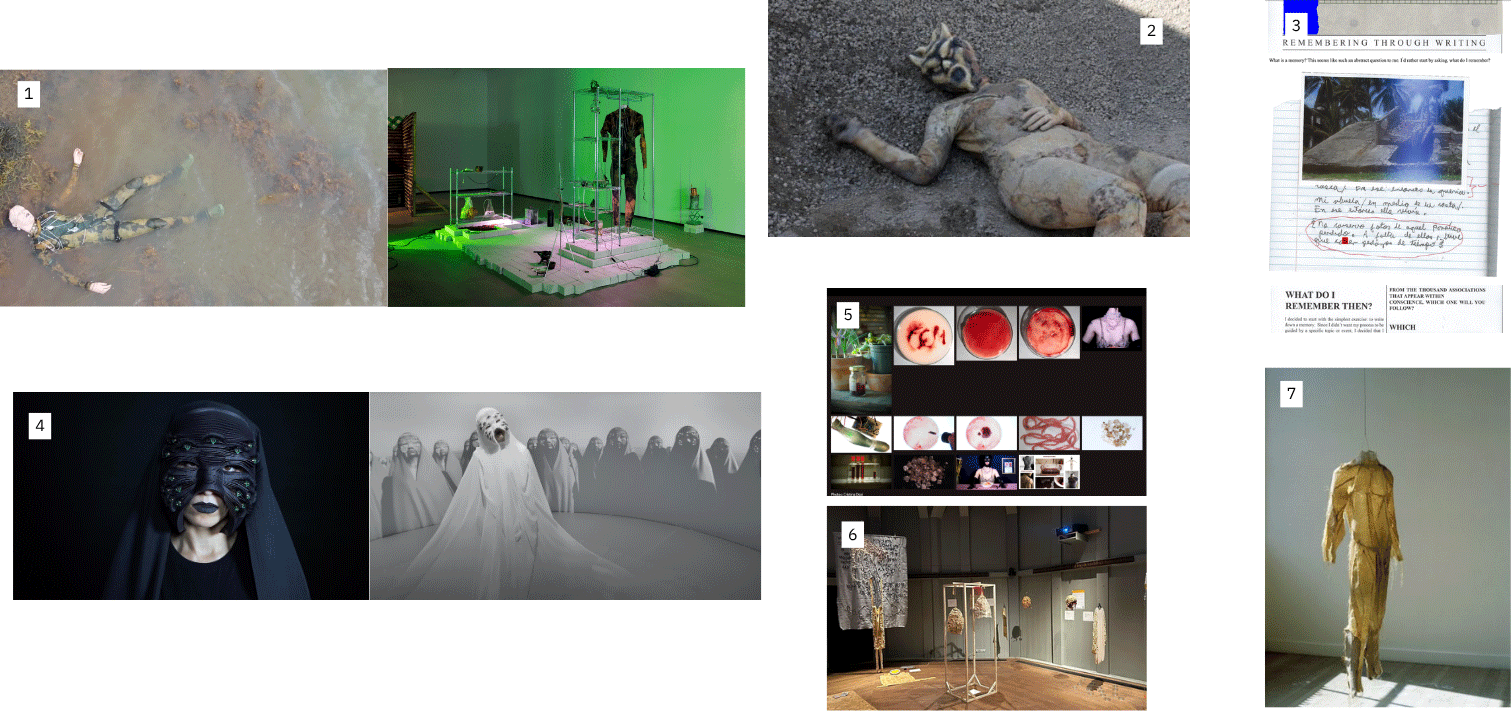
- Murky Murky, Little Bitch Witch Critic of environmentally disruptive fishing industries for the aggrandisement of multinationals
- The Myth Of The CiucciaNebbia Gaia D'Arrigo’s project embodies the phenomenon of air pollution into a living being reflecting the human activities happening in the city.
- Memory as a method for filmmaking This research develops a method for filmmaking that uses autobiographical memory as a guiding principle for the production of images.
- Can the subaltern speak? This project is inspired by the intriguing historical masks worn by the Bandari women from southern Iran. Legend has it that these masks were developed during Portuguese colonial rule, as a way of protecting the wearer from the gaze of slave masters looking for pretty women. Viewed from a contemporary perspective, these masks can be seen as a means of oppressing women under patriarchal colonial rule.
- Body fluid The research behind the taboo/body-fluid-based material combines open-source biotechnology, feminist fermentation, and the construction of a do-it-yourself sensibility in symbiosis with the environment, to create erotic biotech artefacts, sustainable sexual prostheses and body fluid-based biosilicons.
- Safety Curtain/Cocoon Artist Francis Hörters' works serve as self-portraits in and through textiles. She was diagnosed with autism and ADHD in her mid-50s, and she has learned to embrace her neurodivergence, which can be sensed in her works. Her works are an invitation for the audience to listen to autistic and other sensibilities.
- An Inner-Act Resonance is the sensitivity to the movement of entities and energies that build up in our bodies. The project 'An Inner-Act' attempts to reveal these intimate lifeforms by bringing the inner to the outer, tapping into these resonances.
Bibliography
I’m reading a few papers about emotions and body mapping, which have been really inspiring. Two days ago, I found “ Applying Body Mapping in Research An Arts-Based Method, “ which I’m really excited to read. I’m also reading a few books about Italian traditions, folk rituals and magic. Maybe it will be inspiring regarding the biomaterial fabrication.
- Boydell, K. (2020). Applying Body Mapping in Research An Arts-Based Method. Taylor & Francis Group.
- Daikoku, T., Minatoya, M., & Tanaka, M. (2025). Mapping Emotional Feeling in the Body: A Tripartite Framework for Understanding - the Embodied Mind. Neuroscience & Biobehavioral Reviews, 180, 106469. https://doi.org/10.1016/j.neubiorev.2025.106469
- Emilio Angel Reyes Bassail. (2019). MEMORY AS A METHOD FOR FILMMAKING. Journal for Artistic Research, 19. https://doi.org/10.22501/jar.648128Ernesto
- De Martino. (2001). Sud e magia. Feltrinelli Editore.
- Gastaldo, D., Magalhães, L., Carrasco, C., and Davy, C. (2012). B_ody-Map Storytelling as Research: Methodological considerations for telling the stories of undocumented workers through body mapping. Retrieved from: http://www.migrationhealth.ca/undocumented-workers-ontario/body-mapping.
- Nummenmaa, L., Glerean, E., Hari, R., & Hietanen, J. K. (2013). Bodily maps of emotions. Proceedings of the National Academy of Sciences, 111(2), 646–651. https://doi.org/10.1073/pnas.1321664111
- Puca, A. (2024). Italian Witchcraft and Shamanism. BRILL.
- Riva, G. (2018). The neuroscience of body memory: From the self through the space to the others. Cortex, 104, 241–260. https://doi.org/10.1016/j.cortex.2017.07.013
- Xing, X., Chen, M., Gong, Y., Ziyu Lv, Han, S.-T., & Zhou, Y. (2020). Building memory devices from biocomposite electronic materials. Science and Technology of Advanced Materials, 21(1), 100–121. https://doi.org/10.1080/14686996.2020.1725395