Technical information
Final Bill of Materials
| Category | Component | Specification / Part Number | Quantity | Notes | Estimated Unit Price (USD) |
|---|---|---|---|---|---|
| Solar | Flexible Solar Panels (Small) | Thin Film Solar Panel 0.3W / 1.5V | 10 pcs | Lightweight, flexible, for distributed layout | 4 |
| Solar | Flexible Solar Panels (Large) | Thin Film Solar Panel 0.5W / 2V | 4 pcs | Higher output panels | 12 |
| Electronics | Solar Charge Controller | CN3065 Mini Solar Charger Module | 1 pc | Li-ion charging controller | 3,5 |
| Power | Power Bank | 5000 mAh Compact Power Bank (USB-C input) | 1 pc | Used as energy storage | 8 |
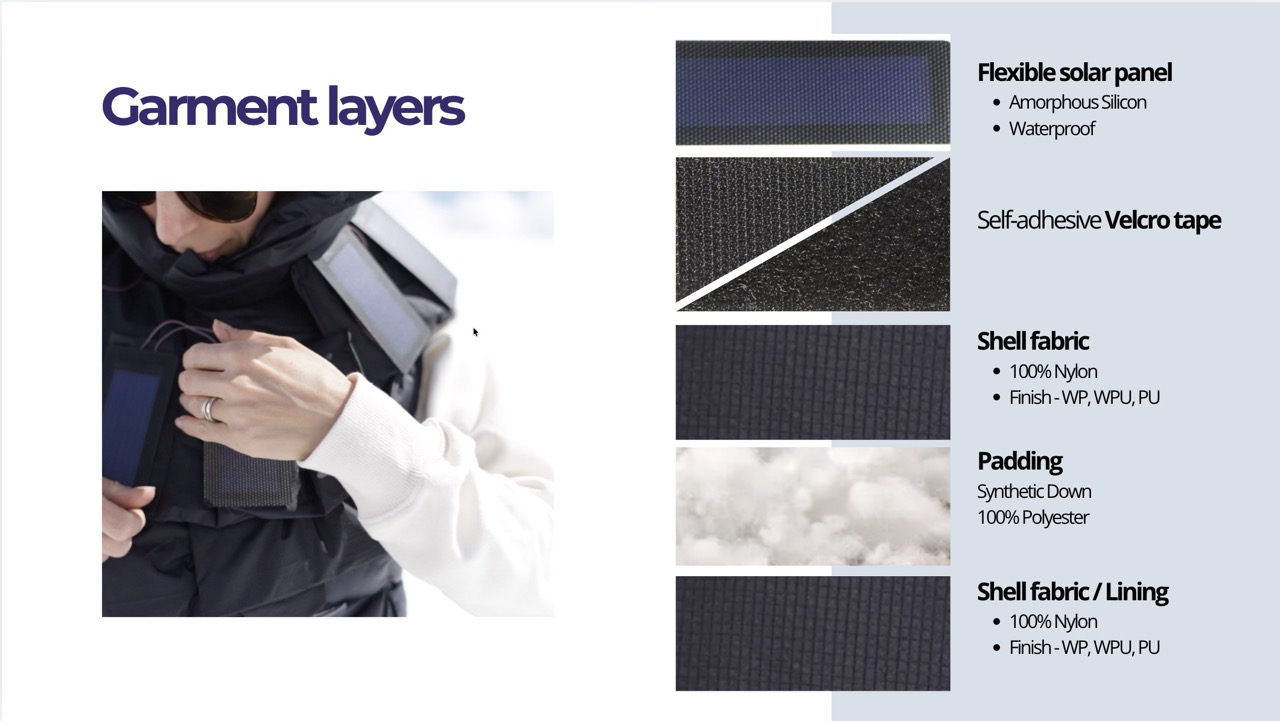
| Textile | Outer Fabric | Reinforced Water-Repellent Polyester (Ripstop) | ~0.5–1 m | Durable, outdoor use | 0 / m |
| Textile | Lining | Lightweight Polyester Lining Fabric | ~0.5–1 m | Comfort layer | 0 / m |
| Textile | Insulation | Synthetic Insulation | ~60 g | Thermal layer | ~0.8 / g |
| Hardware | Magnetic Snaps (Large) | 18 mm Sew-on Magnetic Snaps | 6 pcs | Central closure | 4,4 |
| Hardware | Magnetic Snaps (Medium) | 15 mm Sew-on Magnetic Snaps | 6 pcs | Scarf attachment | 3,6 |
| Hardware | Velcro Tape (Adhesive) | Self-Adhesive Hook & Loop Tape | 2 m | Panel attachment & modules | 6,8 |
| Electronics | Wires | Silicone Insulated Wire (22–26 AWG) | ~2–3 m | Flexible, suitable for wearables | 0 |
| Electronics | Solder | Lead-Free Solder Wire (Sn99Cu1 or Sn60Pb40) | 1 roll | For electrical connections | 0 |
| Fabrication | Filament (3D Printing) | PLA or PETG Filament 1.75 mm | ~100 g | Battery holder | 0 |
| Protection | Silicone Sealant | Neutral Cure Silicone (Electronics Safe) | 1 tube | Waterproofing panel connections | 0 |
Thus, the approximate cost of the project is ≈ $162.3. However, it should be noted that many materials are not included in this estimate, as I used what was already available at Fab Lab Dilijan or received fabric for the project from my previous workplace.
If the project cost is estimated including consumable materials from the lab as well as the fabric, the total would increase to approximately $180–220.
GANTT chart
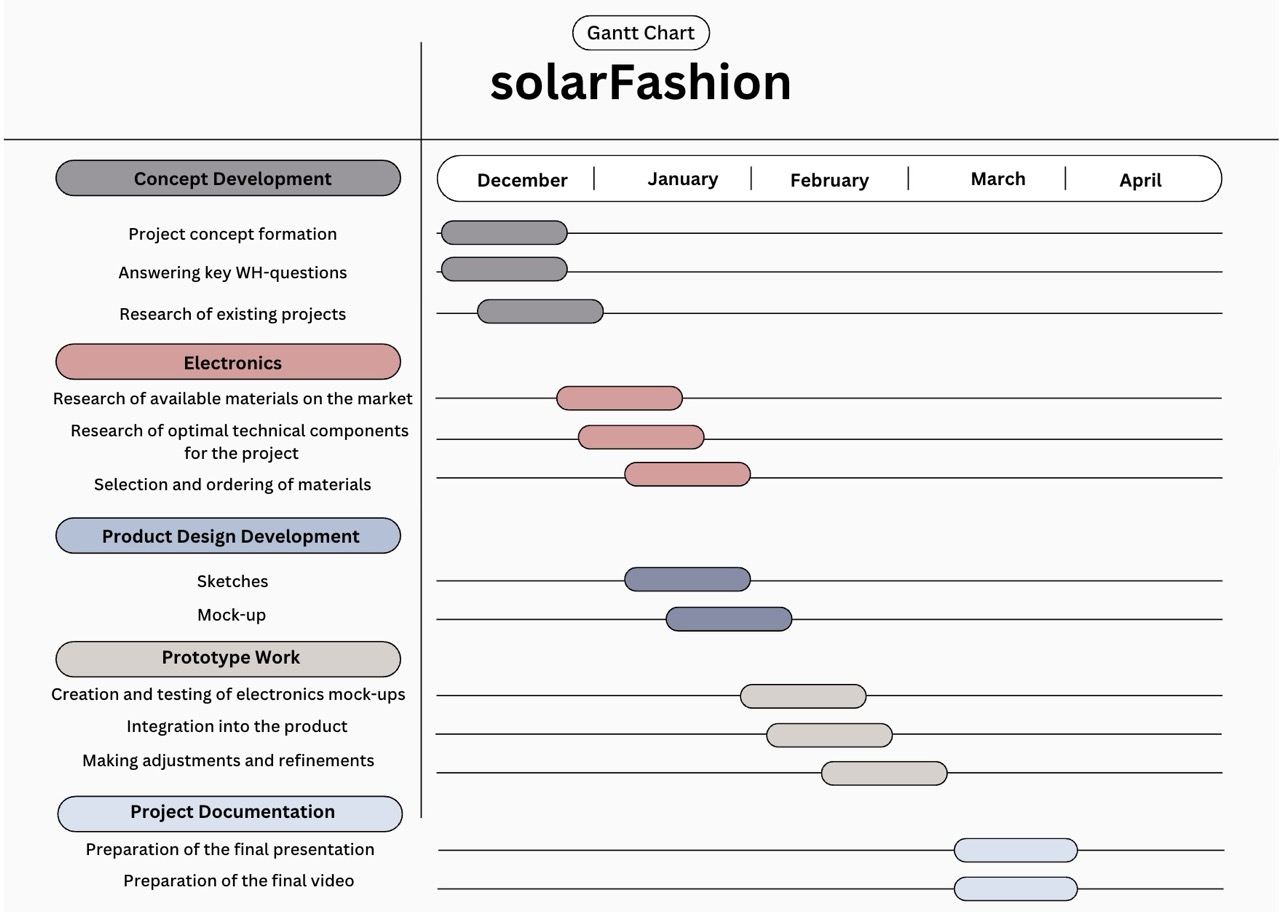
Project Workflow — Step by Step
1. Research Phase
- Studied basic principles of solar energy and small-scale photovoltaic systems
- Researched wearable electronics and solar charging circuits
- Selected suitable components (flexible solar panels, CN3065 controller, power bank)
- Reviewed existing projects in solar fashion and wearable technology
2. Sourcing Components
- Ordered flexible solar panels in two sizes (0.3W / 1.5V and 0.5W / 2V)
- Purchased CN3065 solar charge controller
- Selected compact 5000 mAh power bank
- Acquired wires, soldering materials, and assembly components
3. Parallel Garment Design Process
- Developed initial garment concept (hooded neck garment)
- Experimented with form directly on a mannequin
- Tested proportions, panel placement, and construction logic
- Created a mock-up using prototype fabric
4. Electronics Testing
- Measured voltage output of each solar panel in different lighting conditions
- Identified variation between panels
- Tested simple circuits (including LED test) to confirm functionality
5. Circuit Assembly
- Connected panels into branches (parallel + series configuration)
- Soldered all electrical connections
- Integrated CN3065 solar controller
- Connected system to power bank
6. Garment Fabrication
- Selected reinforced water-repellent fabric for final prototype
- Cut all pattern pieces
- Sewed garment structure including insulation and lining
- Integrated channels for wiring
7. Integration
- Attached solar panels using velcro tape
- Installed magnetic snaps for modular connections
- Placed power bank and controller in a removable module
- Routed and secured wiring inside the garment
8. System Testing
- Tested full system under daylight conditions
- Measured output voltage (~6.3V)
- Verified controller activity (LED indicator)
- Observed charging behavior of the power bank
9. Result
- Confirmed increase in stored energy in the power bank over time
- Demonstrated feasibility of wearable solar energy collection
- Evaluated performance and identified areas for future improvement