BioChromes¶
Week 4 assignment for Fabricademy. This page documents a dye-and-pigment experiment built from three Chinese medicinal plants — 姜黄 (turmeric), 栀子 (gardenia) and 紫草 (gromwell) — the same plants that go into herbal decoctions, here repurposed to colour cotton and, in one case, to be turned into a lake pigment.
1. Objective¶
weekly assignment
Check out the weekly assignment here or login to your NuEval progress and evaluation page.
What this week is. Three medicinal plants, one substrate (plain cotton), and one question: how far can the same plant be pushed? Each plant is run through a small matrix of modifiers — tannin, alum, iron, acid, alkali, time — so that a single herb produces a tonal strip rather than one colour. One of the three (紫草) is then carried a step further: from a dye that dissolves in a bath, into a pigment — an insoluble powder that can be ground, bound with gum arabic and painted.
The three plants were chosen because they fail in different ways. Turmeric is a direct dye but a pH indicator; gromwell refuses to dissolve in water at all; gardenia sits somewhere in between and rewards concentration control. Together they cover the three failure modes a natural dyer actually meets.
三种中药材,一种基底(纯棉),一个问题:同一株植物能推多远?每味药都跑一组小矩阵——单宁、明矾、皂矾、酸、碱、时间——让一味药产出色阶而非单一颜色。其中紫草再往前走一步:从溶于染浴的染料,变成颜料——一种不溶的粉末,可以研磨、调胶、涂布。
1.1 How this page answers the student checklist¶
| Student checklist item | Where it is answered |
|---|---|
| Include some inspiration: research on artists or projects on natural/bacterial dyeing, local ingredients and resources | § 2 |
| Produce at least 1 natural dye with modifiers on fabric or yarn | Three — § 5 turmeric, § 6 gardenia, § 7 gromwell |
| Produce 1 ink or 1 pigment (recycling the dye bath leftover or creating one from scratch) | Pigment — 紫草 lake pigment, § 8 |
| Document your recipes, the ingredients and process, and document changes and unexpected discoveries | Recipes in every §; deviations and surprises collected in § 9.4 |
| Submit swatches or a catalogue to the lab's analog material library (20 × 20 cm approx) | § 10.1 |
2. References, research & inspiration¶
2.1 Two herbal-dye references that set the palette¶
- 服设作品集|中药染小教程|过程记录 — LOAE Fashion Workshop. Seven herbs tested as fabric dye: 鸡血藤 (Spatholobus suberectus), 墨旱莲 (Eclipta prostrata), 花生衣 (peanut skin), 苏木 (sappanwood), 黑豆衣 (black soybean skin), 母丁香 (clove fruit), 枇杷叶 (loquat leaf). The post documents the full bench process and ends with a finished garment cut from one of the dyes — the thing that convinced me this could end in cloth, not just swatches. Source: Xiaohongshu.
- 18种药材植物染色色谱参考 — 木子的养生小院. A reference swatch book of 18 medicinal herbs (incl. 板蓝根, 紫草, 茜草, 苏木, 槐米, 栀子, 姜黄, 桑葚, 五倍子…), each shown under different mordants. This is the chart I checked my own results against — and the source of the biggest surprise of the week (see § 9.4). Source: Xiaohongshu.
2.2 Local resources¶
Every plant, mordant and pH agent on this page was bought within walking distance — a Chinese herbalist (中药铺) for the plants and the mordants, a grocery store for the acid and alkalis. Nothing here needed a laboratory supplier, which is part of the point: the whole palette is reproducible from a pharmacy counter.
| 中文名 | English / Latin | Bought as | Role |
|---|---|---|---|
| 姜黄 | Turmeric, Curcuma longa | powder | direct dye + pH indicator |
| 栀子 | Gardenia, Gardenia jasminoides | dried fruit (生栀子) | direct dye, clean yellow |
| 紫草 | Gromwell, Lithospermum erythrorhizon | dried root | alcohol-soluble dye + lake pigment |
| 五倍子 | Gallnut, Rhus chinensis | whole galls | tannin pre-treatment |
| 明矾 | Alum, potassium aluminium sulphate | crystal | metal mordant (bright) |
| 皂矾 / 绿矾 | Ferrous sulphate | crystal | metal mordant (grey / dark) |
| 柠檬酸 | Citric acid | grocery | acid modifier |
| 小苏打 | Baking soda, sodium bicarbonate | grocery | mild alkali |
| 食用碱 | Soda ash, sodium carbonate | grocery | strong alkali |
2.3 Process rules I set for myself¶
- Cotton only. One substrate, so every difference in the results is attributable to the plant or the modifier, never to the fibre.
- One variable at a time. Each swatch differs from its neighbour by exactly one thing — a mordant, a pH dip, or a duration.
- Label everything at the corner with a marker, before it gets wet.
- Shade-dry, always. Two of these three pigments are light-sensitive enough that direct sun changes the answer while it dries.
- Photograph wet and dry. Wet cloth reads roughly one step darker than it will dry — a fact that cost me one swatch (see § 5.5).
3. Tools¶
Materials
- Plants — 姜黄 powder, 生栀子 dried fruit, 紫草 root
- Mordants — 五倍子 (tannin), 明矾 (alum), 皂矾 (ferrous sulphate)
- pH modifiers — citric acid, baking soda, soda ash
- Solvent — 75 % ethanol (pharmacy grade) for gromwell
- Substrate — plain white cotton, scoured
- pH paper — for the gromwell lake, where the endpoint matters more than the volume
Hardware
- Kitchen scale, 0.1 g resolution
- Stainless-steel pot dedicated to dye (never food again)
- Glass jars / beakers, one per bath, clearly labelled
- Cheesecloth or a fine strainer
- Wooden spoon, stainless tongs
- Marker pen for corner labels
- Drying line in a shaded, ventilated spot
- Camera — window light, neutral background, consistent across the whole series
Ethanol safety
Gromwell needs alcohol, and alcohol needs respect. Everything in § 7 and § 8 was done at room temperature, with no open flame, hot plate, oven or hair dryer anywhere nearby, in a ventilated room. The ethanolic liquor is flammable and the vapour is heavier than air.
4. Concept — three plants, three failure modes¶
The reason these three rather than any other three: they break in different places, so between them they map the whole problem.
| 姜黄 Turmeric | 栀子 Gardenia | 紫草 Gromwell | |
|---|---|---|---|
| Principal pigment | curcumin | crocin (a carotenoid glycoside — same family as saffron) | shikonin / alkannin (naphthoquinone) |
| Solubility | water (warm) | water (warm) | water: almost none. Needs 60 %+ ethanol or oil |
| Dye class | direct — no mordant required | direct — no mordant required | weak on cellulose — wants a tannin anchor |
| Hue family | lemon → gold → orange-brown | clean lemon → deep gold | lilac → purple → blue |
| pH behaviour | extreme — a working indicator | mild — brightens slightly in acid, dulls in base | extreme — acid red, neutral purple, base blue |
| Best lever | pH post-dip | concentration | solvent + pH |
| Light fastness | poor | moderate | poor-to-moderate |
| Bath reuse | yes | yes | no — oxidises within hours |
Read as a sentence: turmeric is a pH experiment, gardenia is a concentration experiment, gromwell is a solvent experiment. One mnemonic covers the whole week — 姜黄配 pH,栀子配浓度,紫草配溶剂.
三种药材,三种失效方式:姜黄是 pH 实验,栀子是浓度实验,紫草是溶剂实验。
5. Dye 1 — 姜黄 (turmeric)¶
5.1 What turmeric does¶
Curcumin is a direct dye — it will colour cotton with no mordant at all — and it is also one of the few natural colorants dramatic enough to work as a pH indicator: bright lemon in acid, orange in mild alkali, red-brown in strong alkali. That dual personality is what this swatch set is built around.
5.2 Recipe as run¶
| Item | As run | Note |
|---|---|---|
| Turmeric powder | ~40 g in 1.5 L water | simmered 30 min, strained |
| 五倍子 tannin liquor | 0.5 L (10 g/L gallnut) | poured into the dye bath, not used as a pre-bath |
| 明矾 alum | 20 g in the 2 L combined bath = 10 g/L | in-bath, not pre-mordant |
| Combined dye bath | 2 L | 1.5 L turmeric + 0.5 L tannin |
| Cotton | 15 × 15 cm × 6, plus a 30 × 8 cm strip | corner-labelled |
| Divided into 3 beakers | ~450 mL each | for the pH post-dips |
| Citric acid | 7 g / 450 mL | beaker A |
| Baking soda | 7 g / 450 mL | beaker B |
| Soda ash 食用碱 | 2 g, then +1 g if needed / 450 mL | beaker C — added slowly, watching the colour |
5.3 The swatch matrix¶
| # | Treatment | Expected |
|---|---|---|
| S1 | plain turmeric, no tannin, no alum | bright yellow — the reference point |
| S2 | tannin → turmeric | deeper gold |
| S3 | tannin → alum → turmeric | saturated golden (the baseline for S4–S6) |
| S4 | S3 base → citric acid post-dip | bright lemon |
| S5 | S3 base → baking soda post-dip | orange |
| S6 | S3 base → soda ash post-dip | red-brown — 1–2 min only |
| S7 | 30 × 8 cm strip, acid → water → alkali in segments | one continuous pH gradient |
| Backup | — | spare for mistakes |
5.4 Procedure¶
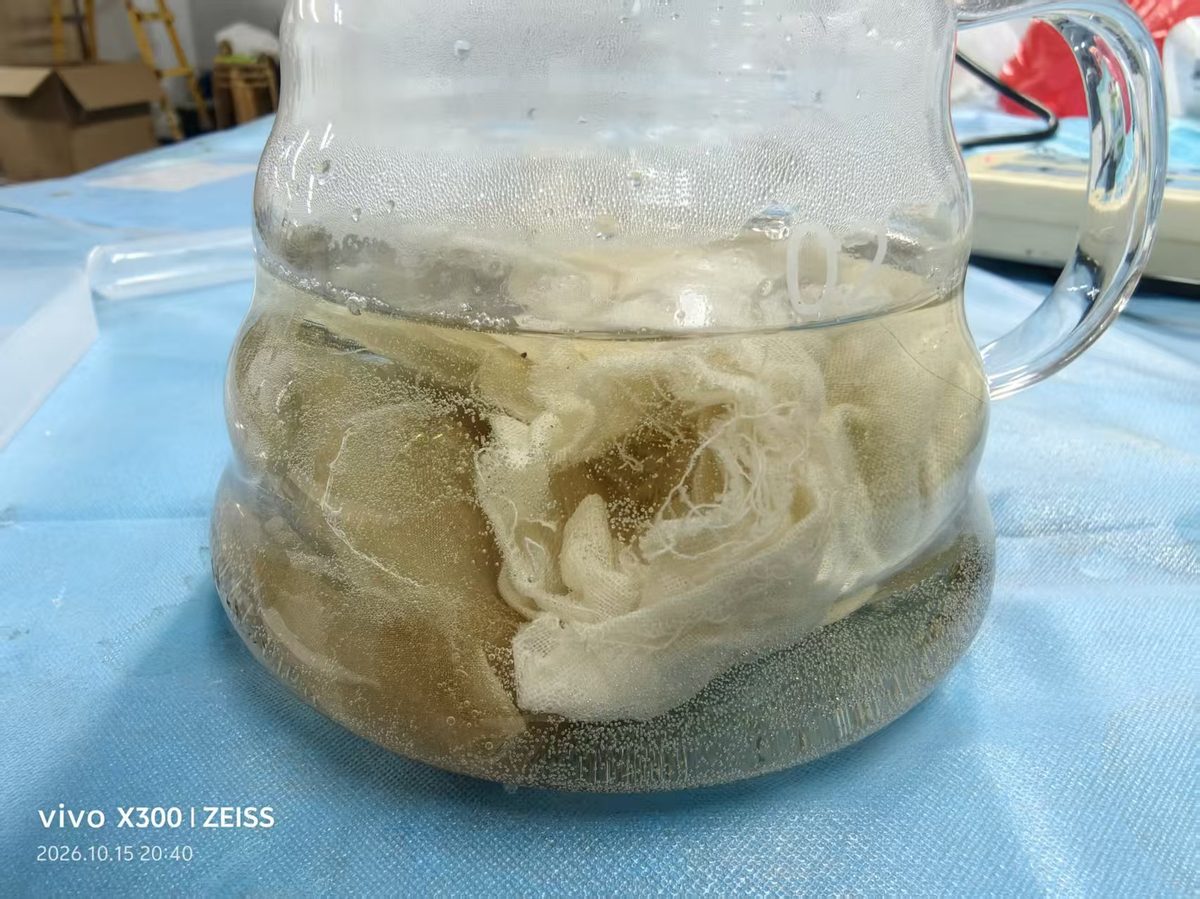
- Scour — hot water with a little neutral soap, 30 min, rinse. Strips the factory sizing.
- Tannin (S2–S7) — gallnut 10 g/L, 60–70 °C, 45 min or overnight. S1 skips.
- Alum (S3–S7) — 15 g/L, 50 °C, 30 min.
- Dye — the turmeric bath at ~60 °C, 30 min, stirring occasionally.
- pH post-dip — three beakers at room temperature. A and B: 5 min. C: 1–2 min and watch it.
- S7 — fold the strip in three and dip segment by segment: acid → clear water → alkali.
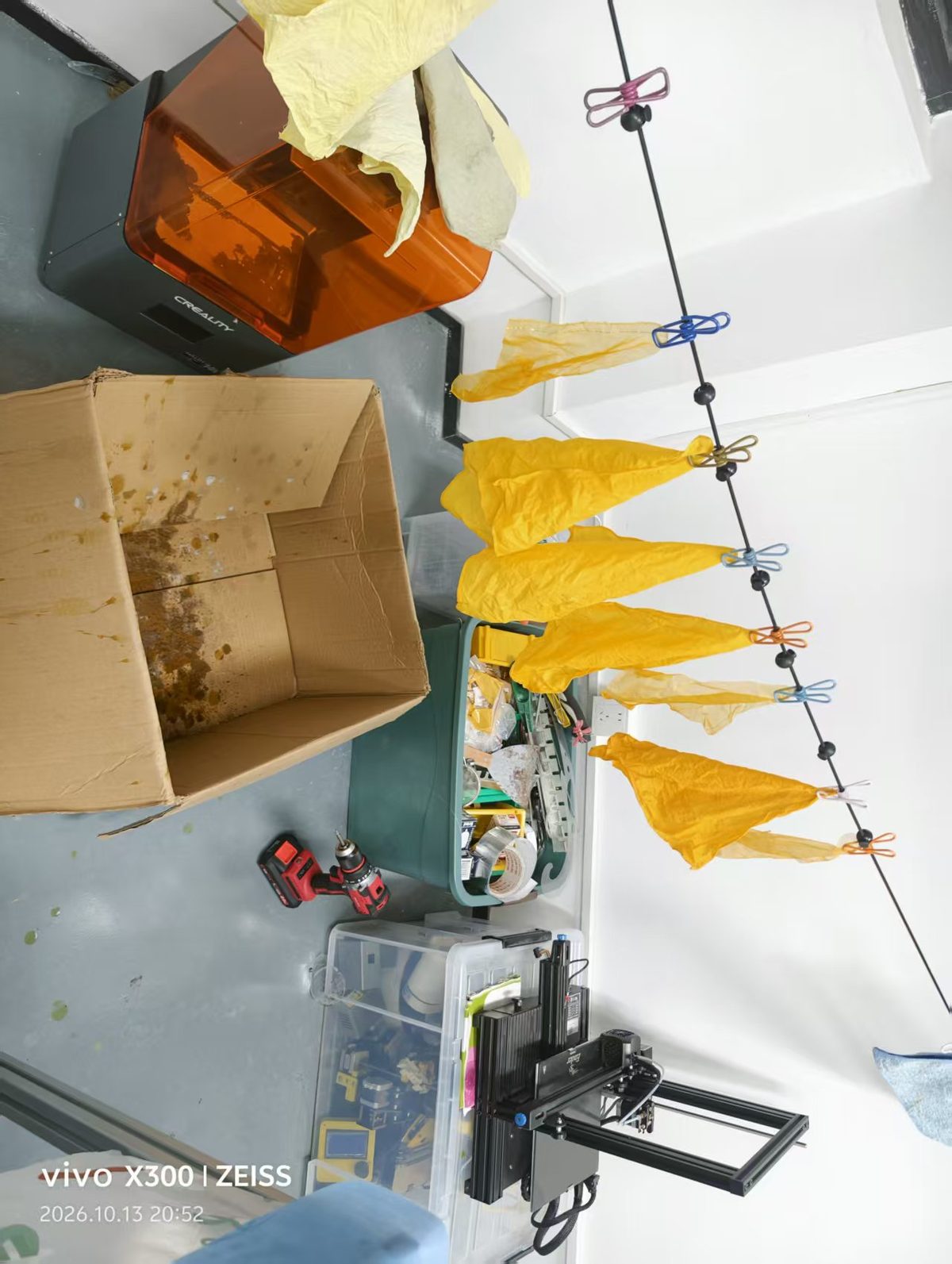
- Rinse until clear, dry in shade. Turmeric fades badly in sun.
5.5 Three pitfalls¶
- Soda ash is not "more is better". Past roughly pH 10 curcumin starts to degrade: the colour doesn't shift to another hue, it goes dull and brown, and it does not come back. Add soda ash in small increments and stop at orange-red.
- Alum + alkali = white haze. Aluminium ions in an alkaline bath precipitate as aluminium hydroxide — a grey-white film on the cloth and a cloudy bath. A little turbidity in beaker C is normal; a white cast on the fabric means the dip went too far.
- Wet reads darker than dry. A swatch that looks "right" in the bath will dry about one step lighter. This is the single most common way to under-dye.
A free demonstration
Take the soda-ash swatch (S6) and drop it back into the citric-acid beaker: it returns from red-brown to yellow. Curcumin's pH shift is reversible, and showing the same cloth go both ways is a better photograph than the swatch chart itself.
6. Dye 2 — 栀子 (gardenia)¶
6.1 What gardenia does, and why this run is small¶
Gardenia's crocin is the cleaner, colder yellow — the historical Chinese "正黄". It is a direct dye like turmeric, but far less pH-sensitive, so the pH axis was deliberately dropped from this set and replaced with concentration, which is where gardenia actually rewards attention.
This run was executed at reduced scale because only 8 g of 生栀子 was available. Rather than stretch the material thin across eight swatches, the matrix was cut to the three comparisons that carry the information.
只有 8 克生栀子,与其摊薄成八块,不如砍到三个真正有信息量的对比。
6.2 Recipe as run (mini scale)¶
| Item | As run | Note |
|---|---|---|
| 生栀子 dried fruit | 8 g, cracked open | 350 mL water, simmered 30 min → ~300 mL liquor |
| Cotton | 10 × 10 cm × 3, plus a 20 × 5 cm strip | scaled down from 15 × 15 |
| Alum bath | 4.5 g in 300 mL = 15 g/L | for N2 |
| 五倍子 liquor | ~300 mL, 20–30 min | for N3 only |
| Ferrous sulphate 皂矾 | 1 g in 250 mL ≈ 4 g/L | for N3 — deliberately on the low side |
| Gradient strip | stock, 1:1, 1:3 dilutions | 10 min each |
生栀子 vs 炒栀子
Buy 生栀子 (raw), not 炒栀子 (dry-roasted). Roasting caramelises part of the fruit and destroys some of the crocin: it still dyes, but the yellow comes out browner and weaker. If only roasted fruit is available, raise the dose to 40–50 g/L and expect 明黄 to drop to 土黄.
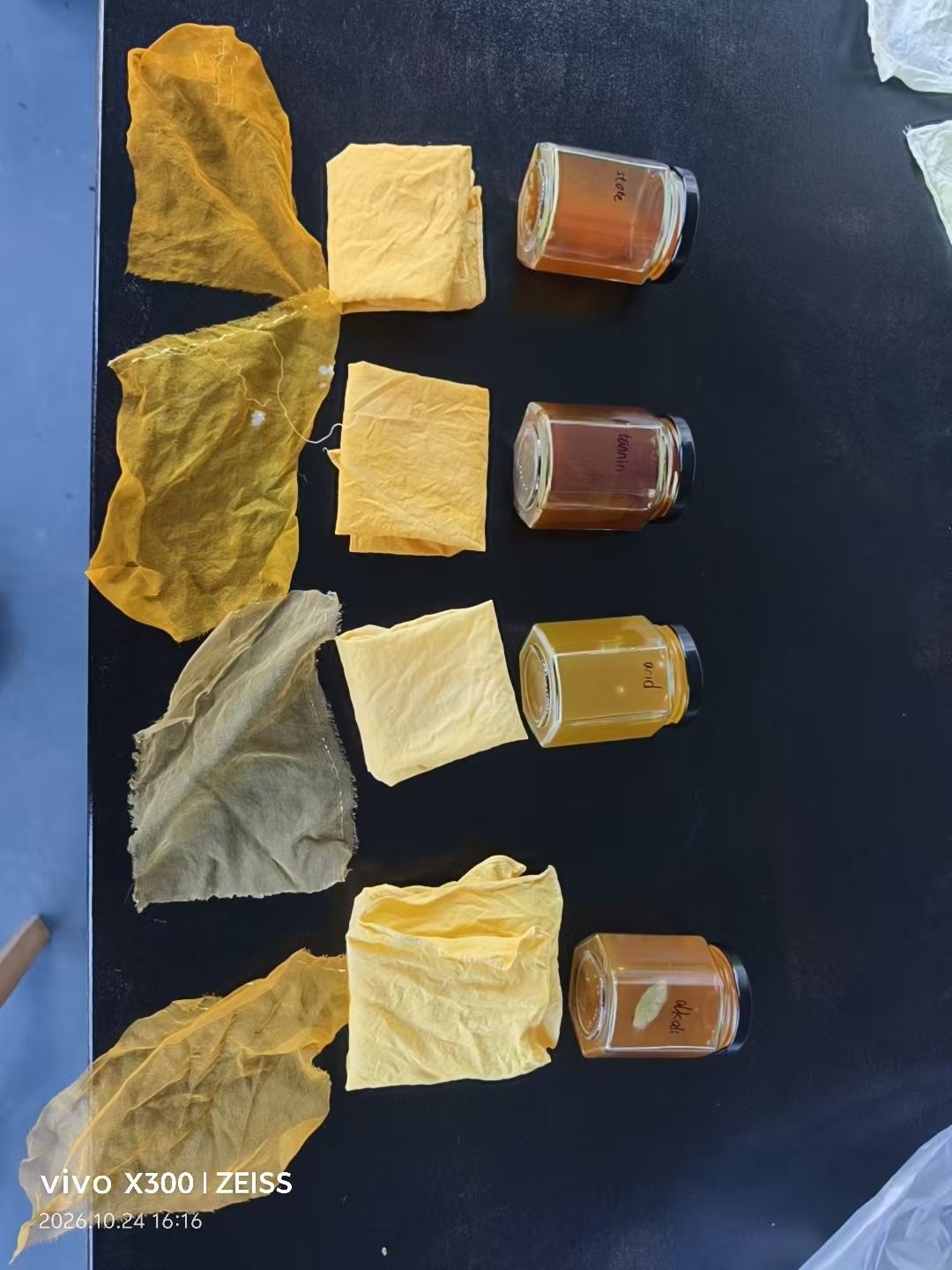
6.3 The swatch matrix¶
| # | Treatment | Expected |
|---|---|---|
| N1 | no mordant → gardenia | clean lemon yellow — the reference |
| N2 | alum → gardenia | brighter, slightly colder lemon |
| N3 | tannin → ferrous → gardenia | olive / grey-green |
| N4 | 20 × 5 cm strip, stock → 1:1 → 1:3 | concentration gradient |
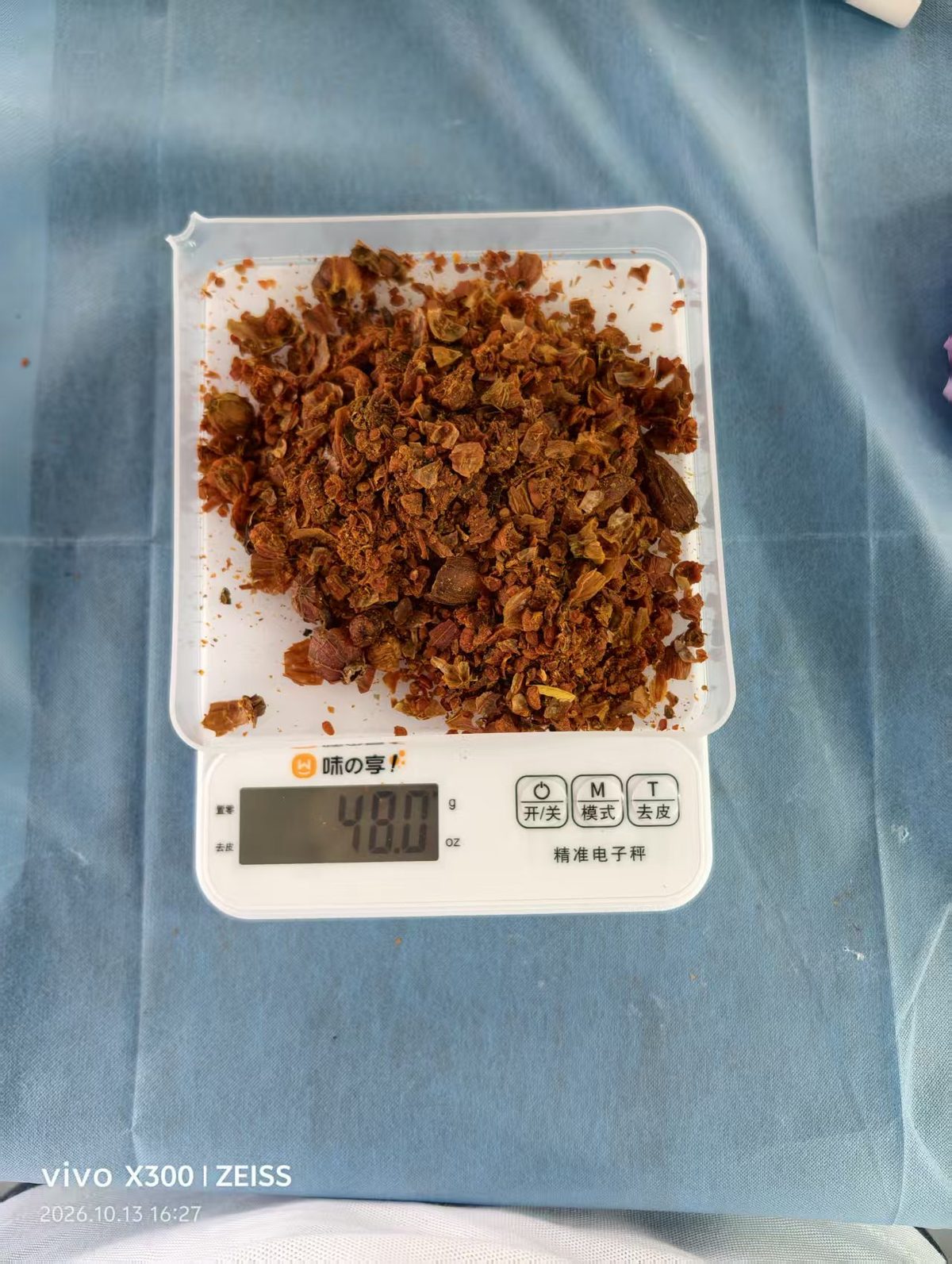
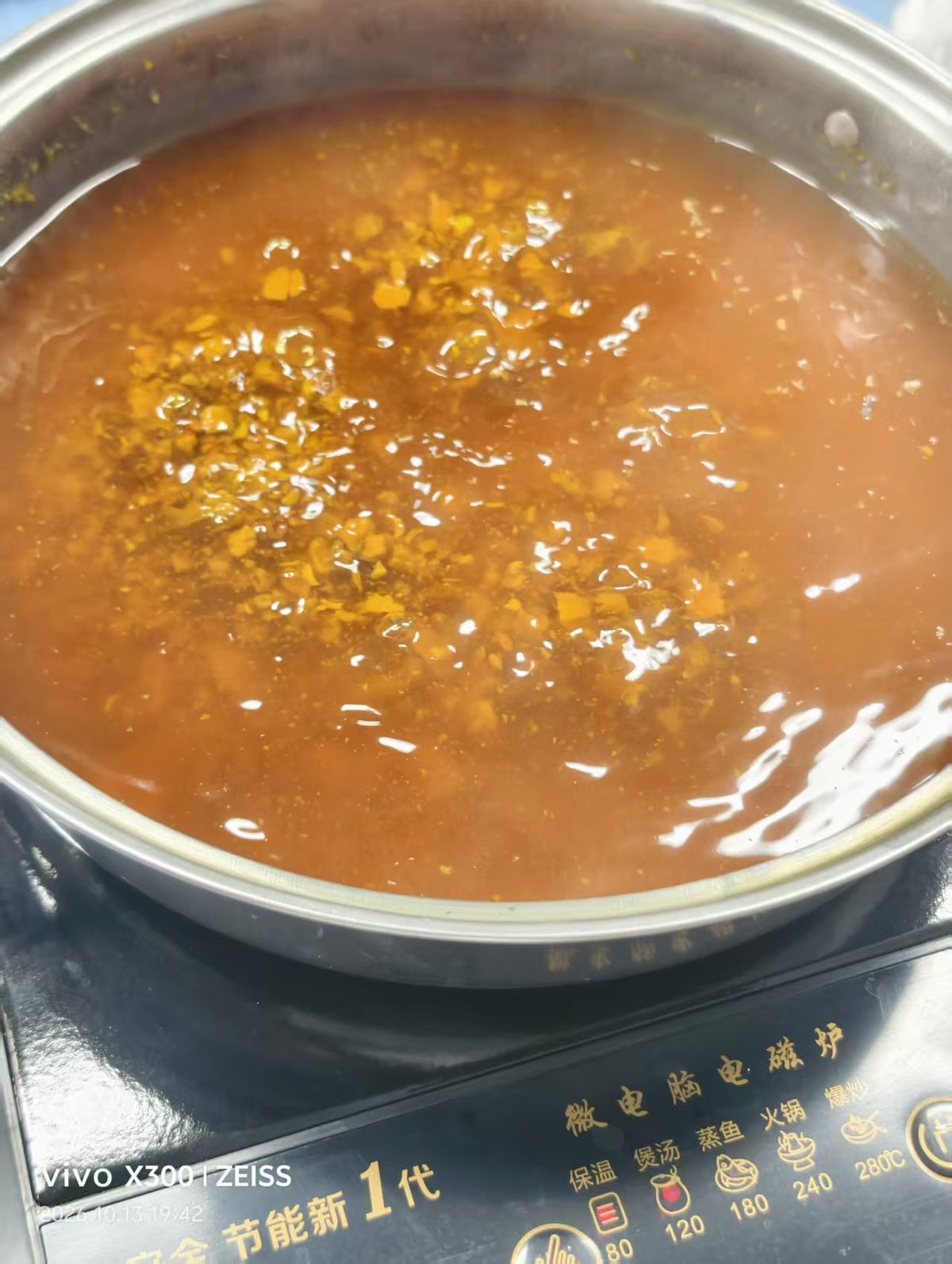
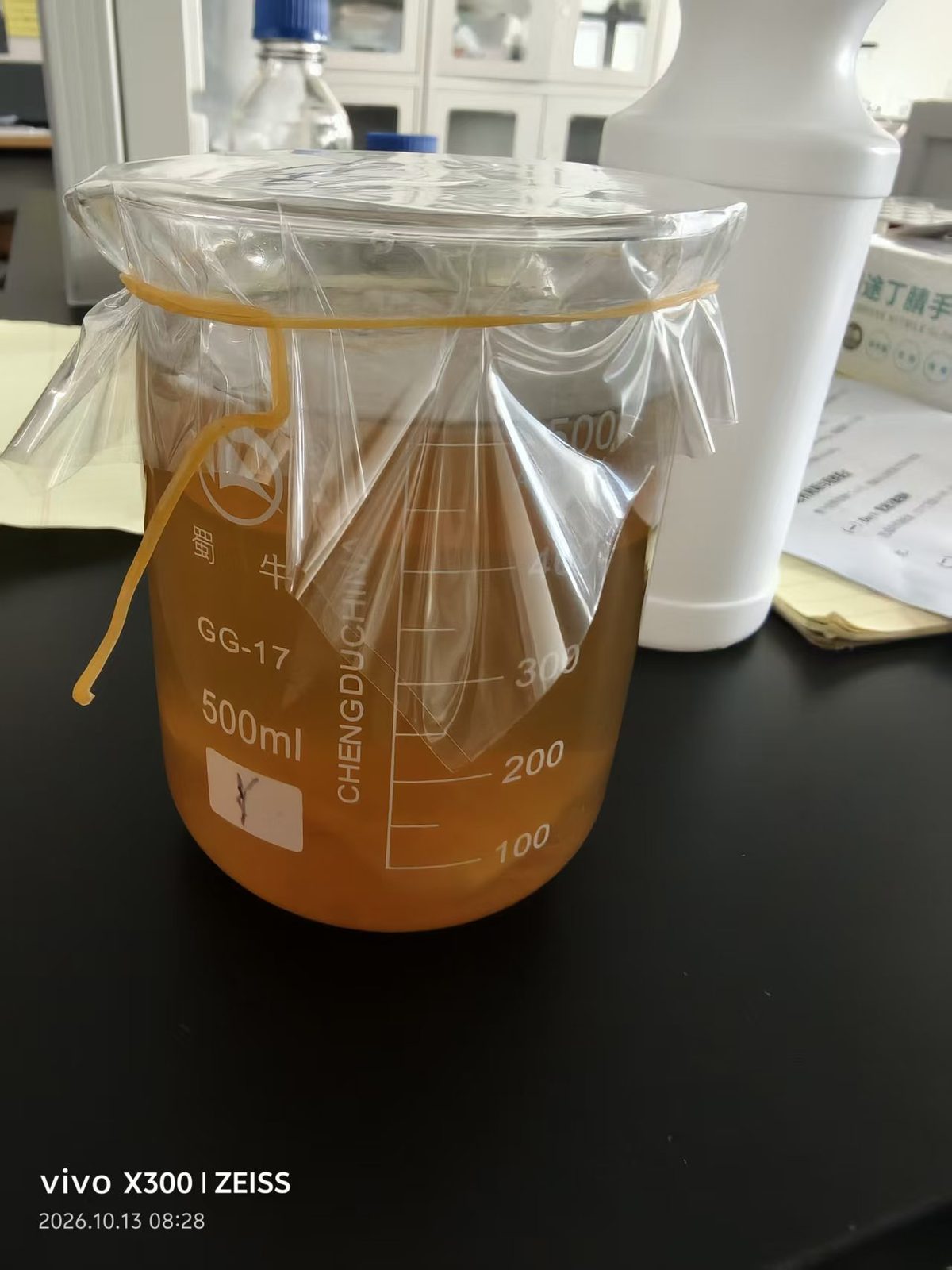
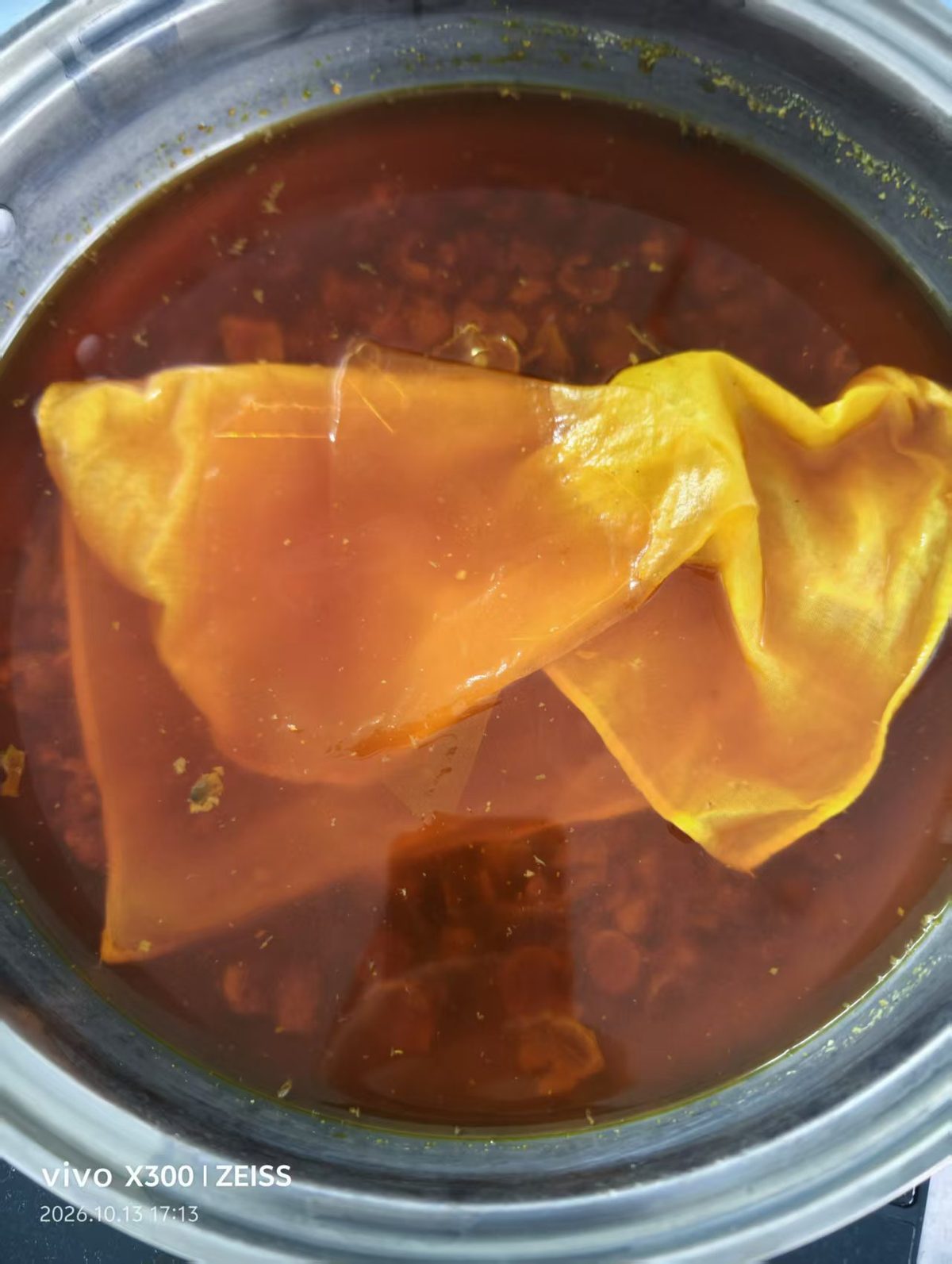
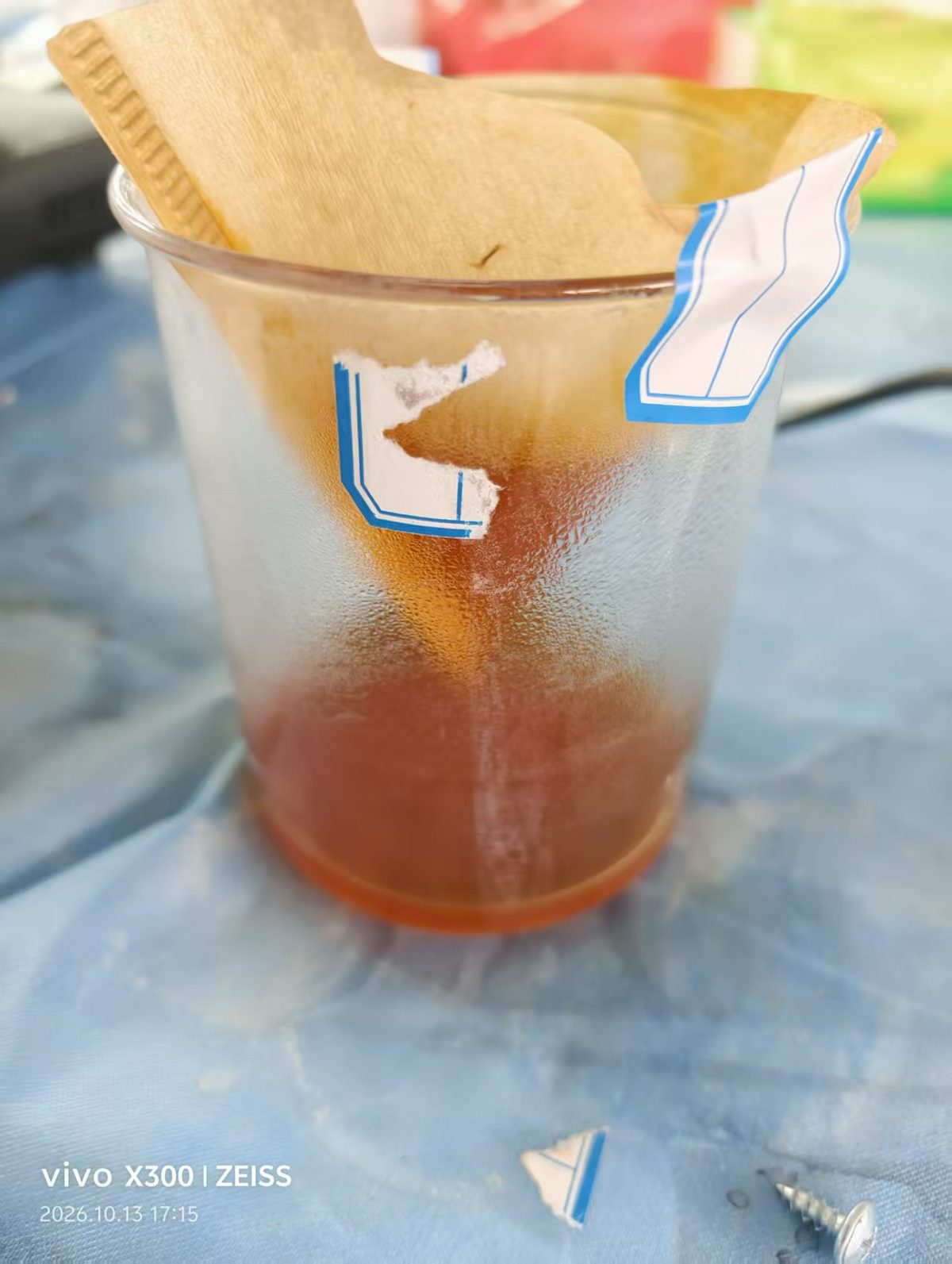
Left to right: 7 g of raw gardenia fruit, cracked open before it goes anywhere near water; the gentle simmer — never a rolling boil, or the crocin dulls; the finished liquor, sealed and resting: a clear, luminous orange-gold.
6.4 Procedure and the one deliberate deviation¶
- Crack the fruit with the back of a knife — whole dried gardenia berries are dense and give up colour slowly.
- Simmer gently, do not hard-boil. Crocin is a carotenoid glycoside and decomposes under a rolling boil; the finished liquor should be a clear golden, not murky.
- Dye in one bath in the order N2 → N3 → N1: mordanted cloth first, the unmordanted piece last. Each successive swatch comes out lighter because the bath is exhausting — which, instead of being a problem, produced an extra data point.
Unexpected discovery
The N2 → N3 → N1 order turned the bath's exhaustion into a measurement. N1 is not the "true" unmordanted colour — it is the unmordanted colour from an already partly spent bath. Noted honestly here rather than corrected, because it is also how a real dyer would work with a limited amount of dye.
- N3 is the only swatch that touches tannin. Iron on bare cellulose tends to stiffen and grey the fabric; the gallnut layer acts as the glue (a tannin–iron complex) and gives a more even olive. N2 deliberately stays tannin-free so that N1 and N2 differ by exactly one variable.
- Gradient strip: three containers, 10 min each, stock → 1:1 → 1:3.
6.5 What was dropped and why¶
| Dropped | Reason |
|---|---|
| Citric-acid post-dip | Mild improvement only — acid does make the yellow a touch brighter and colder, but with 8 g of fruit the swatch was better spent on the mordant comparison |
| Baking-soda post-dip | No meaningful effect on crocin. A swatch that proves "nothing happened" is still information, just not worth the cloth here |
| Soda-ash post-dip | Negative — strong base hydrolyses the glycoside and dulls the yellow. Turmeric turns a different colour in base; gardenia just turns worse |
7. Dye 3 — 紫草 (gromwell)¶
7.1 What gromwell does¶
Shikonin is a naphthoquinone: it barely dissolves in water at all, which is why gromwell is the one plant on this page that needs ethanol. It is also the most pH-theatrical of the three — red in acid, purple at neutral, blue in base — more violently even than turmeric. And it is the plant that gets carried one step further, into a pigment, in § 8.
7.2 Recipe as run¶
| Item | As run | Note |
|---|---|---|
| 紫草 root | 30 g, crushed or powdered | soaked in ethanol, not boiled |
| 75 % ethanol | 500 mL | sealed, dark, 4–6 h or overnight, shaken occasionally |
| 五倍子 tannin | 10 g/L, 30 min | every swatch, including the "no mordant" one |
| 明矾 alum | 15 g/L | bright path |
| Citric acid | 8 g / 500 mL | acid post-dip → red |
| Baking soda | 7 g / 500 mL | mild alkali → violet |
| Soda ash 食用碱 | 3 g / 500 mL, 1 min | strong alkali → blue |
| Cotton | 15 × 15 cm × 6 + 30 × 8 cm strip |
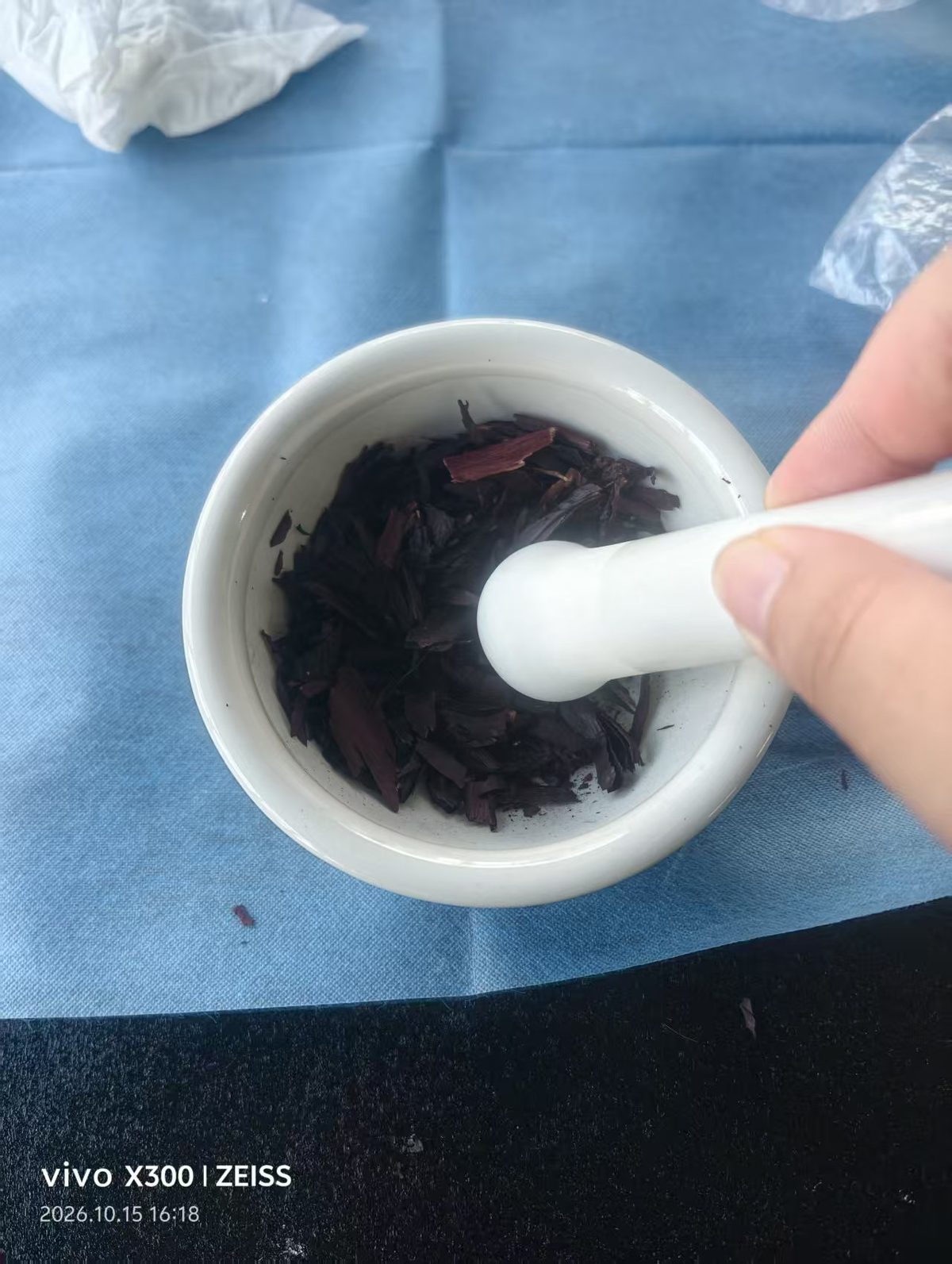
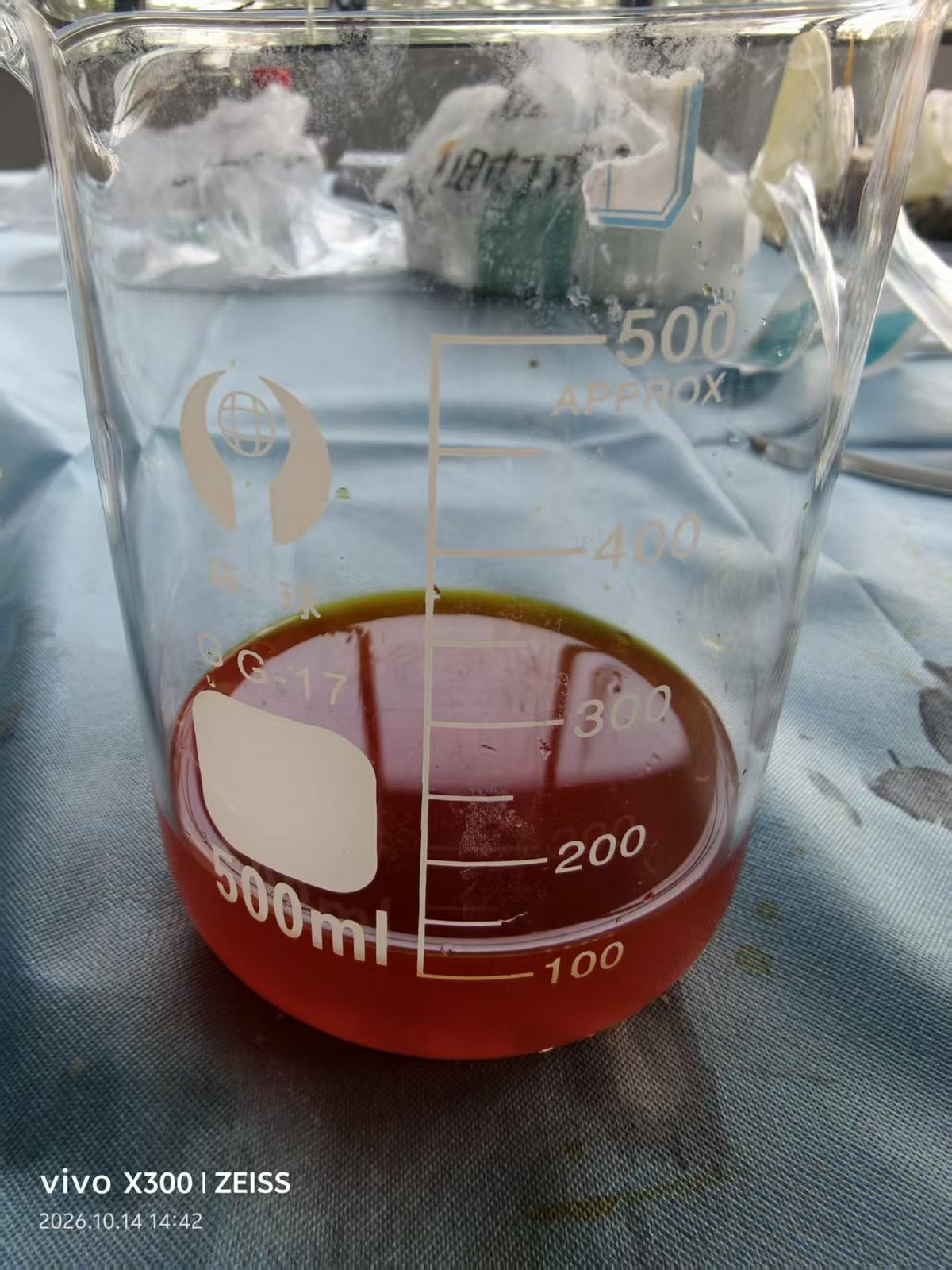
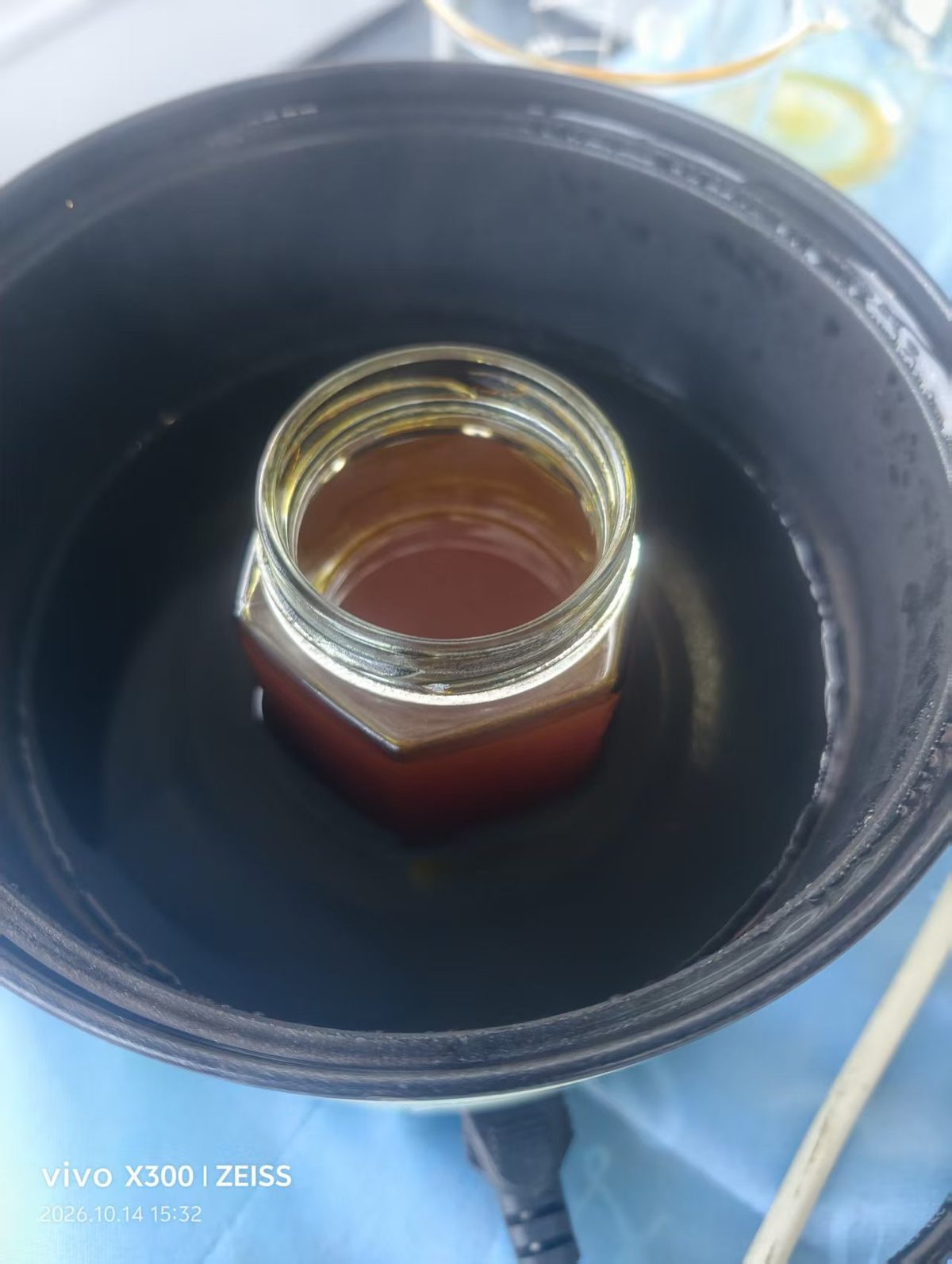
Left: the dried root ground in a mortar — whole chips give up their pigment far too slowly for a cold extraction. Middle: the strained ethanolic extract, a deep red-purple; this liquor is both the dye bath and, later, the raw material of the lake pigment. Right: the sealed jar standing in warm (not hot) water — shikonin extracts faster at blood temperature, but an open flame near ethanol is never an option, so the jar is warmed indirectly and off the heat.
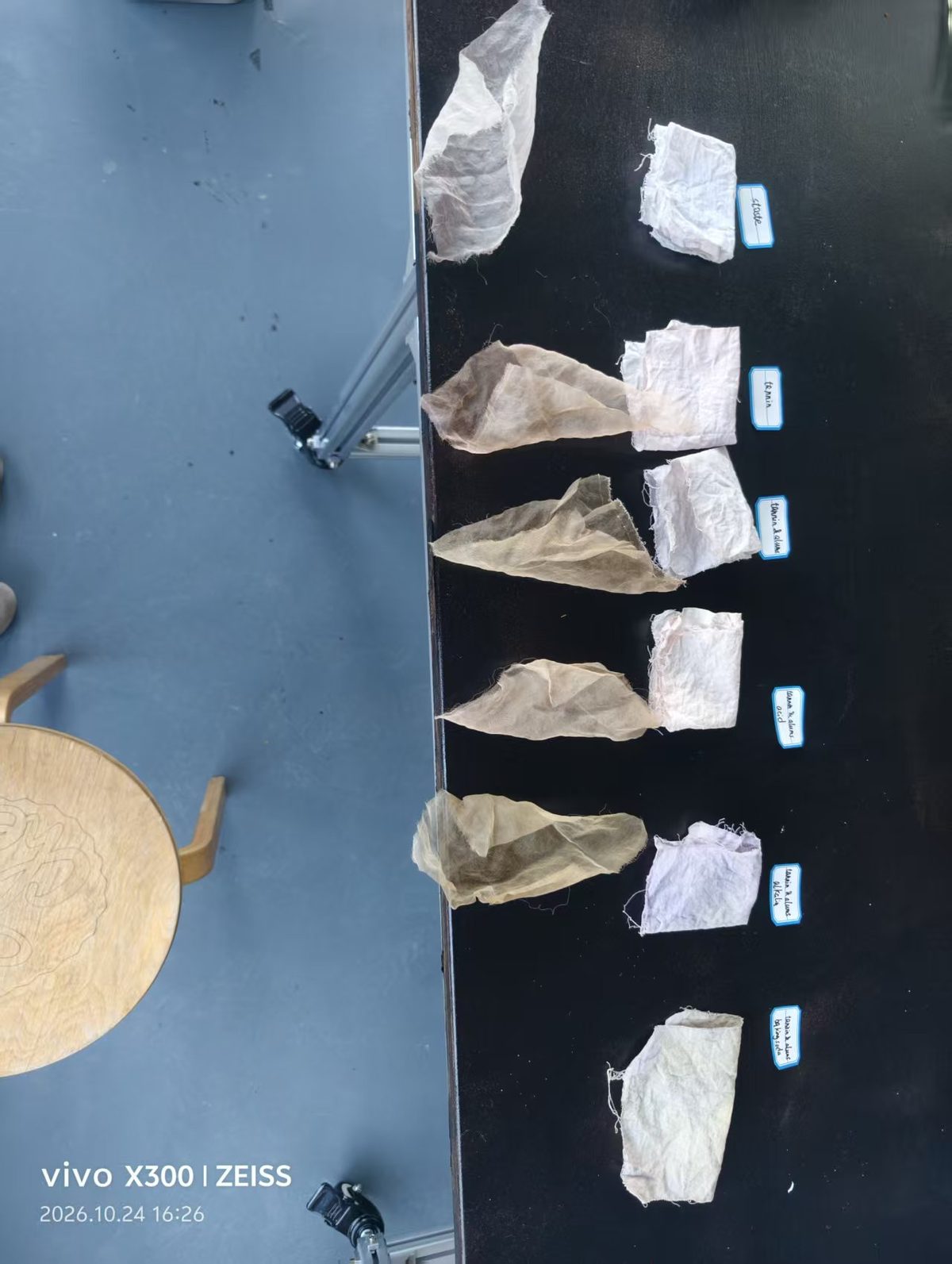
7.3 The swatch matrix¶
| # | Treatment | Expected |
|---|---|---|
| Z1 | tannin only (no metal) → gromwell | pale lilac — shows what tannin alone buys |
| Z2 | tannin → alum → gromwell | clear purple (baseline) |
| Z3 | tannin → ferrous → gromwell | grey-violet / ink |
| Z4 | Z2 base → citric acid post-dip | crimson / carmine |
| Z5 | Z2 base → baking soda post-dip | blue-violet |
| Z6 | Z2 base → soda ash post-dip | deep blue — 1 min |
| Z7 | 30 × 8 cm strip, lifted at 10 / 30 / 60 min | time gradient |
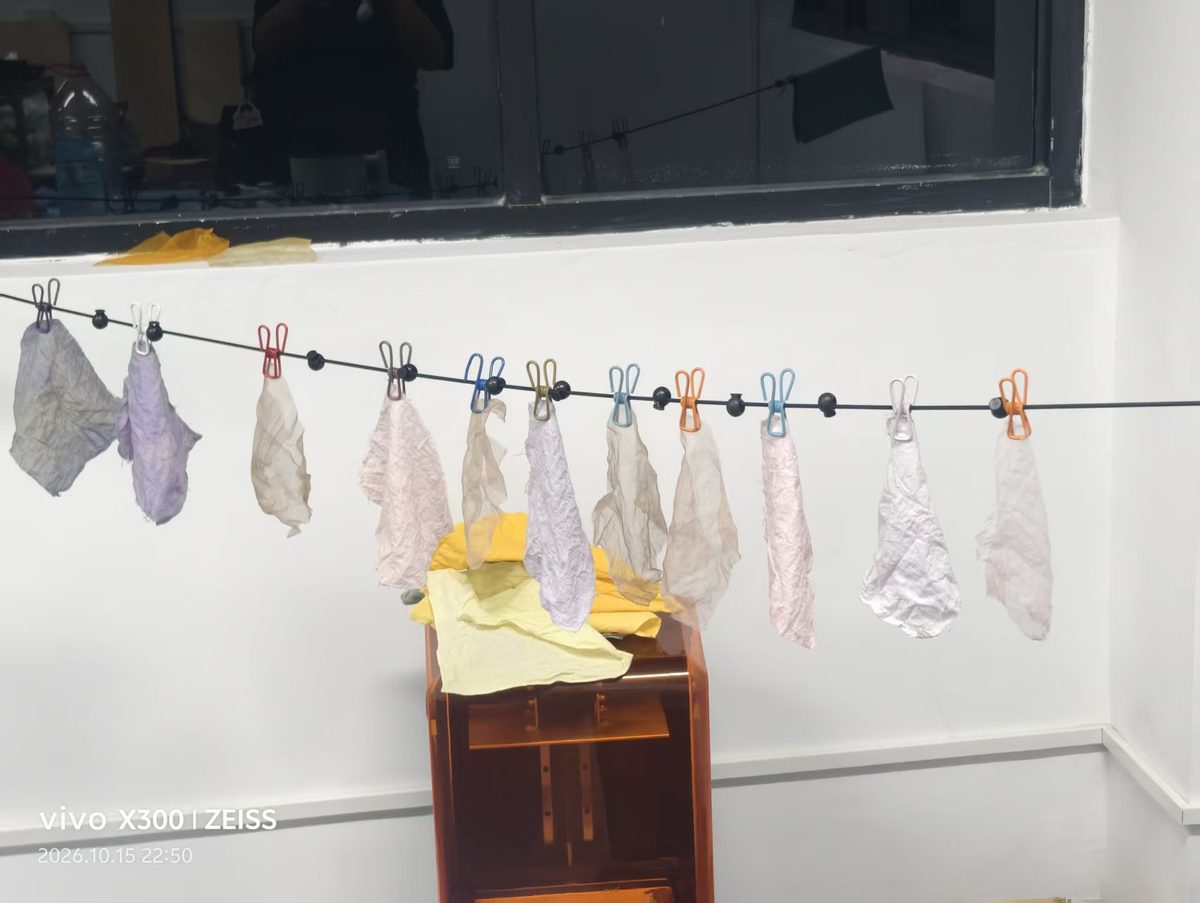
7.4 Procedure¶
- Extract ahead of time. 30 g crushed gromwell in 500 mL of 75 % ethanol, sealed and kept dark for 4–6 hours (overnight is better). Strain before use. The liquor should be a deep purple-red.
- Tannin everything. Unlike turmeric and gardenia, gromwell will barely hold on cellulose without a tannin anchor — so even the control swatch gets the gallnut bath.
- Wring the cloth hard before it goes into the alcohol. Water dragged into the ethanolic bath dilutes the solvent and the dissolved shikonin drops out as sediment — the bath is dead on the spot.
- Dye at room temperature, 30 minutes, covered, stirring every 10–15 min so folded areas don't stay pale. Z1–Z6 all go in together and come out together: they exist to be compared, so their dwell time must be identical.
- Z7 by lifting. Immerse the whole strip, clamp the top to a chopstick across the jar, and lift one third at 10 min, another third at 30 min, all out at 60 min. The result is a continuous gradient rather than three hard-edged bands.
- Rinse in clean water first, then into the pH dips (which are aqueous).
- Shade-dry.
Two hard limits
- No heat, ever — no flame, hot plate, oven or hair dryer near an open ethanolic bath.
- The bath is single-use. Shikonin oxidises to brown within 6–8 hours of extraction. Dye everything in one session and discard.
7.5 Three pitfalls¶
- Wet cloth reads one step darker than it will dry. With gromwell this is expensive, because the instinct is to pull too early. Take the swatch out when the wet colour looks slightly deeper than the target.
- Keep the bath covered. Ethanol evaporates fast; 30 minutes uncovered drops the concentration enough to precipitate the pigment and grey the cloth.
- Do not chase depth with time. Past about 45 minutes the bath is oxidising faster than the cloth is taking up colour. For a deeper shade, dry the swatch and run a second 30-minute dip — shikonin layers; it does not soak in deeper.
8. From dye to pigment: the gromwell lake¶
This section answers the checklist item "produce 1 ink or 1 pigment (recycling the dye bath leftover or creating one from scratch)". A dye dissolves and colours the fibre from solution; a pigment is an insoluble solid that sits on a surface, held there by a binder. The conversion is done by precipitating the soluble colorant onto an inert inorganic carrier — here, aluminium hydroxide — then filtering, drying and grinding it.
8.1 Why a lake, and why gromwell¶
The step from dye to pigment is the third stage of colour this week asks about. Gromwell is the natural candidate on this bench: its pigment is already ethanol-soluble and water-insoluble, which is precisely the behaviour a lake exploits. Adding alum and then raising the pH grows a fluffy aluminium-hydroxide precipitate in the liquor, and the shikonin adsorbs onto it as it forms.
8.2 Experimental design¶
The question is not "does a purple precipitate appear" — it is what produced it: simple dilution with water (which alone can crash the pigment out of ethanol), or the aluminium/alkali system? So the run is a set of controls, not a single recipe.
| Group | 75 % gromwell liquor | Alum sol. | Sodium carbonate sol. | Water | What it isolates |
|---|---|---|---|---|---|
| A — water control | 5 mL | — | — | to 15 mL | precipitation caused by dilution alone |
| B — alum control | 5 mL | 1.3 mL | — | to 15 mL | what alum does without a pH rise |
| C — lake candidate | 5 mL | 1.3 mL | dropwise | to 15 mL | alum and alkali together |
| D — alkali control | 5 mL | — | dropwise | to 15 mL | alkali alone, matched to C's pH |
| E — reagent blank | 5 mL fresh 75 % ethanol | 1.3 mL | same volume as C | to 15 mL | how much precipitate is inorganic |
Every group ends at 15 mL, so the nominal ethanol concentration is 5 × 75 % ÷ 15 = 25 %. Group C is taken to an apparent pH of roughly 6–6.5; group D is matched to the same reading, which is what separates "alkali did it" from "aluminium did it".
E is the group that keeps you honest
A white or pale precipitate appears in E too — that is aluminium hydroxide with no dye on it. Comparing C against E is the only way to know whether the coloured solid is actually carrying pigment or is just inorganic carrier with a stain. More precipitate is not the same as more pigment.
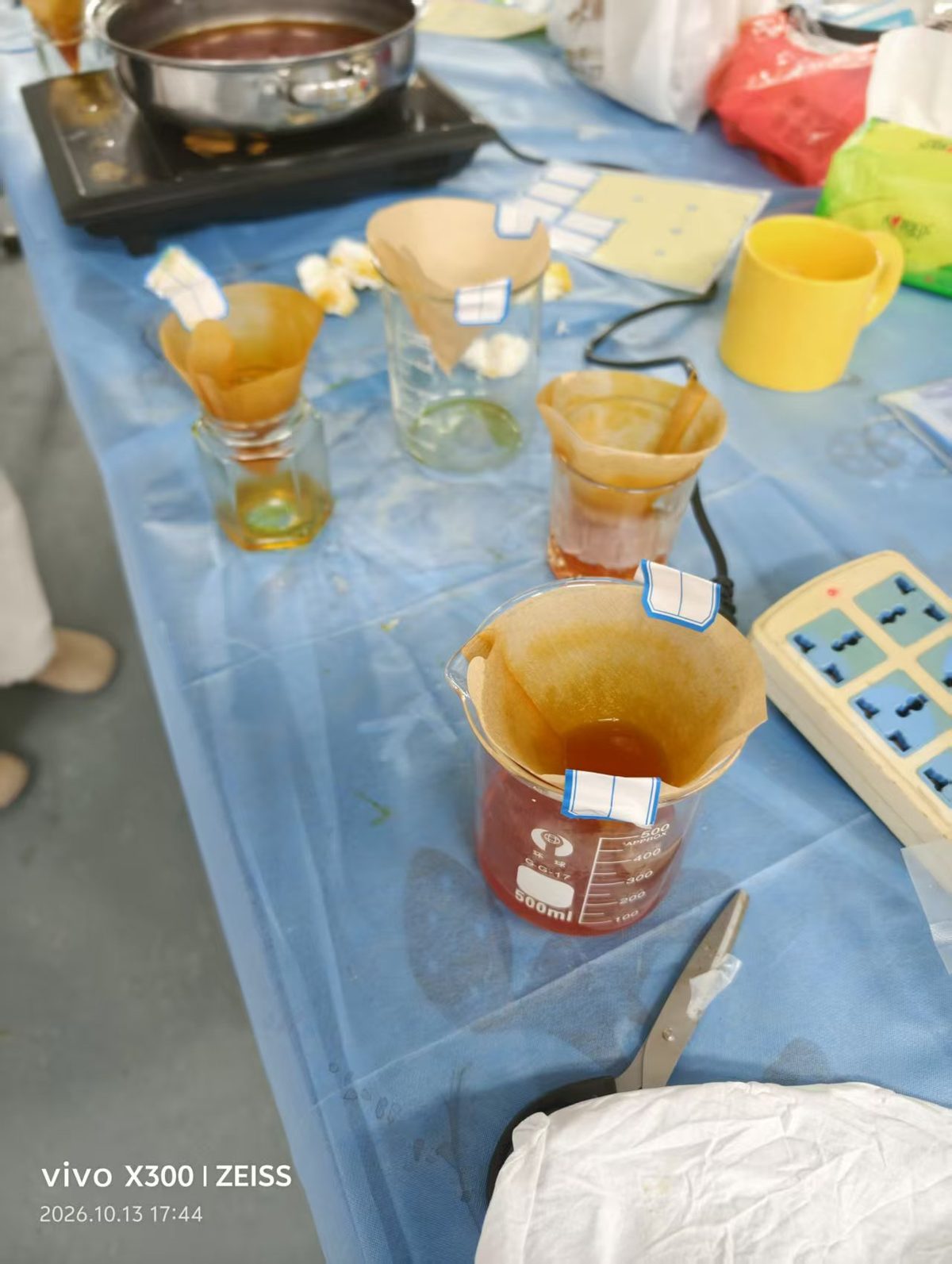
8.3 Solutions and the correction I had to make¶
| Solution | Target | What I actually mixed | Correction |
|---|---|---|---|
| Alum | 2 % w/v (0.4 g / 20 mL) | 3 % w/v (0.6 g / 20 mL) | Take 1.3 mL per group instead of 2 mL → 39 mg alum ≈ the intended 40 mg |
| Sodium carbonate | 1 % w/v anhydrous Na₂CO₃ (0.2 g / 20 mL) | 1 % w/v (0.6 g / 60 mL) | None needed — it is a titrant, dosed to a pH endpoint, not to a volume |
The alum correction matters because the published ratio is close to stoichiometric: precipitating Al³⁺ completely needs Al³⁺ : CO₃²⁻ ≈ 1 : 1.5, and the 2 % / 1 % pair sits right on that. Running alum at 1.5× would have demanded more carbonate, which would have grown more white carrier, which would have diluted the colour of the lake. Restoring the mass rather than the volume keeps the comparison intact.
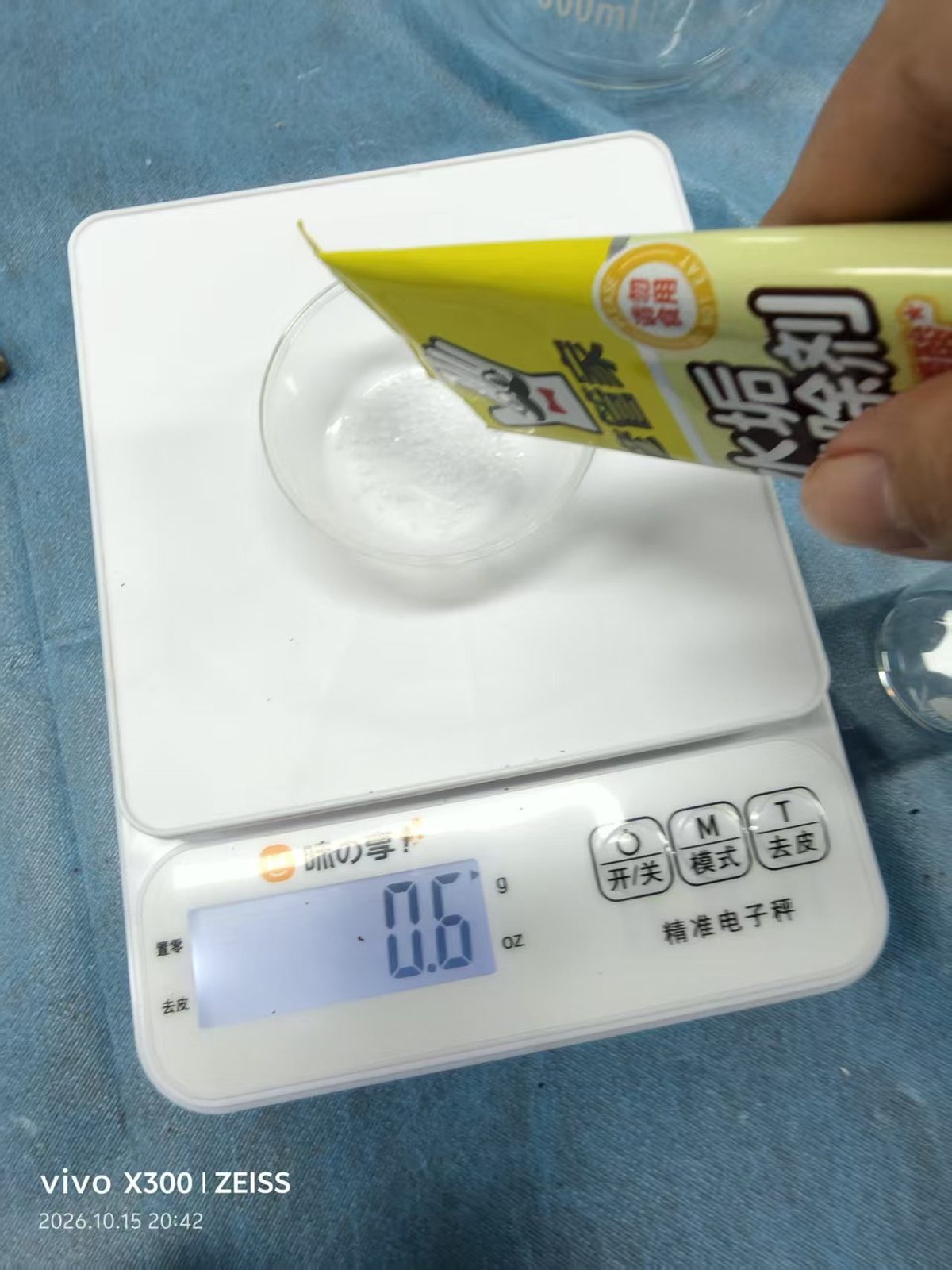
Carbonate, not bicarbonate
The recipe needs anhydrous sodium carbonate (Na₂CO₃), not baking soda (NaHCO₃). Bicarbonate carries roughly half the alkalinity per gram — a 1 % equivalent would need about 15.8 g/L of NaHCO₃ instead of 10 g/L of Na₂CO₃. Check the bag before weighing.
8.4 Procedure¶
- Dilution pre-test — 1 mL of gromwell liquor with 1 / 2 / 3 mL of water, watched for 5–10 min. If the 25 % level already throws a heavy precipitate, run the whole set at 37.5 % instead (same 5 mL of liquor, final volume 10 mL).
- Into each labelled vessel: 5 mL of gromwell liquor + part of the water. Photograph the starting colour.
- Alum into B, C (and E). Stir, wait 3–5 min, record any change.
- Carbonate into C 0.1–0.2 mL at a time, stirring and watching between additions, until the apparent pH reads ~6–6.5. Record the total volume used. Match D to the same reading. Do not keep adding base to chase a colour.
- Make every group up to 15 mL. Stand 30–60 min (overnight is fine). Record sediment height and the colour of the supernatant.
- Filter each group separately, keep both the cake and a little filtrate. Wash the cake with small portions of distilled water and note whether the colour runs.
- Dry the cakes in a ventilated, flame-free spot, then bind them into paint (§ 8.4.1).
8.4.1 From dry cake to paint¶
The powder is not a pigment until something holds it on the paper. Two failure modes bracket the target: too little binder and it dusts off; too much and the film goes glossy and cracks.
| Gum arabic : warm water | 1 : 2 (e.g. 5 g + 10 mL), soaked overnight, strained through muslin, one drop of clove oil as preservative |
| Alternative — peach gum 桃胶 | soaked, simmered to a syrup, thinned to roughly the same flow. It comes from the same herbal shop as the dyes, and it is the traditional binder for Chinese mineral pigments |
| Powder : binder on the slab | 1 : 1 to 1 : 2 — start low, it is easier to add than to take away |
- Grind the cake grit-free. The test is tactile: rub a pinch between finger and paper and there should be no sand.
- Only grind a quarter of it. Yield is small and the rest keeps better dry.
- Mull on glass — a slab, a tile, or the back of a glazed dish — in circles for 2–3 minutes, until the paste draws a continuous streak. A drop of water if it drags; aim for the flow of ink, not paste.
- One small drop of honey or glycerine slows the film's cracking.
- Paint out in three dilutions and let them dry, then read them:
| Symptom | Verdict | Fix |
|---|---|---|
| Rubs off as powder | too little binder | back to the slab, more binder |
| Glossy, cracked, flaking | too much binder | dilute with water, re-mull |
| Even, no rub-off, no gloss | correct | pot and label it |
The binder moves the hue too. Gum arabic is mildly acidic (pH ≈ 4.5) and shikonin is the most pH-sensitive pigment in this whole week, so simply binding it pulls the colour toward red. Three strokes side by side make that visible — plain gum (crimson), gum with a trace of baking soda (violet), gum with a drop of citric acid (redder still). It is the same lever that ran through the dyeing, now working inside the paint.
Pot it small, labelled shikonin lake · gum arabic · date · batch. Watercolour binder grows mould, so mix only what you will use.
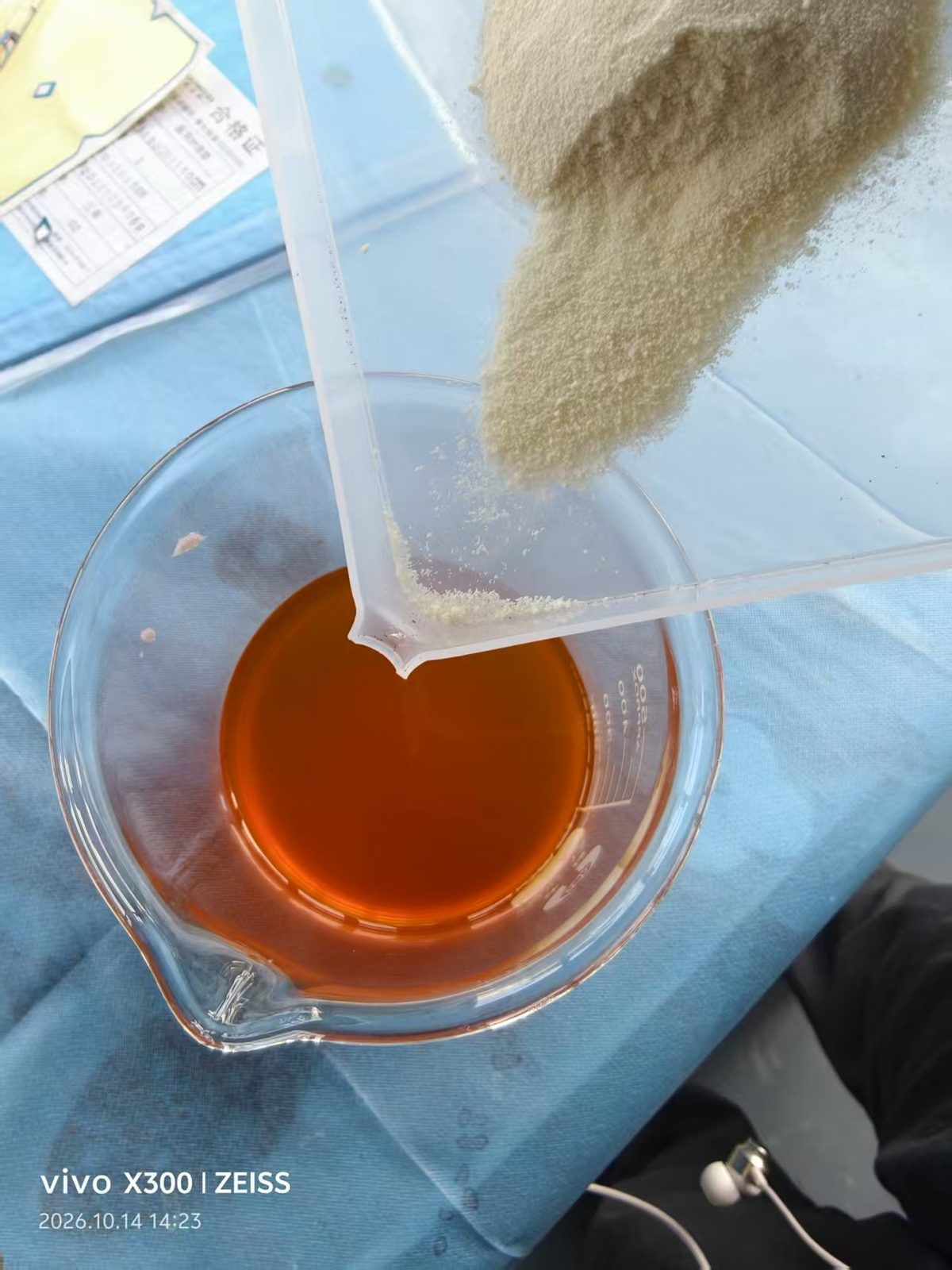
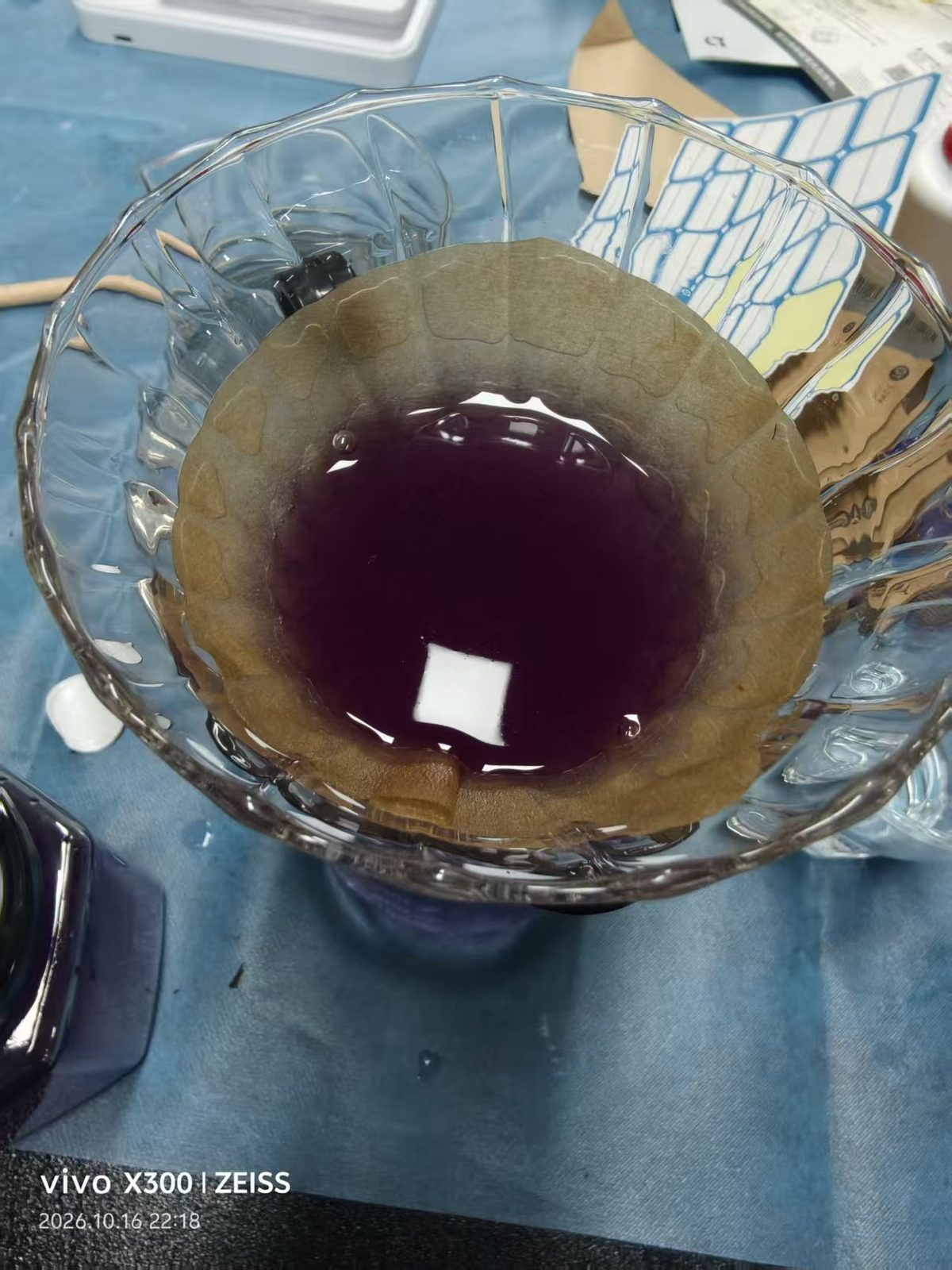
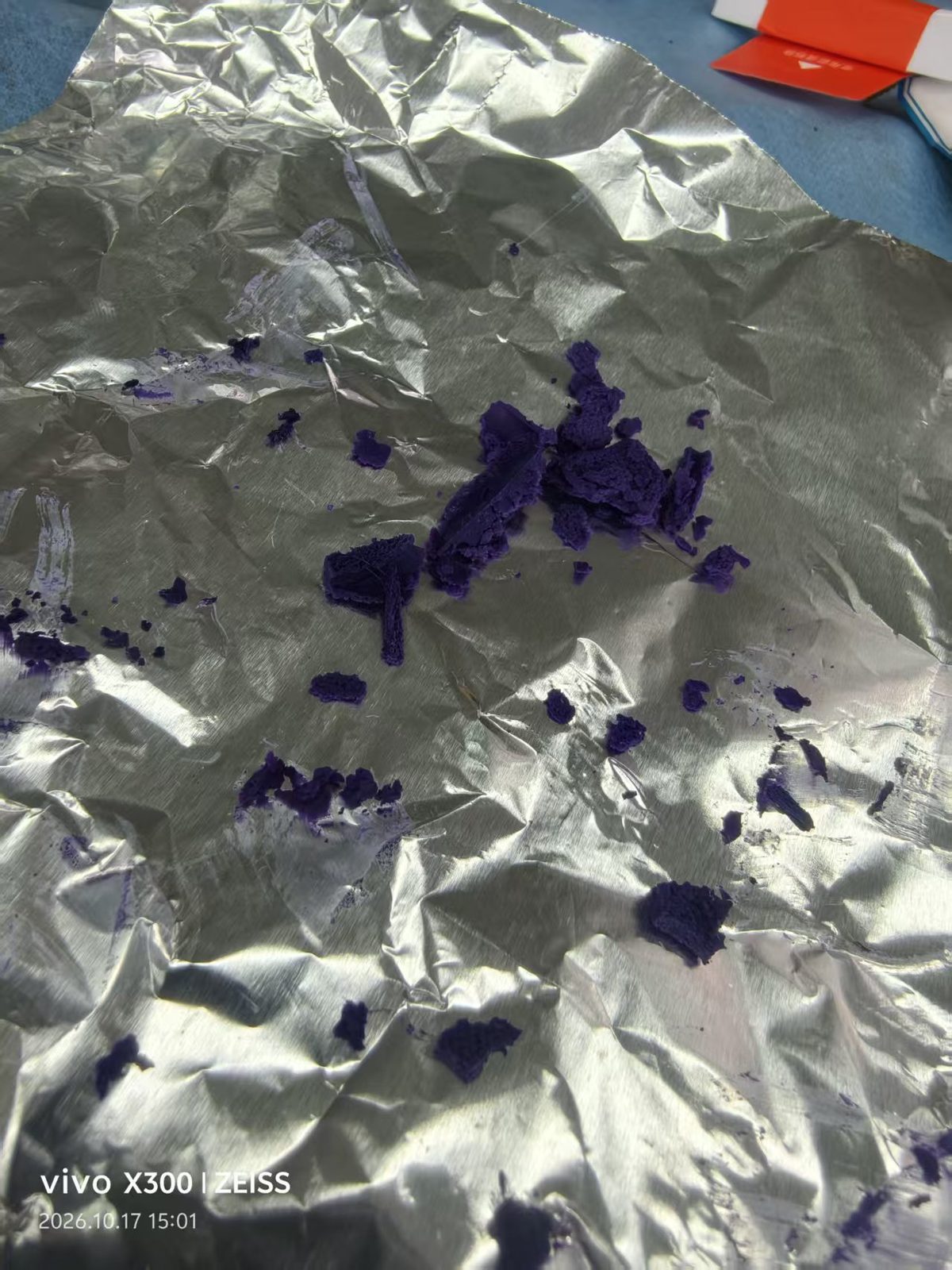
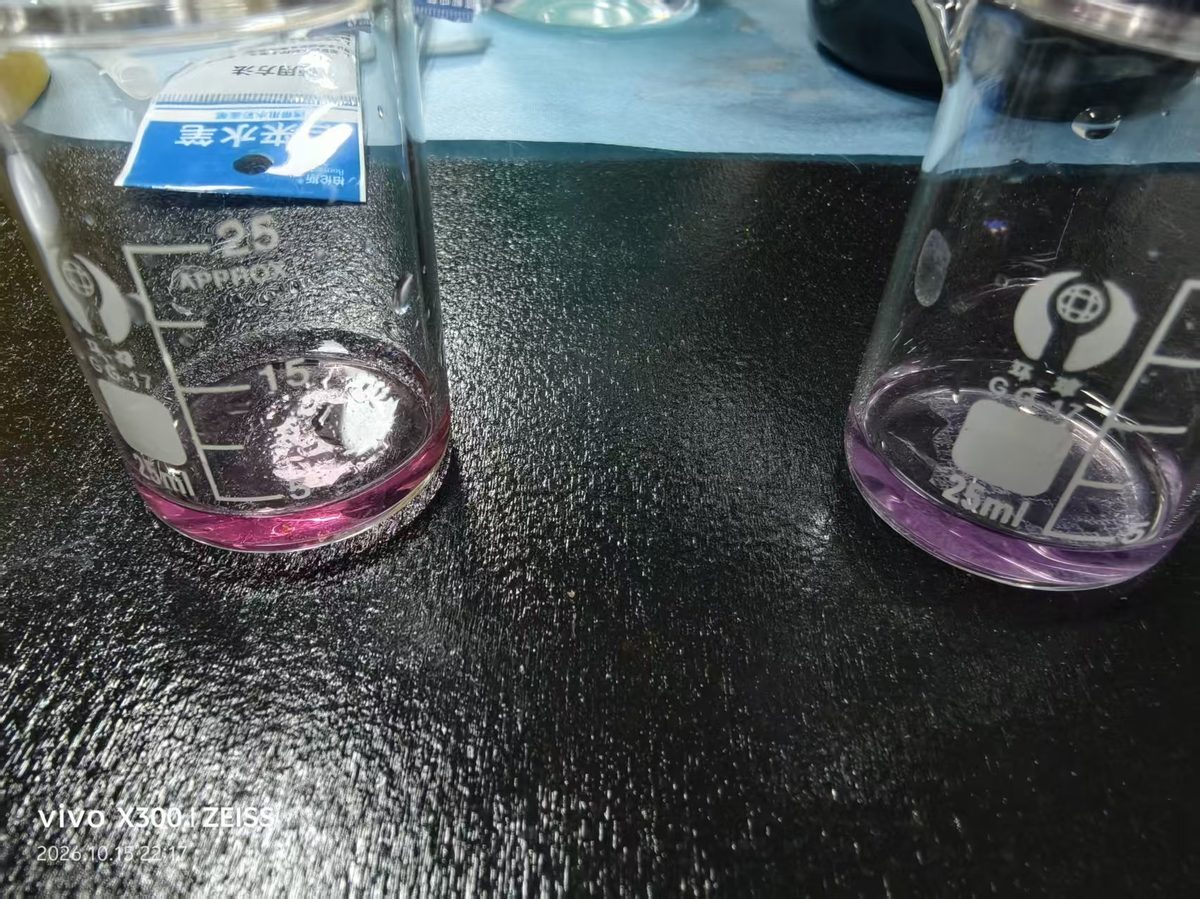
The lake in three moves: sodium carbonate added dropwise to the gromwell liquor, watching the colour turn as the pH rises; the purple solid caught on filter paper; and the dried cake, crumbled on foil — the week's pigment, no longer a dye.
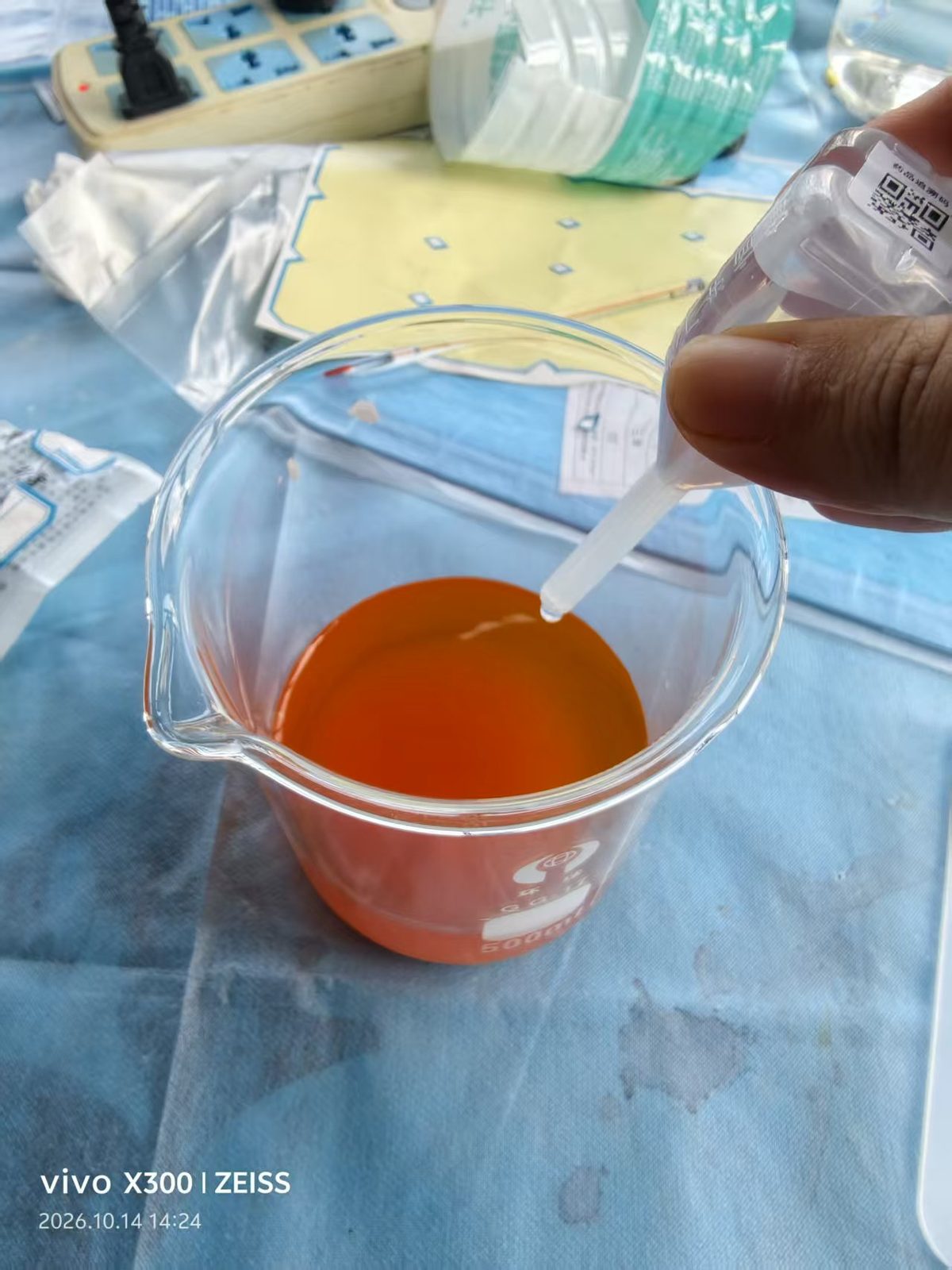
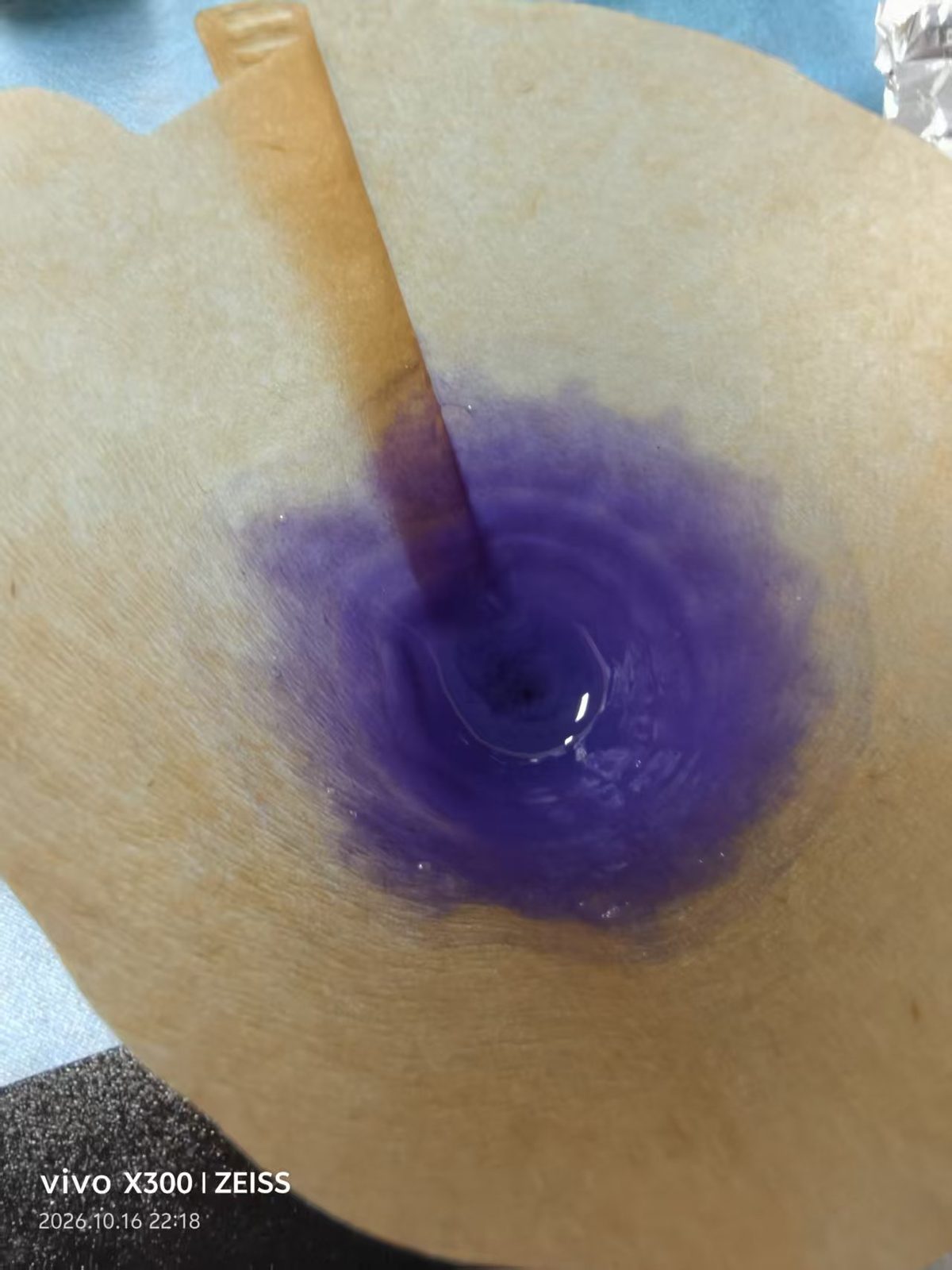
Left: the carbonate going in 0.1–0.2 mL at a time from a pipette — each addition is stirred and watched before the next, and the total volume is written down because group D will need to be matched to it. Right: the pigment settling into the filter paper in a violet stain; this is the moment the dye visibly stops being a solution and becomes a solid.
8.5 Reading the result¶
| Observation | Most likely reading |
|---|---|
| A already throws a lot of purple sediment | Mostly dilution-driven precipitation of the pigment, not a lake |
| D changes colour and drops solids | pH alone moves shikonin |
| C holds more stable coloured sediment than A and D | Supports aluminium + alkali involvement in carrying the colour |
| C's solid stays coloured after washing and paints out evenly with gum | A genuine pigment candidate |
| C and E both give lots of pale solid | Much of the precipitate is inorganic carrier — check how much colour it actually holds |
8.6 Scaling note¶
With 350 mL of gromwell liquor on hand, the 5 mL group scales by ×70: about 93 mL of 3 % alum solution and a final volume near 1.05 L. That is a lot of solvent to handle and a lot of gelatinous hydroxide to filter. The recommendation — followed here — is to run one 15 mL set first, confirm that C gives a wash-fast coloured cake, and only then scale, in batches of about 70 mL of liquor each.
Ethanol at scale
1 L of this mixture carries roughly 260 mL of ethanol. Ventilation, no ignition sources, and the ethanolic filtrate collected as chemical waste rather than poured down the sink.
9. Results¶
9.1 The palette¶
Photo pending
The full palette shot — every swatch from the three plants in one frame, daylight, neutral background — will be added once the pieces are pressed and arranged.
9.2 Comparison across modifiers¶
| 药材 / Herb | No mordant | Alum 明矾 | Ferrous 皂矾 | Acid | Base |
|---|---|---|---|---|---|
| 姜黄 Turmeric | — | ||||
| 栀子 Gardenia | — | — | |||
| 紫草 Gromwell | (tannin only) | ||||
to be completed from the dried swatches
9.3 pH shift notes¶
| Herb | Citric acid | Water | Baking soda | Soda ash |
|---|---|---|---|---|
| 姜黄 Turmeric | ||||
| 紫草 Gromwell | ||||
to be completed from the dried swatches
9.4 What actually happened vs. what was planned¶
The checklist asks for changes and unexpected discoveries, so here they are undisguised:
- Turmeric went in-bath, not stepwise. The design called for scour → tannin → alum → dye as separate baths. In practice the 0.5 L of gallnut liquor was poured straight into the 1.5 L of turmeric liquor with 20 g of alum, making one 2 L bath at 10 g/L alum. This is in-bath mordanting — a legitimate method, but a different one from the plan, and it means S1 and S2 are less cleanly separated than intended. Recorded as run.
- Alum at 10 g/L behaved well. The worry was over-mordanting; 10 g/L sits inside the normal 5–15 g/L range for cotton, and with tannin present the aluminium is used efficiently. The check is tactile: if the rinsed cloth still feels soft, it is fine.
- Gardenia lost its pH axis on purpose. With 8 g of fruit, pH was dropped in favour of the mordant comparison, because crocin barely responds to pH. The bath-exhaustion order (N2 → N3 → N1) was then used as a bonus variable instead.
- Roasted vs. raw gardenia matters more than expected. 炒栀子 loses enough crocin to shift the hue a full step — worth knowing before buying.
- Gromwell refuses water. Confirmed on the bench: this is the one plant where the solvent, not the mordant, is the first decision.
- Wet-vs-dry cost one swatch. A piece pulled when the wet colour looked correct dried a clear step lighter.
10. Physical output¶
10.1 The 20 × 20 cm swatch catalogue¶
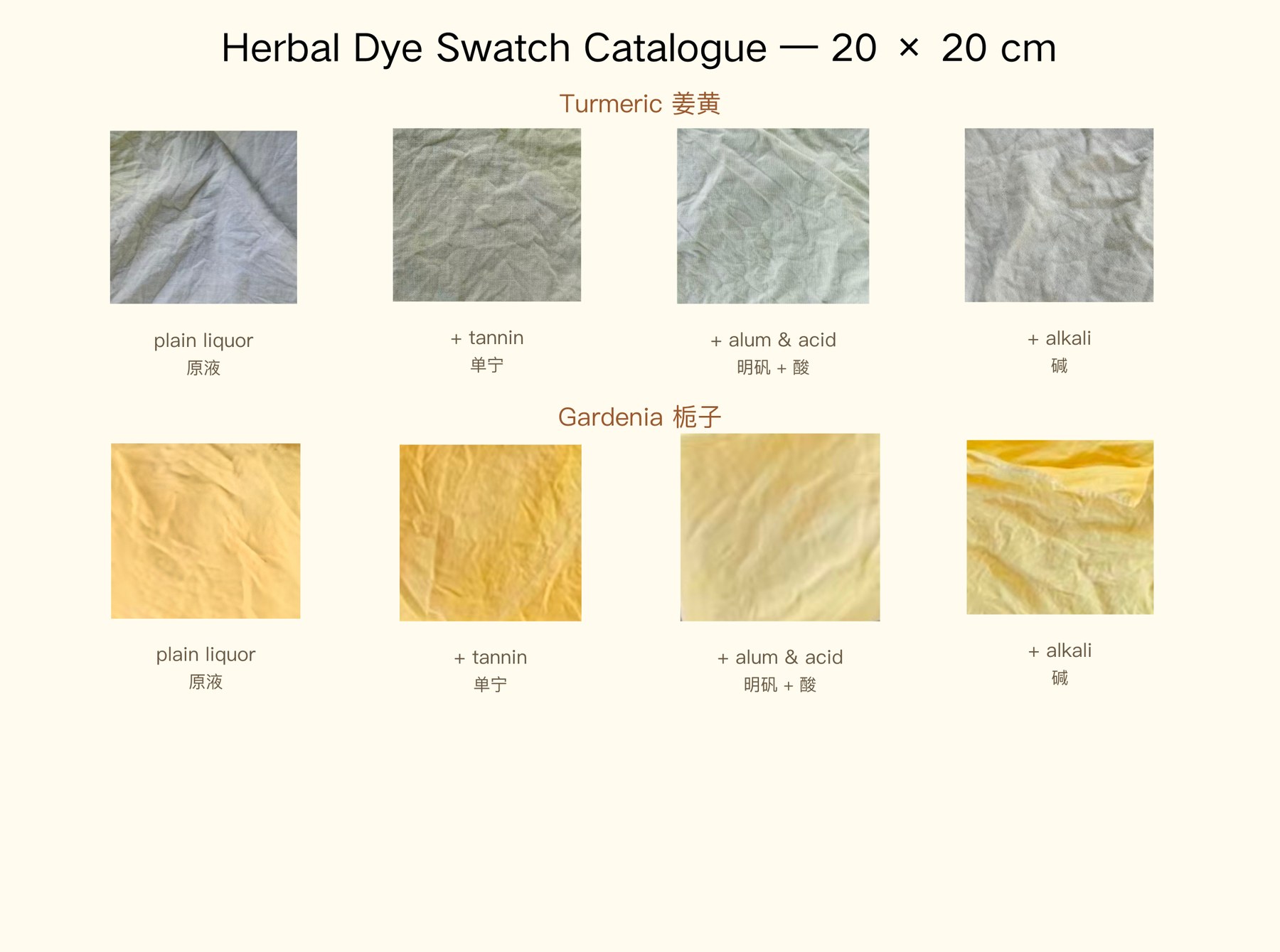
The checklist item reads "submit some of your swatches or a catalogue of them to the analog material library of your lab (20cm x 20cm approx)". The swatches themselves were dyed at 15 × 15 cm (10 × 10 cm for the gardenia mini-run), so rather than hand in loose pieces I built one 20 × 20 cm catalogue sheet: a cotton backing cloth carrying a small coupon cut from every dyed sample — 14 coupons in three rows, one row per plant. The full-size pieces stay in the studio; the library gets the readable index.
| Row | Contents (left → right) |
|---|---|
| Turmeric 姜黄 | plain liquor · + tannin · + alum & acid · + alkali |
| Gardenia 栀子 | + alum · + citric acid · + baking soda · + soda ash |
| Gromwell 紫草 | soda ash · tannin · tannin + alum · + acid · + alkali · + baking soda |
Each coupon is sewn down at the corners with cotton thread and labelled on the backing cloth underneath in archival pen — plant, treatment, and mordant. Sewing rather than gluing matters here: this sheet is meant to be handled by other students.
10.2 Files¶
- Recipe cards — turmeric, gardenia, gromwell, one A4 page, quantities as run — download
- Gromwell lake pigment protocol — the A–E screen, the alum correction, and binding the powder into paint — download
- 20 × 20 cm swatch catalogue template (print at 100 %, includes a 50 mm calibration bar) — download
11. Weekly reflection & critical thinking¶
- What surprised me most was that the three plants needed three completely different control strategies. Turmeric is steered with pH, gardenia with concentration, gromwell with the solvent. An "herbal dye protocol" that treats them the same way would have failed on two out of three.
- The hardest to control was gromwell — not because the chemistry is hard, but because ethanol removes every habit a kitchen dyer has: no heating to speed things up, no leaving the bath overnight, no second use.
- The pigment step changed how I see the dye. Once the shikonin is precipitated onto a carrier and ground, it stops being something that happens to cloth and becomes a material I can control — spread, opacity, which surface it sits on. That is a different kind of colour from the dyed swatch, and this week is where the difference became concrete.
- On sourcing: all three plants are farmed medicinal crops sold by weight at any Chinese pharmacy, and the amounts used here (tens of grams) are trivial against their medical supply. The solvent is the real footprint — ethanol, used once and discarded, plus an aluminium salt that ends up in the waste stream. An honest version of this practice would recover the ethanol and keep the mordant baths small.
- Next: the palette wants a red. 苏木 (sappanwood) and 茜草 (madder) are both on the shortlist, and both are mordant dyes, which would complete the set of failure modes — direct (turmeric, gardenia), solvent-dependent (gromwell), and mordant-dependent (sappanwood).
12. Recipe files & References¶
-
Reference: LOAE Fashion Workshop, 服设作品集|中药染小教程|过程记录, 小红书, 2026. link ↩
-
Reference: Nanjing University of Chinese Medicine, 图鉴 | "好色"本草染, 2020. link ↩
-
Reference: Fabricademy Handbook, Assessment Criteria — 4. BioChromes. link ↩
-
Recipe: gromwell lake-pigment protocol (alum / carbonate precipitation) — download ↩