Process
Ideation and Sketches
Design & Fabrication
Prototypes
Mentoring Notes
Ideation & sketches
My Drawings
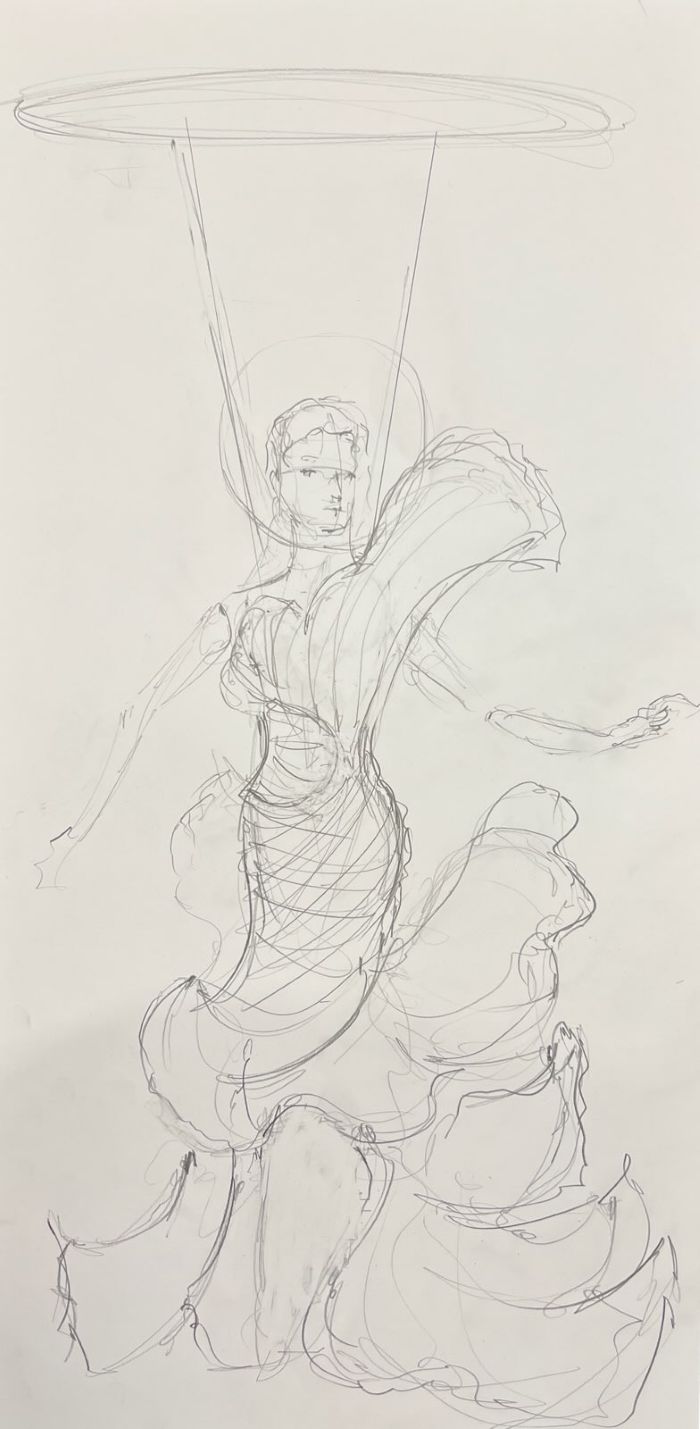
A sketch from my original idea to have mobiles suspended from figures
Calder Inspired Mobiles
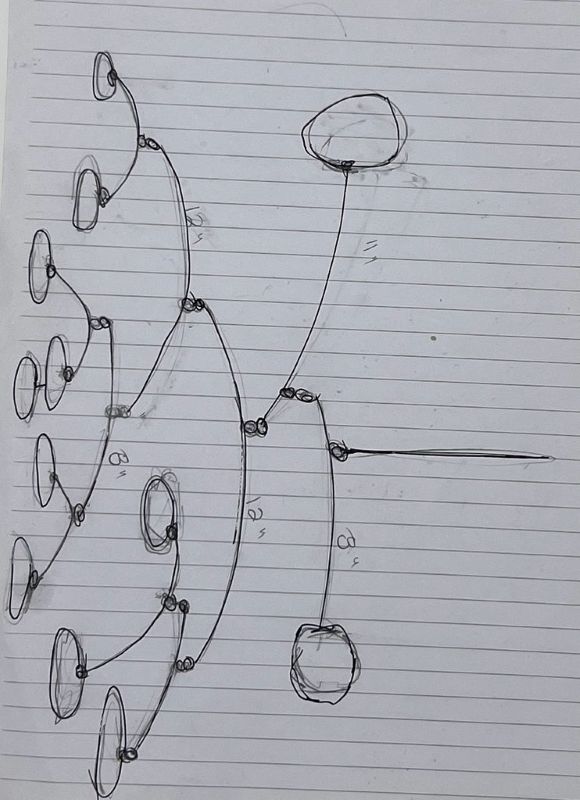
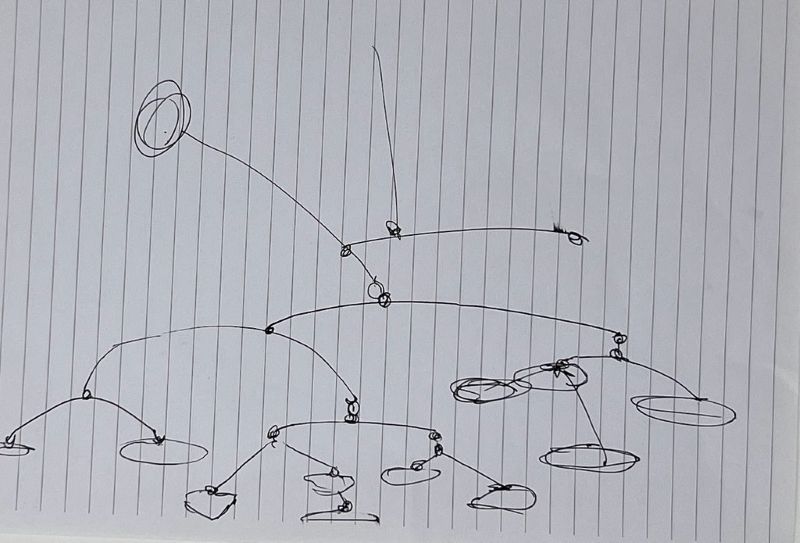
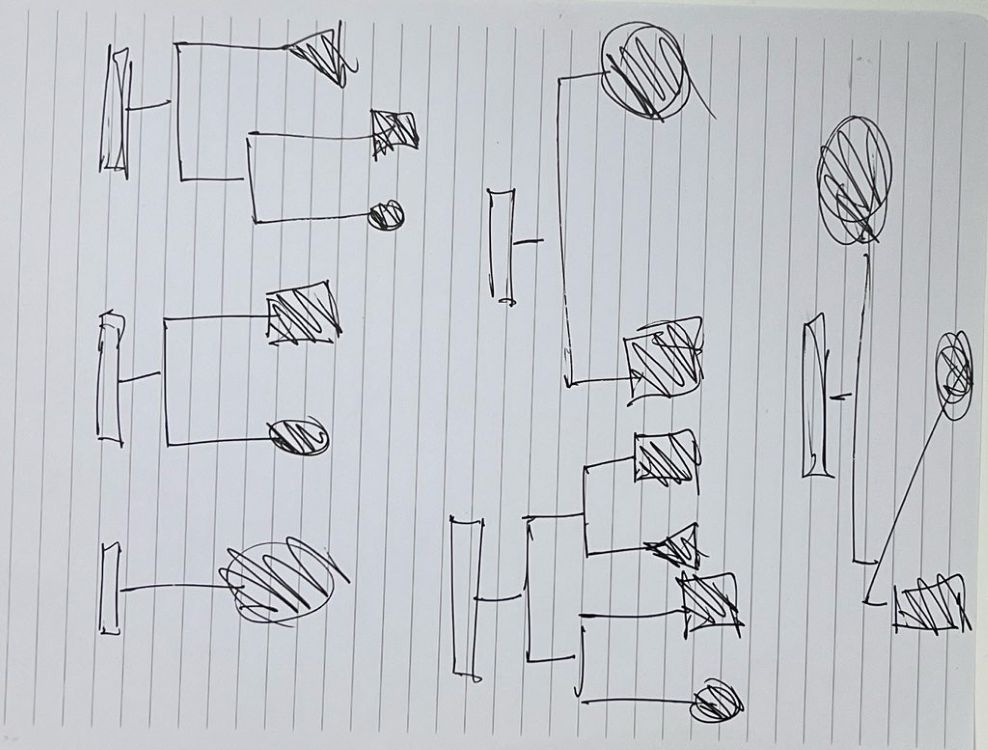
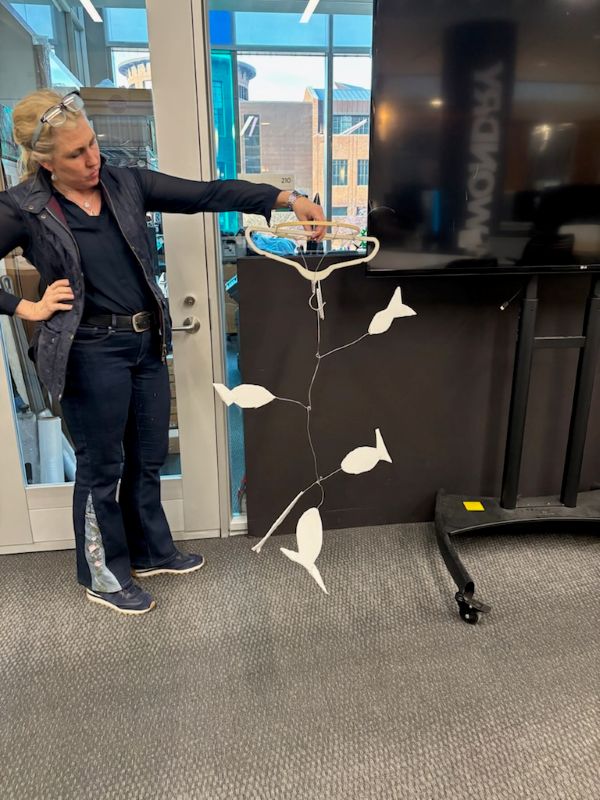
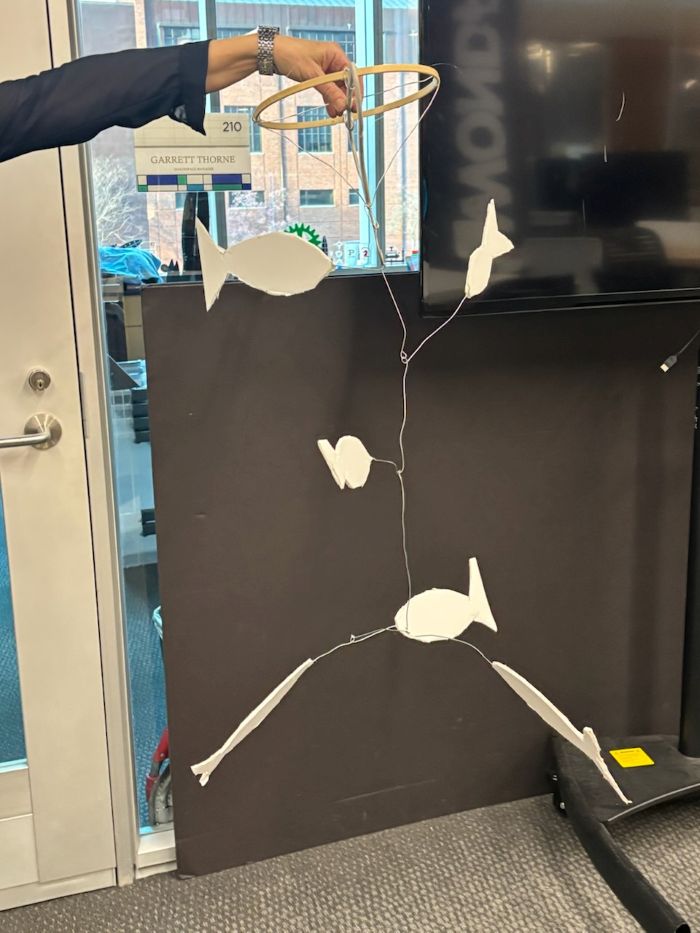
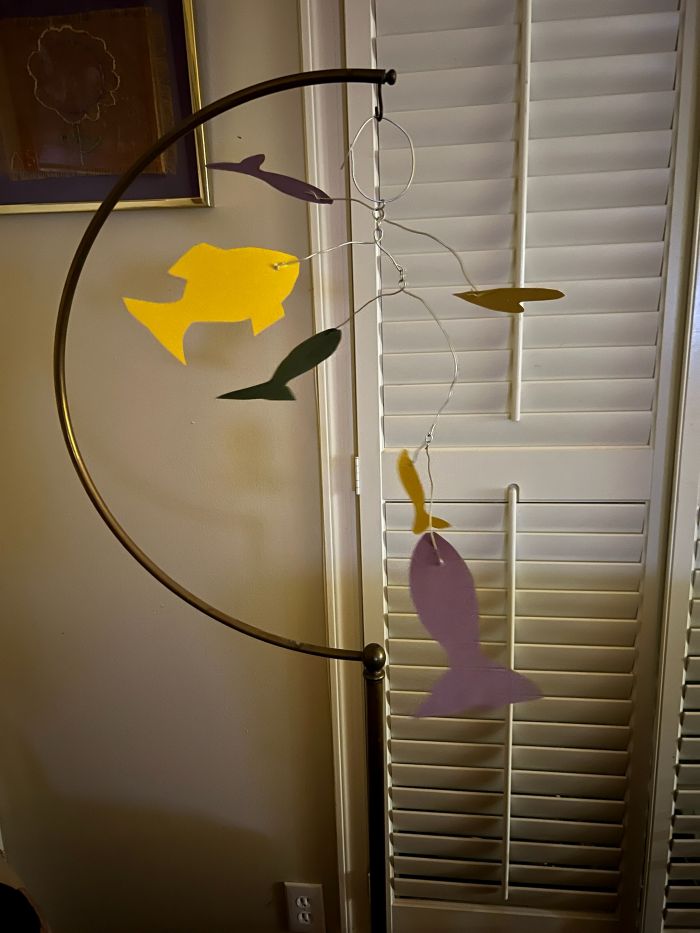
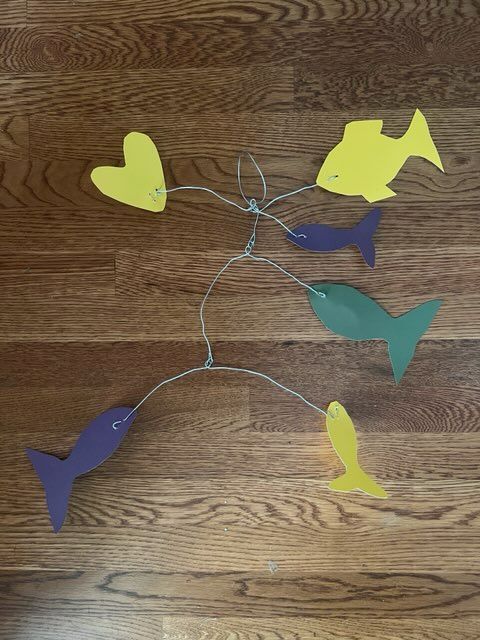
I tried to make Calder inspired mobiles. It was quite difficult and I was marginally successful. Below are drawings I did to try to understand some various apporaches to how mobiles are made.
 |
 |
 |
Photographs of mobiles I've tried to make. I have struggled to figure out how Alexander Calder made his mobiles so elegant and amazing.
 |
 |
 |
||
 |
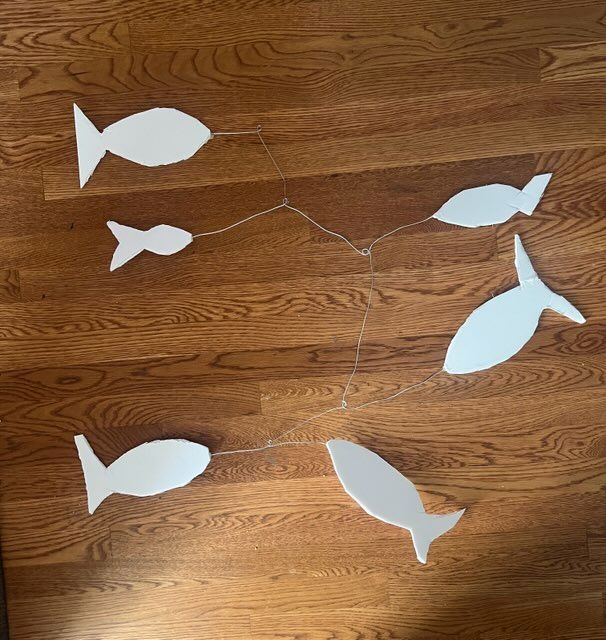 |
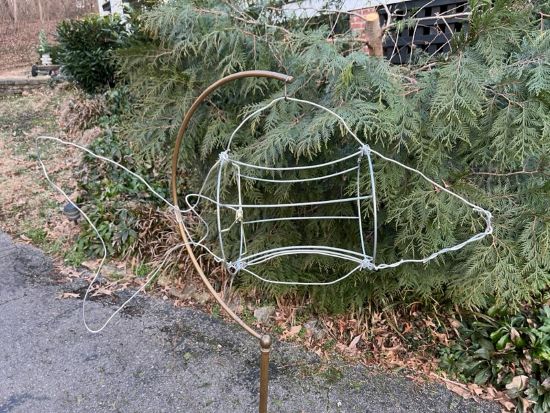 |
My Observations of Inspirational Mobiles
Look up and one starts to notice a lot of interesting hanging art pieces and lighting that are and act as inspiration for mobiles.
The mobile below is at the Nashville Airport, titled ThE UNSCALABLE RAMPART OF TIME, 2022, is described here, as "Composed of 9,000 washi paper and bamboo kites, "The Unscalable Rampart of Time" is Jacob Hashimoto’s largest and most ambitious permanent sculpture to date. The form undulates around the oculus and lunges down into the atrium below, cascading past the escalator and mezzanine. As a whole, the composition evokes the regional landscape’s hills and waterways below and Nashville’s open skies above. The kites contain references to local iconography, architecture, and natural elements, including The Ryman Theater, The Korean Veterans Memorial Bridge, Cumberland Park, dogwoods, milkweed, and irises. With such visible placement in the terminal, passengers can experience the piece at a variety of speeds and scales: driving up to drop a loved one off at Departures, or waiting with a coffee beneath the gently swaying kites."
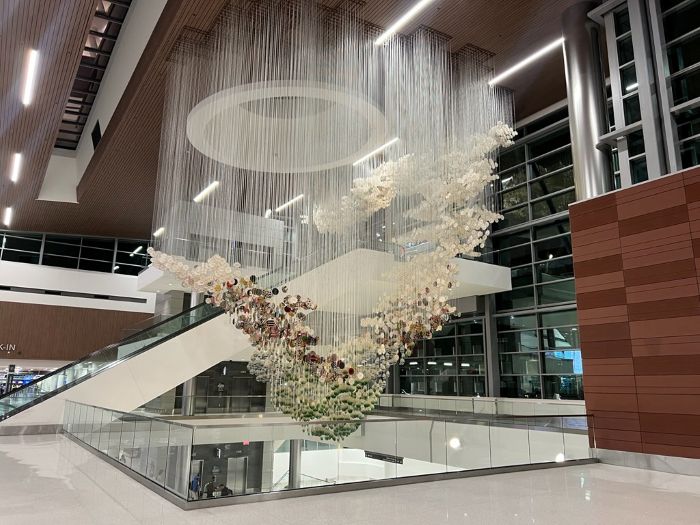 |
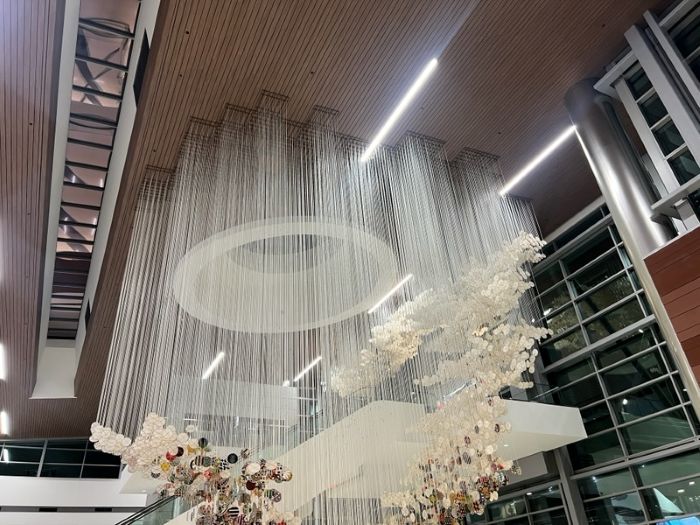 |
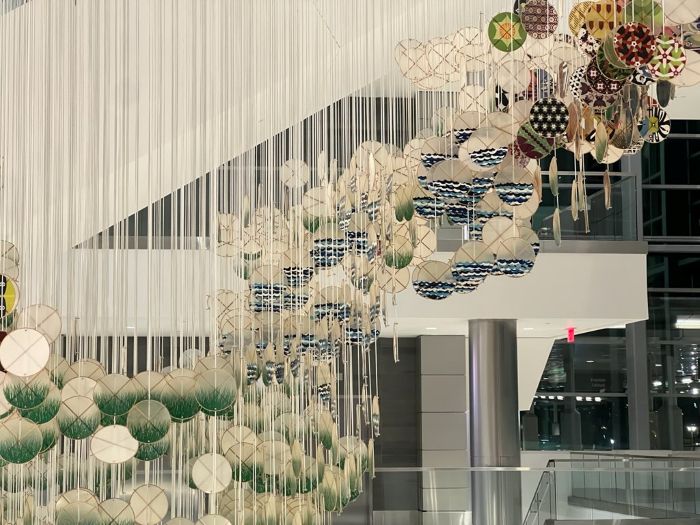 |
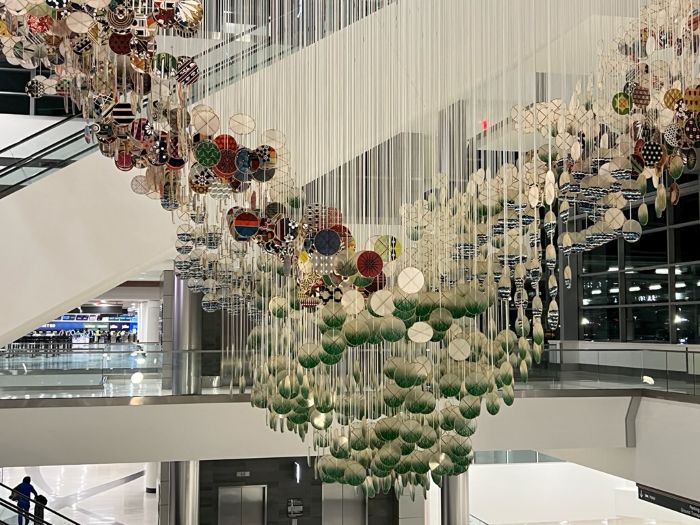 |
The mobile below made from upcycled denim circles in a circular pattern is at the Anthropologie store in Green Hills, TN.
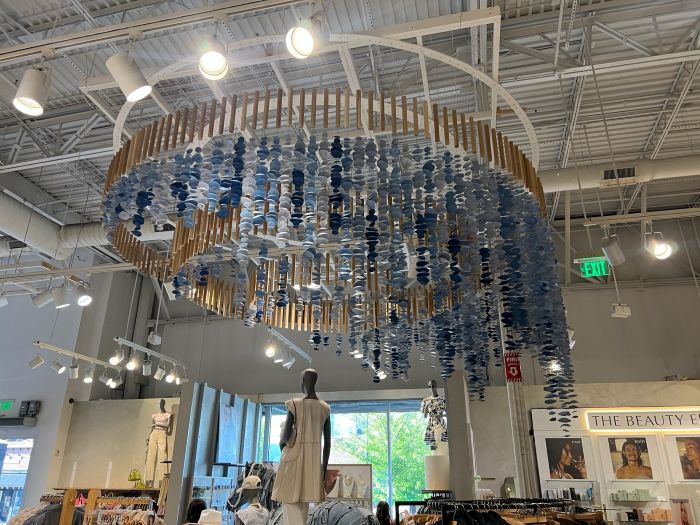 |
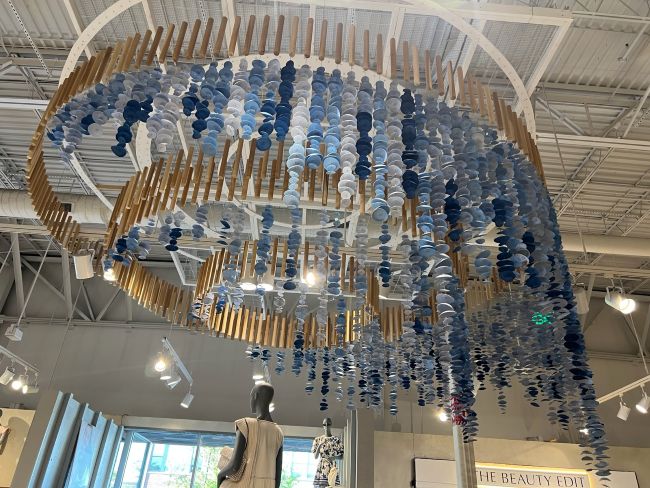 |
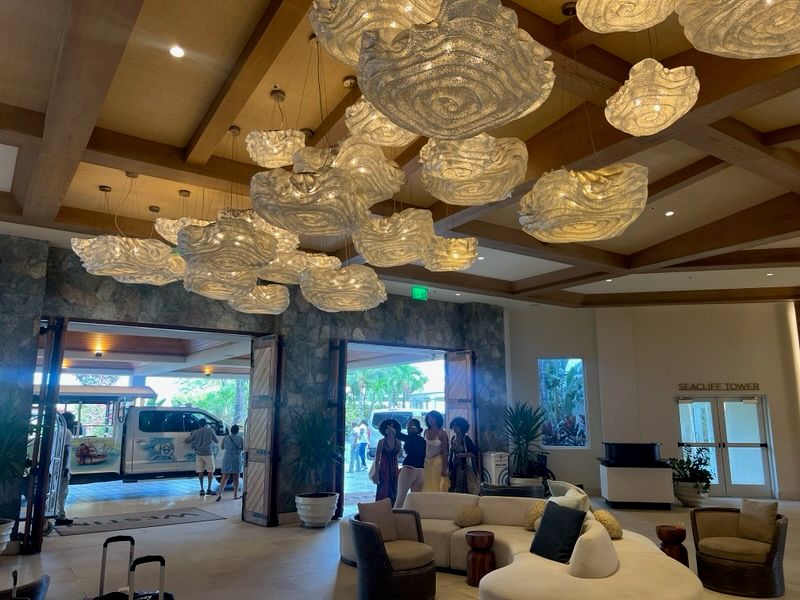
The lighting effect below is in the lobby at the Westin Hotel in St. Thomas, US Islands. I love the organic nature of these mobile-like light fixtures.
 |
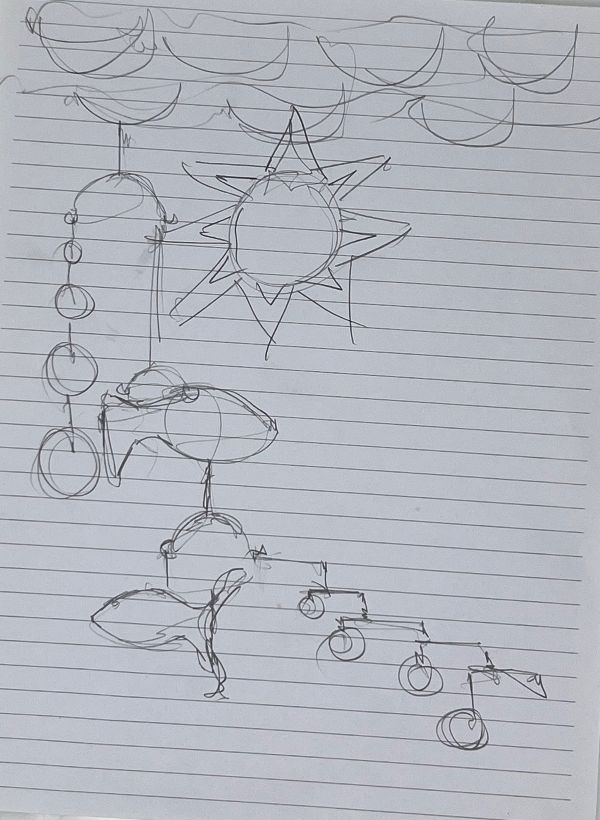
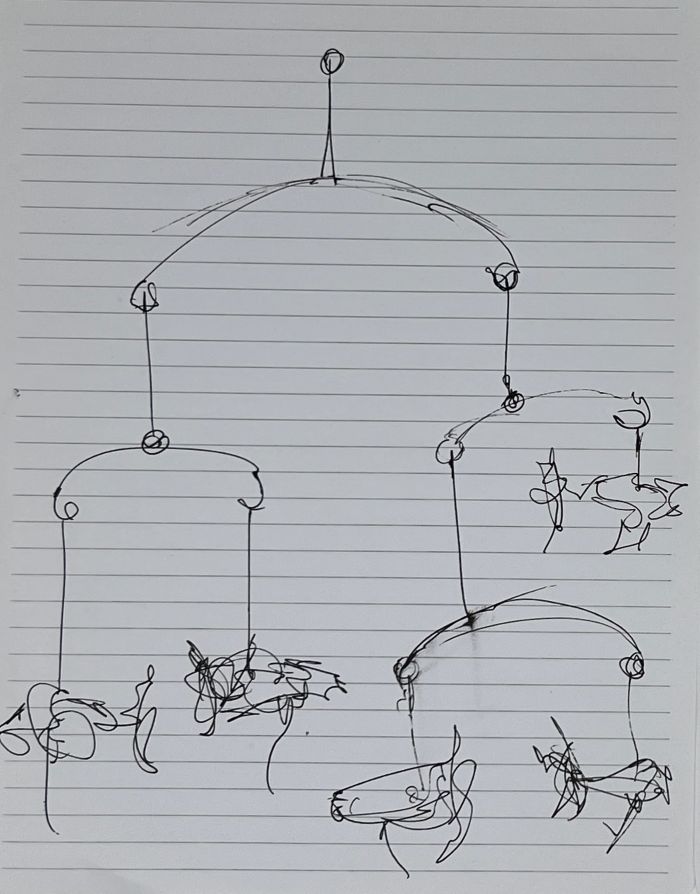
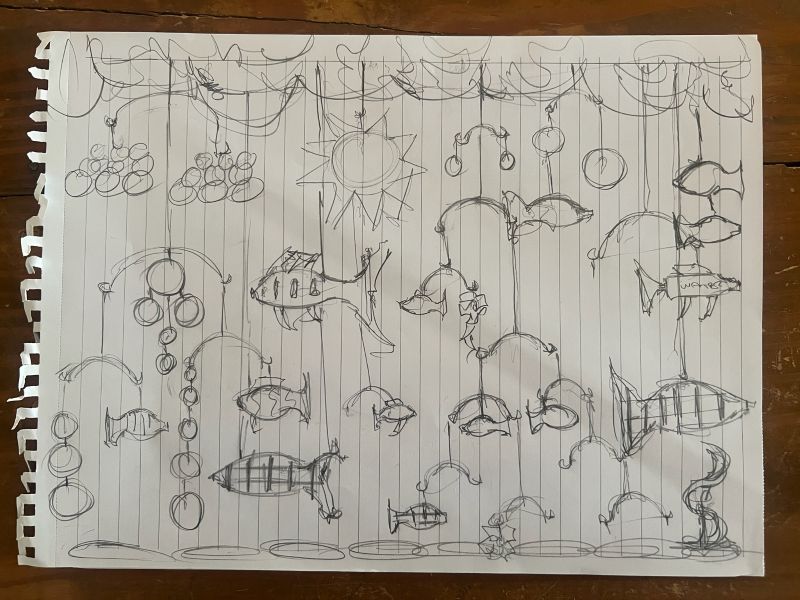
Early Sketches for Mobiles with Ecosystem Elements
 |
 |
 |
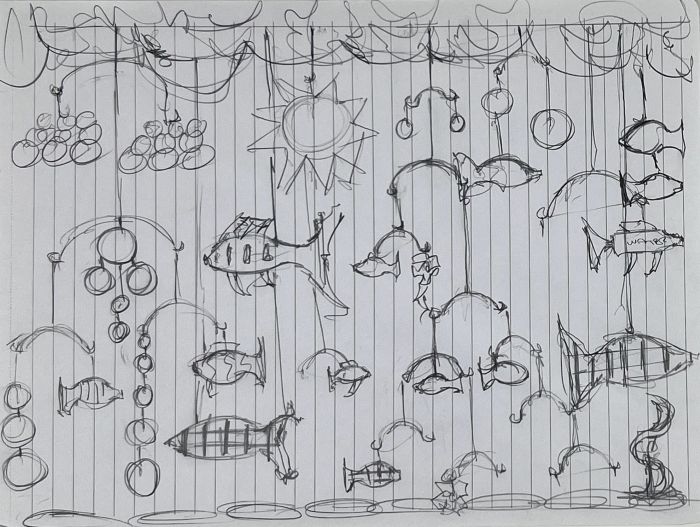 |
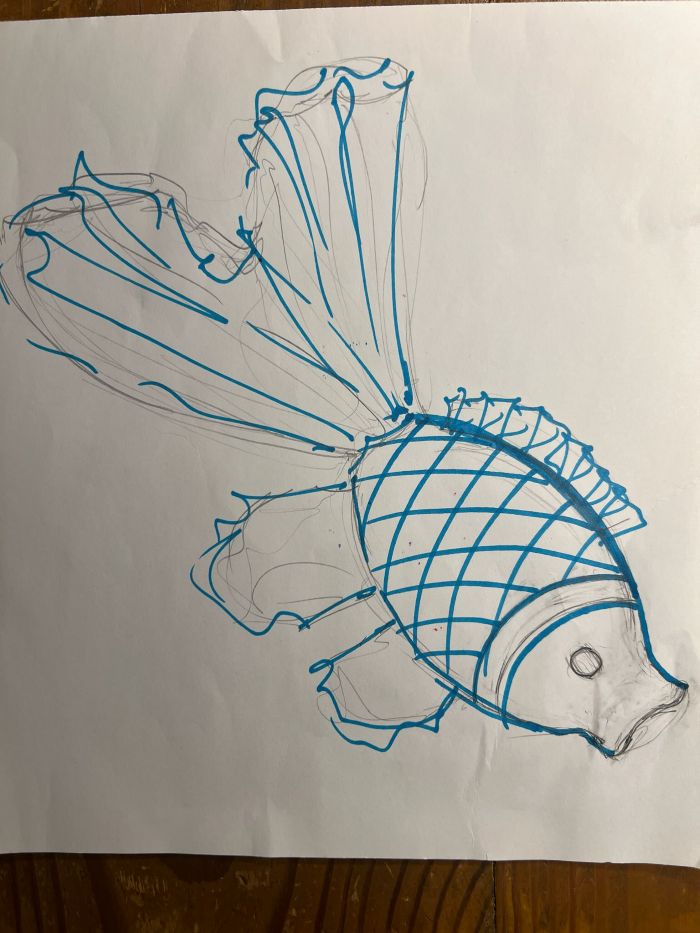
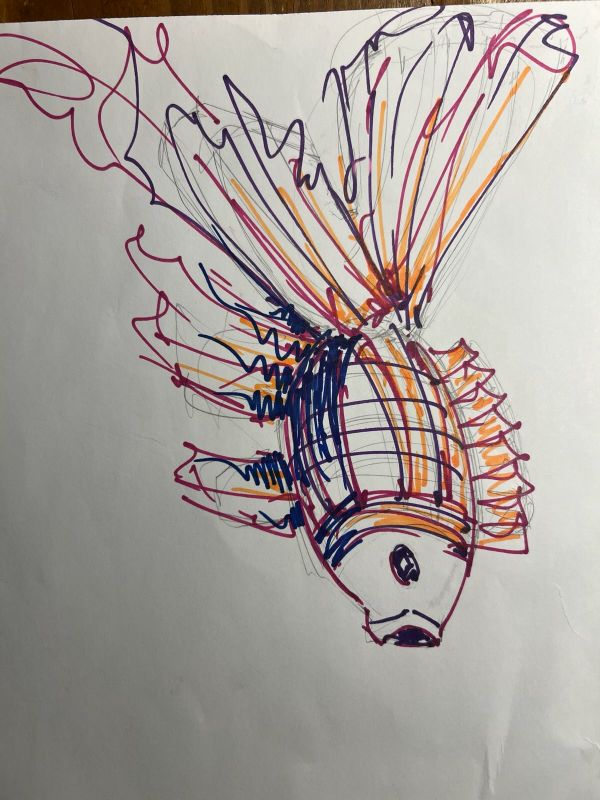
Ideas for Ways for Students to Conceptualize and Make Denim Fish
The drawings below are ideas around teaching quilting using fabric pieces including used denim, then cutting those into fish for the mobiles.
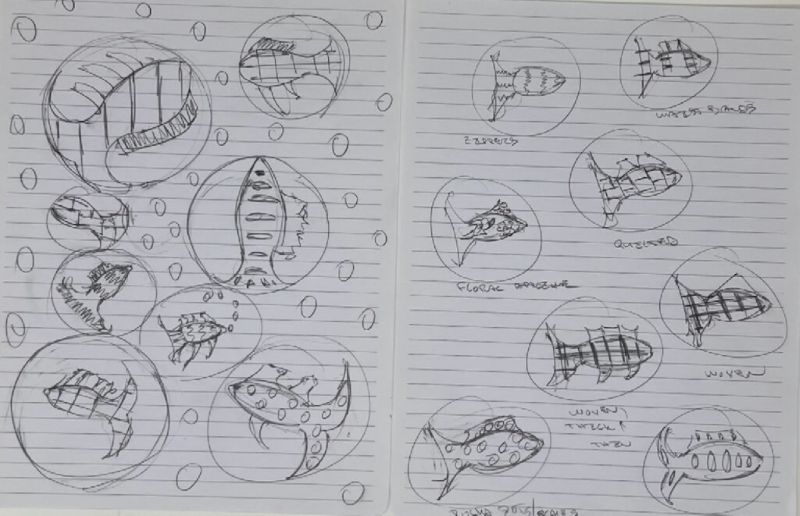
My fish sketches
 |
 |
Making Fish Experimentaing with Bio Resin
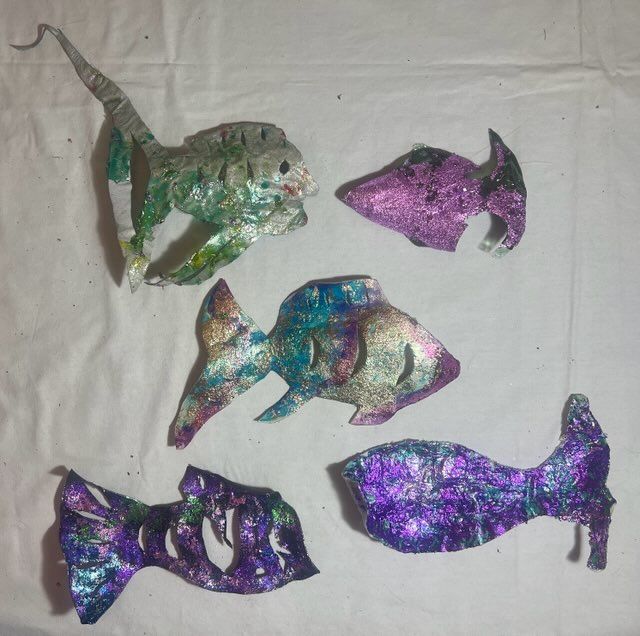
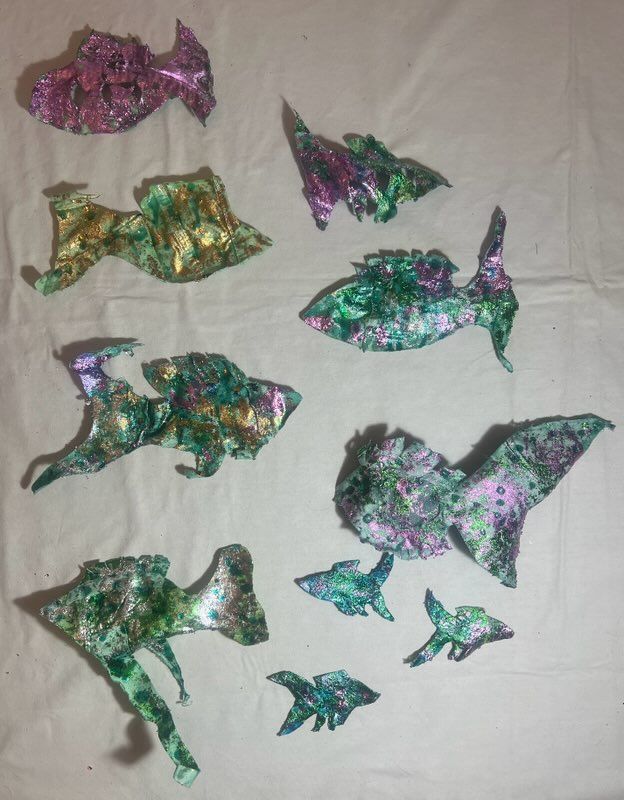
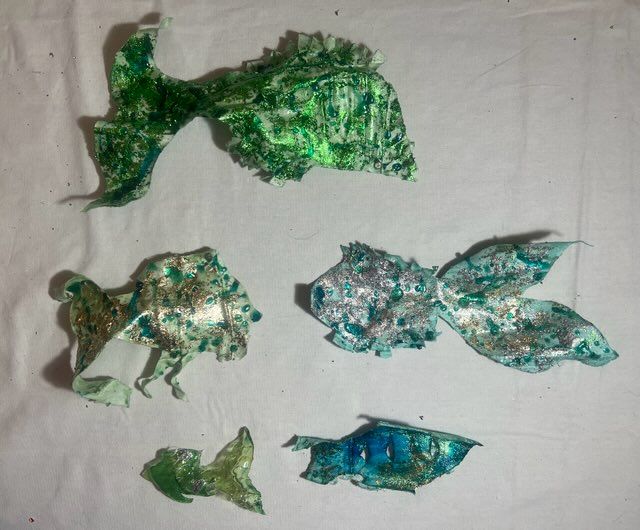
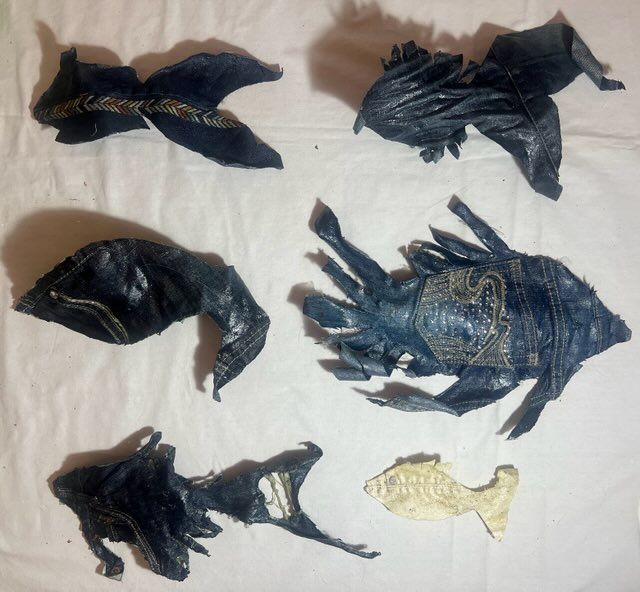
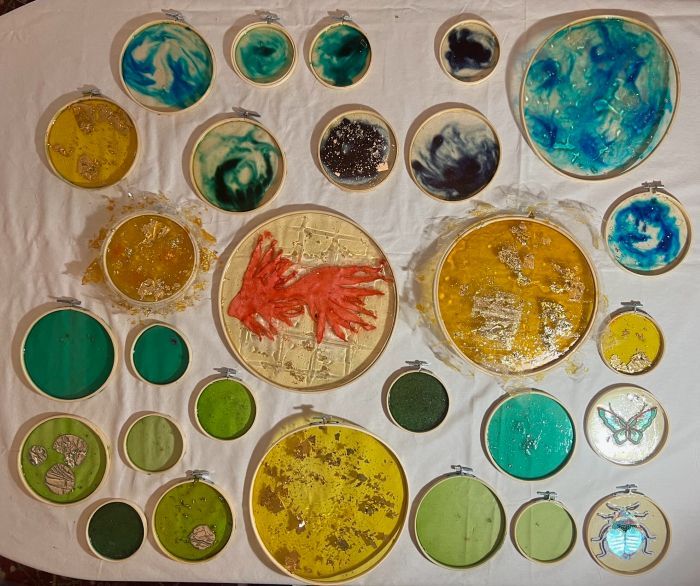
All the fish and bio resin-treated products below were made with the same recipe which I discovered in the fall during the bio materials module, when I wanted to make bio plastic. When dried naturally, the resulting bio resin is quite stiff and holds shapes very well. It absorbs into the denim better than the leather, and therefore the denim gets stiffer than the treated leather, although both maintain some flexibility. Because I had so many tests I wanted to run, I used this recipe for all the following samples to simplify my process and enable me to make a volume of samples relatively quickly. If I had tried different recipes, I would have had to have tracked the different recipes in a materials chart, which would have slowed down my experimentation with fabrics, food dye colors, and effects.
.
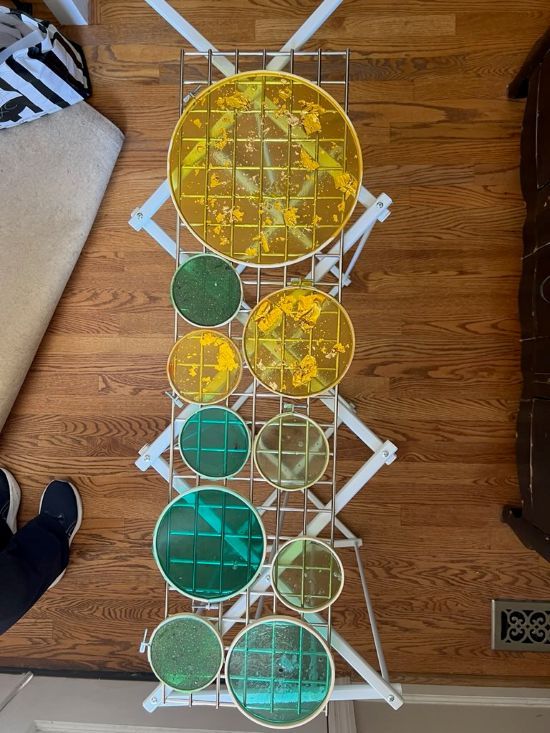
When poured into embroidery hoops and left to dry, the results are a bit stiff and are difficult to remove from the embroidery hoops. When trying to get them out, they were prone to cracking. For working with bio resin poured into embroidery hoops in the future, I plan to tweak this recipe by adding more glycerin for a more flexible result. Future experiments will include making a material chart of results from adding glycerin, one teaspoon at a time per tablespoon of gelatin.
I considered adding Alginate to my recipe so that my results would withstand heat more effectivy than does the recipe with just gelatin, glycerin, and water. I did one experiment adding alginate. It changed the consistency of the result and was not as smooth and easy to use. I have read the following about adding alginate to my recipe, so future experiments will include working with a mixture that includes alginate:
1) Improved Flexibility: Alginate increases the flexibility of the bio resin, making it less brittle.
2) Enhanced Viscosity: It thickens the mixture, allowing for better mold filling and detail retention.
3) 4) Increased Biodegradability: Alginate is a natural polymer, contributing to the overall biodegradability of the resin.
5) Better Water Retention: It helps retain moisture, which can be beneficial for certain applications.
6) Gel Formation: Alginate can form a gel when combined with calcium ions, altering the curing process.
7) Reduced Shrinkage: The addition of alginate can minimize shrinkage during the drying process.
The recipe I used for all the following experiments is below.
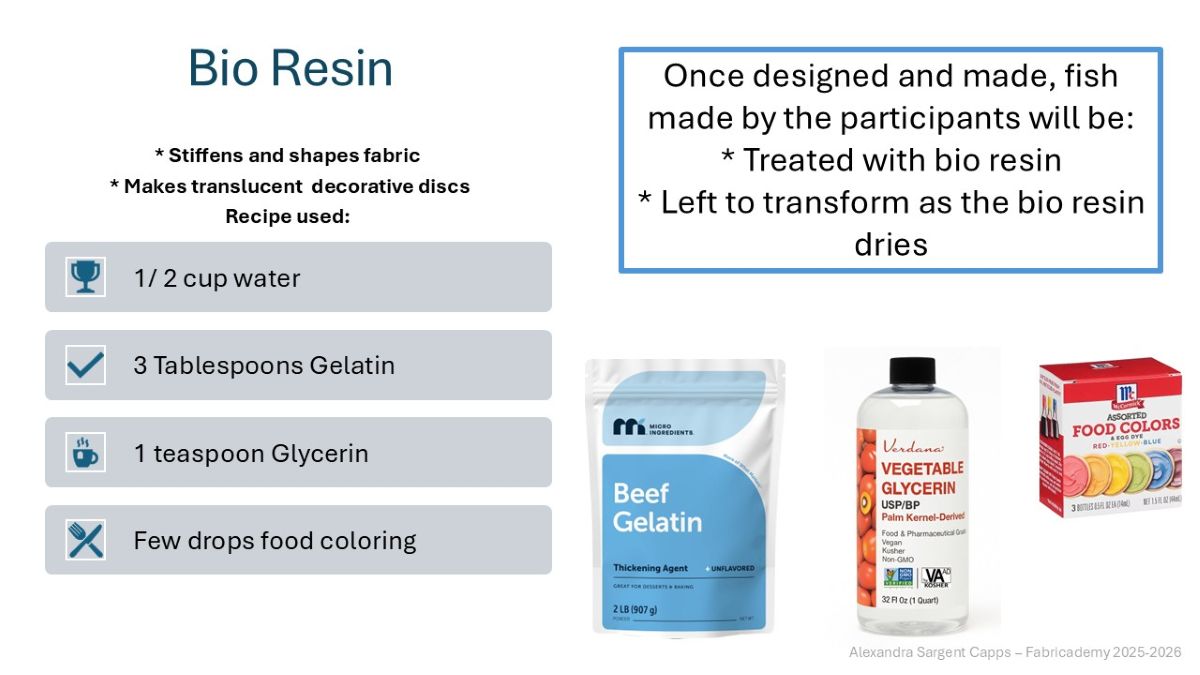 |
I oftened doubled or tripled the recipe to make a large quantity at one time. The tripled recipe is:
1 and 1/2 cup water
1/2 cup plus 1 Tablespoon Gelatin
3 teaspoons Glycerin
Assorted colors of food coloring, usually a few drops mixed in
Additonal Recipe with alginate: Anastasia sent me this recipt to test to make my products more heat resistant, "for your structures, that you want to have fold and look like blown glass, you should use 24g gelatine, 4gr of alginate and max 8 of glycerine in 100ml of water." I plan to try this recipe but have not done so yet due to time constraints.
Variations
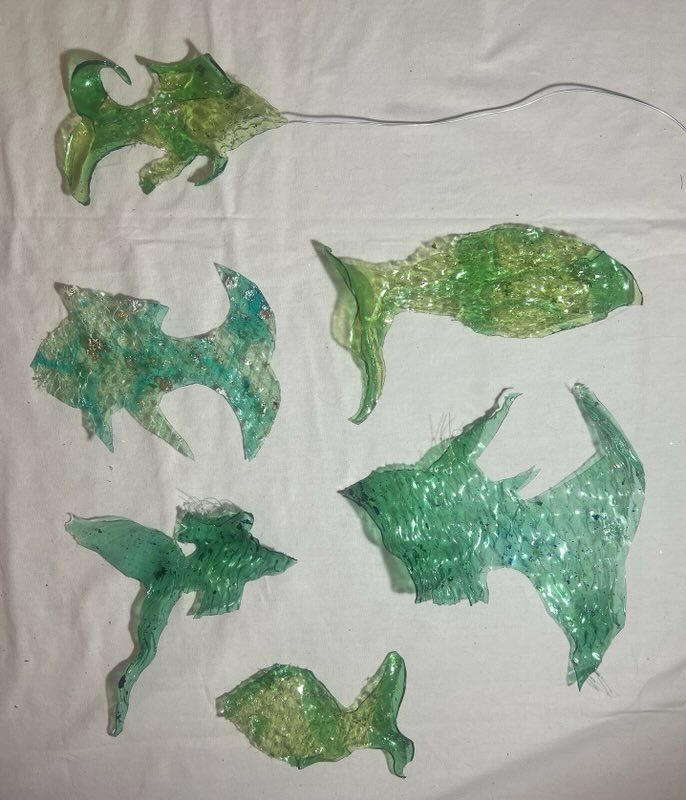
1) Sometimes I made the bioresin fish with, for instance, a few drops of green food coloring. I let it dry, then I took the same green bio resin and added some blue food coloring, to get a teal color which I dropped in dots or lines onto the original fish to give the color depth and interest.
2) In some of the embroidery hoops, I dropped food coloring right into uncolored bio resin already poured into the embroidery hoop, then swirled the food coloring in with my finger to create clouds or sky-like outcomes as the bio resin hardened.
Experiment Samples Below
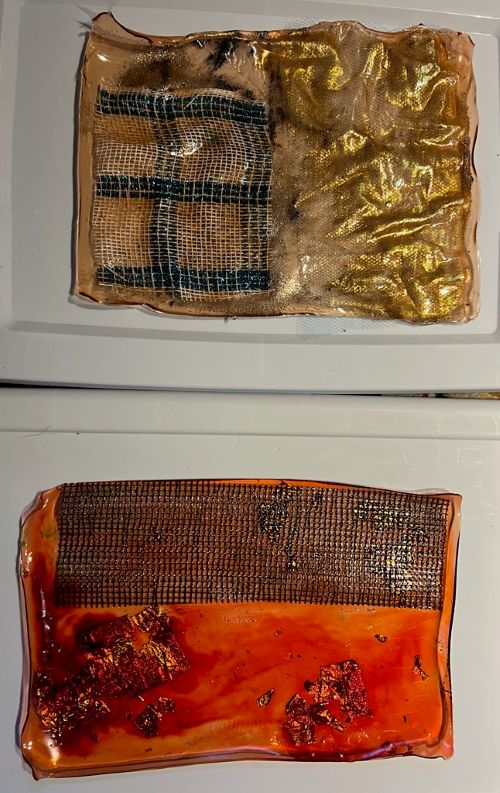
Pure bio resin with pieces of old metal placemats and plastic mesh turkey wrappers cut-up and added in.
 |
 |
 |
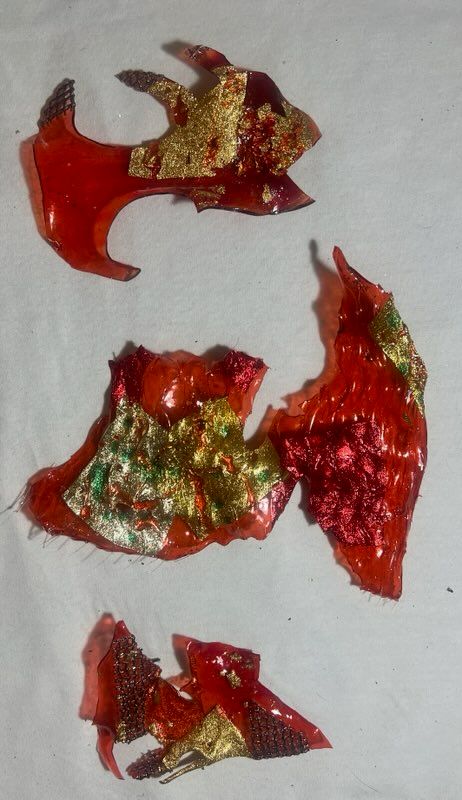
2) Fish hand-cut from leather, dipped on bio resin, then treated with bits of different colors of gold leaf.
 |
 |
3) Denim hand-cut fish soaked in bio resin, treated with different colors of gold leaf, then left to dry naturally. The second image is of denim fish without gold leaf, just the natural denim.
 |
 |
Making Ecosystem Circles Experimentaing with Bio Resin
 |
 |
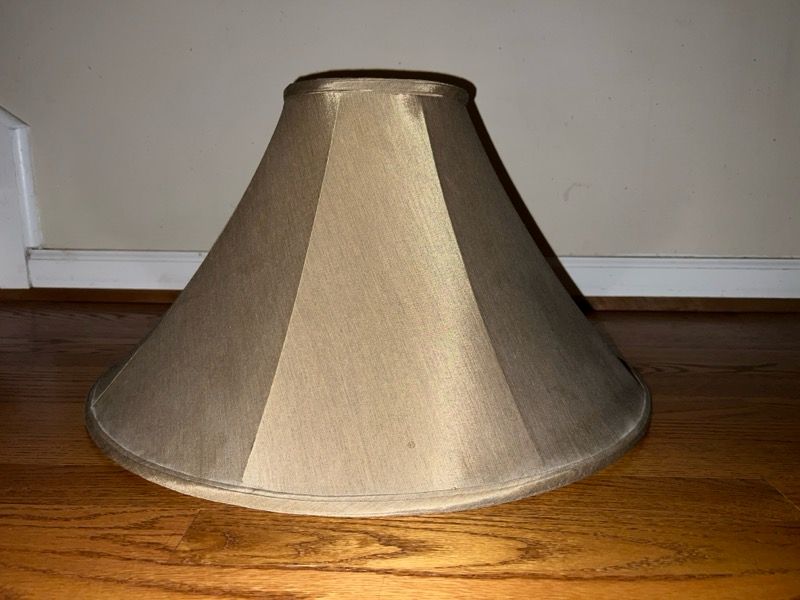
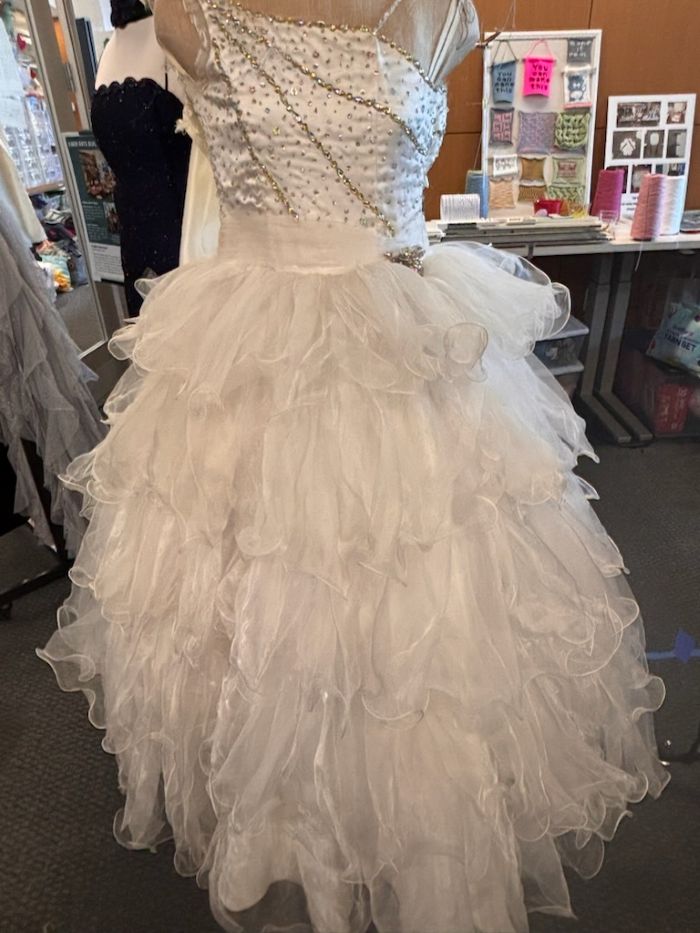
Making Sample Mobiles Using Upcycled Materials
 |
 |
 |
Prototypes
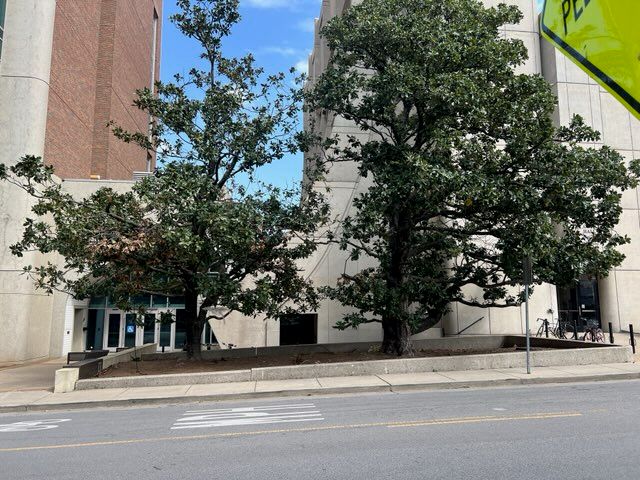
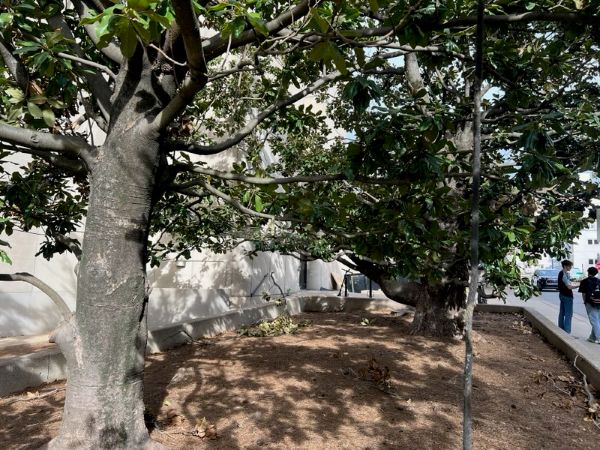
Looking for a place outside my building where students could first hang the Mobile Fish Garden project that I ran through my Mechanical Engineering How to Make Almost Anything class. I found the spot below that was easily accessible and had lots of branches for the students to choose from on which to hang the mobiles they created.
 |
 |
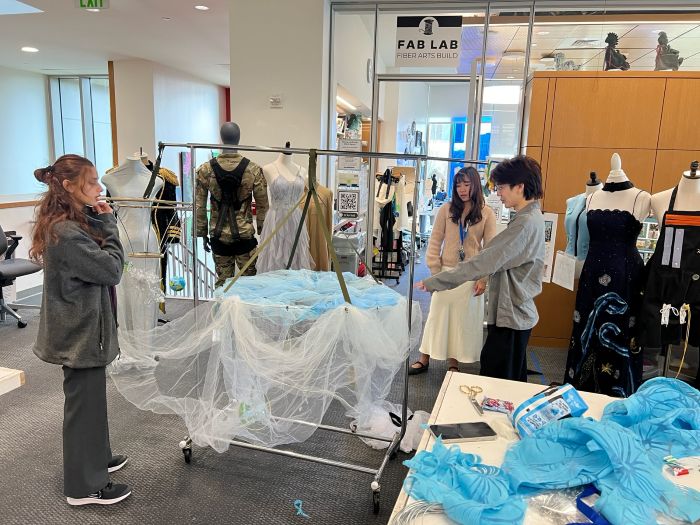
Students and staff in my building walking by stopped for hours to help try to figure out materials and designs for the mobiles I was making. I was very excited for their enthusiasm! I was also burned out from working on the project and very happy for their collaborative ideas and input.
 |
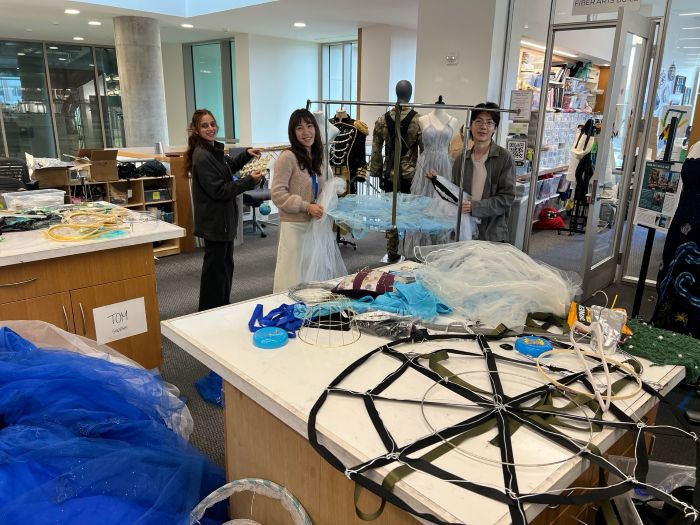 |
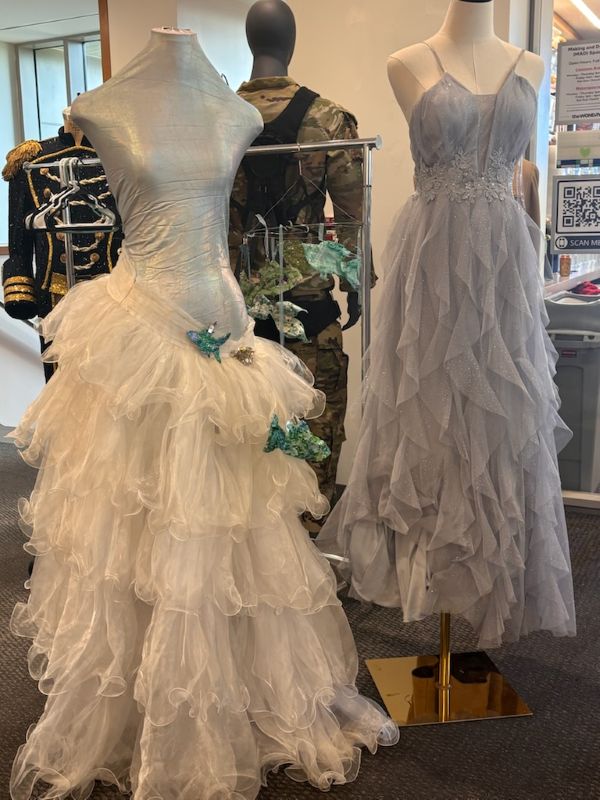
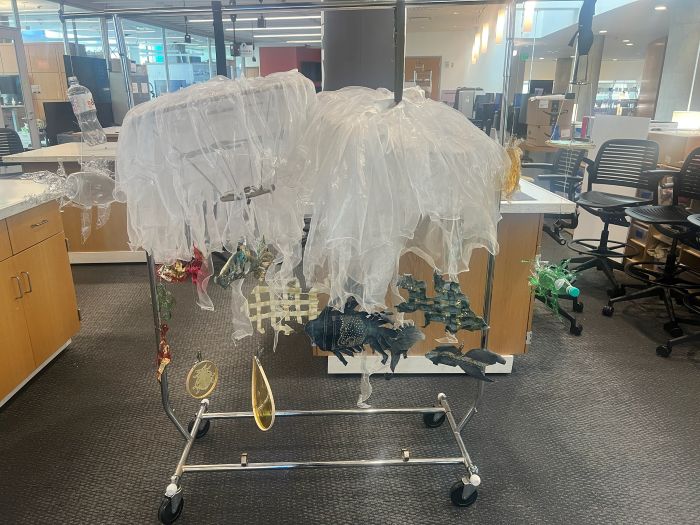
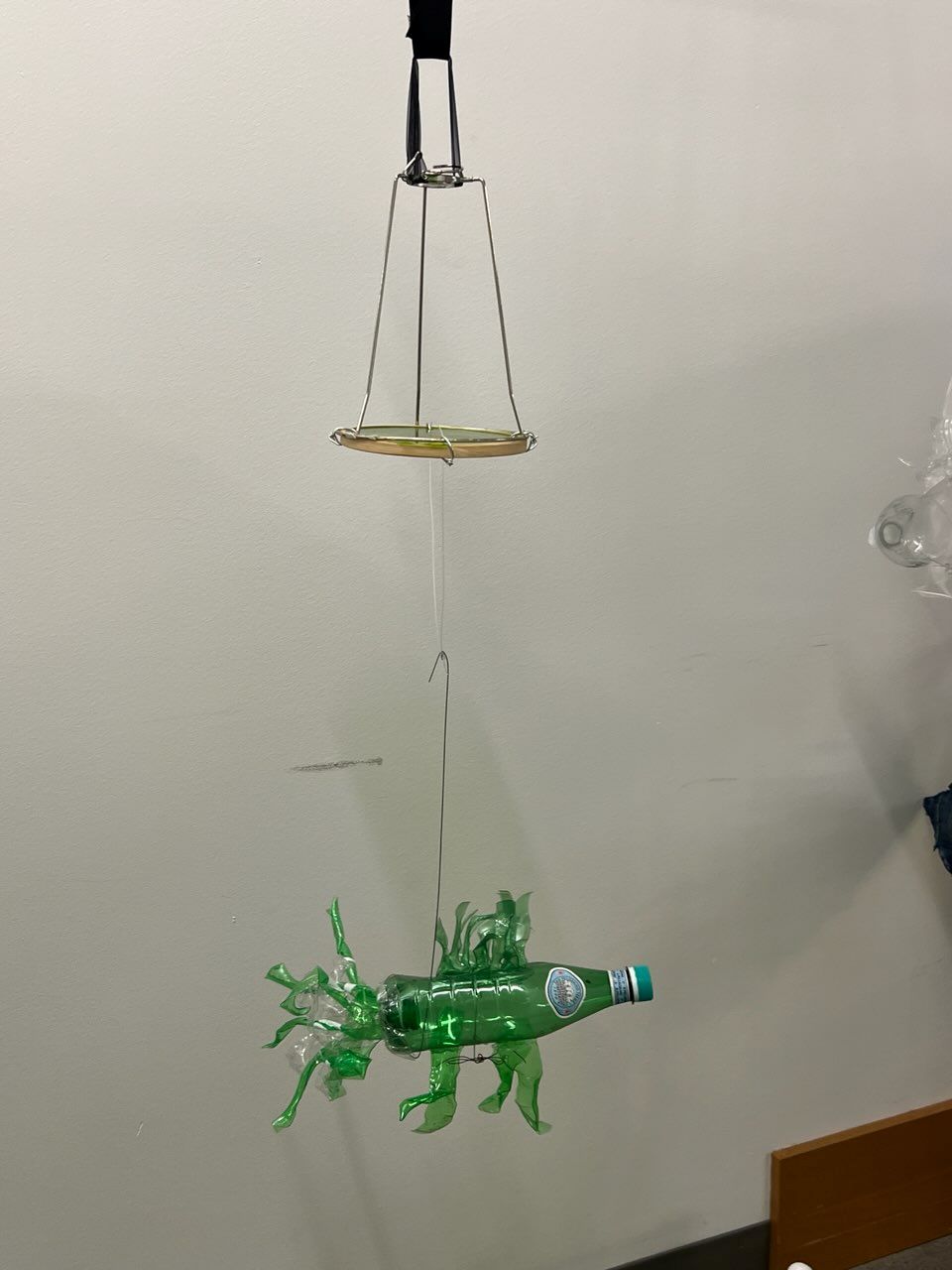
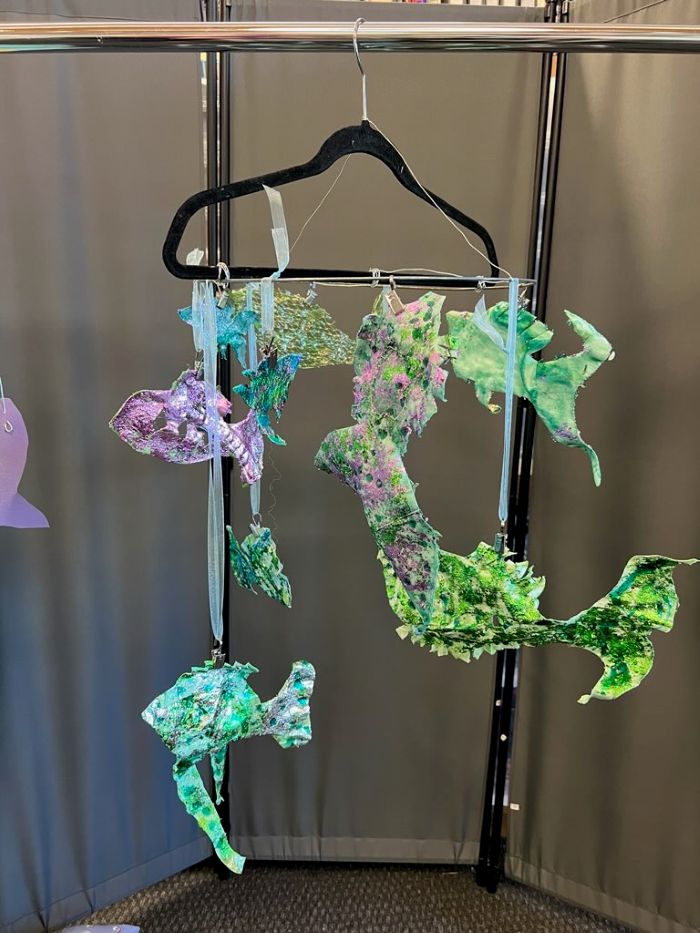
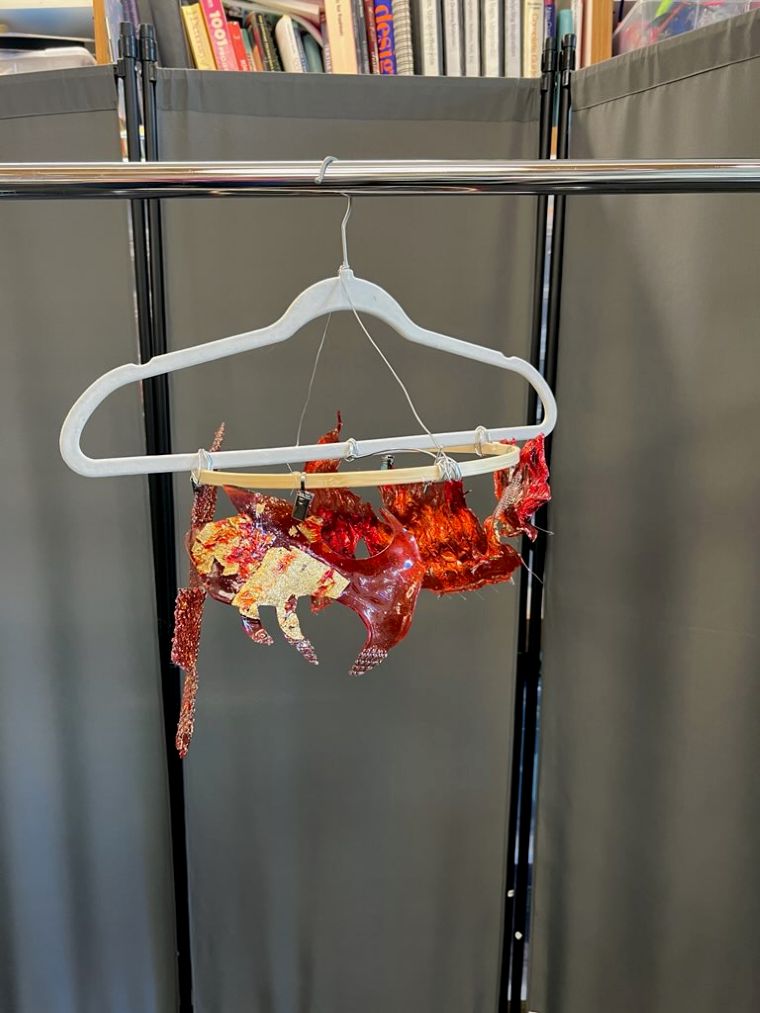
Some mobiles hanging on a garment rack, made from lampshapes and a dress
 |
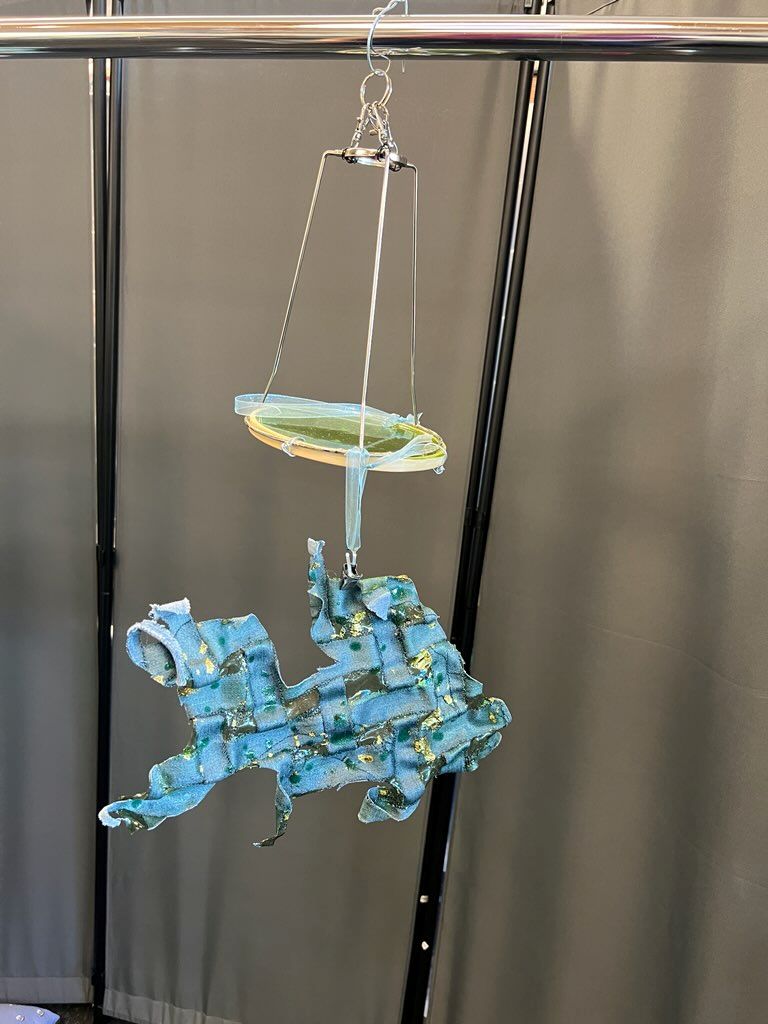
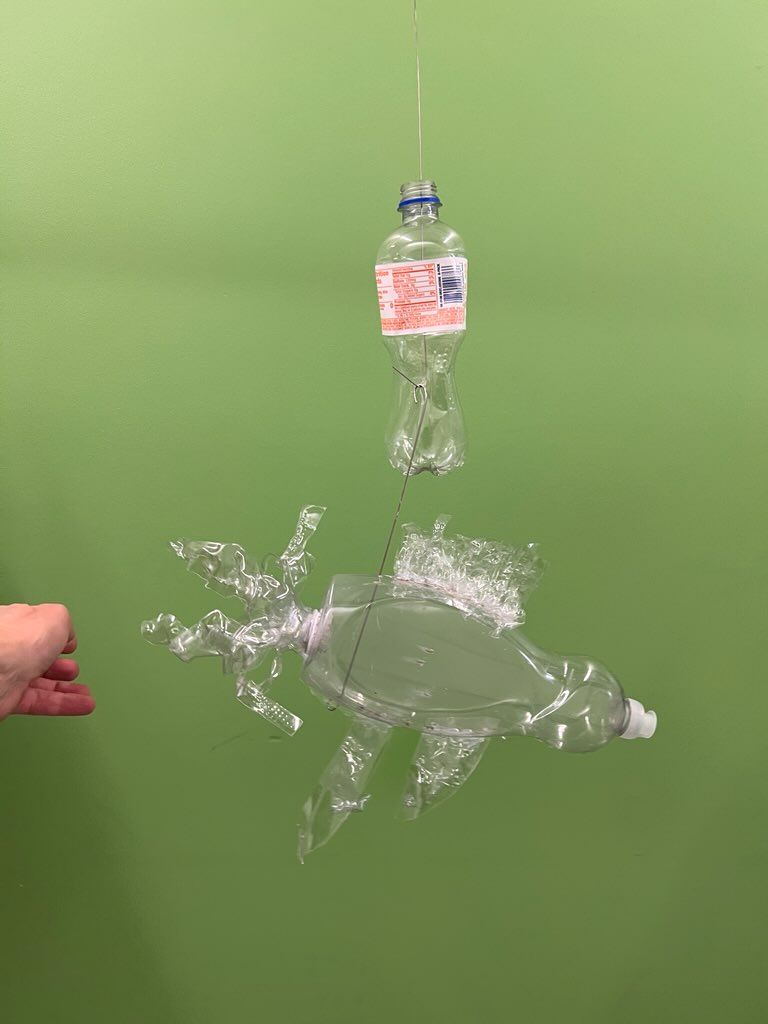
Additional sample mobiles, made very quickly.
 |
 |
 |
 |
 |
Initial Text Ideas
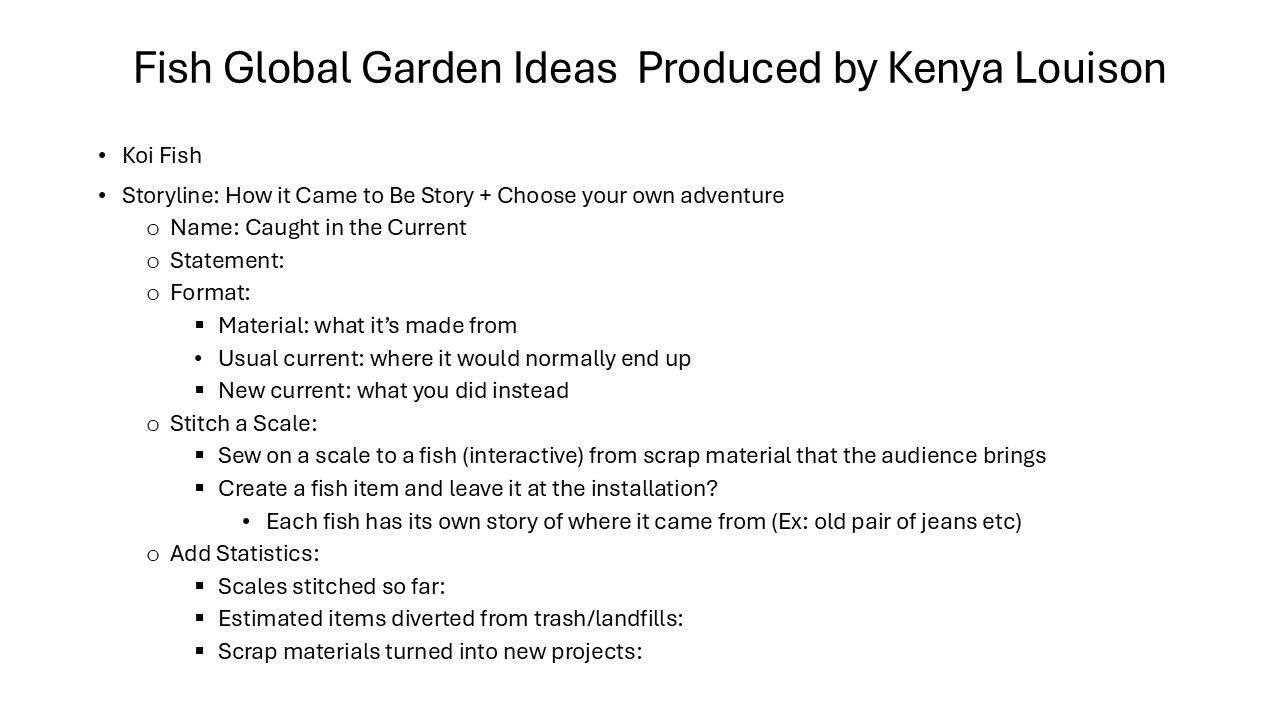
I had a student intern, Kenya Louison, who helped develop some potential workshop exercises to enrich the fish-making experience.
 |
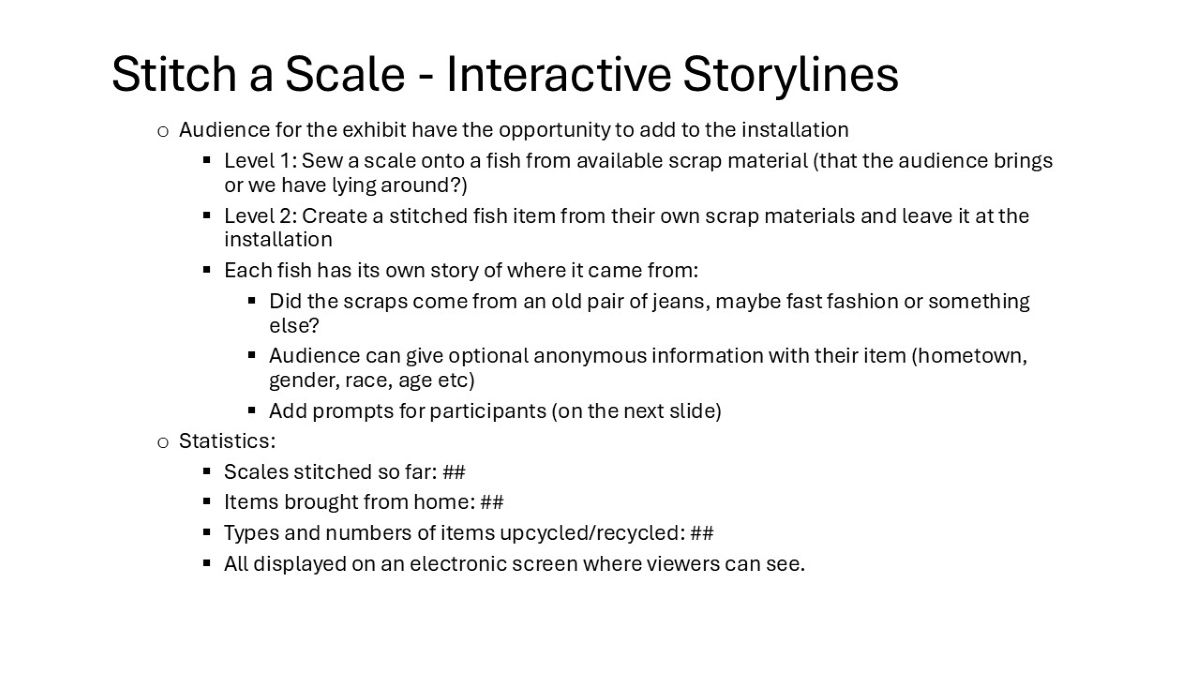 |
Use of AI
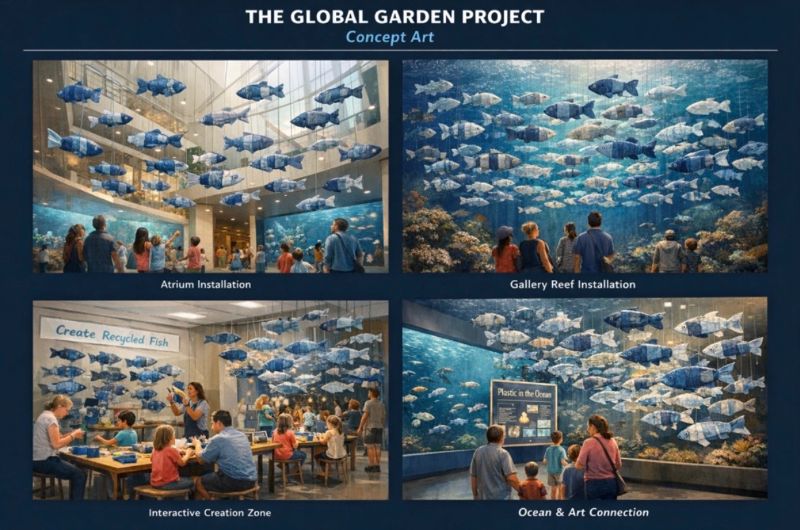
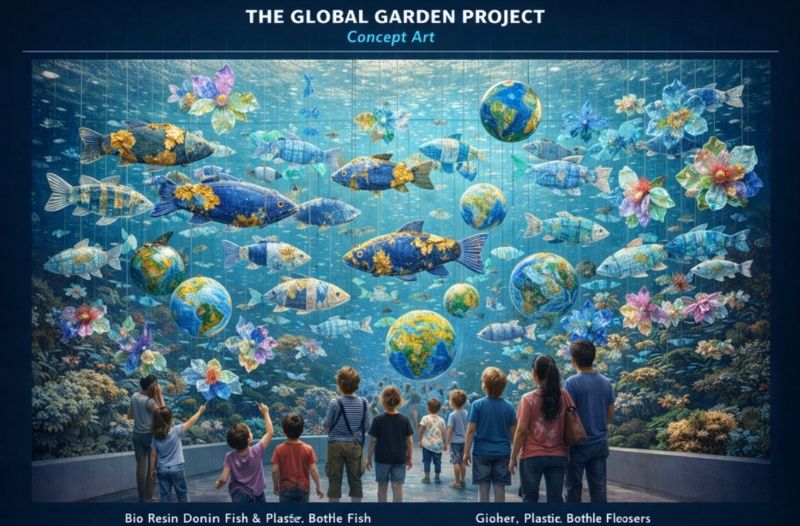
I used Chat GPT to help me develop and refine my ideas. In the process, it generated images which I love and can see being a version of the ultimate outcome of this project. Below are the images.
Videos, Watchimg Calder Mobiles
I have not in anyway mastered Calder's mobile-making techniques. But, I have enjoyed studying them throughout my process. I haven't really had time to make any that work. I whope to continue to work on understanding the art, design, and engineering of mobiles. I think calder is amazing and I enjoy working with wire. Below are videos I've watched to try to grasp mobile making tools and techniques.
Learning how to Make Calder-Esque Mobiles
_Think of upload
Cantilever Mobiles:
Mentoring notes
Mentors in all sessions may share with you their comments, notes, advise, projects and technical equipment to check out. This is good place to share those, so that you can find them later on when you need them the most!
Thanks so much to stephanie.vilayphiou for all of the resources below on artists and designers who make mobiles!
Hello Alex, as promised, here are the references I wanted to share with you:
1) Isobel Leonard is an alumni from last year. She made wonderful mechanical installations which were moving when you would approach them found here
2) Manoah Camporini made an interactive installation also based on the proximity of visitors. The structure would move using brake strings, motors and conveyor belts found here
3) Bruno Munari was an Italian designer. He made mobiles which were used within the Montessori pedagogical methods. I really like the fact that things are not centred, but it is balanced anyhow, found here
4) Livingly, a very nice brand of contemporary mobiles found here
5) Other nice contemporary mobiles found here
6) Crochet Coral Reef Project. A collective project to warn people about the pollution of the oceans and the death of corals Corals are fractals, super interesting link between maths and textile! found here
7) lastly, an installation I saw in Brussels from found objects from the sea. I really like the way it is presented and the aesthetics of those found objects
Feedback from Mentors, January 27
Feedback From Aristarco Cortes
Engineers, can go deep into the data, make sure to close the argument with more than data
Installation:
Museum or in some kind of interactive space
Recycling, call of
plastics in the ocean,
how to connect with fish in the space?
Reflection:
Why want to do it? Workshops as performance; engage with people to connect
Fish—how to connect with the recycling part?
Connect with textiles/ and plastic bottles
In Columbia: cutting plastic bottles; making weaving bags/accessories. They connect old tradition with recycling
Mobiles: bring liveness and structure. Piece of art/how to distribute in a space—put as a mobile
Bauhaus: connected elements
Which material should you use? People can start to weave, perhaps using metal pieces
Fish—how they navigate—fish as an object. Present as a figure.
Interactive project—fish, skeleton important figure in Greece
The story—what is the story? Arguments, pieces, take the time by myself to think about the most important part. How can you organize this story? The more clear it is for me the more clear it will be for others. Story telling, my main concepts, how will I integrate them into my story.I want to put in a museum—argument about recycling/upcycling, and the sea.
This is the first part—how to navigate fish in the ocean. Soft robotics—moving fishes. Don’t add more for now.
When collect things and concepts, find the constraints.
Nice elements: more of an experience.
Feedback From Stephanie
Great to have other references, more examples. Levels of mobiles for babies. Balance. Simple to complex. Isabella –made robots with woods, articulated sculptures—interactive—very smart mechanical techniques. More concerning ocean and recycling: crochet corral reef project. For depth of color in the oceans.
Feedback from Adriana
Great project; good ideas.Show the path. Need to focus. Narrow to one idea. Doesn’t matter. Will 100 Years of Solitude: Focus: potential. More references. Countries have traditions of mobiles. Interesting to see how they approach. Fish leather: --resources; stretched. Library of materials. Fish leather—make it into quilts.
March 2 Storytelling Tutorial
Katrina Biliouri; Melissa Fleming Story Telling Outline Nancy Duarte: What is…contrast with what could be…the shape of a great talk http://www.speechinminutes.com/#google_vignette
THE HERO’S JOURNEY: in storytelling. The problem becomes human. Make it the audience’s journey or your/my journey
Start in a way that captures attention: how do you make your audience listen more? First 30 seconds are the most important. How do we capture people’s attention?
The audience’s journey:
Old versus new reality—
Our solution:
Tell stories—not just facts…
STRONG OPENING:
Write your opening—write your ending—to feel prepared
3 best practices for the perfect pitch: Key thing: content—too much/too overwhelming. Keep things minimal Who/what/why—3 aspects
All boils down to: how/what/why
Common problem—straight to solution/future, no problem today Preparedness vs passion Receptivity vs confidence No storytelling/why of the idea People presenting to—they are investing in YOU Every time: public speaking
THIS IS A TOOLBOX—find the tool that works best for you Identify/build/rethink/restructure
CLARITY: storytelling/persuasion/delivery/inspiration/design
Persuasion: how do I tell my audience that what I’m bringing forward is different How will your idea stand out? Why should people care? How did you begin? What is my story? What is my goal? What comes from your heart? What is AUTHETIC to you?
WHAT IS YOUR BIG IDEA/THROUGHLINE in one sentence? If you had one sentence… Throughline needs to be there throughout the narrative. When it is more than one idea, it is confusing. Every pitch: has one main sentence… The audience must be in the center of your communication…ABC…Audience before content—who am I talking to? What is their experience? Depending on the audience, adjust your content to your audience so you can INSPIRE them.
Narrative: how to teach students: my project is about teaching students how to do this—make the students understand the problem—students learn these things/realize the problem The techniques: part of design of a workshop. Structure the workshop. https://youtube.com/shorts/isVPW_WU1cA?si=4lo7sAlL97Qk07WL DIY keychain rings https://bauhauskooperation.com/wissen/das-bauhaus/koepfe/biografien/biografie-detail/person-1444
Feedback From Adriana
Mobile: as a teaching tool. Have a demonstration. Fish and mobiles—an installation/presenting in a space Finish the object through which I can teach. Showing people how to have fun and to learn.
Decide what exactly I’m trying to do Interesting: something with the dress Interesting: embedded grids in the bioplastic: contrast with the story
Because final project is coming: start to think about the integration. Sense of building these; go from the paper; integrate the fishes with all the elements Somehow reflect the story I’m talking about. Need a video; story; visually; the key points; plastics go to the sea Make It very clear— Transparency—in the sea you have the foam; work with foamy materials; Bauhaus: Oscar Schlemer—worked with transition from dancing/movement to clothes/geometric/work with organic shapes; pictures are artists are balancing; harmony in the design I’m doing.
Now: shapes Color palette/shapes/different mobiles
Feedback from Aristarco
Mobiles: remove walls from junk people. Let them play with the thing. Beautiful images, paly with the materials in a light in a garden.
Message: through this piece of art. Communicate about recycling/biomaterials/building schematics; learning; Try to present three strong concepts
When communicate it/present it/clear/help Try to focus on/while doing biomaterials/another layer of sustainability in my lectures/kinematics/visual effects with the lights with the material/building
Anastasia: orient the project not as mobile of bioplastics/the project is workshops to the community.
https://bauhauskooperation.com/wissen/das-bauhaus/koepfe/biografien/biografie-detail/person-1444
Feedback March 10, 2026
From Cecilia
Project ideas:
Send to Chattanooga see what it does to people:
Mobile assembled/prototypes assembled/holding them/showing them/seeing students making from waste
GOAL: contribute/entire room/create something that grows
Feel:younger students get to do something about the problem. Usually, people just talk about the problem.
Start with— change happens by doing something about the problem—shaping it together/ecosystem forms a new picture
Pitch THE HOPE. Do you want to be a part of the change??
Museum social media channel/loopback/go to check how your piece changes once it’s treated with bio resin, if your fish has been incorporated into the project. Messages to “keep checking our social media!”—advertising opportunity for a museum
Bio resin to dry it faster: industrial dehydrator, buy one used, 2nd hand, professional
Essential to prepare: the metal wire, the pieces, arches, so people can quickly add the fish. Ready made pieces, have the ingredients ready for a modular creation.
Feedback from Louise
To do: Printed version of the documentation/booklet/outline to follow with expectations A bit of work— Use as documentation/depends on what I’ve been working on A lot on the different recipes/visual effects/at the end what is the end, what is the or two recipes I[m using, with a photoshoot and video
Advance in the research, look at the feedback table. Mattermost. Put the comments in with the parts/headlines. Microplastic issue with scientific facts/bunch of links. Great start. Read those.
Two links: Tutorial on how to make a mobile. Simplicity, going for, need reflection on fish shapes how to integrate fish shapes into the mobile.
Getting back to the basics of the mobile. Bio materials: How can I present in a systematic scientific way. Visual as a reference as what type of visual I’m looking for and how to achieve it with the materials. Have the experimentations already/ more about why What are the parameters of what I’m looking for? Characterize the experimentation, what I’m looking for, the emotion I’m looking for.