8. Soft robotics
Research
For personal reasons, this week was a shorter and quieter one for me. Despite that, I took great pleasure in experimenting with inflatable structures. I have been passionate about this technique for several years, especially since I visited the exhibition “Aerodream: Architecture, Design and Inflatable Structures” at the Cité de l’Architecture & du Patrimoine in Paris. I love the idea that air becomes a material: once captured inside an envelope, it becomes visible and transforms into a tangible, palpable form.
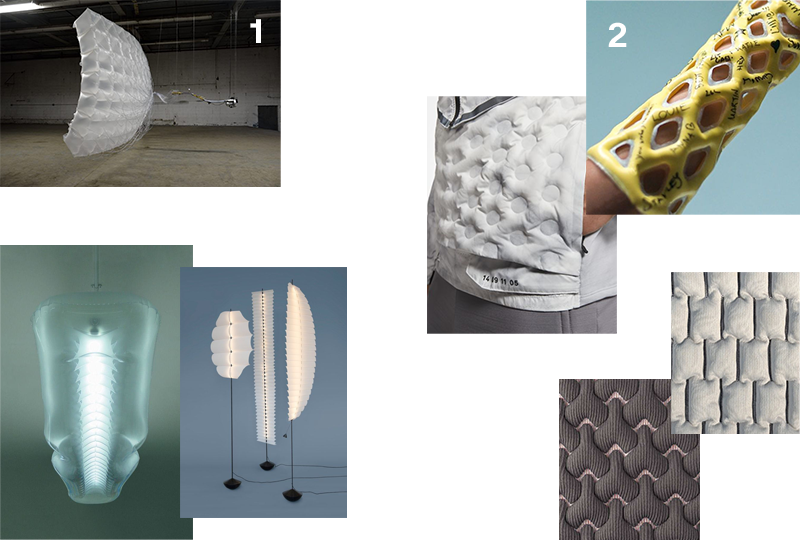
I was particularly impressed by the work of Saskia Helinska, who has explored the possibilities of soft robotics in a remarkable way.
References that also inspired me include :
References
Process
After observing the soft robotics examples available at Green Fabric, I decided to experiment using the baking parchment and thermo-adhesive technique. Process :
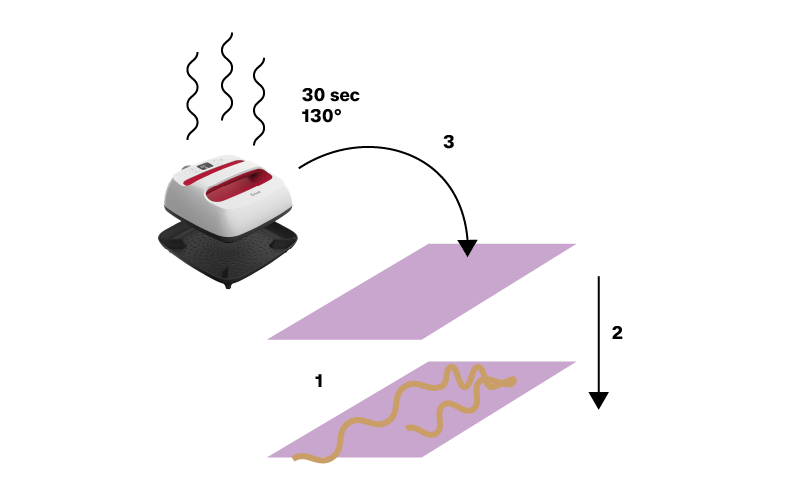
- Cut shapes in baking paper and place them onto the thermo-adhesive film, adding a margin of about 5 mm toward the outside to allow air to circulate.
- Place another film on top, matte side against matte side.
- Press with a heat press at 130°C for 30 seconds.
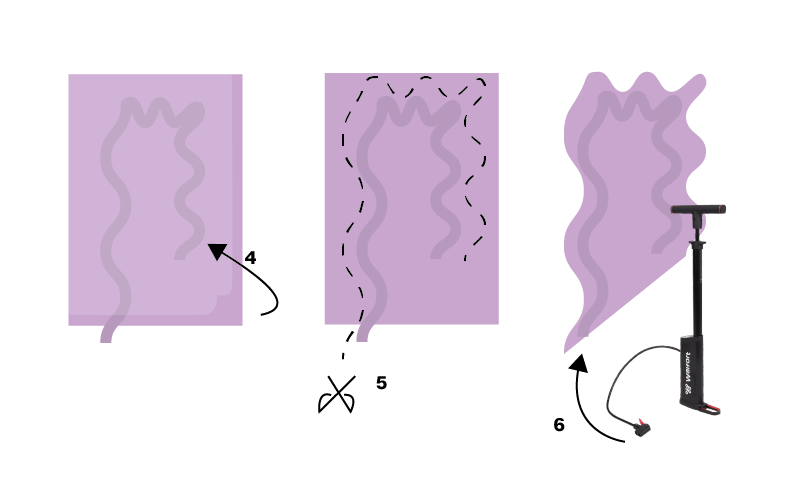
- Let it cool, then gently separate the two transparent plastic films.
- Cut around the final shape.
- Use a pump with a small nozzle to inflate the structure through the passage left for airflow.
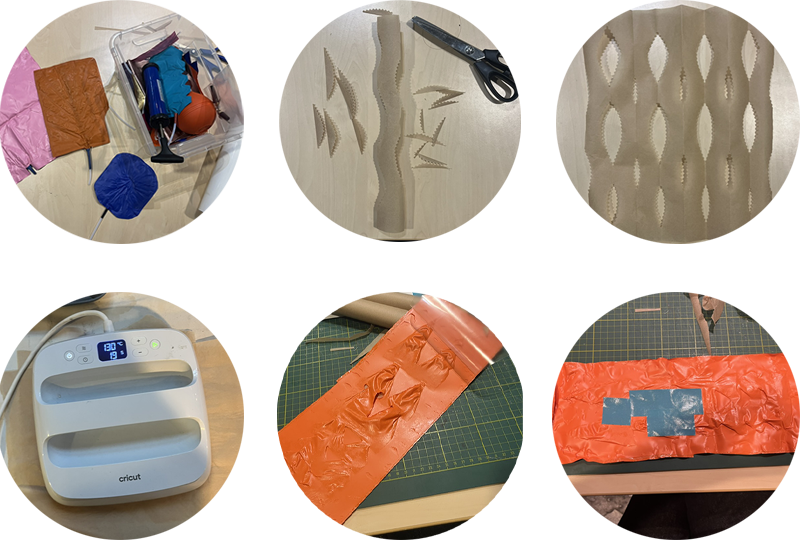
I chose to create my shapes intuitively by cutting directly into the baking paper to form networks through which air could circulate. To achieve relatively symmetrical patterns, I used different paper-folding techniques before cutting. Once unfolded, organic networks appeared—sometimes refined using decorative scissors to add more detail.
For most of the tests, I used vinyl purchased on Amazon. One sample used vinyl found at Green Fabric, but it was too thin, which caused holes to appear in the inflatable. I repaired these using tape, much like patching a damaged inflatable float in the summer. Once each sample was finished, I inserted a small plastic tube into the channel I had intentionally left beforehand to facilitate inflation.
Results
Personal Reflection & Technical Assessment
Due to the difficult personal circumstances I faced this week, my approach to these samples was deeply intuitive and spontaneous. Rather than focusing on complex, calculated geometries, I wanted to capture the poetry of the material and focus on the tactile magic of air becoming a physical volume.
Here is my takeaway from the experiments:
-
Material Constraints (Vinyl Thickness) : The choice of material is critical. The standard Amazon vinyl worked best because it offered enough resistance to maintain the pressure. The thinner vinyl from Green Fabric was too fragile and easily pierced during the heat-pressing or inflation stages. Patching it with tape was a fun, quick fix, but for a durable object, a higher gauge/thickness of plastic or TPU film is definitely required.
-
The Symmetrical Folding Technique : Using paper-folding (like origami cuts) before heat-pressing proved to be an excellent, fast way to prototype complex air networks without a computer. It allowed me to naturally create organic "veins" and "pockets" that inflated smoothly.
-
Future Potential : Even though these were quick, instinctive tests, I am completely fascinated by this technique. I can see a strong connection between these inflatable structures and my work with other flexible mediums. In the future, I would love to explore how to hybridize these air networks with textiles or soft robotics to control movement and structure more precisely.