Process
I didn’t document this live. I came back to it after finishing my final presentation.
Honestly, I spent way too long stuck in my head at the beginning. About six weeks of thinking, researching, and redefining my idea… without actually making much. I’d also never used a real loom before, so I was figuring things out as I went.
Everything clicked once I started prototyping. My project moved faster, made more sense, and I could actually see what was working (and what really wasn’t). Huge thanks to my mentor Louise Massacrier for pushing me to start making.
If I could do it again: I’d start much earlier. Things get clearer once your hands are involved.
Week 1 — Project Planning
We came back from winter break and started shaping our project: description, timeline, bill of materials, and references.
I spent a bit too long looking for the “perfect” Gantt chart tool, but in the end, I went with a simple Google template—it was free and easy. My timeline shifted a lot, but it was still helpful to have something to guide me.
In terms of budget, I ended up spending much more than I initially anticipated. Most of the cost went into 3D printing fillament, largely because of the many rounds of trial and error required to achieve the right fit and produce large-scale prints successfully. Looking back, I think I could reduce these costs in future iterations by refining the design more thoroughly before fabrication.
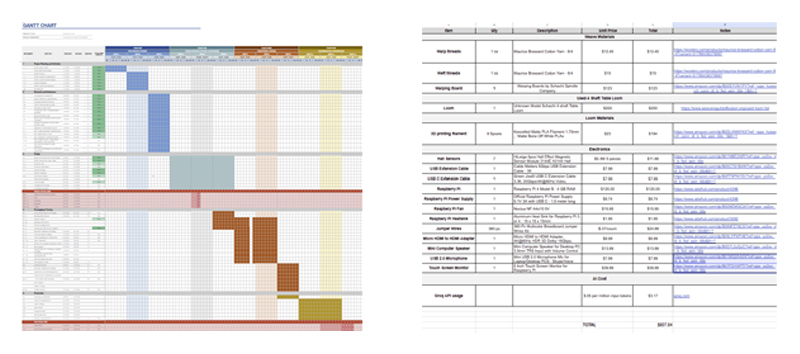
Gannt Chart and BOM by Pattaraporn (Porpla) Kittisapkajon
Week 2 — Conceptualizing & Understanding Weaving
This week was a lot of thinking. I worked through the 5 Ws (who, what, when, where, why) and started defining the system behind my project.
My cohort mate Maddie Olsen suggested I try weaving on an actual loom—something simple, but not something I had prioritized. That advice really changed how I approached the project.
I started looking for places in Boston and found A Place to Weave where Penny Lacroix kindly organized a last-minute crash course for me and my sister on a 4-shaft table loom.
During that session, I noticed how small missteps in weaving show up clearly in the fabric—they reveal the maker’s attention (or lack of it). That observation became the core concept of my project at the time: tracking and highlighting those “mistakes” in the weaving process.
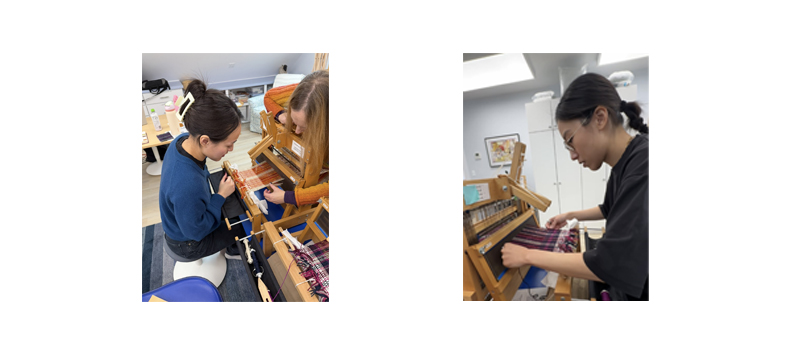
Learning to Wevae with Penny Lacroix at A Place to Weave, Leominster, MA
Loom Anatomy — 4 Shaft Table Loom
Understanding the anatomy of the loom is essential to designing Gratitude Loom as a human–machine system. Each component—such as the shafts, beater, warp beam, and cloth beam—defines how bodily actions are translated into woven structure. In this project, the loom becomes not only a tool for making textiles but also a physical interface where voice, movement, and algorithmic logic converge.
The diagram below illustrates the basic anatomy of a table loom, which informs both the physical and conceptual design of the Gratitude Loom system.
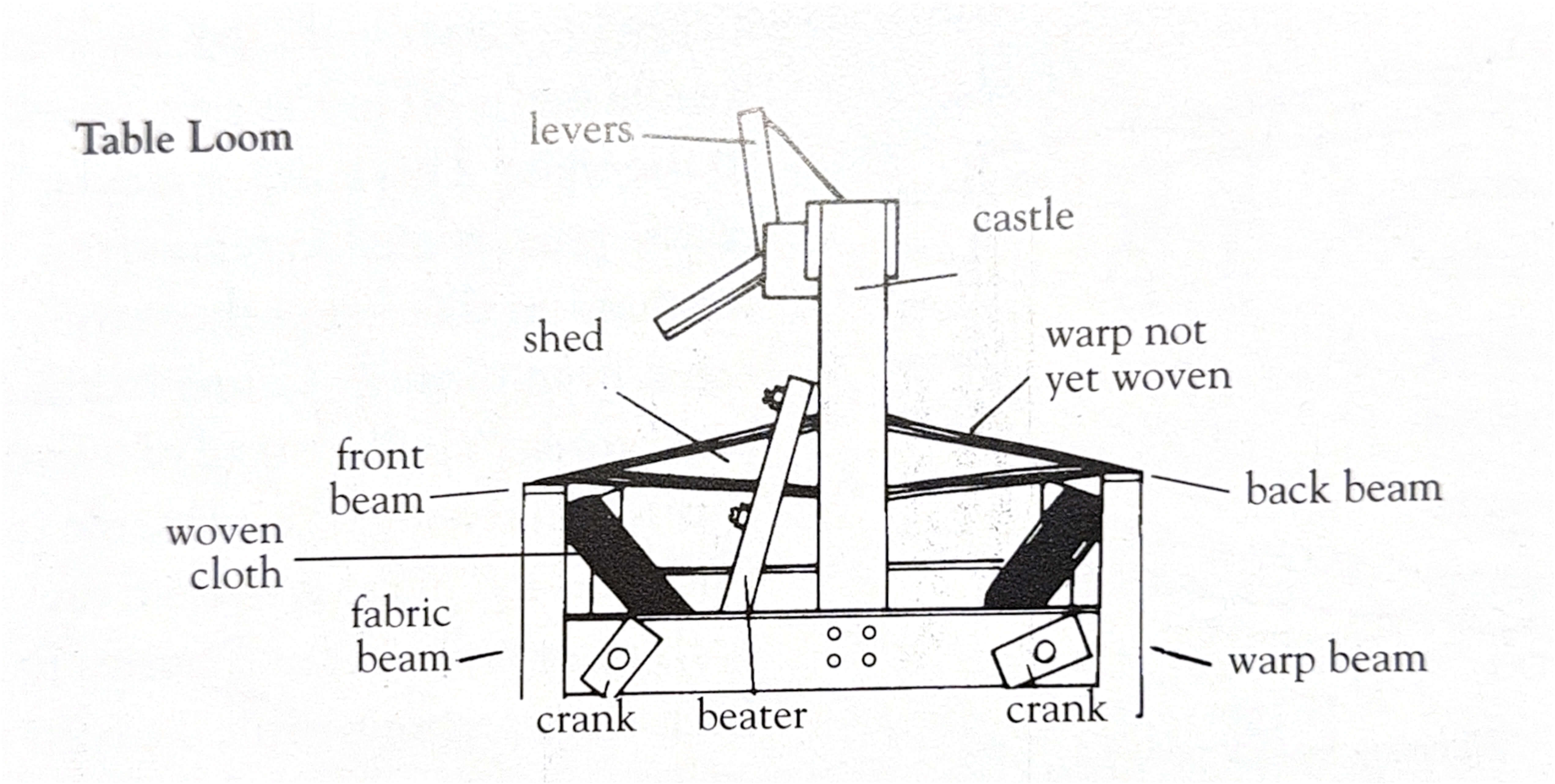
The anatomy of a table loom. Source: Deborah Chandler, Learning to Weave.
References
-
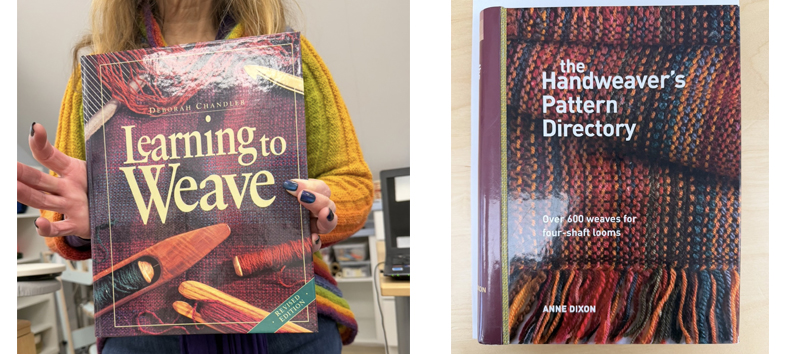
Chandler, Deborah. Learning to Weave. Loveland, CO: Interweave Press, 1995.
-
Dixon, Anne. The Handweaver’s Pattern Directory: Over 600 Weaves for Four-Shaft Looms. Loveland, CO: Interweave Press, 1994.
Weaving Terminology
- Warp — The vertical threads held under tension on the loom
- Weft — The horizontal thread that is woven through the warp
- Shaft (Harness) — Frames that hold heddles; lifting different shafts creates patterns (a 4-shaft loom has four of these)
- Heddle — A loop or eye that each warp thread passes through, used to control thread movement
- Shed — The opening created between raised and lowered warp threads for the shuttle to pass through
- Shuttle — Tool used to carry the weft thread through the shed
- Reed — Comb-like tool that spaces warp threads evenly and is used to beat the weft into place
- Beater — Frame that holds the reed and swings forward to pack the weft
- Pick — One pass of the weft through the warp
- Beat — The action of pushing the weft into place using the reed
- Threading — The process of passing warp threads through heddles in a specific order
- Tie-up — The connection between shafts and levers/treadles that determines which shafts lift together
- Treadling — The sequence of lifting shafts during weaving (the “pattern” in action)
- Sett (EPI) — Ends per inch; how densely the warp threads are spaced
- Tension — The tightness of the warp threads on the loom
- Selvedge — The finished edge of the fabric along the sides
- Float — A section where a thread passes over multiple threads without interlacing
Weaving Steps
One pick (one pass of the weft) typically includes:
- Press shaft(s) to open the shed
- Raise the heddles
- Throw the shed
- Place the shuttle down (personal preference)
- Adjust the weft diagonally (personal preference)
- Release or lift shafts (personal preference) Beat
Some of these steps—like when to place the shuttle back or when to lift the shafts before beating—depend on the weaver. But I noticed that these small choices really affect the final fabric.
For example, the weave becomes tighter and more even when I lift the shafts before beating and set the weft at a slight diagonal.
Thanks to Penny for pointing this out. It shaped how I approached consistency in my weaving.
According to Deborah Chandler’s Learning to Weave, the fundamental sequence of actions in weaving consists of three recurring steps: changing the shed, throwing the shuttle, and beating the weft into place (Chandler, 1995). These actions form a rhythmic loop that structures both the physical making of cloth and the embodied experience of weaving.
While these steps remain consistent, their order can vary depending on technique and personal preference. Some weavers beat the weft while the shed is still open, which reduces draw-in and creates a softer structure. Others close the shed before beating, which locks the threads more firmly into place and produces a tighter fabric. Each sequence has practical and aesthetic consequences, and no single method is universally correct.
What is essential is not the specific order chosen, but the consistency of the sequence. Repetition establishes rhythm, stability, and coherence in the woven structure. This highlights weaving as a temporal and procedural system in which meaning and form emerge through ordered bodily action rather than isolated gestures.
In the context of Gratitude Loom, the weaving sequence becomes part of the ritual logic of the system. The act of changing the shed, throwing the shuttle, and beating the weft is not only a technical process but a performative structure that supports presence, attention, and embodied interaction. By framing weaving as a sequence-based practice, the project emphasizes how pattern and memory arise from repeated, intentional movement over time.
References
- Chandler, Deborah. Learning to Weave. Loveland, CO: Interweave Press, 1995.
Week 3 — Continued Research & Systems Definitions
Existing Gratitude Practices
Following my mentor Louise’s suggestion to ground the project within broader cultural contexts, I began researching existing gratitude practices across different communities and traditions.
I was fascinated to discover that, across both contemporary wellness practices and many traditional and Indigenous cultures, gratitude is often expressed through spoken words, songs, gestures, rituals, and the making of objects such as textiles, baskets, and offerings. These practices revealed that gratitude is not only an internal emotion or private thought, but something embodied and enacted through voice, movement, rhythm, and material creation.
This research strongly influenced the direction of Gratitude Loom. Within the project, spoken gratitude becomes sound input, hand movement and weaving rhythm shape evolving textile patterns, and the woven cloth itself becomes a physical trace of the ritual over time. Rather than treating gratitude as a purely digital interaction, the project explores how gratitude can emerge through a shared relationship between voice, body, material, and machine.
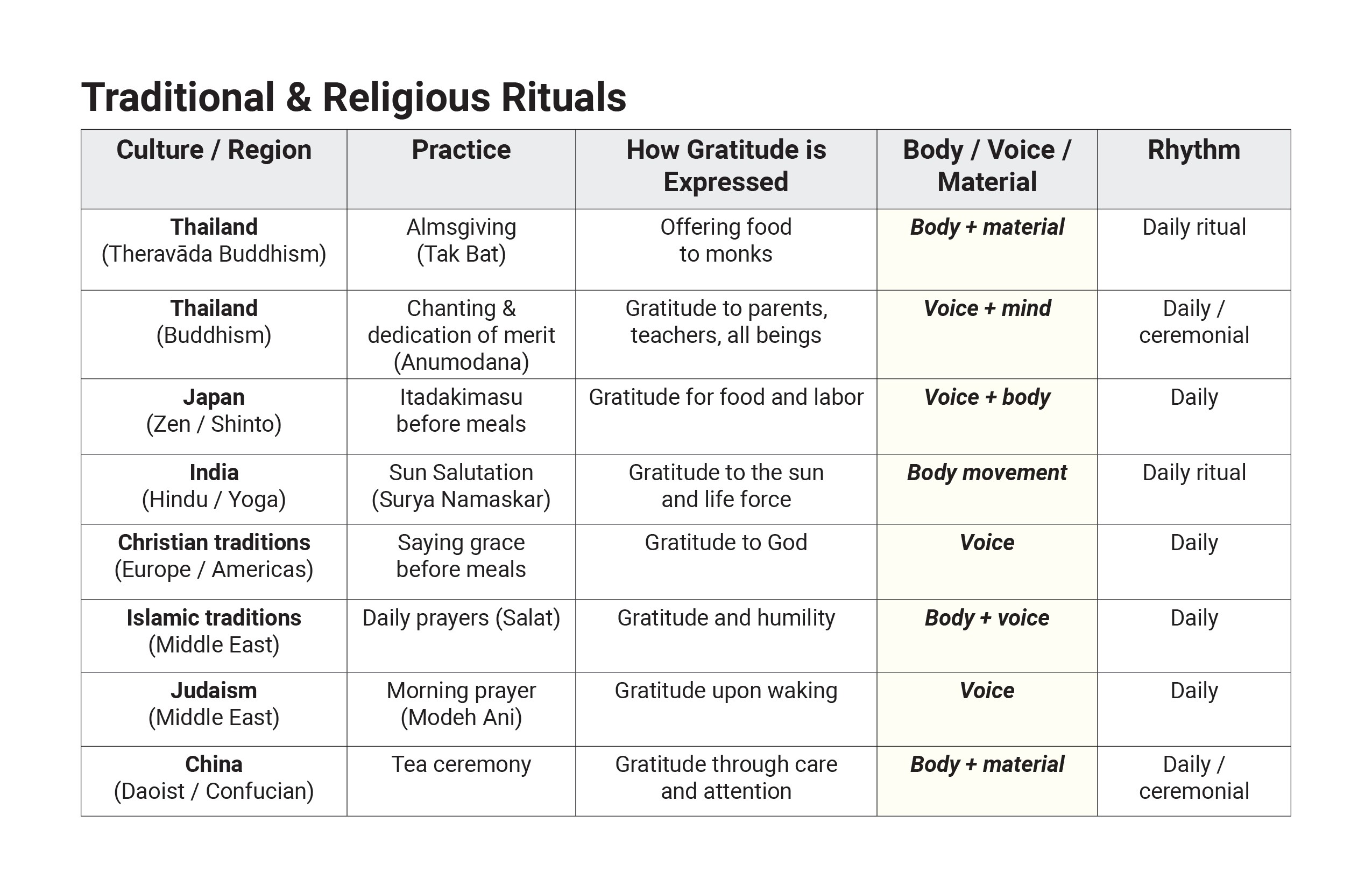
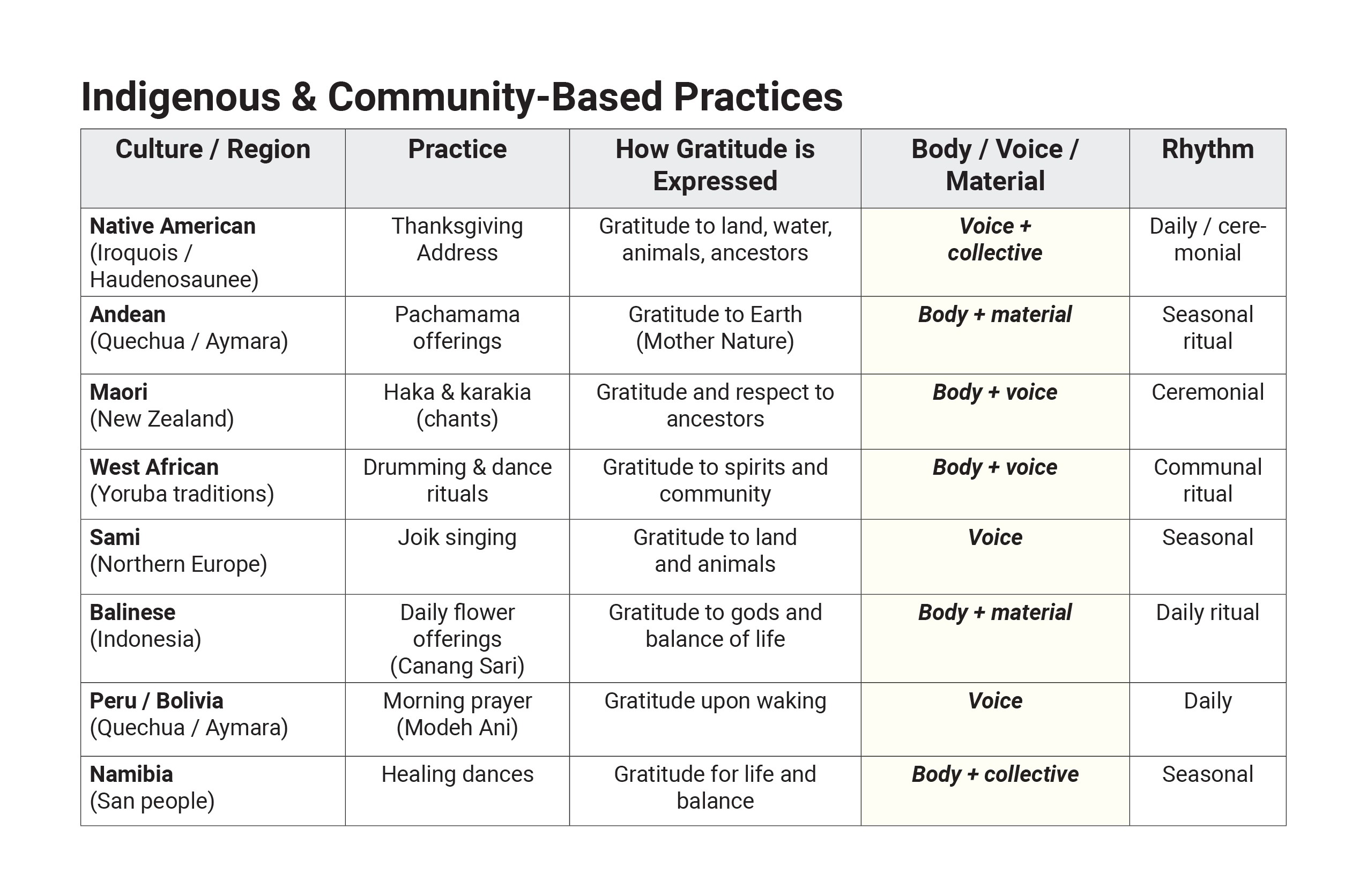
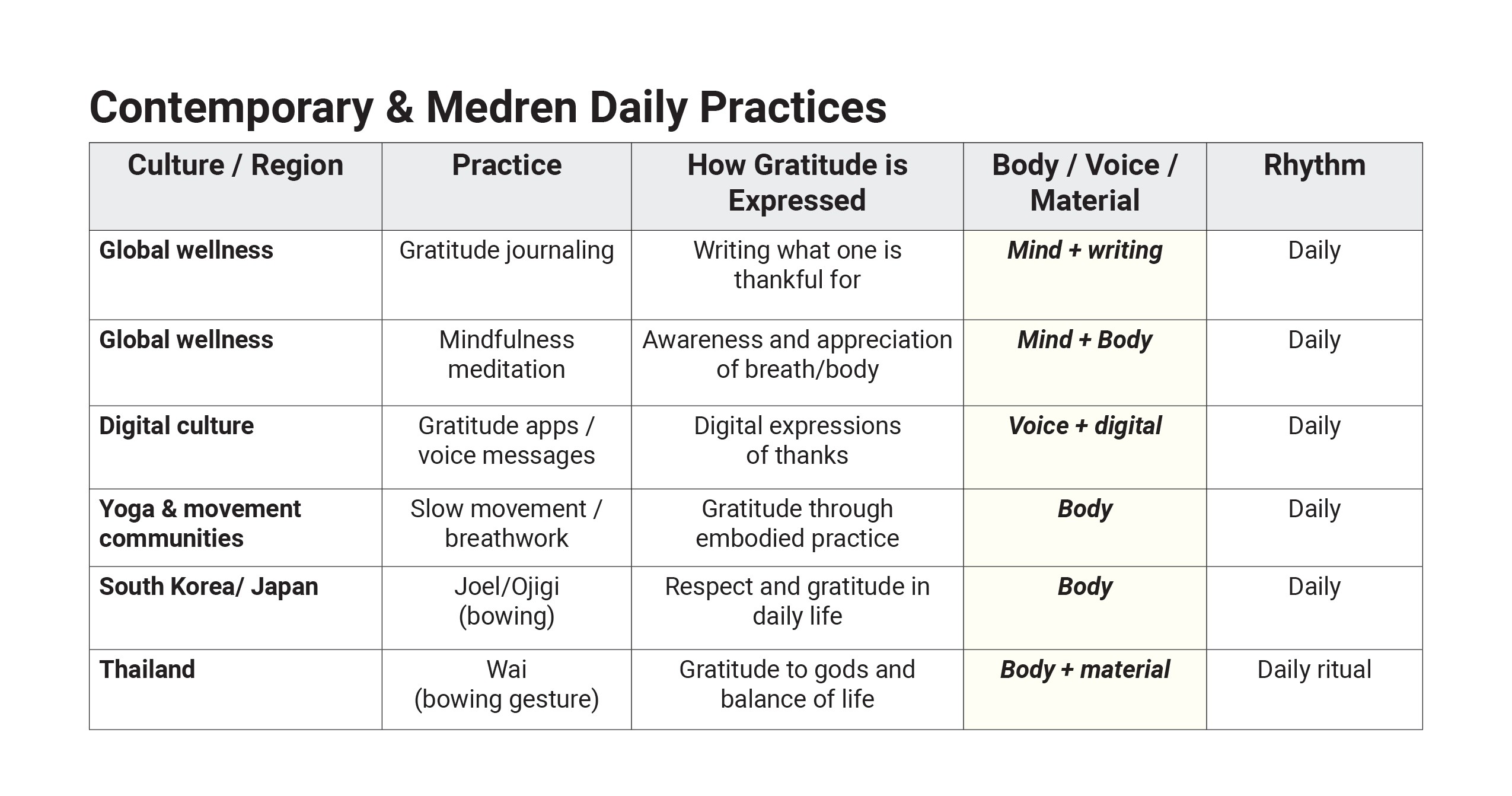
Research table of existing gratitude practices across modern and traditional cultures, focusing on voice, bodily action, and material expression. — Pattaraporn (Porpla) Kittisapkajon
Craft as a Knowledge System
Craft practices such as weaving operate as knowledge systems that encode cultural memory, skill, and meaning through bodily movement and material process. As Richard Sennett argues in The Craftsman, knowledge in craft emerges through repetition, attention, and the intimate relationship between hand and material, where making becomes a form of thinking rather than mere production (Sennett, 2008).
Similarly, Kristina Höök’s work on somaesthetic interaction design emphasizes that the body itself is a site of knowledge, where understanding arises through sensation, movement, and lived experience rather than abstract instruction alone (Höök, 2018). In weaving, pattern structures function as both visual forms and procedural knowledge, translated through gesture and rhythm into textile structure.
Gratitude Loom draws from these perspectives by treating weaving as a living archive of intention and ritual. Spoken gratitude and mindful movement become inputs into a system that produces material patterns, allowing emotional and temporal experiences to be recorded in textile form. In this way, the loom functions as both a craft tool and a knowledge interface, transforming embodied reflection into a shared material record.
References
-
Sennett, Richard. The Craftsman. New Haven: Yale University Press, 2008.
-
Höök, Kristina. Designing with the Body: Somaesthetic Interaction Design. Cambridge, MA: MIT Press, 2018.
AI as Co-Regulator / Collaborator
Sougwen Chung collaborates with robots on large-scale paintings
Recent work in art and human–computer interaction suggests that artificial intelligence does not need to function as an autonomous creator or an automated tool. Instead, AI can be designed as a collaborative partner that participates in creative processes through interaction, feedback, and adaptation. In this view, intelligence does not exist only inside the machine but emerges through the relationship between human and system.
Artist-researcher Sougwen Chung provides a key example of this approach. In her drawing and robotics projects, Chung creates systems in which machines respond to her gestures in real time. Rather than using AI to generate finished artworks independently, she treats the machine as something that “draws back.” The artwork is created through an ongoing exchange between human movement and machine behavior. Chung frames this process as a new form of intelligence based on flow, adaptation, and shared agency, rather than automation or efficiency.
Seeing Double - Bridging Dualities with Relational Intelligence by Sougwen Chung | SIFA 2023 Talks
This perspective challenges the idea that creativity belongs solely to either humans or machines. Instead, authorship becomes distributed across a feedback loop: human action influences machine response, and machine response in turn shapes human action. The result is not a pre-determined output but an emergent pattern formed through interaction. Such systems emphasize responsiveness, rhythm, and negotiation rather than control.
Research in co-creative and embodied interaction design similarly argues that intelligent systems can support reflection and attentiveness instead of replacing human decision-making. When computational systems respond to bodily input — such as voice, movement, or timing — they can function as co-regulators, helping guide the pace and structure of an activity while leaving meaning and intention with the human participant.
Within Gratitude Loom, AI is framed as a co-regulator rather than a pattern generator. The system does not independently design weaving patterns; instead, it modulates existing weave grammars in response to human voice and ritualized movement. Pattern variation emerges through a continuous feedback loop between human intention, machine response, and material execution. In this way, the woven textile becomes a physical trace of collaboration between human, machine, and material.
By treating AI as a collaborative participant embedded within craft and ritual, the project explores a model of intelligence grounded in relationship and embodiment. This approach shifts AI away from automation toward a form of creative partnership that supports mindfulness, repetition, and shared meaning through making.
References
- “Seeing Double — Bridging Dualities with Relational…” YouTube video, April 27, 2025, Sougwen Chung on Human-Machine Collaboration, posted by Singapore Computer Society, 1:09:23, https://www.youtube.com/watch?v=pnjx0X8dJGQ .
Woven Pattern Logic
Woven patterns operate as structured systems of rules that determine how warp and weft threads intersect to produce visual and material form. In Learning to Weave, Deborah Chandler describes weaving patterns as sequences of ordered actions governed by shaft movements and treadling instructions, where each row of weaving follows a defined logic of repetition and variation (Chandler, 1995). These pattern systems function as procedural knowledge, translating abstract design into physical structure through the weaver’s embodied practice.
Anne Dixon’s The Handweaver’s Pattern Directory further demonstrates how complex woven designs emerge from systematic combinations of shaft lifts and thread arrangements. The book presents over 600 weave structures for four-shaft looms, revealing how a limited set of mechanical parameters can generate extensive pattern diversity (Dixon, 1994). Each pattern operates as a modular rule set that can be altered through changes in sequence, rhythm, and repetition.
Together, these references frame weaving as a form of pattern logic comparable to algorithmic systems. The weaver follows structured instructions while allowing for improvisation and material feedback, producing outcomes that are both rule-based and responsive. This balance between constraint and variation informs Gratitude Loom’s approach to pattern generation, where spoken gratitude and bodily interaction influence how predefined pattern rules are activated through computational guidance.
By treating woven structures as logical systems rather than fixed designs, Gratitude Loom extends traditional weaving knowledge into a responsive human–machine framework. Pattern becomes not only a visual outcome but a record of interaction shaped by timing, attention, and ritual performance.
Basic Weave Structures as Pattern Grammar (Plain Weave & Twill)
Fundamental weave structures such as plain weave and twill form the basic grammar of woven pattern logic. These structures define how warp and weft threads interact through ordered sequences of shaft lifts and treadling instructions. Rather than functioning as decorative outcomes alone, weave structures operate as rule-based systems that translate abstract patterns into physical form.
Plain weave follows the simplest alternating logic of over–under repetition, producing a stable and uniform textile surface. Twill introduces variation by shifting this sequence across rows, creating diagonal pattern formations through controlled offset and repetition. These structures demonstrate how complex visual effects can emerge from a limited set of mechanical and logical rules.
On a four-shaft loom, only certain pattern combinations are structurally possible, while others are restricted by shaft count and thread arrangement. These constraints create a defined design space governed by mechanical and logical rules. Gratitude Loom builds upon this grammar by allowing voice and bodily interaction to activate and modulate pattern sequences within established weave structures, transforming traditional pattern logic into a responsive human–machine system.
By treating weave structures as pattern grammar, this project connects textile design with computational thinking, where rules, repetition, and variation form the basis for meaningful pattern generation.
| Weave Structure | Core Logic Rule | Shaft Requirement | Pattern Behavior | Structural Stability | What Works Well | What Does Not Work |
|---|---|---|---|---|---|---|
| Plain Weave | Alternating over–under sequence (1,2,1,2…) | Minimum 2 shafts (4 shafts can replicate) | Uniform, repetitive grid pattern | Very stable and balanced | Clear rhythm, slow repetition, ideal for ritual-based interaction | Limited visual variation, no directional patterning |
| Twill Weave | Offset sequence that shifts each row (e.g., 1-2-3-4 / 2-3-4-1) | Minimum 3–4 shafts | Diagonal or stepped pattern formation | Moderately stable, more flexible than plain weave | Directionality, variation, expressive pattern logic | More complex setup, sensitive to errors in sequence |
Design Constraints for Weavable Pattern Logic
For this prototype, Gratitude Loom focuses on basic weave structures—plain weave and twill—to ensure structural stability and conceptual clarity. While computational systems can generate infinite pattern variations, not all patterns are physically weavable or meaningful within textile logic. This project therefore establishes constraints to prevent unweavable, unstable, or aesthetically chaotic outcomes.
These constraints ensure that generated patterns remain balanced, structurally sound, and aligned with traditional weaving principles. By limiting pattern generation to valid weave grammars, Gratitude Loom treats weaving as a rule-based system rather than arbitrary visual output. This approach maintains coherence between computational logic and material practice.
| Issue to Avoid | Description | Why It Fails Structurally | Design Principle |
|---|---|---|---|
| Excessive floats | Long sequences of warp or weft threads without interlacing | Creates loose threads, weak fabric, and distortion | Limit float length to maintain textile stability |
| Unbalanced twill | Patterns that do not repeat evenly across shafts | Produces irregular tension and visual imbalance | Use symmetrical or offset treadling sequences |
| Random shaft combinations | Arbitrary lifting of shafts without rule structure | Results in unweavable or incoherent fabric | Follow defined weave grammars (plain, twill) |
| Aesthetic chaos | Too much variation without repetition | Breaks visual rhythm and ritual consistency | Preserve repetition and pattern continuity |
| Disconnection from textile logic | Patterns that ignore warp/weft interdependence | Produces designs that cannot be translated into physical weaving | Respect structural constraints of the loom |
References
-
Chandler, Deborah. Learning to Weave. Loveland, CO: Interweave Press, 1995.
-
Dixon, Anne. The Handweaver’s Pattern Directory: Over 600 Weaves for Four-Shaft Looms. Loveland, CO: Interweave Press, 1994.
Sequences of Weaving Process
According to Deborah Chandler’s Learning to Weave, the fundamental sequence of actions in weaving consists of three recurring steps: changing the shed, throwing the shuttle, and beating the weft into place (Chandler, 1995). These actions form a rhythmic loop that structures both the physical making of cloth and the embodied experience of weaving.
While these steps remain consistent, their order can vary depending on technique and personal preference. Some weavers beat the weft while the shed is still open, which reduces draw-in and creates a softer structure. Others close the shed before beating, which locks the threads more firmly into place and produces a tighter fabric. Each sequence has practical and aesthetic consequences, and no single method is universally correct.
What is essential is not the specific order chosen, but the consistency of the sequence. Repetition establishes rhythm, stability, and coherence in the woven structure. This highlights weaving as a temporal and procedural system in which meaning and form emerge through ordered bodily action rather than isolated gestures.
In the context of Gratitude Loom, the weaving sequence becomes part of the ritual logic of the system. The act of changing the shed, throwing the shuttle, and beating the weft is not only a technical process but a performative structure that supports presence, attention, and embodied interaction. By framing weaving as a sequence-based practice, the project emphasizes how pattern and memory arise from repeated, intentional movement over time.
References
- Chandler, Deborah. Learning to Weave. Loveland, CO: Interweave Press, 1995.
AI as Rule-Based Pattern Engine
Rule-based systems have long been used in computational design to generate structured variation through defined constraints rather than unrestricted form-making. In generative and algorithmic art research, patterns emerge from formal grammars composed of rules, parameters, and iterative processes (Galanter, 2003; McCormack & Dorin, 2001). These systems demonstrate how complexity can arise from limited and well-defined logical structures.
Within textile traditions, weaving itself operates as a rule-based pattern system. As Deborah Chandler describes in Learning to Weave, woven structures are governed by ordered sequences of shaft lifts and treadling instructions that must follow strict structural logic (Chandler, 1995). Anne Dixon’s The Handweaver’s Pattern Directory further illustrates how hundreds of pattern variations can be produced through systematic combinations of a small number of shafts and rule-based sequences (Dixon, 1994). These references position weaving as a material grammar comparable to computational rule systems.
Recent research in human–computer interaction and embodied interaction design has emphasized that intelligent systems need not function as autonomous decision-makers but can instead operate as constrained partners within human-centered processes (Höök, 2018). In such frameworks, computational systems respond to bodily input and support reflective engagement rather than automation or efficiency alone.
Framing AI as a rule-based pattern engine situates Gratitude Loom within this lineage of constrained generative systems. Rather than producing arbitrary outputs, the computational layer operates within established weave grammars such as plain weave and twill, ensuring that pattern generation remains structurally coherent and materially grounded. Human input—through voice and ritualized movement—acts as a parameter that activates and modulates these pattern rules.
This approach aligns computational intelligence with craft knowledge, suggesting a model of human–machine collaboration in which algorithms function as guides within a predefined grammar rather than as independent creators. By embedding AI within textile logic and ritual structure, the project explores how intelligent systems can support attentiveness, repetition, and embodied meaning instead of prioritizing speed or automation.
| Element | Role in System |
|---|---|
| Weave Grammar | Defines valid pattern rules (plain weave, twill) |
| AI Engine | Selects and modulates pattern sequences within rules |
| Human Input | Voice rhythm, timing, and ritual completion |
| Constraints | Prevents unweavable or chaotic patterns |
| Output | Structurally coherent woven textile |
| Feedback | Visual and tactile reflection for the user |
References
-
Chandler, Deborah. Learning to Weave. Loveland, CO: Interweave Press, 1995.
-
Dixon, Anne. The Handweaver’s Pattern Directory: Over 600 Weaves for Four-Shaft Looms. Loveland, CO: Interweave Press, 1994.
-
Galanter, Philip. “What Is Generative Art? Complexity Theory as a Context for Art Theory.” GA2003 – 6th Generative Art Conference, 2003.
-
McCormack, Jon, and Alan Dorin. “Art, Emergence, and the Computational Sublime.” Proceedings of the 2nd Iteration Conference on Generative Systems in the Electronic Arts, 2001.
-
Höök, Kristina. Designing with the Body: Somaesthetic Interaction Design. Cambridge, MA: MIT Press, 2018.
System Overview
Gratitude Loom reimagines AI as a listener to human rhythm. Instead of speeding things up or optimizing output, the system creates space for slower, continuous making. Within a chosen pattern family, structure deepens through steady repetition over time. Slowness is not forced — it becomes possible. The woven cloth becomes a quiet record of how time was experienced during the weaving process.
System Components
| Component | Definition | Role | Contribution |
|---|---|---|---|
| Human (Weaver) | The person who performs the weaving ritual through repeated hand movements. | - Begins with a brief spoken expression of gratitude, marking the start of intentional time. - Repeats weaving gestures — pressing shafts, throwing the shuttle, and beating the weft. - Maintains continuity of movement at their own pace. - Adjusts tension when needed and continues weaving. |
The weaver’s attention and rhythm influence how the structure develops. The textile becomes a subtle trace of this lived rhythm. |
| AI-Guided Loom | A 4-shaft loom enhanced with sensors and simple AI that listens to the rhythm of weaving. | - Detects repeated weaving gestures. - Listens to steadiness of movement. - Allows structure to deepen within a selected pattern family when continuity is sustained. - Keeps structure lighter when movement becomes fragmented. - Never takes control of the weaving process. |
The loom does not judge, score, or reward. It responds gently to continuity, shaping how depth builds within the pattern. |
| Woven Material (Textile) | The woven fabric created through repeated gestures within a chosen pattern family. | - Shows variation in density and repetition. - Subtly reflects sustained or fragmented continuity. - Makes time visible through structure and texture. |
The textile holds a quiet record of how the weaving unfolded — denser where continuity settled, lighter where it did not. All outcomes remain coherent and beautiful. |
| Sensors | Small electronic components attached to the loom that translate physical gestures into digital signals. | - Detect repeated weaving movements. - Register the spoken gratitude as the beginning of a session. - Provide timing information to the AI system without analyzing emotional content. |
Sensors allow the loom to respond to rhythm rather than measure performance. They support responsiveness without surveillance. |
| Pattern Library (Structural-Temporal Fields) | A set of fixed weaving pattern families (such as tabby, twill, or block-based structures). Each family represents a different mode of repetition. | - Provides structural constraint and coherence. - Remains fixed during each session. - Allows depth to accumulate within one selected field. |
Pattern families act as landscapes for repetition. They are not rewards, but spaces where continuity can take root. |
| Feedback Interface | Minimal visual or sound cues that support awareness without interrupting flow. | - Marks the beginning of a session. - Supports continuity without correction. - Avoids gamified signals or rewards. |
The interface maintains presence without pressure, helping the loom feel like a temporal environment rather than a performance system. |
System Relationships
Gratitude Loom functions as a quiet loop between human, loom, and material.
The human speaks gratitude and begins weaving.
The loom listens to the rhythm of repeated gestures.
The material reflects how continuity unfolds over time.
Human gesture → AI listening → Structural change → Material trace
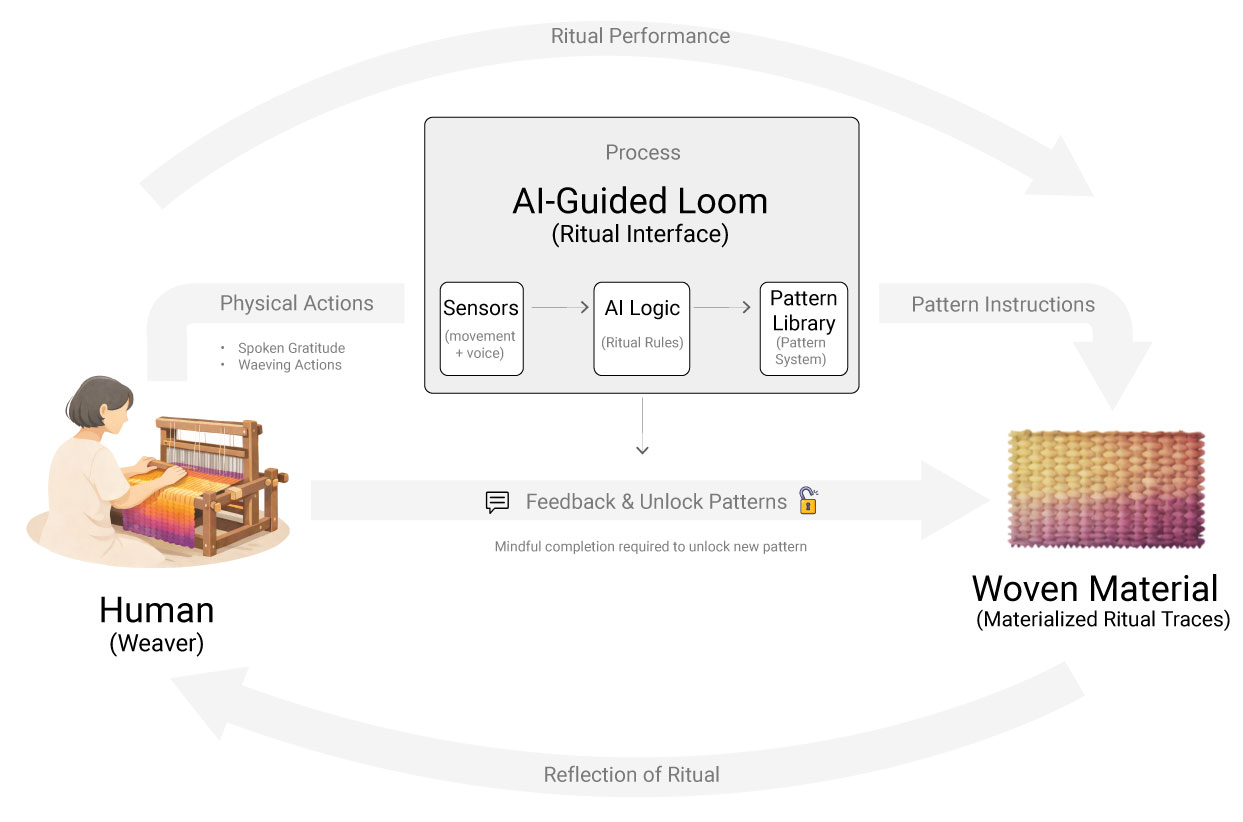
Early Gratitude Loom System Diagram by Pattaraporn (Porpla) Kittisapkajon
System Boundaries
| Gratitude Loom is not | The system focuses on |
|---|---|
| - A productivity tool - A mood detection device - A performance tracker - An optimization machine - An automated weaving device It does not reward speed or punish variation. It does not evaluate the meaning of gratitude. |
- Sustained continuity - Embodied repetition - Slower temporal experience - Structural depth within constraint - AI as listener rather than controller |
Week 4 — Design Development
Ritual and Interaction Flow Design
The Gratitude Loom is designed for beginner and hobby weavers who want to use weaving as a mindful and reflective creative practice. Rather than focusing on speed or productivity, the system encourages a slower relationship with technology through intentional action and spoken gratitude.
The interaction is structured as a short ritual that can be practiced daily or weekly in the home, studio, or shared creative and wellness spaces.
Step 1: Preparing the Ritual (Set Intention)
The participant begins by approaching the loom and preparing for a short weaving session.
They are invited to:
- pause
- take a breath
- place their hands on the loom
- set an intention for the session
This step establishes weaving as a ritual instead of just a technical task.
Step 2: Speaking Gratitude
The participant speaks a short phrase of gratitude out loud, such as:
- “I am grateful for today.”
- “I am grateful for learning to weave.”
- “I am grateful for my hands.”
The system captures the voice input using a microphone and tracks:
- rhythm
- timing
- pauses
- duration of speech
The meaning of the words is not analyzed. Instead, the system focuses on the quality and pace of the spoken gratitude.
Step 3: System Guidance (AI + Sensors)
The Gratitude Loom combines a 4-shaft loom with sensors and simple AI to guide the ritual.
The system:
- listens to the participant’s voice rhythm
- tracks weaving actions
- monitors whether the ritual steps are completed slowly and mindfully
Rather than generating a finished design automatically, the AI introduces gentle guidance and structure to the interaction.
New pattern structures are only unlocked after each ritual cycle is completed with attention and car
Step 4: Weaving Through Mindful Action
The participant weaves by hand while the loom responds through pattern and timing.
This creates a feedback loop between: voice → system → hand movement → textile pattern
The woven material reflects:
- the rhythm of the spoken gratitude
- the duration of the ritual
- the consistency of movement
Each textile becomes unique because it is shaped by the participant’s mindful actions during that session.
Step 5: Reflection and Observation
After completing the ritual cycle, the participant observes the woven textile.
The cloth becomes a physical record of the session:
- dense areas may reflect longer or steadier speech
- open spaces may reflect pauses
- repeated structures may reflect calm and consistency
Instead of reading words, the participant reads patterns as traces of their attention and intention.
Interaction Flow Summary
The full ritual and interaction flow can be summarized as:
- Prepare and set intention
- Speak gratitude
- The system listens and provides gentle guidance
- Weave by hand
- The system checks that the ritual steps are completed slowly and mindfully
- A new pattern structure is unlocked
- Reflect on the woven textile
This loop transforms weaving into a slow and meaningful ritual supported by technology rather than driven by it.
Purpose of the Ritual
In a world that moves fast and values efficiency, the Gratitude Loom explores how:
- mindful movement
- conscious spoken gratitude
- and pattern-making
can work together to create a slower and more reflective relationship with technology.
Patterns are unlocked through attention, and the woven material records the traces of the ritual.
The result is not only fabric, but a material memory of the participant’s mindful practice.
Pattern Logic
I began by studying the weaving patterns available on a 4-shaft table loom through The Handweaver’s Pattern Directory: Over 600 Weaves for Four-Shaft Looms by Anne Dixon. I documented and categorized different weave structures without fully knowing how they would be used yet. Over time, this collection evolved into the pattern matrix that now guides the weaving journey within Gratitude Loom.
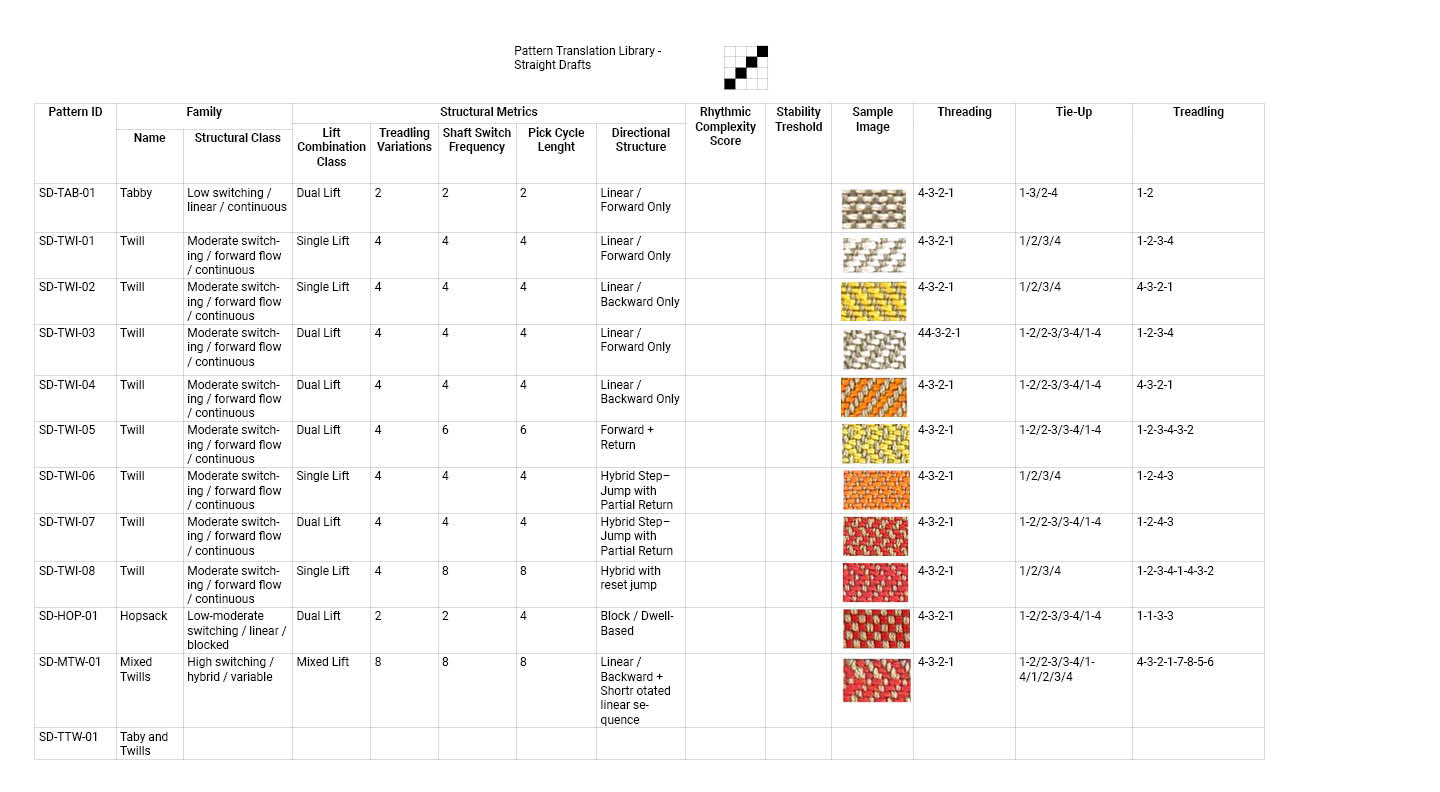
Pattern Study by Pattaraporn (Porpla) Kittisapkajon
Week 5 — Mid Term Presentation
For the mid-term presentation, I didn’t yet have much to show beyond the project concept, system definitions, interaction flow, and pattern logic. I presented an updated system diagram that better explain how patterns deepen as the weaver’s presence is sustained, and soften as attention begins to drift.
At this stage, I felt quite behind, as I had not yet started prototyping. However, my reviewer, Troy was able to understand the vision and direction of the project. He introduced me to several meaningful references that deeply resonated with the work, including the data-centered design research of Audrey Desjardin and the temporal design research of Will Odom
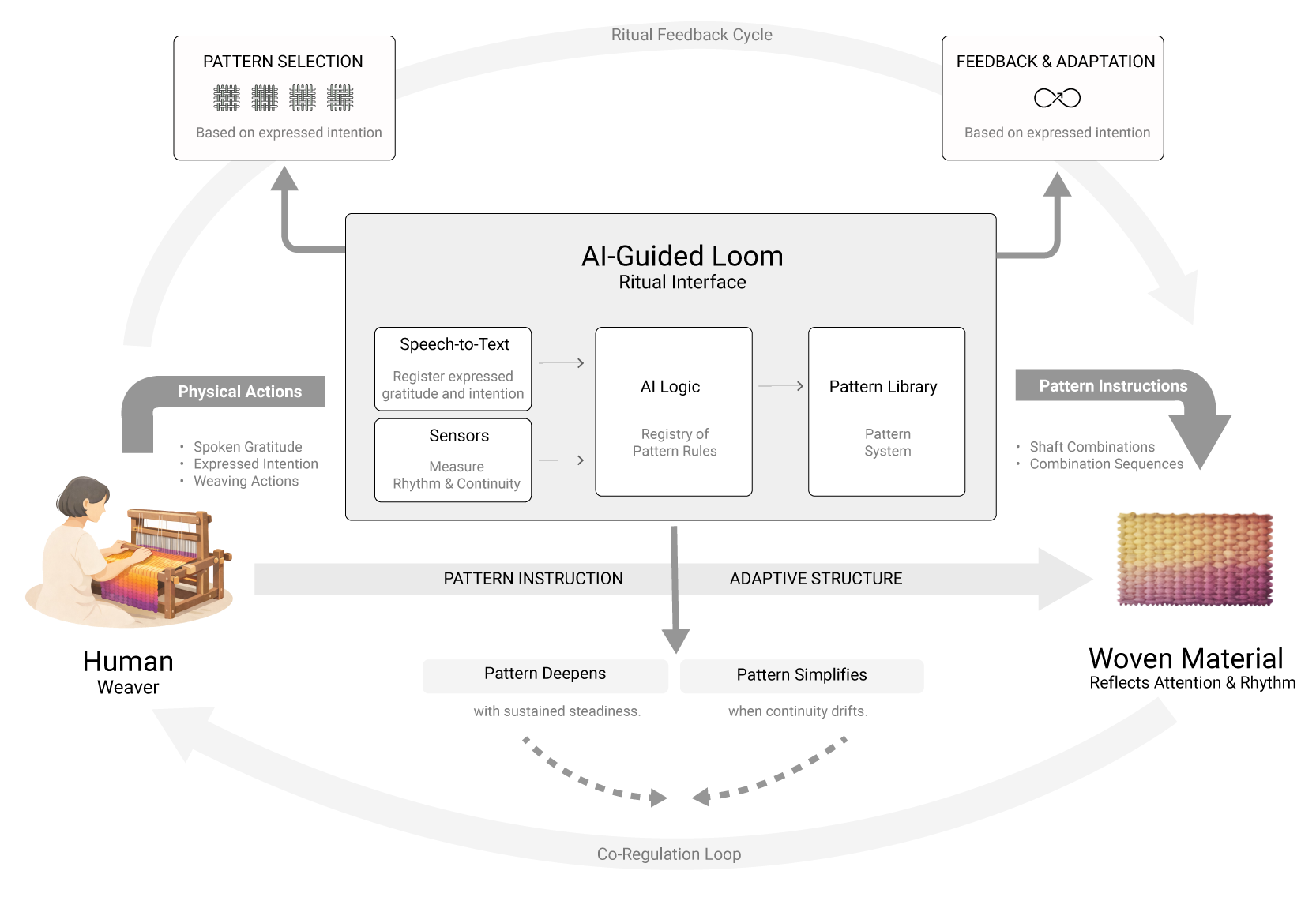
Early System Diagram by Pattaraporn (Porpla) Kittisapkajon
Week 6 — Reading Reseach Paper
Troy recommended two research papers that became important references for the development of Gratitude Loom: On the Making of Alternative Data by Audrey Desjardins and Attending to Slowness and Temporality by William Odom.
I was fascinated by the different ways Audrey Desjardins approaches data—not as something purely quantitative or optimized, but as something personal, emotional, and situated within everyday life. Her work helped me rethink what “data” could mean within Gratitude Loom. Instead of measuring productivity or efficiency, the loom collects subtle temporal and embodied signals such as weaving rhythm, pauses, and consistency of movement. These signals are not used to judge performance, but to gently reflect the weaver’s state of presence through evolving textile patterns.
William Odom’s work on slowness and temporality was equally impactful. His research reframed time not as something to optimize, but as a material for design itself. This deeply influenced how I began shaping the interaction flow of Gratitude Loom. Rather than creating instant feedback or fast-changing interactions, I designed the system so that pattern transitions only emerge gradually through sustained rhythm and attention over time. For example, the loom does not immediately react to every movement. Instead, it waits for moments of consistency and coherence before softly evolving the woven structure, allowing the experience to unfold at a slower, more reflective pace.
References
-
Desjardins, Audrey, Gabrielle Benabdallah, and Maya A. Kaneko. “Un/Making Data Imaginaries: The Data Epics.” ACM Transactions on Computer-Human Interaction 31, no. 6 (2024): Article 83. https://doi.org/10.1145/3685269.
-
Odom, William, Ron Wakkary, Ishac Bertran, Matthew Harkness, Garnet D. Hertz, Jeroen Hol, Henry Lin, Bram Naus, Perry Tan, and Pepijn Verburg. “Attending to Slowness and Temporality with Olly and Slow Game: A Design Inquiry into Supporting Longer-Term Relations with Everyday Computational Objects.” In Proceedings of the 2018 CHI Conference on Human Factors in Computing Systems. New York: ACM, 2018. https://doi.org/10.1145/3173574.3173651.
-
Odom, William, Ron Wakkary, Jeroen Hol, Bram Naus, Pepijn Verburg, Tal Amram, and Amy Yo Sue Chen. “Investigating Slowness as a Frame to Design Longer-Term Experiences with Personal Data: A Field Study of Olly.” In Proceedings of the 2019 CHI Conference on Human Factors in Computing Systems. New York: ACM, 2019. https://doi.org/10.1145/3290605.3300264.
Week 7 — Setting up the Loom and Prototype Sensing
After living in my head for so long, I finally began working with my hands. This week marked the beginning of physically prototyping Gratitude Loom using a secondhand table loom that I was fortunate to find.
A huge thank you to Penny for not only giving me a short crash course in weaving, but also helping me find a used loom so I wouldn’t have to build an entirely new one from scratch within the limited timeframe of Fabricademy. If you are in the Boston area and looking for a used loom, the Weavers’ Guild of Boston Used Loom List that Penny is an incredibly helpful resource that Penny also shared with me
IMU Sensor Testing
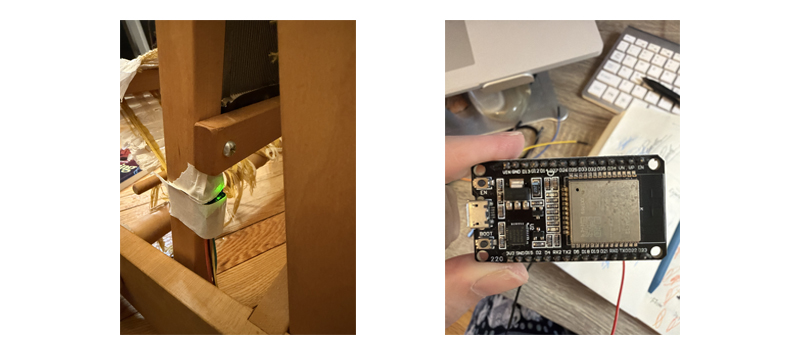
IMU Sensor with ESP32 for Sensing the Beater’s Rhythm
I began by experimenting with an IMU sensor attached to the loom’s beater using an ESP32 microcontroller. Code Here
The IMU sensor initially seemed like a good option because it could capture movement and acceleration from the loom’s beater. My goal was to sense weaving rhythm and translate bodily movement into interaction data. However, during testing, I realized that the IMU was not the best fit for this application.
One challenge was that the data coming from the sensor was highly sensitive and noisy. Even small vibrations, unintended movements, or slight shifts in orientation produced constantly changing values, making it difficult to reliably detect a clear “beat” or weaving action. Instead of capturing a simple rhythmic event, the sensor generated a continuous stream of fluctuating motion data that required heavy filtering and calibration.
Another issue was that weaving movements are relatively subtle and repetitive. What I actually needed was not complex spatial motion tracking, but a stable and dependable way to detect specific moments in the weaving cycle — such as when the beater reached a certain position. The IMU captured too much information for what the interaction required.
This experiment helped me realize that simpler sensing methods, such as Hall effect sensors with magnets or physical switches, were more appropriate for Gratitude Loom because they could provide cleaner binary states and more reliable timing data. In a way, this aligned with the philosophy of the project itself: the goal was not to capture every movement in high resolution, but to gently sense rhythm and presence through minimal, meaningful signals.
Dressing Up the Loom from Back to Font
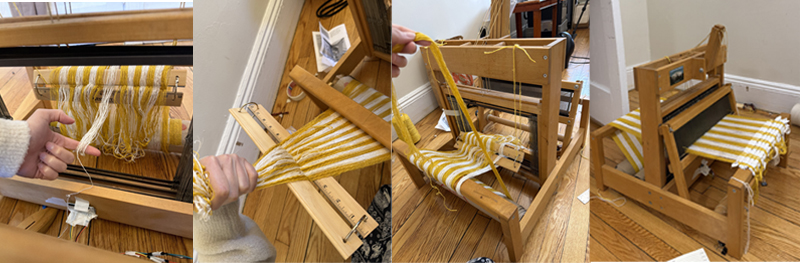
Dressing Up the Loom
I initially thought this process would be relatively straightforward because the previous owner had already partially dressed the loom. However, since I had never dressed a loom before, I ended up spending almost the entire week learning the process from scratch.
Special thanks to Marissa Renteria for generously answering my questions along the way and for openly documenting her own weaving journey, which became an incredibly helpful learning resource throughout this process. I also relied heavily on several YouTube tutorials to guide me through dressing the loom from back to front.
In many ways, this week became less about building technology and more about learning to understand the loom itself—its structure, rhythm, tension, and material behavior. That hands-on process later became essential to how I approached the interaction design of Gratitude Loom.
Week 8 — Electronic Design
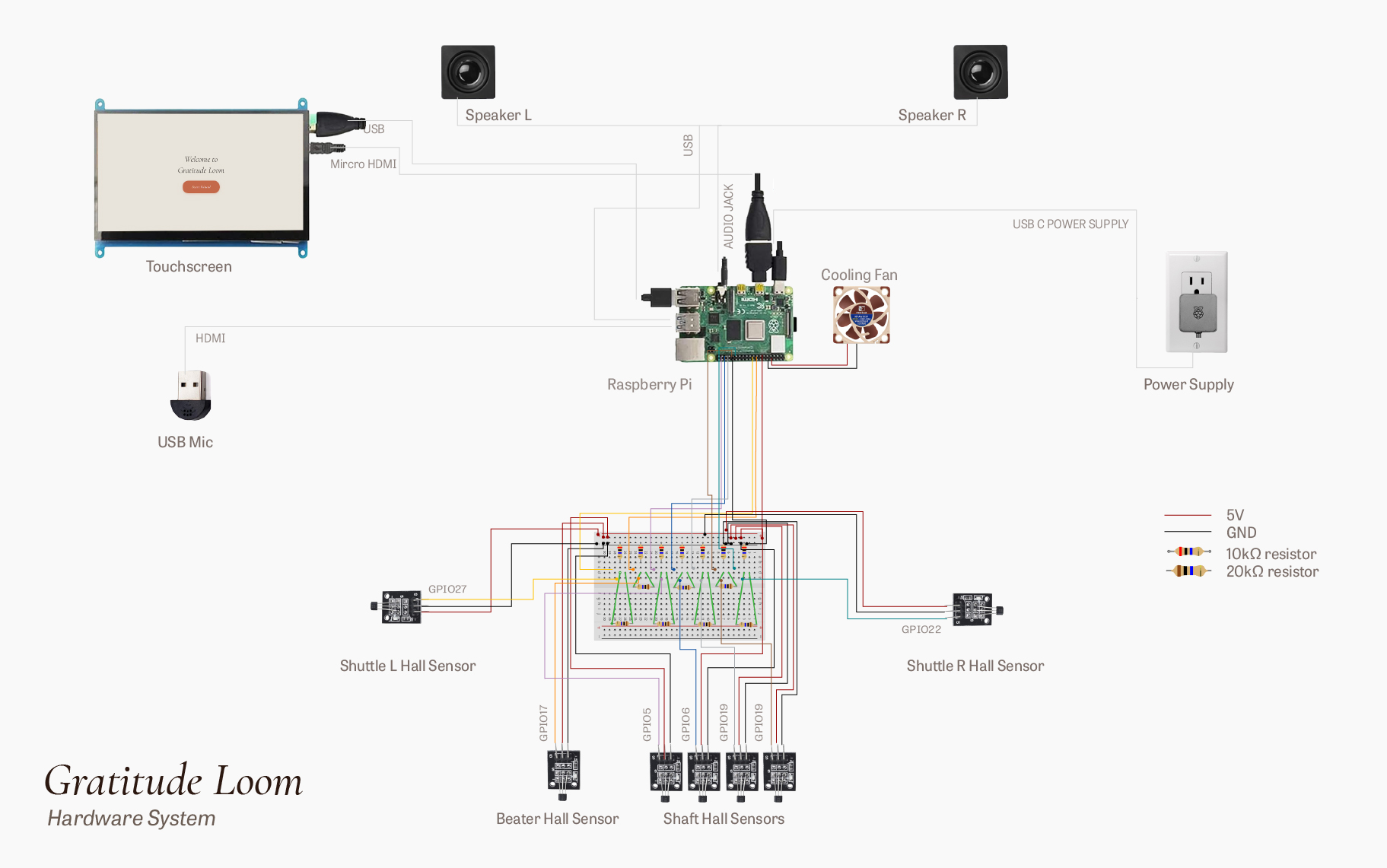
Hardware System Diagram — Pattaraporn (Porpla) Kittisapkajon
During the global mentoring session with Anoush Arshakyan, Emma Pareschi, and Louise Massacrier, I discussed several important questions regarding the technical and interaction design direction of Gratitude Loom.
One of my main concerns was deciding which sensing methods and computing platform would best support the kind of experience I wanted to create. I was debating whether to continue using an ESP32 microcontroller or move toward a Raspberry Pi for a more standalone and seamless system. I was also reflecting on whether the rhythm scoring system I designed might unintentionally punish the weaver for “not being present.”
This conversation helped me clarify the intention behind the interaction design. I realized the system was not meant to judge or penalize the weaver, but rather to use gentle forms of gamification and feedback to encourage awareness and reflection. The loom does not punish moments of distraction. Instead, it softly responds to sustained rhythm and attention over time.
Emma also suggested that simpler sensing methods such as touch sensors, light sensors, or Hall effect sensors might be more appropriate for the project than more complex motion tracking systems. This resonated strongly with me, especially after my earlier IMU sensor experiments produced unstable and overly noisy data. I realized that Gratitude Loom did not need highly detailed motion capture. What mattered more was being able to reliably sense small but meaningful moments within the weaving rhythm.
Although the ESP32 worked well for early sensing experiments, I realized the project was evolving beyond simple input detection. I wanted Gratitude Loom to function as a standalone interactive object with an integrated screen, microphone, speaker, and conversational interface. Since the project involved visual feedback, audio interaction, networking, and AI integration, Raspberry Pi became a better fit for the direction the system was moving toward.
Another reason I chose Raspberry Pi was the flexibility it offered during prototyping. Since I was still rapidly changing the interaction flow and experimenting with different sensing behaviors, working in a Python-based environment on the Pi allowed me to iterate and test ideas more easily.
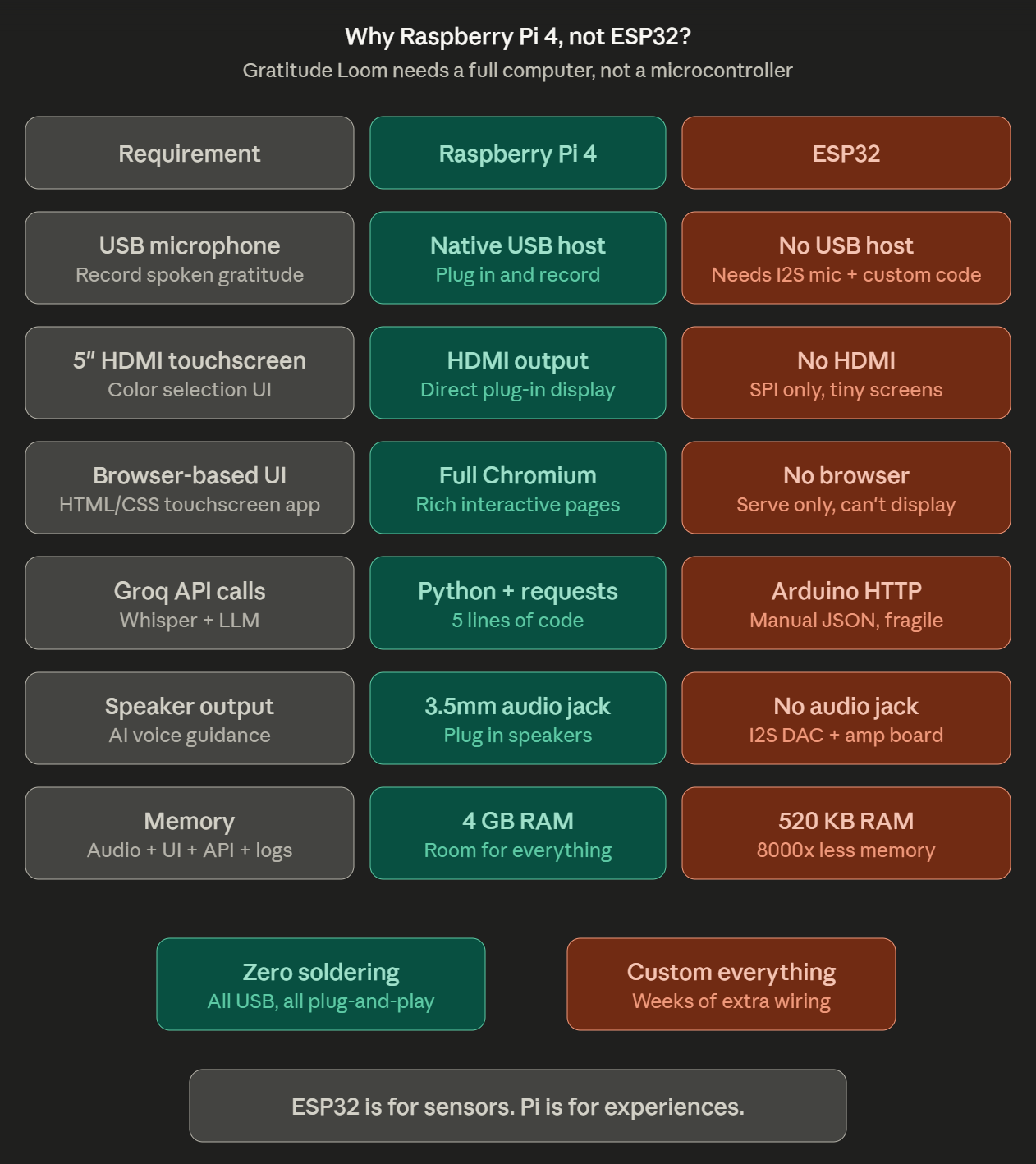
ESP32 vs Raspberry Pi comparison diagram generated using Claude AI by Pattaraporn “Porpla” Kittisapkajon.
This decision became an important turning point in the project. Instead of thinking of the loom as only a sensing device, I began thinking of it as an embodied interactive object capable of listening, responding, and evolving alongside the weaver over time.
Week 9 — Loom Design
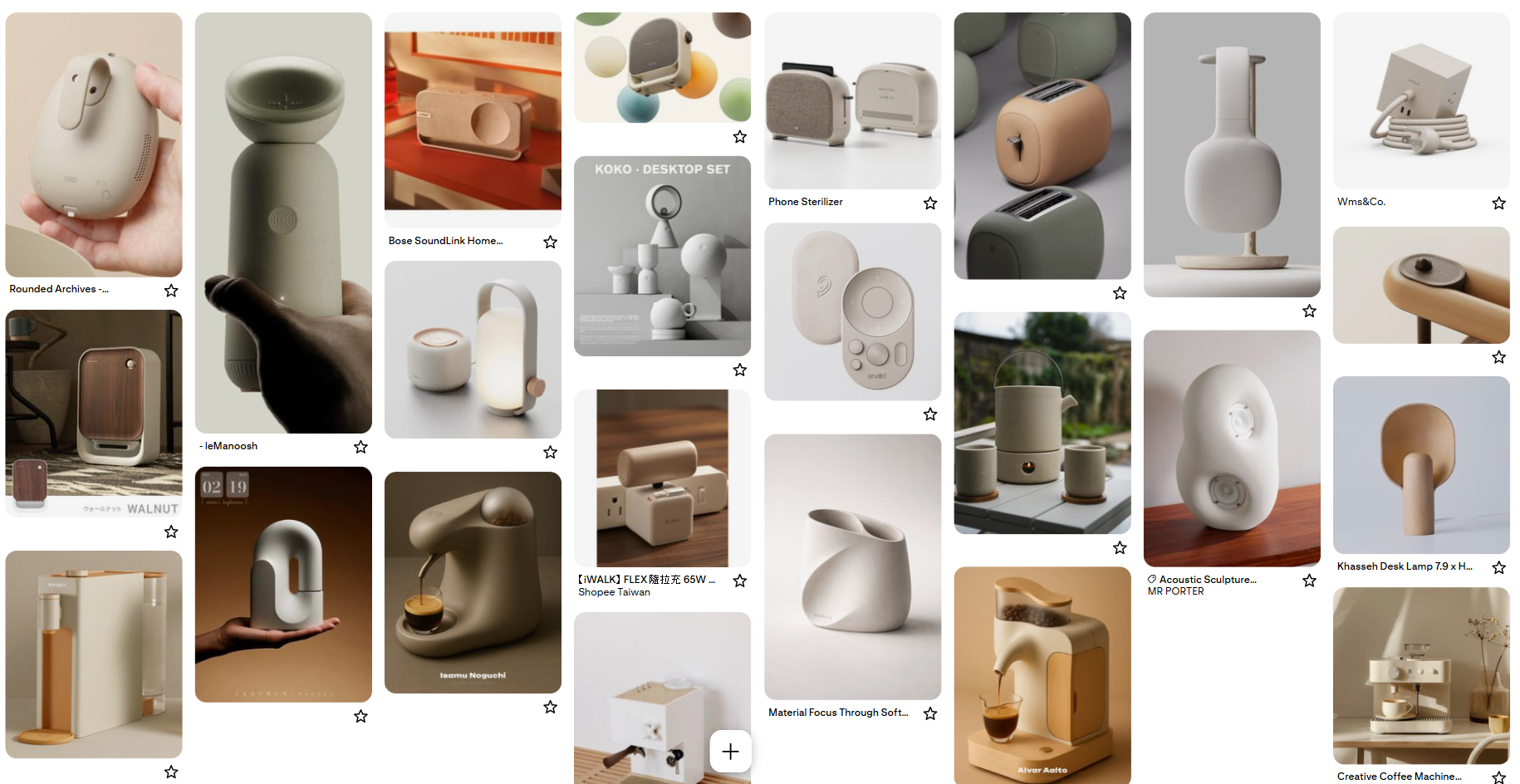
Loom Design Inspiration References Collected from Pinterest
I wanted the design of Gratitude Loom to feel seamless, calm, and muted — more like a slow ritual object than a technological device. Visually, I was drawn toward a soft Japandi-inspired aesthetic that could blend naturally with the existing wooden loom rather than overpower it with electronics.
From the beginning, I also wanted to preserve the integrity of the original loom as much as possible. Instead of permanently modifying the structure, I designed the electronic housings and attachments as modular 3D-printed components that could be assembled and disassembled without damaging the loom itself. This approach allowed the technology to remain lightweight, reversible, and integrated more respectfully into the weaving object.
However, this process took much longer than I initially expected.
One challenge was that I could not fully design the system until I finalized where each electronic component would be placed. The physical arrangement of the Raspberry Pi, screen, sensors, speaker, and wiring continuously influenced the form and dimensions of the printed parts. In many ways, the design process became an ongoing negotiation between the loom, the electronics, and the limitations of fabrication.
The most difficult part was creating 3D-printed pieces that fit precisely onto the loom. Since my 3D printing skills were still developing, I encountered many design and measurement errors throughout the process. Small inaccuracies in sizing often meant that parts would not align correctly, requiring multiple redesigns and reprints. This iterative cycle consumed far more time and filament than I anticipated.
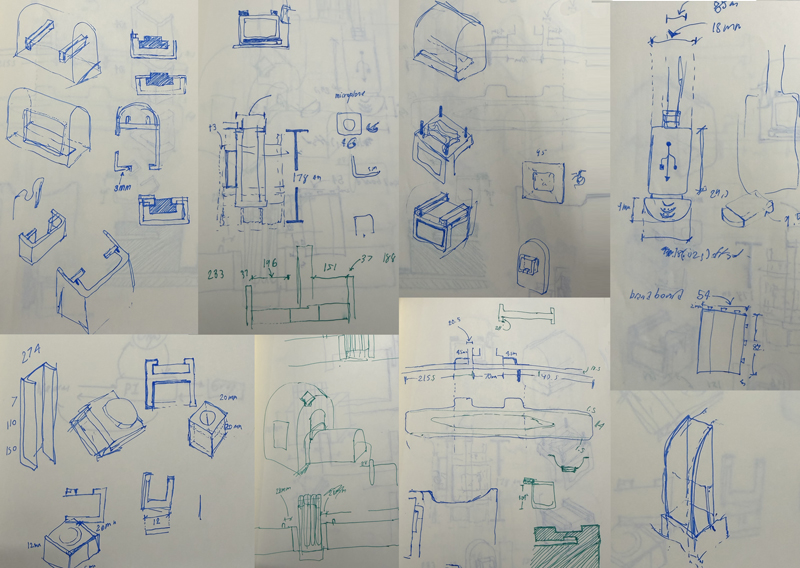
Loom Design Sketches by Pattaraporn (Porpla) Kittisapkajon
I began by carefully measuring the existing loom and electronic components before sketching different assembly ideas and enclosure structures. Although frustrating at times, there was also something deeply satisfying about finally seeing a printed component fit perfectly onto the loom.
Test Fitting 3D-Printed Components for Gratitude Loom by Pattaraporn (Porpla) Kittisapkajon
I continued printing and refining the parts almost until the weekend before the final presentation. Some of the larger components required many hours to print, which significantly slowed the iteration process.

Enclosure Assembly — Pattaraporn (Porpla) Kittisapkajon
Looking back, if I were to redesign the system, I would simplify the fabrication strategy and be more intentional about designing for reduced print time, material usage, and assembly complexity.
Week 10 — Storytelling + Interface and Interaction Design
At first, I was simply planning to create a video that explained what the project was and how it became Gratitude Loom. However, my mentor Louise suggested something that completely shifted my approach: the video itself should become the ritual.
I immediately connected with this idea. Instead of creating a conventional explanatory presentation, I began developing the storyboard around the feeling of the experience itself — focusing on mood, pacing, sound, rhythm, and atmosphere. I wanted the viewer to slowly enter the world of the loom rather than just intellectually understand it.
Gratitude Loom Storyboard by Pattaraporn Kittisapkajon
This perspective also influenced the interaction and interface design of the project. Rather than designing a highly informational or productivity-oriented interface, I focused on creating a softer and more contemplative interaction flow. The pacing of transitions, ambient sound, spoken prompts, and visual rhythm all became important parts of the experience.
During this phase, I found myself constantly multitasking between loom fabrication, interface design, interaction logic, coding, and presentation preparation. After spending so much time earlier in the semester developing concepts and research, I suddenly entered an intense period of production and iteration.
In a strange way, the long 3D printing times became helpful. While waiting for components to finish printing, I used the downtime to continue refining the interaction flow, interface visuals, and system behavior. The entire process became highly iterative, with each design decision influencing another part of the system.
The video below shows one of the early interaction prototypes. At this stage, the project was evolving rapidly through continuous experimentation and iteration.
Testing an Early Gratitude Loom Prototype by Pattaraporn (Porpla) Kittisapkajon
You can hear the sound of 3D printers running in the background. I was building, testing, and iterating at lightning speed while preparing for the final presentation. Looking back, these prototypes show the progression from a robotic AI voice toward something calmer, more human, and more ritual-like.
The first version of the Gratitude Loom used espeak, the default Raspberry Pi text-to-speech system. It was functional, but every time the loom spoke, the ritual broke. The voice sounded mechanical and disconnected from the experience I was trying to create.
I later switched to Edge TTS and eventually experimented with Orpheus TTS through Groq’s API. After testing multiple voices, I settled on Diana, whose slower and more expressive tone felt much more aligned with the atmosphere of the loom. Small details such as punctuation also became surprisingly important — exclamation marks and dramatic pauses could completely shift the emotional tone of the interaction.
The loom’s conversational system runs on Llama 3.3 70B through Groq’s inference API. I chose Groq primarily because of its low latency, allowing the loom to respond quickly enough to feel present during weaving.
A large part of the process became prompt engineering: teaching the loom how to speak without sounding instructional, performative, or overly technical. During weaving, Diana follows a strict set of constraints:
- Maximum two short sentences
- Use body-centered language such as hands, breath, rhythm, and cloth
- Never mention the technology directly
- No questions, instructions, or excitement
The goal was for the loom to feel less like an assistant and more like a quiet presence that witnesses the act of weaving.
I built this project with almost zero coding and hardware skills, and I was basically just vibe code in claude
Week 11 — IN PANIC MODE
Alright, it’s the week before the final presentation, and I am still 3D printing parts, coding, recording the presentation video, editing footage, and dressing the loom. The original thread that came with the loom from the previous owner did not show the woven patterns clearly enough to communicate the concept, so I decided to completely rethread it at the last minute.
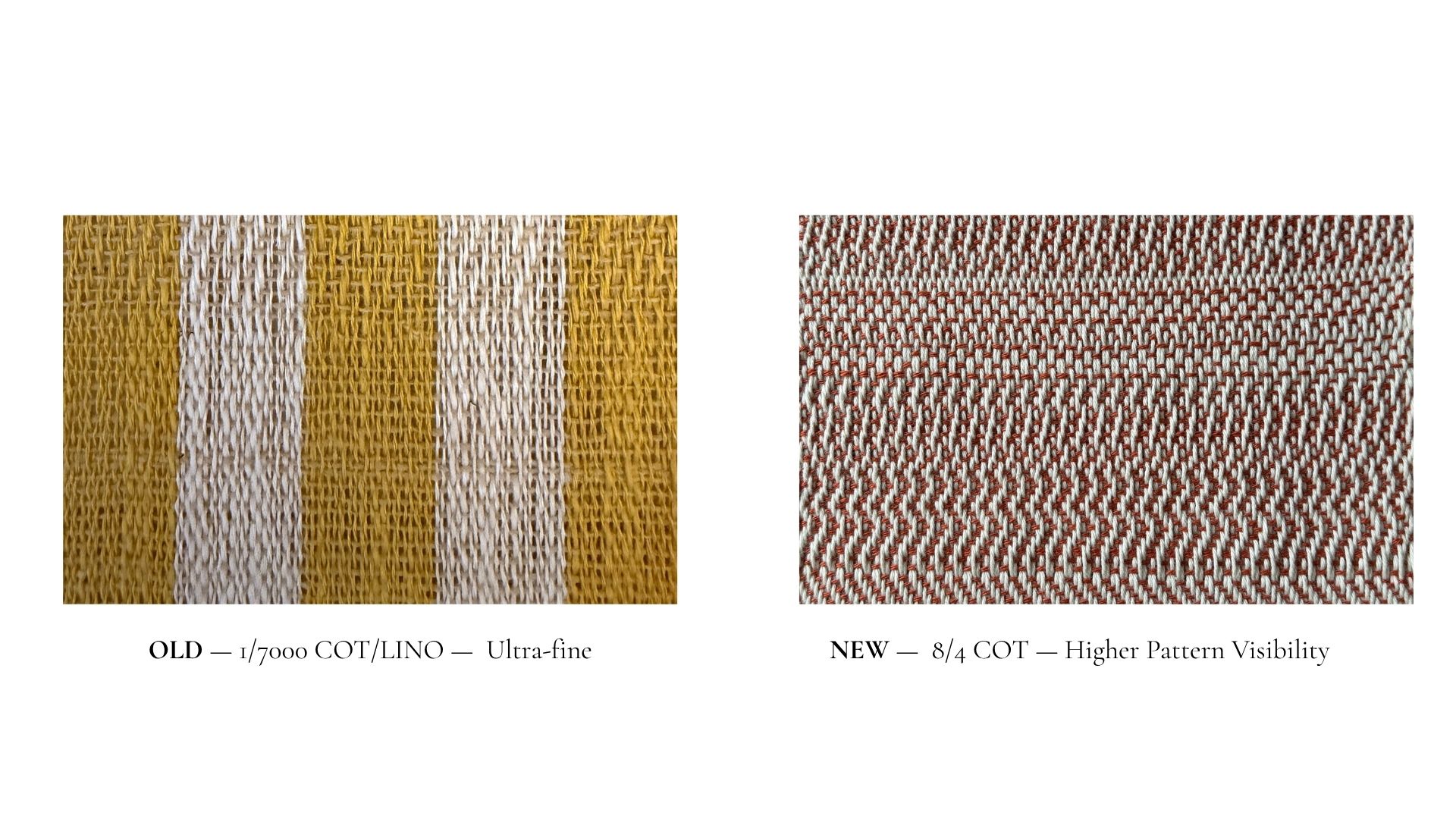
Comparison between the original thread that came with the loom and the new 8/4 cotton thread used to improve pattern visibility and texture readability.
I was incredibly lucky to have friends and family helping me rethread the loom while I continued working on other parts of the project. I only knew part of the dressing process myself, and they had no weaving experience at all, so we ended up learning together through YouTube videos while dressing the loom so I could continue working on other parts of the project.
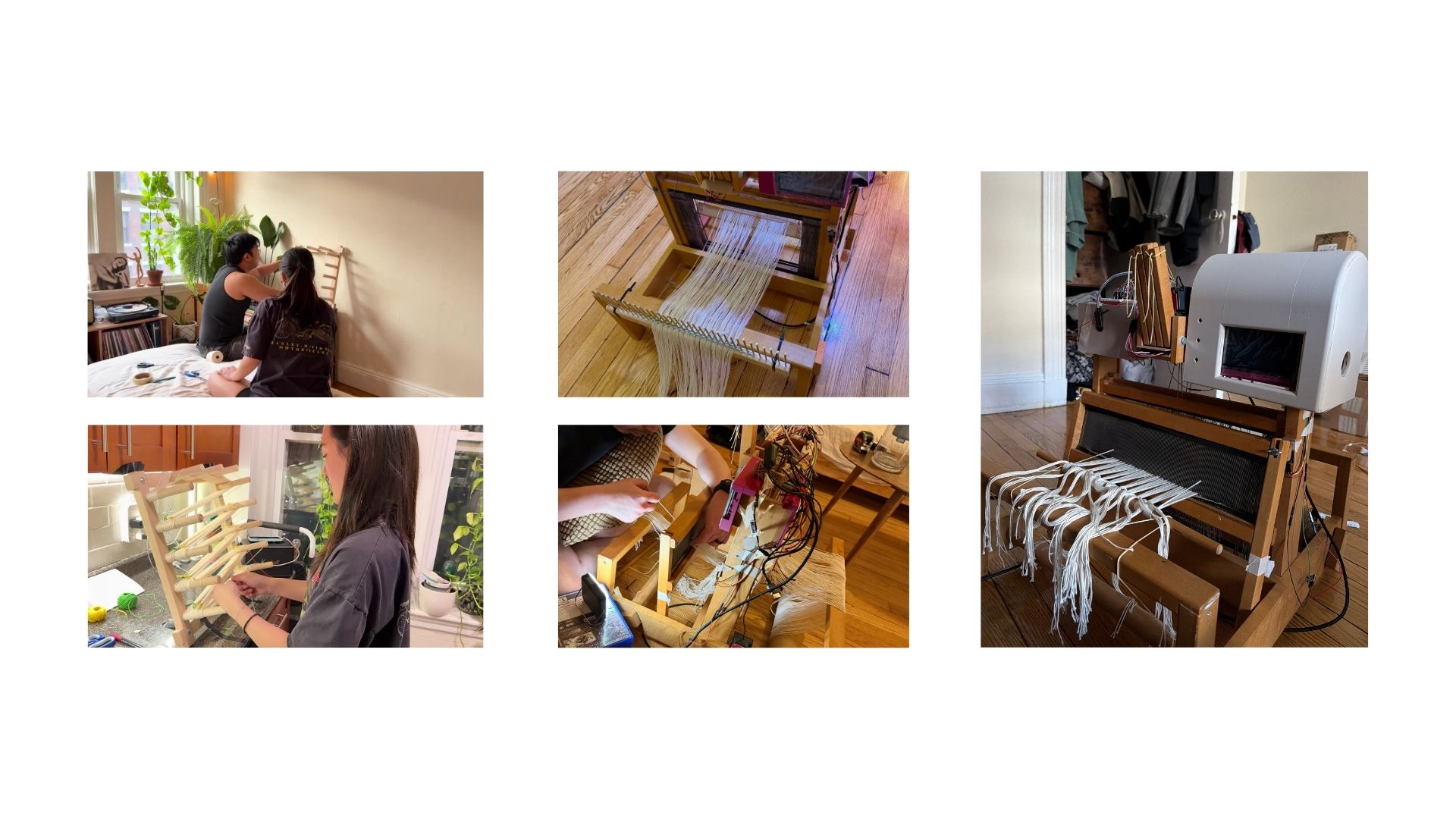
The video production process also involved many retakes to better capture the ritual experience. One challenge was continuity: every time we wove, the textile pattern visibly changed, making it difficult to film repeated shots of what was supposed to feel like one continuous ritual.
After our first recording session, I ended up coding a specific scene interaction so we could repeatedly recreate the same sequence and maintain visual continuity between takes — a strange but useful lesson learned during production.
One thing I still have not fully figured out is how to visually communicate rhythm through video. In the final documentation, it is not immediately obvious how sustained rhythm gradually deepens the woven pattern, or how interruptions in rhythm soften the structure over time.
Part of the difficulty comes from the way the footage was recorded. Each shot was captured at slightly different rhythms, speeds, and moments in the weaving process, making it difficult to clearly show the system responding consistently over time. Unlike a live interaction — where rhythm is felt continuously through the body — the video is fragmented into many separate clips stitched together afterward.
Because of this, the relationship between continuity, rhythm, and pattern progression became harder to communicate on screen than it felt during the actual weaving experience.
Week 12 — Final Presentation & Final Thoughts
Fabricademy 2025-2026 Final Projects Day 3
I backloaded much of the prototyping and fabrication toward the end of the program, which made the final weeks especially difficult. In fact, I was still editing my presentation video on the morning of the final review — not my proudest moment, especially since I missed some of my cohort’s presentations because of it.
Despite the chaos, I left the presentation feeling deeply encouraged. It meant a lot to realize that there are audiences who genuinely resonate with the kind of work I am trying to create. Troy’s comment about pushing the slowness of the project even further, along with Claudia’s question of whether the loom could have a memory, are ideas I am excited to continue exploring in future iterations.
Like Marissa and many others in the program, I felt completely burned out by the end of Fabricademy.
Despite the stress and exhaustion, this experience was incredibly meaningful for me. Gratitude Loom helped clarify the kind of work I want to continue pursuing in the future — work that exists between ritual, embodied interaction, material practice, and technology.