Circular Open Source Fashion
1. Objective
Weekly assignment
Learning outcomes
- Research skills: the participant has acquired knowledge through references and concept development
- Design skills: the participant has learnt through sketches & prototypes, material choices, 2D vector design
- Fabrication skills: the participant acquired skills necessary for laser cutting, digital workflow, assemblying, material used and leftovers
- Process skills: Anyone can go through the workflow, understand it and reproduce it
- Final outcome: The assignment is assembled and either complete or tested
- Originality: Has the design been thought through and elaborated?
Student checklist
- Include some inspiration: research on artists or projects that work with modules and zero waste systems
- Document, Design and prototype with paper and scissors modular configurations and interlocking connections
- Document, Design and prototype digitally your modular configurations and interlocking connections in 2D
- Document the process of testing and laser cutting your designs, including the machine settings, material type and thickness
- Laser cut the modules. Create a modular or seamless garment, showing that the connection is well-designed and holds the pull/stretch.
- Document the assembly process and tests
- Upload the fabrication PDF file at oscircularfashion.com, in 1:1 scale accompanied by 1-5 pictures (preferably in white background)
2. References, research & inspiration
Afer the session by Zoe Morano on the Open Source and its relation to technology, fashion, and maker culture, The secondf part of the session and this week's topic was Circular fashion, where the idea is to reduce the waste generation during the production of clothing by a the designing things in a way they retain their maximum value for longer and by making them safer and easier to return to nature. The way we are approaching this is by designing in modules and with a "zero waste" philosophy.
And thus, the second part of the session was about modular clothing, tiling, and tessellations. There are some interesting projects on the subject that I saw from Fabricademy Alumnis. And the oscircularfashion.com was a great resource as well. They explored various applications, like clothing, accessories, packaging storage as well as various interpretations for "zero waste" and "circular fashion".
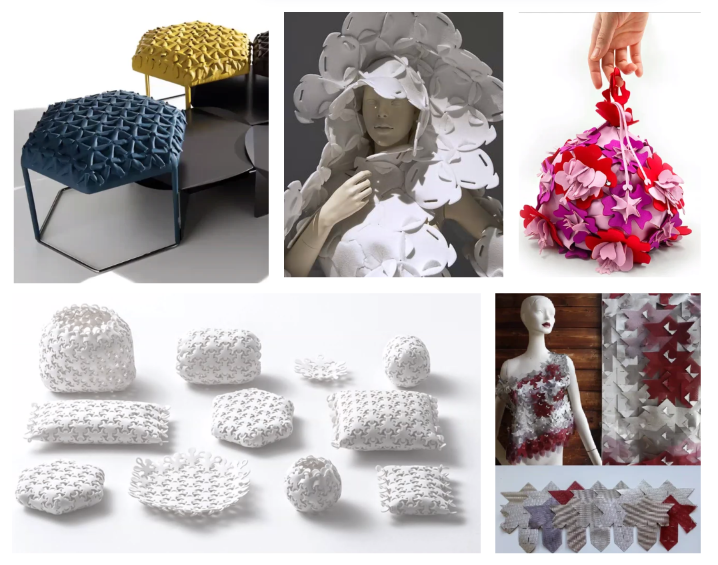 { }
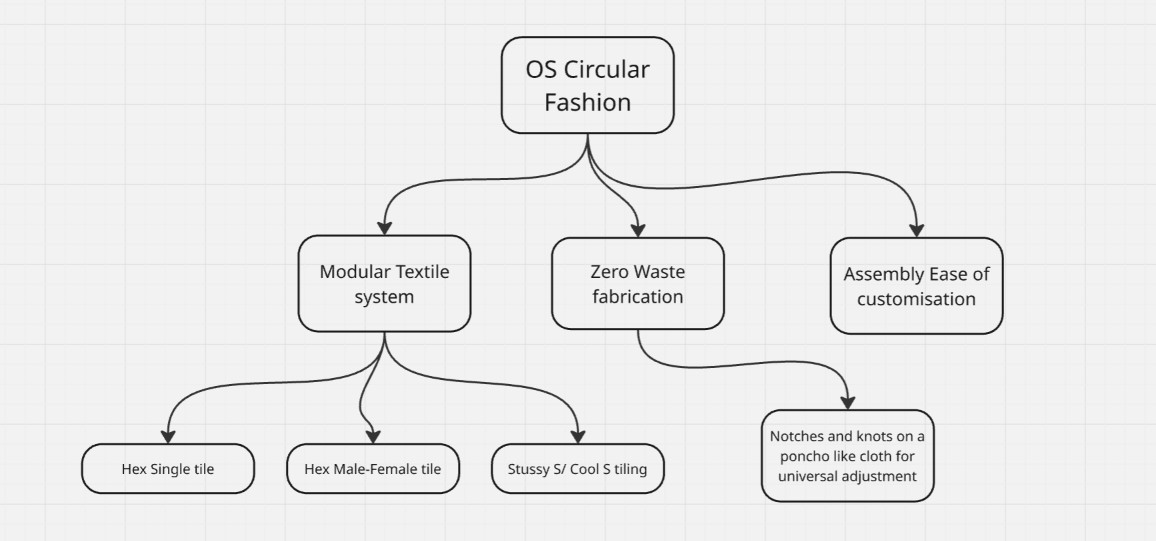
But the subject of tiling and tessellations was reminding me of some of my favourite math youtube channels - like standupmaths and numberphile, but above all the one phrase kept coming back, Hexagons are the Bestagons by CGP gray, and thus my first approach to this week assignment was to explore hexagonal tiling. While researching in the math side of things I also came across aperiodic tiling and archemeadean tiling, I particularly liked the ordered chaos in these to designs which would be fun to try.(In the business, we call it "Forshadowing")


Another concept that I was looking forward to explore was creating a supertile, a repeating unit of tile, that is created by smaller tiles, and for that I was looking at some eccentic and cool shapes, and what can be cooler than the "Cool S" or "Stussy S"

One more concept that was discussed during the session was the use of Origami and Kirigami in circular fashion, to make items change their shape and size. origami kirigami images
Thus, The plan for the week was in two stage, to explore the hexagonal tilings, aperiodic tilings, and supertile. And explore the application for the panels created during first stage.
3. Process
. Weekly reflection & critical thinking
NuEval — final step
Go to NuEval and fill in the checklist, when not complete notify your instructor.
7. Fabrication files & References
-
File: Laser cut sheets ↩
-
Reference: Author; Title; Source; year ↩