Concept
Motivations & Inquiries
How can modularity be used to aesthetically alter silhouette and fit?
Unlike ready-to-wear fashion, which relies on standardized sizing and mass production, costume design is fundamentally a uniquely body-specific and highly individualized practice. The disciplin offers a responsive approach to garment design, with the expectation that the clothes adjust to the body and drive the aesthetic decision-making. This project aims to develop design strategies for both the entertainment and apparel industry that allow for easy, functional fit adjustments that can accommodate a wearer’s body as it changes over time.
How can modularity create interchangeable garments that can be repurposed for different functions and contexts?
Prior to the industrial revolution, garments were often constructed with the assumption they would be altered to adapt to changing uses and styles. This concept of built-in adaptability is still employed in the entertainment industry, where costumes are constructed to be altered and refit to adjust to the needs of different bodies and productions. This project hopes to revisit this practice to offer new methodologies for clothing the body that support deconstruction and reconstruction as a fundamental part of the garment's life cycle, and inherently resists its obsolescence.
How can modularity be explored in more sustainable ways?
The current landscape of modular garment design is heavily dominated by examples that rely on non-biodegradable, often synthetic materials, or rigid, 3D-printed plastics. This prevalence presents a significant limitation in terms of material sustainability and the tactile experience of the garments. This project aims to explore and develop more sustainable and versatile approaches through practical experimentation with the bioplastic fabrication methods and the development of textile scaffold techniques introduced within the Fabricademy curriculum.
Who
I am Alison Heryer, a Portland-based designer, educator, and socially engaged artist. With two decades of experience as a costume designer in the entertainment industry instilled in me a profound respect for handcrafted garment construction. Through my work with Fabricademy, I am now merging that appreciation with digital fabrication to explore more sustainable methods for creating clothing.
What
For the final project I will create a garment prototype that can be reconfigured in multiple ways to adapt to the specific needs of the wearer. My research will focus on how modular design techniques can be sustainably incorporated into garment construction using 3D fabrication and biomaterials to create adaptive garment systems. By investigating historic garment silhouettes through modern tools like CLO3D and 3D body scanning, I aim to develop customizable, reconfigurable patterns that allow clothing to adjust to a wearer’s body as it changes over time, inherently resisting the obsolescence built into the modern fashion industry.
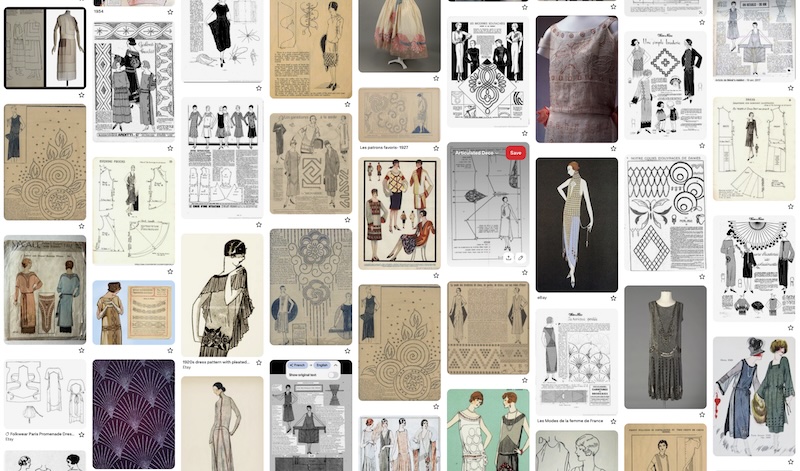
For this project I am using Pinterest as a moodboard platform where I can collect and tag images related to this project. My initial pass of image research can be found at this link. It includes historic approaches to zerowaste patterning, recofigurable closure systems, and modular appliques.
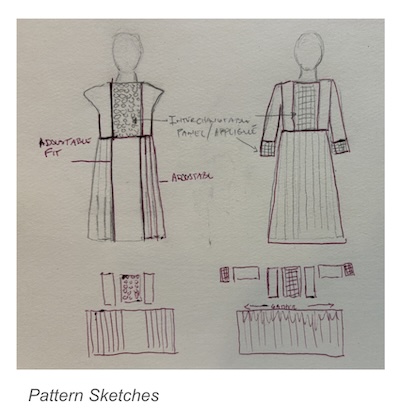
The initial sketches below show some potential silhouettes and with interchangeable pattern elements.
The project will build on the discoveries made during Fabricademy assignments that explored modular garments and 3D printing seen below.
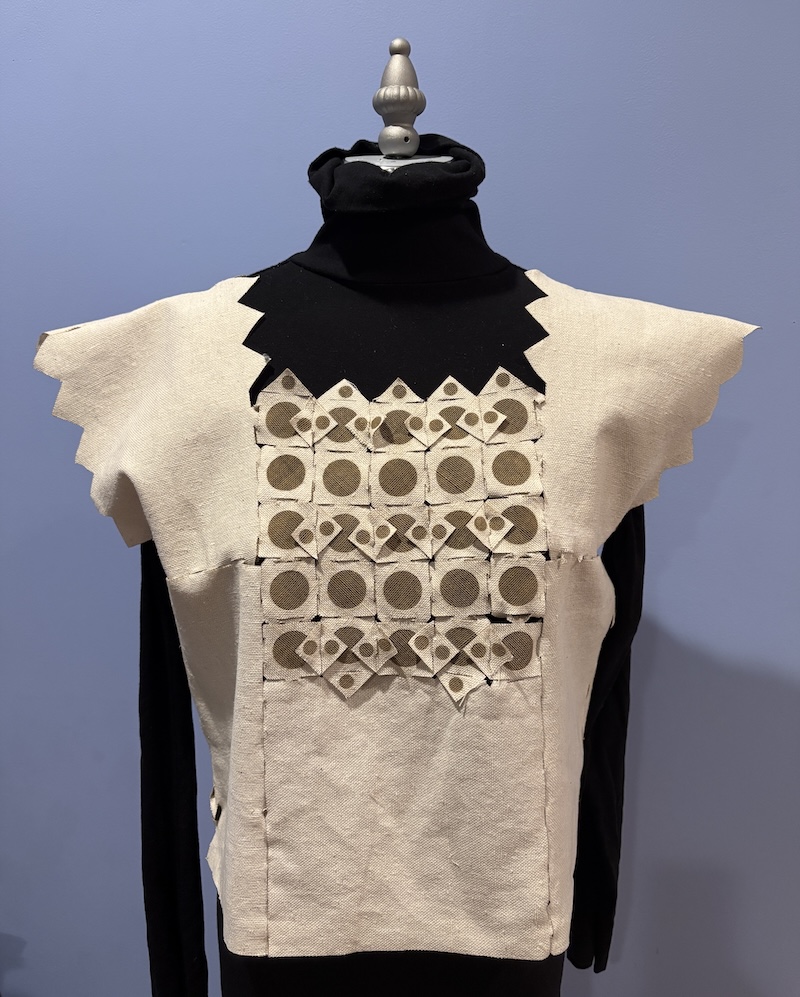
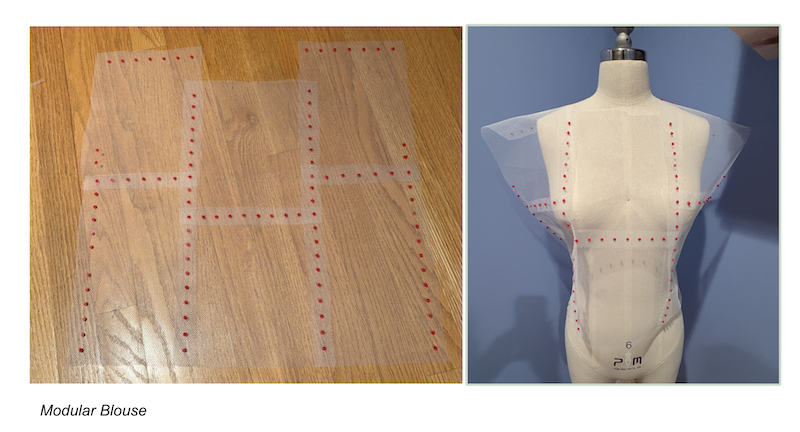
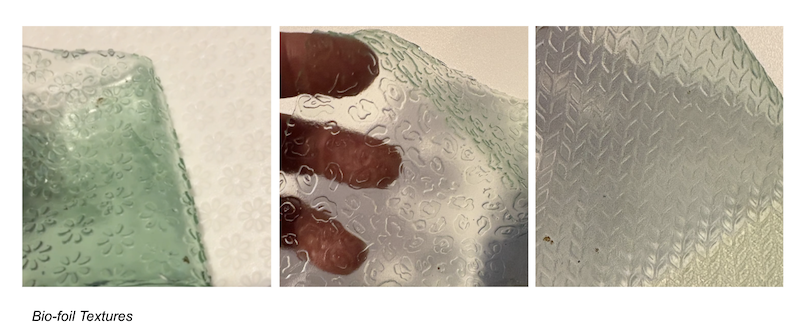
Additional prototypes and material exploration can be found on my Process page.
Where
I will be working out of my personal studio where I have an Xtool M1 Ultra Crafting Machine and a Bambu Lab A1 3D printer.
When
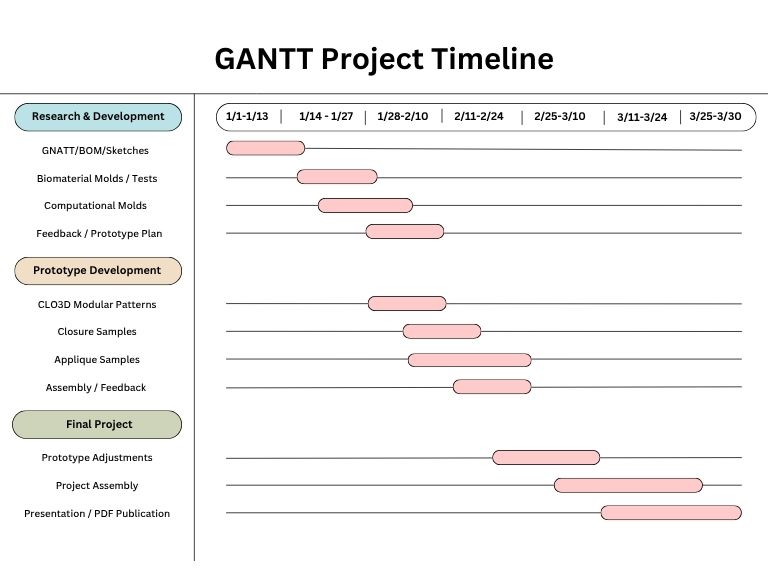
In the GANTT timeline I created I identified three phases of investigation.
Research and Development: During the first phase I will focus on expanding my knowledge of biomaterials, specifically exploring the possibilities of molding and 3D printing and researching historical zero-waste patterning methods that I can virtually prototype using CLO3D.
Prototyping: Using feedback on the artifacts generated during this phase, I will develop virtual prototypes of size-adjustable garments that can be adapted to fit two different bodies with interchangeable bioplastic appliques.
Documentation & Presentation: Video and photography are not a strong skill for me. I intentionally left time at the end of this project to be able to refine the imagery and storytelling for the final presentation and publication.
Why
The modern fashion industry is built on a foundation of planned obsolescence. It is a model that treats garments as disposable commodities rather than durable goods, prioritizing quick cycles and cheap labor over longevity. Conversations around sustainable fashion often center on waste and are usually accompanied by images of mountains of synthetic fabrics in impoverished regions where "donations" become a local environmental catastrophe. For the individual consumer, this problem can feel insurmountable. Seeking to transform our relationship with clothing, this proposal introduces a garment system designed for lifelong durability. By implementing modular techniques for adaptable fit and aesthetics, the project aims to proactively prevent apparel from entering landfills.
Research
In my initial round of research, I found the following articles that investigate how digital fabrication is being used to explore the different techniques I hope to employ in my project.
-
Fanglan, Z., & Kaifa, D. (2021). Innovative application of 3D printing technology in Fashion design. Journal of Physics. Conference Series, 1790(1), 12030. https://doi.org/10.1088/1742-6596/1790/1/012030
-
Porterfield, A., & Lamar, T. A. M. (2021). A framework for incorporating virtual fitting into the costume design and production process. International Journal of Fashion Design, Technology and Education, 14(1), 91–100. https://doi-org.proxy.lib.pdx.edu/10.1080/17543266.2020.1864484
-
Musto, Michela. (2025). Fashion’s future: the power of biomaterials and digital manufacturing for systemic sustainability. TECHNE - Journal of Technology for Architecture and Environment. 60-64. 10.36253/techne-16819.
-
Pasricha, A., Greeninger, R. Exploration of 3D printing to create zero-waste sustainable fashion notions and jewelry. Fash Text 5, 30 (2018). https://doi.org/10.1186/s40691-018-0152-2
-
Zhang, Xiaoqing & Normand, A & Yan, S & Wood, Jane & Henninger, Claudia E. (2024). What is modular fashion: Towards A Common Definition. Resources, Conservation and Recycling. 204. 107495. 10.1016/j.resconrec.2024.107495.
References & Inspiration
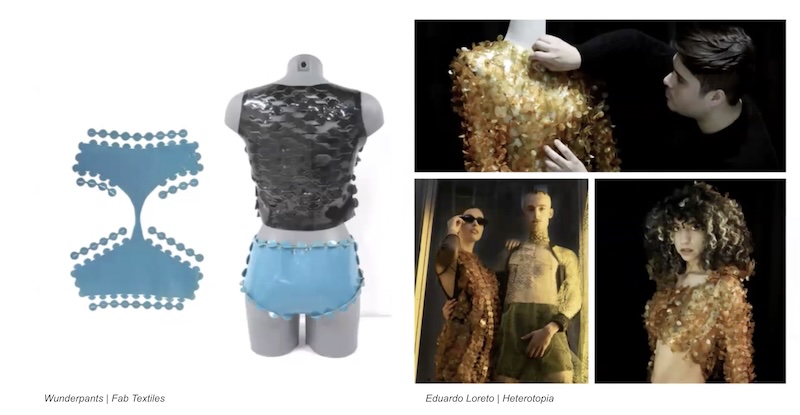
Over the past twelve weeks, I have become particularly interested in using digital fabrication processes that allow for the incorporation of biomaterials into modular garment designs.
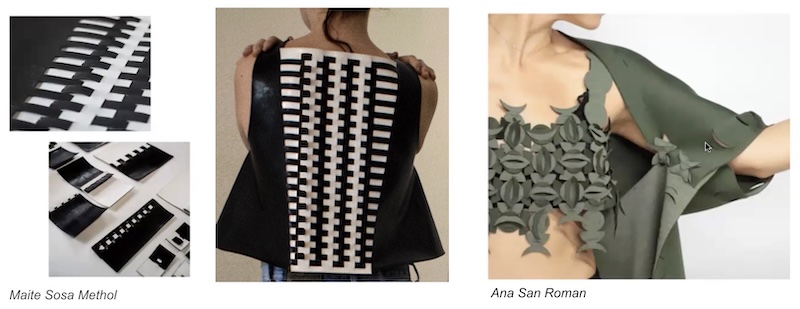
During the Open Source Circular Fashion Week, I was inspired by the modular strategies used by Maite Sosa Methol and Ana San Roman to engineer decorative joint connections and intricate surface texture. The idea of garments with interchangeable, adjustable parts is exciting and practical for the field of costume design, because of the way garments are frequently reworked for different bodies and narratives.
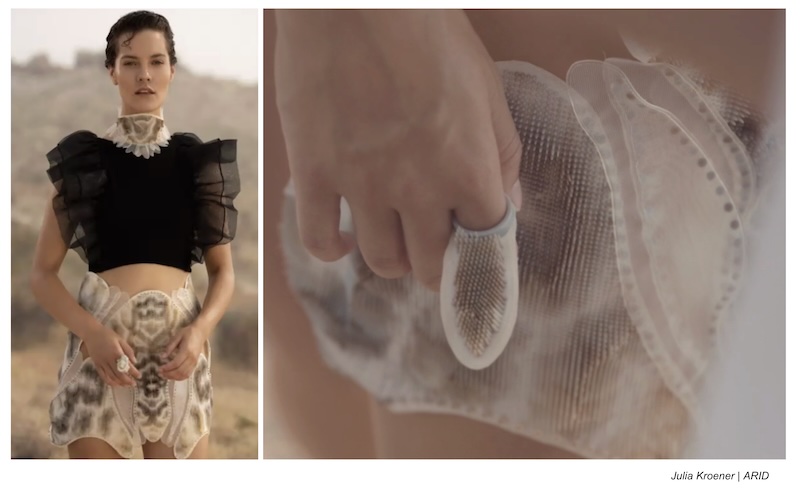
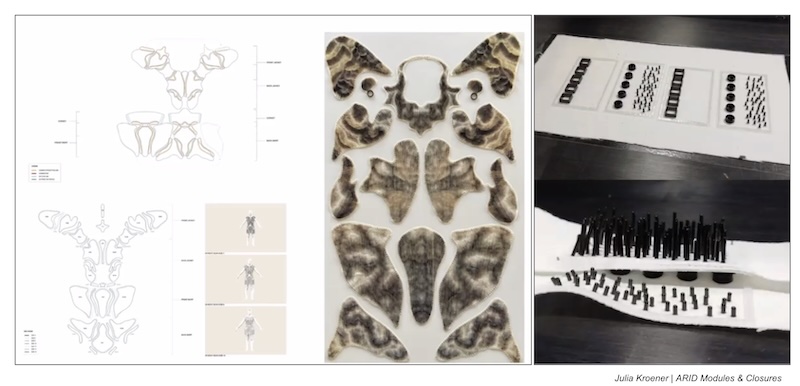
I was also very inspired by the process that Julia Kroener shared for creating the garments from her ARID collection during the Computational Couture.. I was specifically interested in the way she used CLO3D to sustainably prototype the modular patterns and the extensive research she did around embedding 3D printed closures into the fabrics to enable secure methods of attachment.
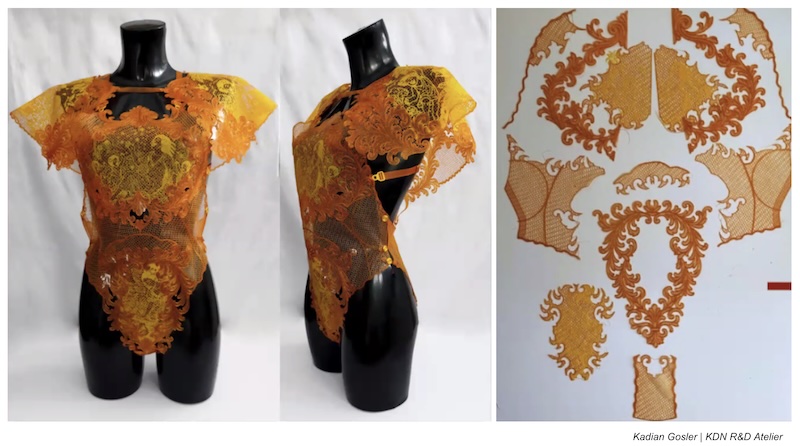
Another source of inspiration that week was Kadian Gosler’s work with recreating traditional lace patterns for lingerie using 3D printing. As a designer who works extensively from historical garment references, I am eager to find ways of integrating these strategies into my period costuming work using biodegradable materials.
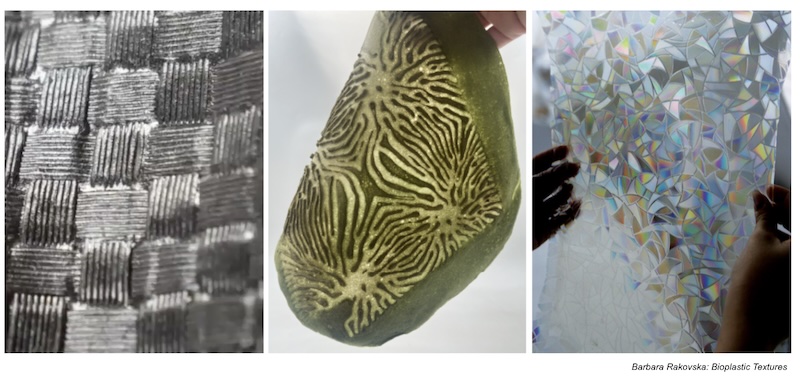
This brings me to Week 7 where I was very inspired by Cecilia Raspanti’s presentation and the material properties that Barbara Rakovska was able to achieve with gelatin and algae based bioplastics. In my own experimentations following this lecture, I have explored creating textures by skimming bioplastics over etched surfaces and embedding them into fabric using 3D-printed molds.