Concept | Liquid Gestures
Liquid Gestures is a project that explores the translation of bodily movement in water into a visual and material language. Based on the analysis of trajectories, the project proposes a system in which bodily gestures become data, data becomes patterns, and patterns become structures applied to the body.
Beyond an aesthetic representation, the project aims for the pattern to function as an interface between movement, material, and body, demonstrating how computational design can materialize dynamic phenomena into tangible objects. Through the use of technical textiles, digital printing, and modules manufactured via 3D printing, a dialogue is established between flexibility, structure, and flow.
This project is also understood as a personal process of experimentation and learning. Throughout its development, parametric design has been used not only as a tool for formal generation but as a means to understand relationships between data, geometry, and material behavior. Similarly, the application of digital fabrication techniques has allowed these explorations to be brought into a physical context, confronting real-world decisions regarding scale, materiality, and assembly. The project proposes a way of designing in which the process, experimentation, and iteration are as relevant as the final object, establishing a foundation for future explorations within parametric design applied to the body and textiles, as well as personalization.
Concept first Proposal from Monse Islas
Download presentation here
5 Ws who, what, when, where, why
WHO
- Personal experiences
- People who have an intimate relationship with water
- Swimming or diving underwater as a way to connect with water
- Can be applied to any type of underwater immersion
WHAT
- Physical representation of the relationship with water
- Personalized textile artifact/ garment that functions as a material record of movement and identity
WHEN
- During the inmersion
- During aquatic movement
- During data recording and translation
- Period from January to March
WHERE
- The project operates across multiple environments:
- In water, where movement originates
- On the body, where the object is worn, activated, and aged
- In the fabrication lab at IDIT Ibero Puebla, where patterns and materials are developed
WHY
This project responds to the need for textiles that: - Are deeply connected to the body that generates them - Resist anonymity through personalization and embodied data - Value time, care, and long-term use
RESEARCH
Movement is one of the most fundamental ways in which the body interacts with its environment, communicates information, and expresses emotions, intentions, and physical states. Beyond a just mechanical action, movement can be understood as an expression of physicality that reflects the relationship between perception, space, and experience
LABAN MOVEMENT ANALYSIS
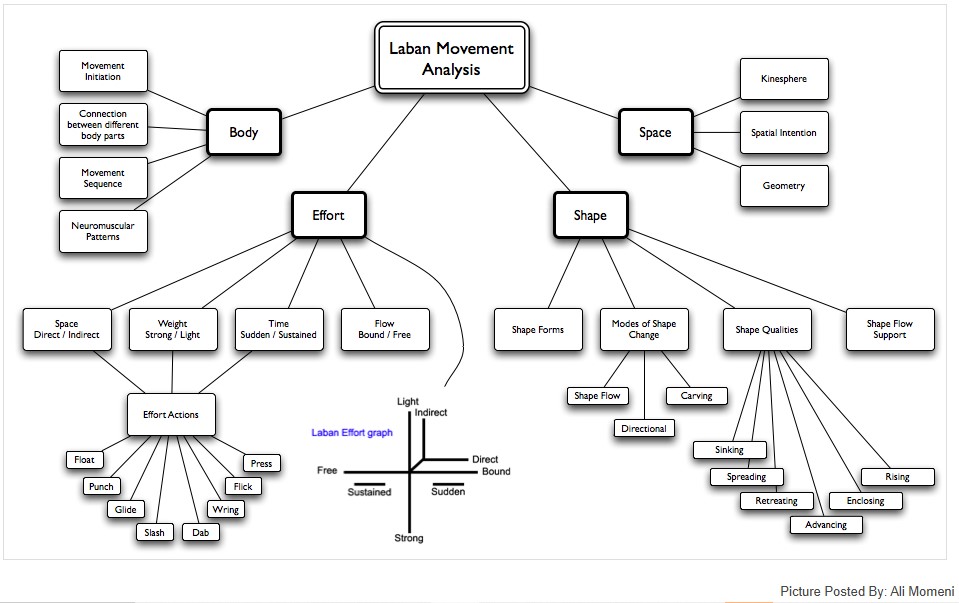
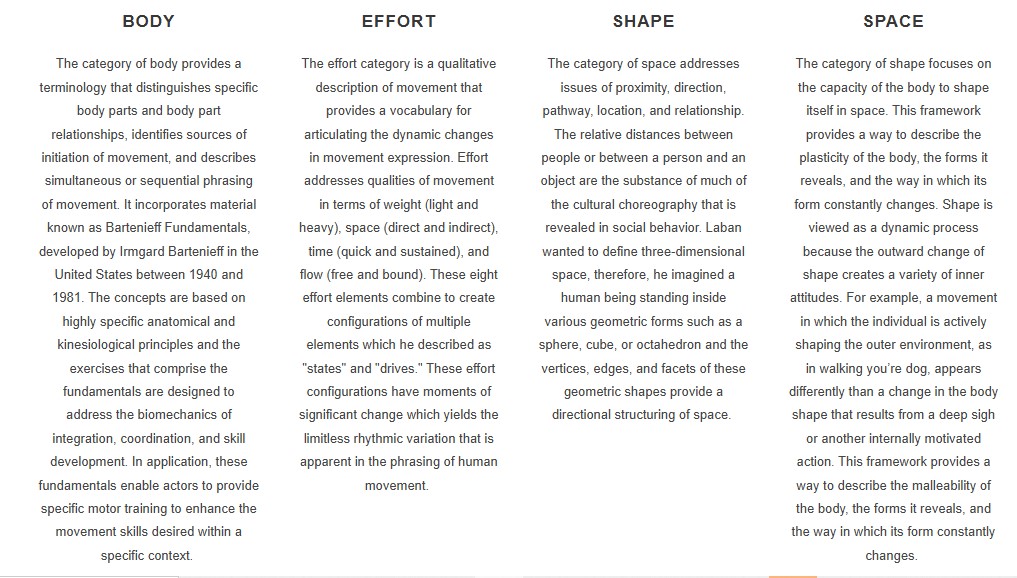
One of the metodologies that helped me to understand more about movement was the Laban Movement Analysis (LMA) wich is an effective system for observing, describing and understanding human movement and what it expresses. It is widely used in the fields of dance, theater, dance therapy, physical therapy, sports, and psychology. It was proposed by Rudolf Laban, who is considered as the most important movement theorist of the twentieth century and the founding father of modern dance in central Europe. He considered human movement as both a science and an art that embraces a continuum from nature to spirituality. I believe that this system aligns with my project on the study of movement in swimming as a structurable body language, as it provides a theoretical basis for the idea that movement can be analyzed, broken down, and translated into visual systems.
MOVEMENT UNDERWATER
The space in which the body moves directly influences the way its trajectories unfold and are perceived. One of the environments that most significantly alters bodily behavior is water, as its physical properties generate constant interaction between the body and the environment. The density and resistance of water condition every movement, producing more continuous, expansive, and organic movements than those performed on land. This interaction allows for a clearer observation of aspects such as the rhythm, cadence, power, and fluidity of bodily gestures.
COMPUTATIONAL DESIGN AND BODY IDENTITY
How does generative and parametric design influence this system?
Generative design is a solution that, through the use of algorithms, automatically generates different design alternatives based on user-defined parameters. Unlike traditional product design methods, in which the designer manually creates iterations, this “algorithmic design” generates multiple and varied solutions in a short amount of time, using parameters that determine the design. Part of the essence of this project involves the use of generative design; however, while it offers many benefits such as time efficiency and feasibility, the goal of this project was to combine the innovation of generative design with traditional practices within the textile industry, creating a kind of ally rather than a replacement, since it is possible to humanize highly technical and technological processes by using personalized information. In the same way this concept is essential to understanding the user’s relationship with personalized products, as it enriches that relationship and enhances the user’s sense of identity.
Bodily identity refers to the set of physical, perceptual, and expressive characteristics that enable each individual to relate to their own body and distinguish themselves from others. Beyond physical appearance, this identity is constructed through the way a person occupies space, moves, and interacts with their environment. Each body develops unique movement patterns influenced by factors such as experience, context, physical abilities, and habits acquired over time.
References
Moving Shapes
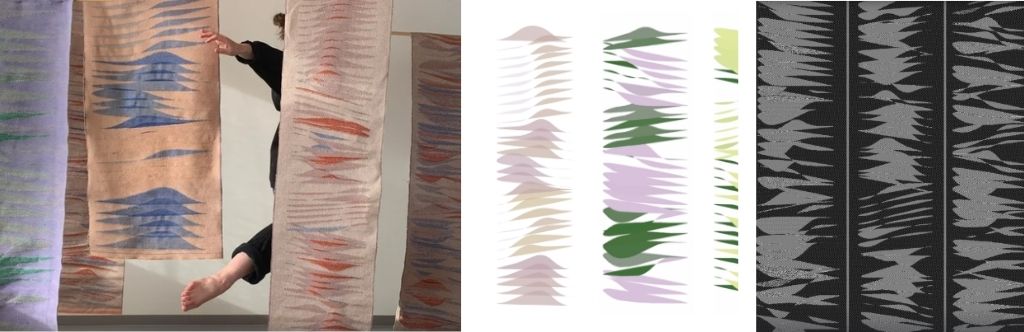
As I had mentioned before, the first reference for this project was "Moving Shapes" from Margrét Katrín Guttormsdóttir, what makes this reference particularly relevant to Liquid Gestures is that the designer does not merely represent the shape of the body, but seeks to capture an intangible experience: the feeling of liberation and well-being that movement produces when dancing. She explored the relationship between parametric design and textiles, transforming bodily trajectories into patterns capable of communicating emotions and sensations through the material. I liked that this project proposes a constant transition between the physical and the digital: the body’s movement is recorded, processed using computational tools, and subsequently translated into textile structures.
*3D Printed sound
One of the projects that helped me to clarify the posibilities of bring data into form was from Evette´s Niche,since both projects share the goal of capturing transient phenomen and transforming them into tangible elements, in this case she used the sound of the ocean that produce data that can be translate into an fashion garment.
Maite Sosa Methol`s
Maite Sosa Methol's “Movement” project (Fabricademy MVD 2021) inspires the idea that body movement can function as a parameter for generating geometry and design, showing that movement data not only analyzes but also formalizes and materializes design processes.
Moodboard
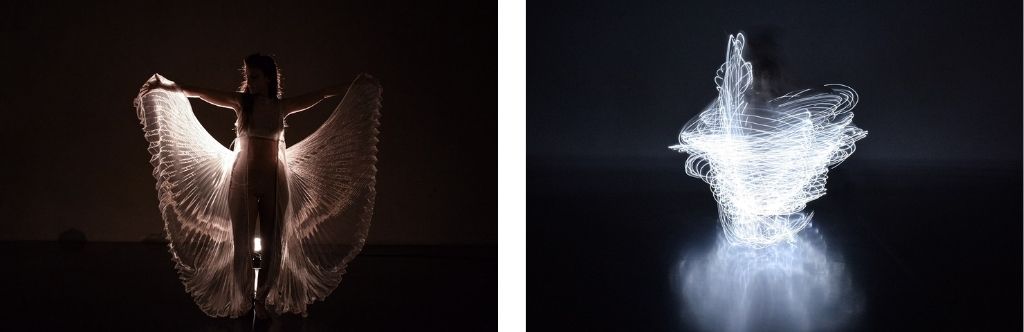
Part of the inspiration for this project’s aesthetic came from the fluidity and properties of water, specifically its color palette and forms, as well as the organic silhouettes it creates and the calm and peace that come from immersing oneself in it, but also from the power, strength, and rhythm generated by the body’s movement.
CMoodboard from Monse Islas