Digital bodies
Thoughts and inspiration
Future Story - AIrielle
"What a silly story", they thought and touched her little, green, shiny scales, as if they were new to them, "And so many mistakes. We don't speak like that under water and we don't have hair. Seapeople don't look like that." The 8 year old switched off the hologram. "Mum?" they asked. "Yes, my little catfish?", the answer came from behind the next coral. "I'm glad we have the Babelfishies.", the child said, thoughtfully touching the small bump on their neck, a little device that looked like a pearlescent, barnacle, emitting a violet glimmer of light. "Even if I had to give up my voice for something, I would still be able to speak to everything around me." Suddenly, her expression changed. They narrowed her eyes slightly and furrowed her brow, looking at her mother with determination. "But I wouldn't give it away for someone else, anyway. Especially not for some silly dryland-boy, that doesn't want to live in the ocean with me."Their mother smiled, "The story comes from a time long long ago, my dear. Things were very different back then, worse. I don't know why your grand-parents are collection these old things." "But I liked her hair". They changed the subject as suddenly as only children can, while swimming to a mirror next to her, holding a strand of seaweed to their scaly head, "it was red."
Thoughts on bodies
Short version: Bodies are diverse and that's a good thing, no matter what other people want you to believe.
Long version
I'm pretty sure, that the body is a very personal thing for all of us. This can be in a positiv way like feeling well in our body, liking how it looks and feels, moving it while dancing, touching things (living and non-living) and being touched. But, as always, things have to sides. We all grew up, learning about beauty standards, people commented on our bodies, perhaps sexualized them, we felt pain through our body, sometimes we're hurting ourselves, some days it doesn't work as we want it to and unfortunatly, there are also those moments, when our bodies are being touched in a way, moment or from people, that we don't like. All of these things play a role in whether or not we feel comfortable in our own skin. Escpecially for girls, women and/or queer people, just having a body can be pretty hard sometimes and a lot of companies are making profits from beaty standards and our insecurities.
Clothes for itselves are an exciting thing. You can produce them directly in a three-dimensional shape (like knitting or crocheting) or sew them and bringing flat sheets of fabric in three-dimensional forms. If you're not into pattern-making, it can feel like magic, when people do changes at the paper-pattern and you see later how those changes have affected the garment. Now, in times of digitalization, it's nice to be able to see this effect directly in software (f.e. Clo3D). The other way round, draping three-dimensionally on a body or a mannequin and than being surprized later how the flat pattern looks like, is also a nice effect.
One sad things about bodies, is the way how nearly all of our surroundings are made for healthy, non-disabled people. Missing senses, having problems or not being able to walk, not having two well-functional 5-fingered hands or even just being-left handed in a world that's not thinking of you, can lead to many issues and problems. On the other side, involving all those things into developing products and services can help a lot of people, for example subtitles or ramps.
In our digital AI-times, where we're facing surveillance in both the digital and the analog world, it's not just the way we treat our bodies (sports, cosmetics, hairstyles and so on), but the bodies themselves that are becoming a point of interest for companies, with all the body-related data. Apps are tracking our health data, our faces and fingerprints, in Germany there's a big discussion about digital medical informations, AI-surveillance is identifying us via pattern recognition and motion tracking, is intended to identify dangerous situations and gain recognition is used to detect people.
HIER NOCH LINKS ZU QUELLEN EINFÜGEN
After having a body all of our live, there's always that one point, when we all (at least, that's what people believe in our culture and what is often expressed through language) will leave our bodies. What's left seems to be just an empty shell, like a abandoned house, where no one's home anymore. In our culture, we often fear, that it's happening to us or the people that we love. We fear it that much, that there are people, that are trying to live forever. But it's not only the process and point of dying, it's also the process of getting old, many of us are having problems with - oberserving how our body changes and feeling it losing its abilities, that we're so used to. Germany even has a political party, who's main topic is doing research on how to prevent getting old and instead living for hundreds of years. We fear illness and dying so much, that we're getting disgusted, when we see ill people or just people that seem to be hacing a poor hygiene, which can keep, which can prevent us from helping people in need.
Aside from all these things, bodies are miracles. Like plants, fungi and other animals, we all start from beeing a clump of cells, growing in an unbelievable short time into this small human which then at some point stops to grow, but never stops to change and learn new things. Most of us are able to somehow manage it to balance this body, which has a truly impractical center of gravity, our ancestors (from a very long time ago) developed thumbs, which helps us a lot and we use our bodies to do such wonderful things as expressing ourselves, talking, dancing, singing, hugging, swimming and whatever you love do do. Thank you bodies, you are great.
Personal body
Personally, now at being on this planet for some decades, I'm fine with my body, most of the time. Post-covid sometimes leads to having a not very cooperative body, I'm lying more than dancing and in the past I also I experienced mobbing and other not so nice things, that were related to my body (but even more to the mindset of the people who did those things). But all those things don't stop me from being thankful to my body, what it does for me and that I'm okay most of the time.
I like manipulating my and other bodies. I do have piercings and tattoos, I like wearing corsets (sewed a few of them for me and others) and I'm into Shibari, where you manipulate bodies with the help of ropes. I also had a plastic surgery for health-reasons, that changed a lot how I look and a lot more how I feel. But even if you're not into those ways of transforming and manipulating a body, you do it everyday - wearing clothes or changing your hairstyle. As a fashion designer, thinking about how people look in the clothes, that I design, is always part of the process. The idea, that I want to transport through the garments is always connected with the body and the mind of the person that's wearing it. Besides the design-side of clothing, there's the perspective of the people wearing the clothes. Wearing clothes can make you feem comfortable, cozy, sexy, strong, wearing an armour or on the other hand feeling itchy, make you feel insecure or even hurt. As a designer, you should always keep that in mind.
Inspiration
I had so many things, having the potential to inspire me this week. So many thing, I'm interested in and where I could imagine to bring my inspiration into a three-dimensional form. Manipulated bodies, bodies in protests, 2 dimensions to 3 dimensions, grotesque bodies in horrorfilms and all my thoughts about bodies. After all, my main inspiration came from Science Fiction, bioart and altering bodies with technology, especially transhumanism.
- 1 Karine Jollet, http://www.karinejollet.com/;
- 2 Iness Rychlik, Caution, https://inessrychlik.com/portfolio/self-portraits-2022;
- 03 Stelarc, Ear on arm, Photo: Andy Miah. https://www.flickr.com/photos/andymiah/5854860252;
- 4 ORLAN, The Reincarnation of Saint ORLAN, by ORLAN, 1990-93. Photo: Far Out Magazine via thecollector.com, https://www.thecollector.com/plastic-surgery-art-facts-orlan/;
- 5 Sonja Bäumel, Crocheted membrane, https://sonjabaeumel.at/work/crocheted+membrane/;
- 6 Lucy McRae, Luca an Bart, https://www.lucymcrae.net/lucyandbart;
- 7 Last of us, Photo: BGFX/HBO via stanwinstonschool.com,https://www.stanwinstonschool.com/blog/the-last-of-us-tv-series-makeup-effects-fx-behind-the-scenes-interview-with-barrie-gower-bgfx-infected-fungus-zombies-runners-clickers-bloaters
- 8 Doctor Who, Screenshot via https://galacticjourney.org/june-6-1965-the-dawdle-more-like-doctor-who-the-chase-parts-1-3/;
- 9 FEMEN, https://femen.org/stop-war-on-women-2/;
- 10 Michaela Stark, Sel Portrait, https://www.michaelastark.com/art;
- 11 Sewing pattern, https://thefoldline.com/blogs/pattern-series-get-ready-to-sew/the-sewing-pattern-tutorials-6-assembling-a-pdf-sewing-pattern;
- 12 Hsu Tung Han, Photo: Hsu Tung Han via https://mymodernmet.com/hsu-tung-han-wood-sculptures/;
Artificial bodies
During my time as a biodesigner and Science communicator, I stumbled upon the topic of transhumanism from time to time, which also interests me as a SciFi-lover and a Fan of Bodymodification. The idea of transforming our bodies with the help of technology fascinates me.
From hearing about transhumanism many years ago, until now, I'm recognizing some challenging trends in our society. More and more gadgets all around human/technology-interfaces are evolving. We're having smart glasses, people with implanted RFID-chips and brain-interfaces are becoming a thing, potentially helpful for paralyzed people. All this technology can be used in a positive way. But as we're still living in a patrchial, capitalistic system, in which billionairs are working on making their dream of ultra-libertarian, anarchocapitalistic world come true, it's pretty dangerous to have technology like that. There's no place for ill or handicaped people in a social-darwinistic world, so you're forced to optimize yourself through technology, which (of course) is sold by their companies. This allows them to have power over your data and, depending on the technology, power over you as well. All that goes hand in hand with things like classism, eugenic and with the risk that we will detach ourselves even further from the Earth's ecosystem and the idea of a symbiocene.
My prefered idea of transhumanism is of a kind, that will work well in solarpunk future scenarios. We will use technology to reduce suffering, to help uns adapt to our surroundings (on earth or in space) and to allow us to interact with our surrounding ecosystem, we could all become Dr. Dolittles or talk to aliens (I want to believe!) with some help of AI.
Since a few years, scientists are researching and experimenting in growing organs and skin in the lab. At the moment, they're trying to produce organs that we need to survive. But what will come after they succeeded and when we're used to genetic modification? Will we start to grow organs and body parts that we see in the animal world? Will we have horns, cat ears, tentacles or will we develop fins and gills to live under water? All that together with the help of AI, training our brain to control those new parts of our bodies. Or will some of us leave their bodies, to live in robots or just "the cloud"?
When anything is possible, what will be the impact on societies? What will be the new beauty standards? Which political consequences will show up? And what will be the essence of being human?
Book Recommendations:
Becky Chambers, Wayfarers siries
Dietmar Darth, The Abolition of Species
Dennis E. Taylor, Bobiverse series
Documentation
Tutorials
This week, we had three great tutorials about 3D-modeling. The first one by Rico was about blender and MakeHuman, the second one by Asli was about using AI for 3D-modeling and the third one by Anastasia was about Slicerforfusion360. I really liked the speed of all three tutorials. For me, it was easy to follow most of the time, there was a lot of time to ask questions and all three instructors were very supportive.
Rico
Rico explained us how blender works and showed us step by step, the most important tools, workflows and shortkeys. After starting with the basics (l loved the among-us-tutorial), we installed MakeHuman-Plugin and learned how to build and adjust a human figure.
Asli
Asli showed us in a very well structured lecture how to build a 3D-model with the help of AI. I liked very much, that Asli mentioned not only the good, but also the critical parts of using AI and we had a nice discussion about AI at the end of the workshop. What I particularly liked was Asli's scientific approach. The asked us to fill a survey before and after the workshop. As I interpreted the survey, Alsi wants to find out, how her workshop helps people to learn about the use and also the consequences of using AI for design.
GEMINI
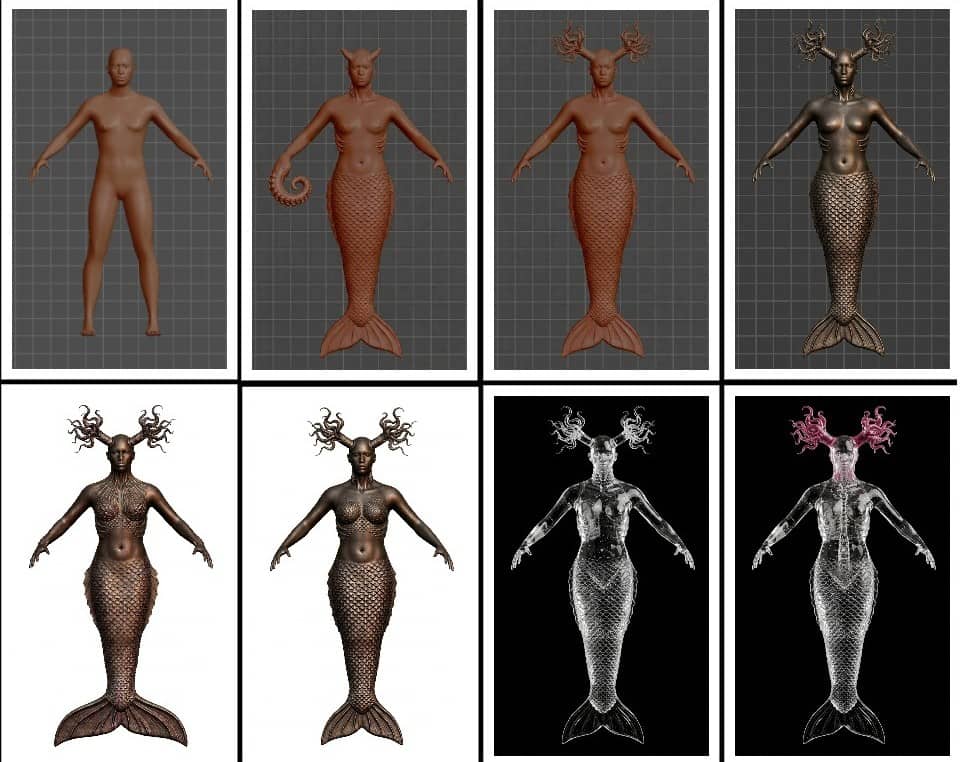
We startet with prompting a picture in Gemini. We could start from scratch (which I tried, but Gemini wouldn't let me remove my figures cothes) or with the picture Asli gave us. Inspired by my story, I gave my character a gender neutral, mermaid-like look. To do so, I told Gemini to add gills and a fishs tail, horn (that I had to adjust) tentacles and fishscales. First, I wanted to have one or two fingers to be tentacles, but Gemini always transformed the whole hand into one or to big tentacles. So I wanted to have them on the hip, but I wrote "tip" and didn't notice that. To optimize the picture for the use in the next software, I deleted the background. Playing with texture, I told Gemini to show the figure from a glass-like material.
Prompts
I mixed english and german prompts (not intentionally).
- Let the figure have Gills and a Fishs tail
- Add horns on the sides of the head
- The horns are too big. And don't make them curled.
- Let tentacles grow form the tip (I wanted to write "hip")
- Erhöhe die Bildauflösung und mach die Fischschuppen markanter.
- Lass noch Fischschuppen über die Brust wachsen
- Entferne den Hintergrund
- Mach die Schuppen auf der Brust markenter und die Brüste flacher und kleiner.
- Die Schuppen sollen mehr nach Fischschuppen aussehen und weniger nach Drachenschuppen. Mach eine Art Flosse oder Schwimmhaut, die vom Kinn in den Hals übergeht.
- Remove the background and let the figure look like it's made from glass
Tripo
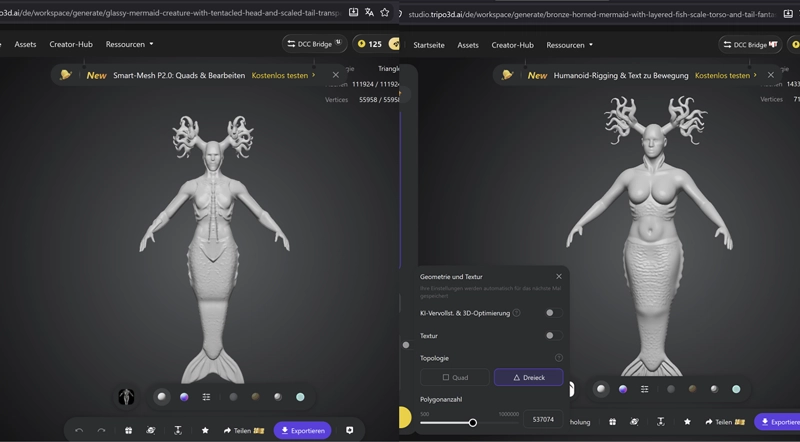
The next step was to upload the generated pictures to Tripo. Tripo is an AI-tool, that can generate threedimensional from pictures. I learned to make sure, that the picture has a sufficient size, otherwise the generated model won't look good. Because we're working with the 15 free tokens, we had to make sure, that we won't use texture (it's also not needed for 3d-printing) and have less polygons. In the end, we exported an stl-file.
Blender
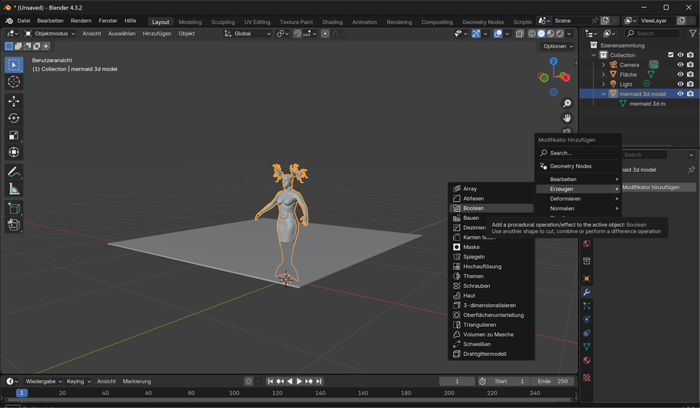
To modify the figure, we imported the stl in blender. We installed the extensions bool tool and 3D print tool. We learned how to use Bool Tool tu cut through our model. Doing this, I was able to build a bust our of the whole Seaperson, that the model was before. Using the 3d print tool, we we're able to export the model for slicing.
FormSlice
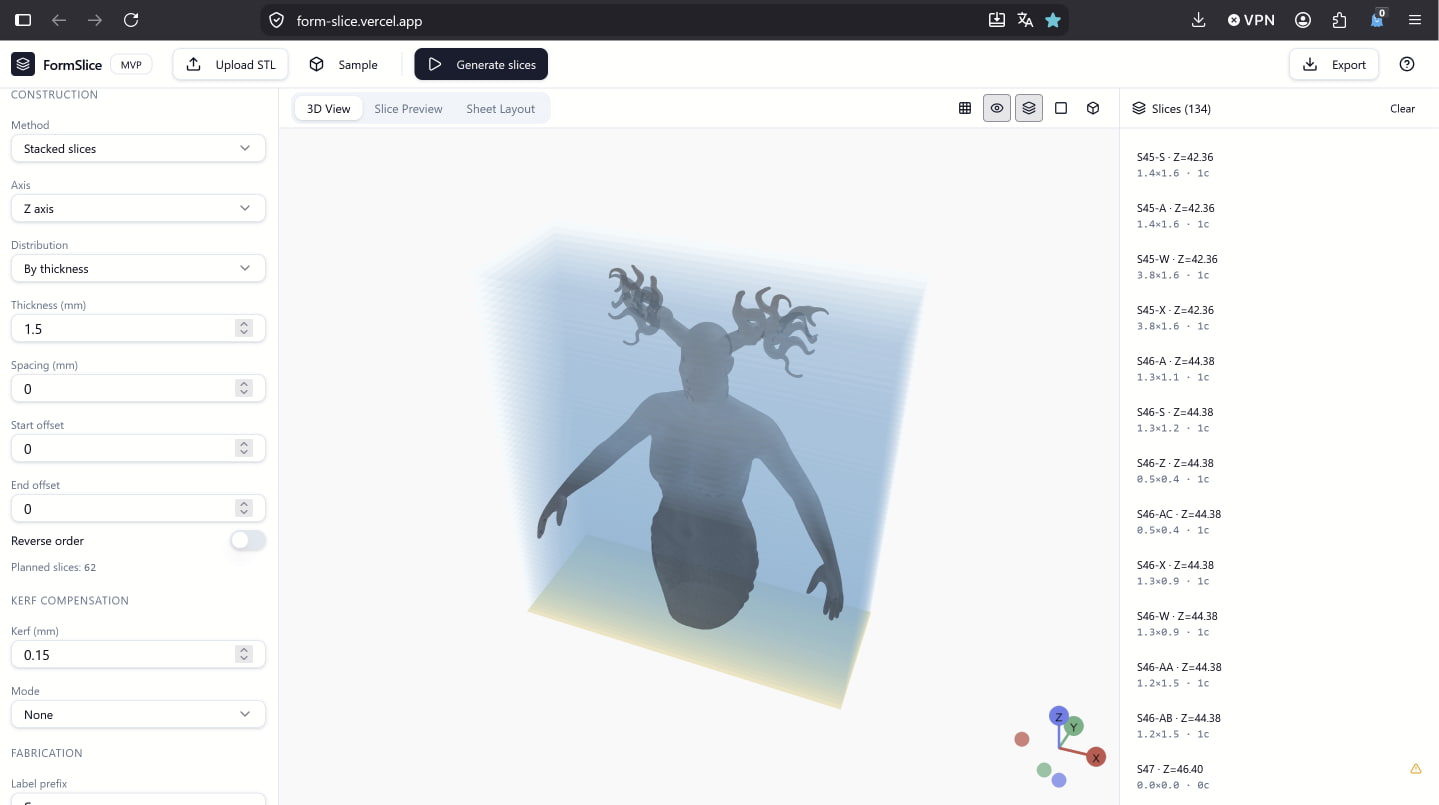
The last step was to use FormSlice. An online application, Asli build with the help of AI. We could upload our model and slice it, using different slicing models and settings.
From Human to Seaperson
We did the 3D-scanning before I was thinking about my design process. My first idea was to build a model of my whole body. Later, after being inspired by my research and my story, I changed my opinion and did a bust of myself as a Seaperson.
3D-Scan
We're using the 3D-Scanner Einstar Vega at our FabLab. It's a 3D-laserscanner, which uses MEMS- and 2 VCSEL-infrared-laser-sensors, 4 stereo depth cameras, and 48mega pixels color camera. The 4 stereo depth cameras let me wonder, if the scanner combines both photogrammetry and laserscanning or if the cameras are used for the lasersensoring.
Laserscan theory
Vcsel, Mems, what the heck?

Disclaimer: This is just a very brief summary, about what I understood. Feel free to watch the videos to learn more about it.
VCSEL-technology: infrared-laser-sensors
- a type of laser in which the laser beam is emitted from the semiconductor at a 90° angle
- the laserbeam is particularly round
- relativly temperature-tolerant
- has a high transmisstion speed with low power consumption
- [Explanation video](https://youtu.be/FkHi4LaSzew?is=46oB4hrEm5SS6WLH){target="_blank"}

MEMS-technology (micro-electromechanical systems)
- is used for different sensors, using movement
- uses mechanical movement to control a laser
- movable micro-mirrors diffuse light, that creates a grid. Instead of one laserbeam a lot of laserpoints can be created by using only one laser, that makes the measurment more accurate
- is also used in self-driving cars
- wird zum Beispiel auch bei selbstfahrenden Autos eingesetzt
- [Explanation video](https://youtu.be/g7gHm-38t_s?is=b_OCDCMi-lplIiru){target="_blank"}
- nice Video of a big model of such a [mirror](https://youtu.be/oJdUvOxeCBY?is=YlJX1aY5JbrLF7hR){target="_blank"} (German, but even without understanding, it's nice to see the mirror)
https://fmd-insight.de/de/news/interviews/vom-mems-scanner-zum-lidar-system-ueber-die-weiterentwicklung-einer-besonderen-technologie/
Scanning process
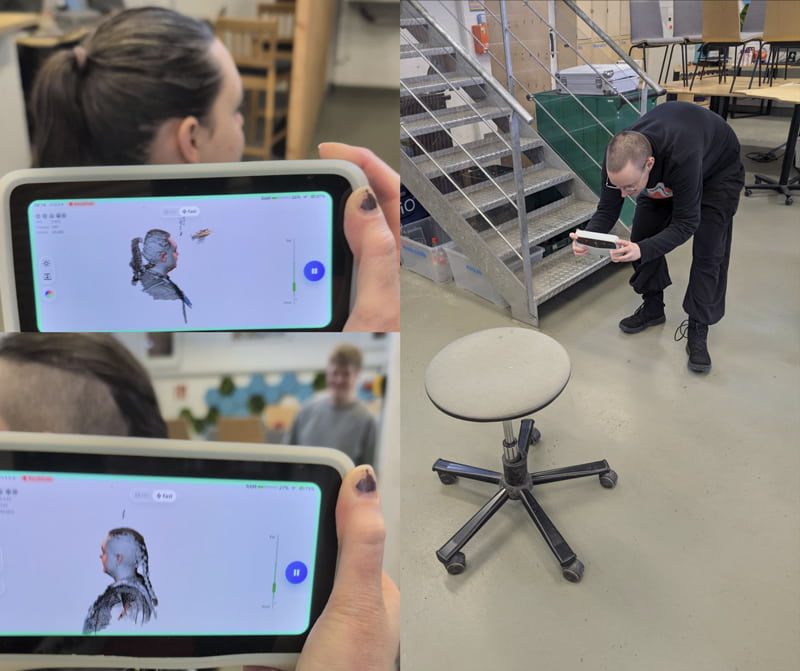
Lena and I scanned each other. I wanted to have a whole body scan of myself, Lena wanted her upper body to be scanned. Before scanning each other, we trained scanning a stool. This is an easy way to get a feeling for the handling of the scanner, for example the right speed to move the scanner or the right distance. The most important thing was to hold the scanner as steady as possible. Not that easy, when you're moving it at the same time.
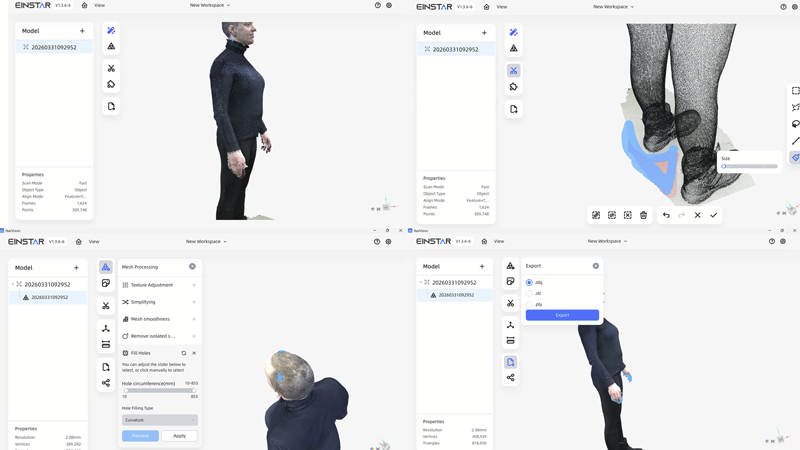
As Software to edit the scan and export a mesh, we're using the software StarVision. After importing the file, I saw, that I had to do some further mesh-corrections. The last step was, to export it as an .obj-file, to edit the model with blender. I doublechecked the mesh in meshmixer.
Blender
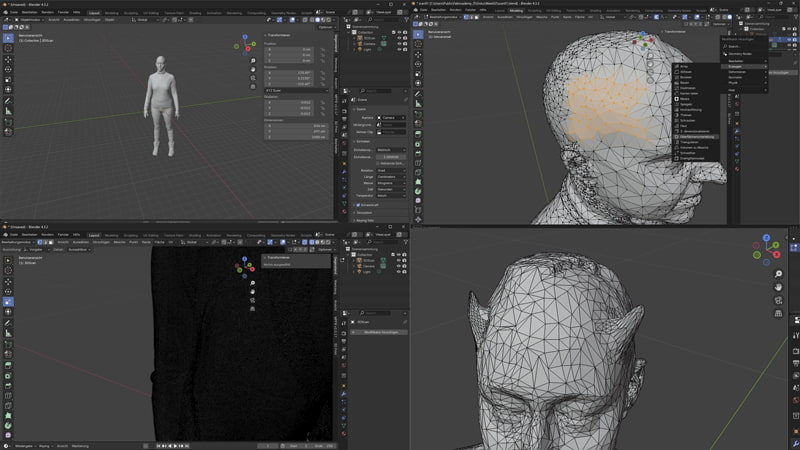
For the first try, I imported the whole figure. As the mesh was very fine and detailed, it was a lot to do für my computer, and pretty hard for me to work on this mesh. I did some corrections with the meshmixer. In the beginning I added some horns, deviding the mesh, so I had more points to work with. With the tipps we learned von Rico and Asli, I added some horns, did some small corrections (I had a hole in my ear, for example). What was just some playing aorund, being inspired by the mermaid, I did before, became my new goal. So I cut my model in half and made a bust.
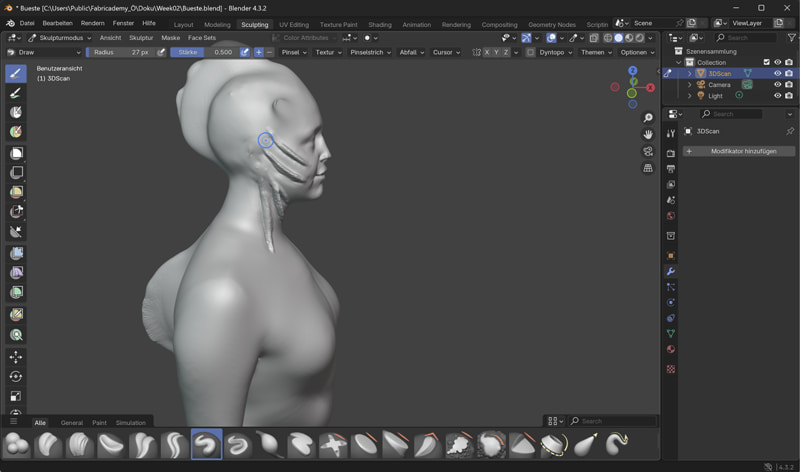
Doing some experiments in Blender, I stumbled upon the "Sculpting"-option and I loved it. Using my pen, I could just draw on my model. Now I did a mixture of the techniques I learned before and the sculpting tools. To be able to use the sculpting tool in a nice way, I hat to added some more points, using the Subdiving-Modificator. While modeling, I was thinking about practical features as a person, who lives in the water. So I had to remove the clothing first, then I added gills, two fins, changed my nose a little mit, closed my ears and added some small decoration. In the end I had a seaperson-model of myself.
Slicing (an Odysee)
What I thought, would be the easiest part, was surprisingly the most frustrating in the beginning. I struggled with some bugs. My idea was to make a model with stacked slices. I had some finer details in the face of the model, which would be gone, using a waffled structure or the folding option. I tried slicing my model with FormSlicer and with slicer for fusion. Exporting my files from FormSlicer, I recognized, that the files had some errors and I would have had to group and arrange every part one by one. Slicer for fusion worked perfectly with all the slicing modes, except of the one, that I chose. Web-researchs revealed that it's a well known bug, but because there's no more support for the software, I couldn't find a solution. Based on recomendations I tried Kiri:Moto (I wasn't able to do any slicing) and Luban 3D (my model was to big for the free version).
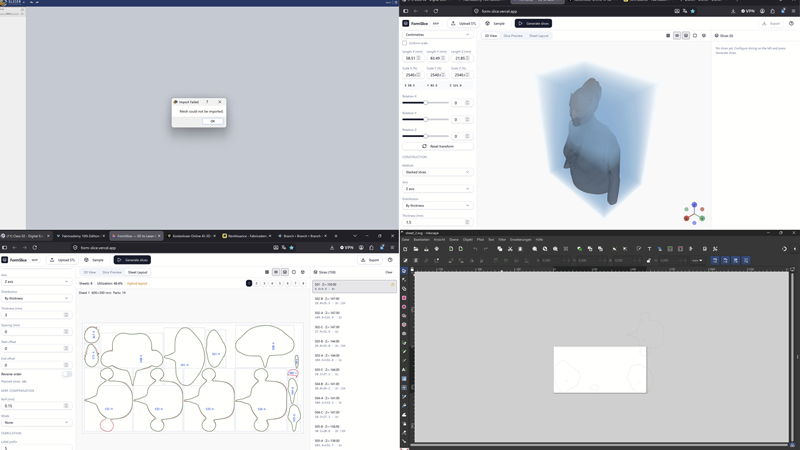
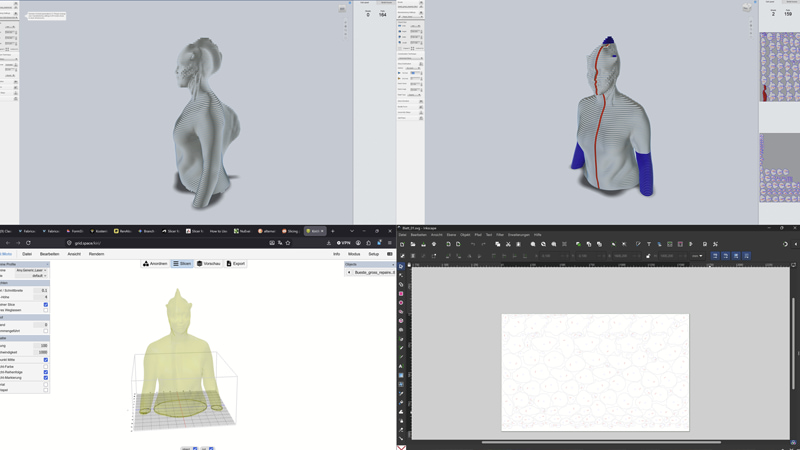
Seeing me struggling, my collegue Micha was curious if he can vibecode a slicing model. I showed him what wanted to do in Slicer for Fusion, gave him the specifications and explained all the steps, that needed to be done, the core information that I told him was:
- the stl file should be devided in layers with a thickness of 4mm, which should then be stacked on top of another to build the model
- I'd like to have holes in the model, to be able to insert sticks, because I don't want to use glue
- the layers should be arranged on a svg-sheet 1600mmx1000mm, so it can be used for lasercutting in our big lasercutter
Michael wrote a in Claude Code.
Prompt
Original (with corrected spelling errors)
Du hast im Verzeichnis eine STL-Datei, die eine Person darstellt. Ich möchte diese in Schichten aus pappe aufbauen, in der Mitte soll ein Loch sein, so dass ich die Pappe von 4mm Dick aufstapeln kann, so dass genau die gleiche Außenkontur aus Pappe entsteht, wie die STL datei hat. Das gleiche gilt für die Arme, für die es einzelne Pappscheiben geben muss, die auch durch eine Stange gehalten werden.
Die einzelnen Pappscheiben werden von einem Lasercutter geschnitten, der einen Bauraum von 1600 x 1000mm hat. Verteile die einzelnen Laserschnitte auf diesem Sheet, so dass wir möglichst geringen Platzverbrauch haben und speicher das als durchlaufend nummerierte svg-Datei.
Mach das im Loop bis du fertig bist, überprüfe sehr sorgfältig. Melde dich bei Unklarheiten.
English
You have an STL file in the directory that shows a person. I want to build this model out of layers of cardboard; there should be a hole in the center so I can stack the 4mm-thick cardboard to create an outer contour that matches the STL file exactly. The same applies to the arms, which will consist of individual cardboard discs held in place by a rod.
The individual cardboard discs will be cut by a laser cutter with a build volume of 1600 x 1000 mm. Arrange them to take up as little space as possible and save it as a sheet. Arrange the individual laser cuts on this sheet so that they take up as little space as possible, and save it as a sequentially numbered SVG file.
Repeat this in a loop until you’re done, and check your work very carefully. Let me know if anything is unclear.
I was pretty surprised, that I had a finished, well arranged model surprisingly it worked on the first try after a short time. I was surprised how well the AI arranged the parts on the sheet.
Workarounds, that I would have tried, if that wouldn't have worked:
- use the Sheets from the online Slicer and rearrange them in a time consuming process by hand
- use interlocked slices with only one vertical slice and heights/layer thickness = numes of slices vertical slices
- do some more research on other slicing tools (I found the tool Lamina three days later, which seems to work pretty well)
Lasercutting
Preparing
As we're using waste, f.e. from used packages, I could not use the whole space of the lasercutter. I used inkscape to rearrange the sheet to 1000x1000mm, made another layer for the second cut and exported a dxf-file. To prepare the laser-file, I imported the dxf into the lasercutsoftware, which is RDWOrks. I had to learn, that the software reads the different layers as one, so the consequence was to export to two different dxf-files from inkscape.
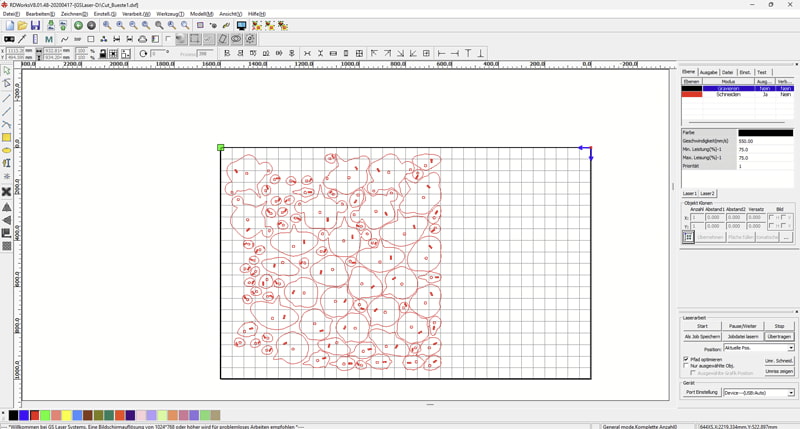
One thing, that we forgot to mention in the prompt was to give the numbers another colour. As you can see in the picture, all parts are one colour. I had to decide it I want to cut the numbers or if I select every number to change the colour and engrave them. I decided to save some time and cut them.
Lasercutting
We have different laseructters in our lab. The one that we used, is a GS, in our lab it's called "Kaiser", which means emperor. You can cut things like acrylic glass, rubber, MDF, leather, multiplex, paper, plywood and cardboard. Materials, that contain Chlorine (like PVC) are not allowed for cutting.
Before using the laser, you have to focus. To do this, you have to place your material on the laser bed, bring the laserlense right in the center above you material and then choose autofocus. Not it will autofocus itself. Now you're ready to send your file. In the lab, there's a step by step-instruction, which helped me a lot.
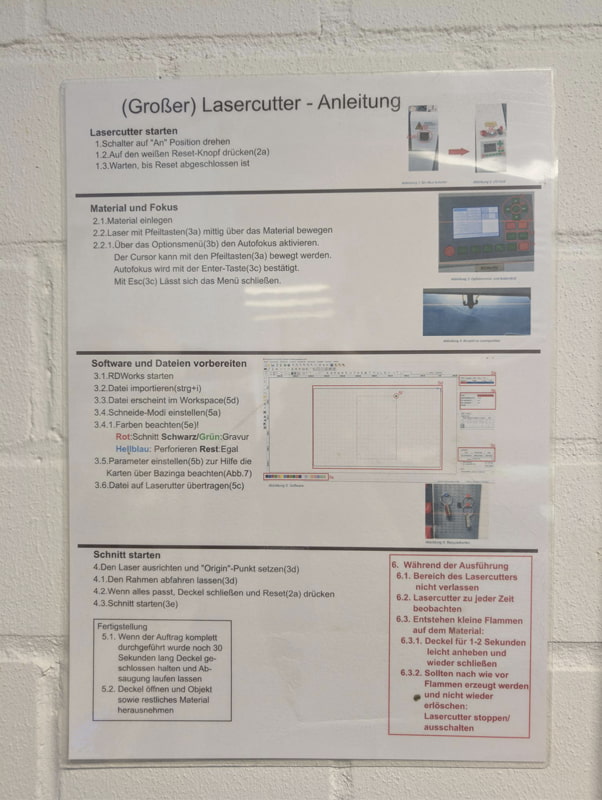
I did some tests to find the right parameters for lasercutting, before starting the final piece. I was surprised by the power, I needed. But after some tests, I could start my first cut with a speed of 100mm/s and 35% power (oh I was so wrong). I tested the parameters at the wrong corner, in the opposite corner, the power has to be even higher and the speed lower. On whole piece for nothing, because the laser did not cut through.
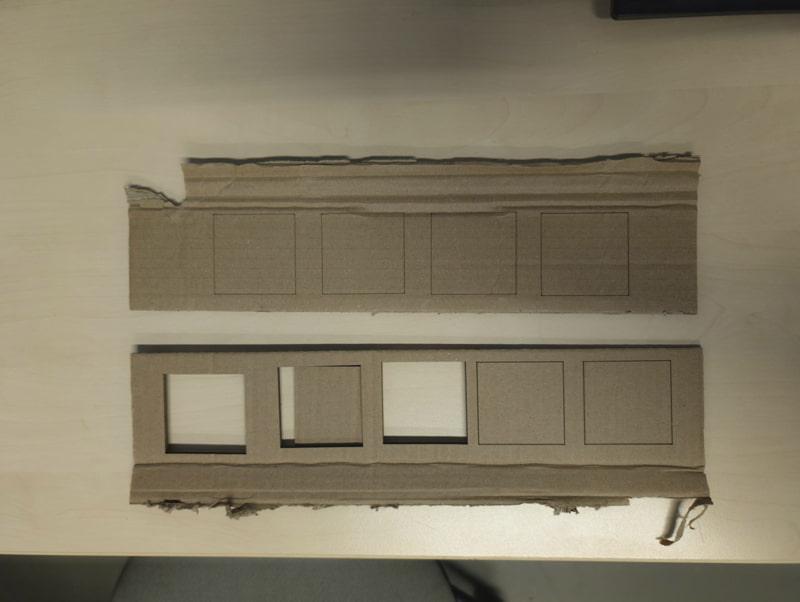
I thought the lense is maybe dirty and also the laserbed was not aligned. So Lena showed me how to clean the lense and adjusted the laserbed, but nothing changed. I still had to cut now with a speed of 20mm/s and 100% power to get the whole piece of cardboard cutted.
/Timelapse video of the lasercutting/
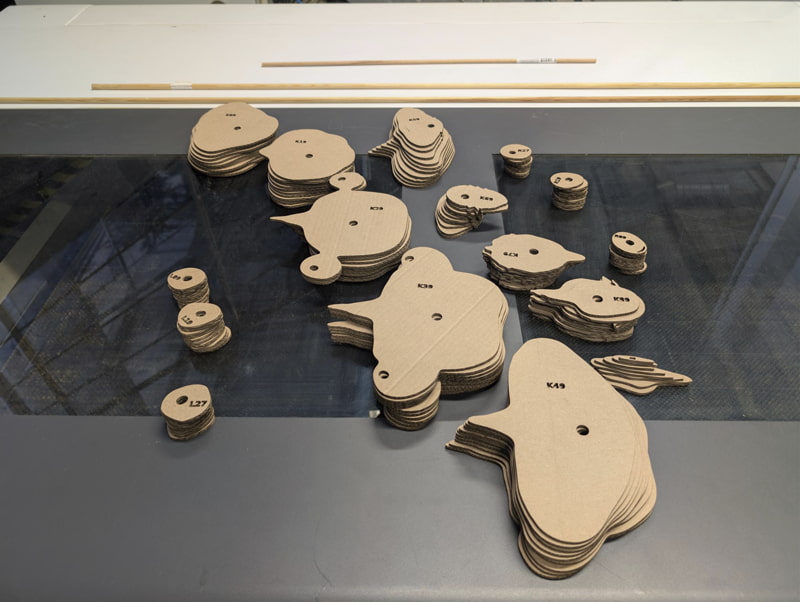
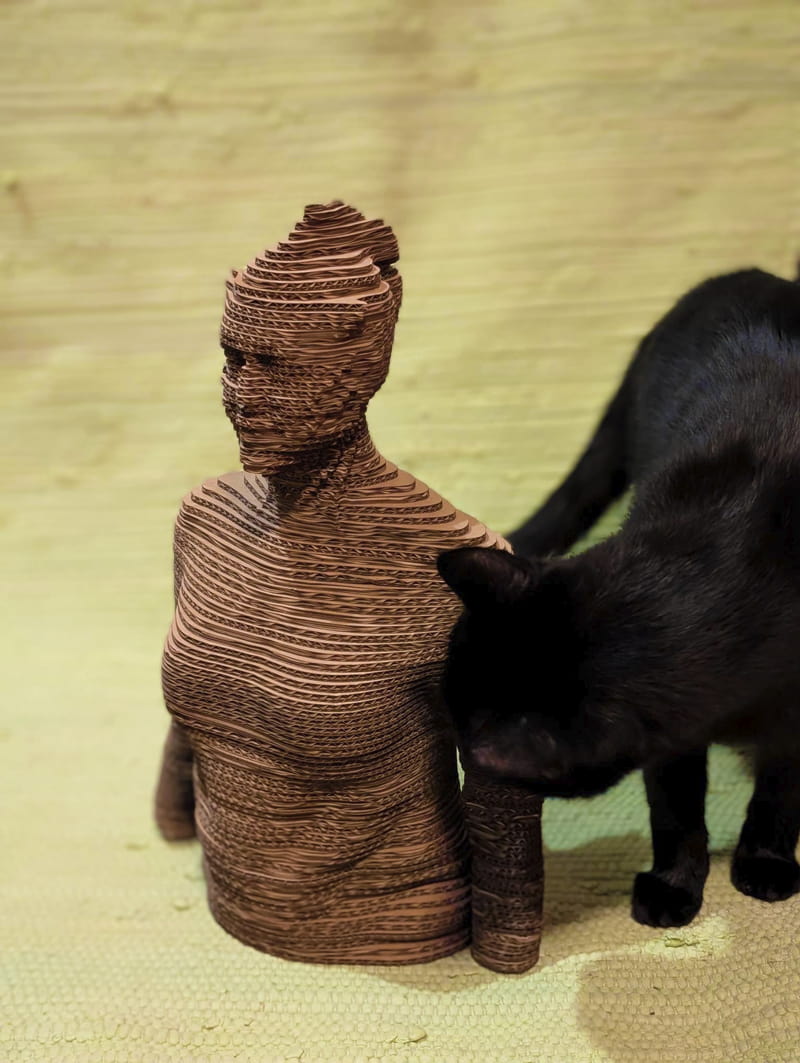
I assambled the model with the help of wooden rods and toothpics.
Downloads
If you want to have your own seaperson-bust at home, in the .zip you'll find the stl-file and the two dxf-files:
Seaperson_zip
Sidequest
Beside the assigned tasks, I did some sidequests.
Video editing
First I didn't like, that some of the layers are facing in different directions. It disturbs the effect of looking like it's one big piece. But after a while, I liked what those different layers do with light, when you turn the model around and I wanted to make this effect visible in a video. So I did my first steps in Adobe Premiere. I had to overcome a few initial hurdles on the road to success. I learned how to arrange the videos in the timeline, how to use effects and (most important) how to change the framesize. I filmed my model on a turntable, removed the background and used instead a video of the river Ruhr, that I made at the same day while riding a pedal boat. I wanted the video to remind people of the beginning of this millenium, when every website had crazy, colourful, animated gifs. No matter which website you opened, comicsans, gifs and bright colours were everywhere. One last challenge was to reduce the filesize of the three videos, I wanted to use this week.
Website optimization
During the last days, I found some points on my website, which could be improved. I optimized a few of them.You can find the documentation on the page of week one, as it fits better in there.
Tools and sources I used
Modelling to Slicing
- Blender: https://www.blender.org/
- Gemini: https://gemini.google.com/app
- StarVision https://support.einstar.com/support/solutions/articles/60001436421-download-starvision-pc-software-for-einstar-vega-
- slicer for fusion: https://www.autodesk.com/support/technical/article/caas/tsarticles/ts/3yg7zznS94MHNDG7KMV8Qg.html
- FormSlicer: https://form-slice.vercel.app/
- Claude-Code: https://claude.com/de/product/claude-code
- Lamina Slicer: https://marcelfarres.github.io/lamina/app/index.html#curve
Website related
- Squishtool (for PNG and JPG): https://squish.tools/de/compress-png
- Video-compressing: https://www.happyscribe.com/de/werkzeuge/mp4-kompressor
- Adobe Photoshop: https://www.adobe.com/products/photoshop.html
- Adobe Premier: https://www.adobe.com/products/premiere.html
- Collage-tool: https://www.photocollage.com/
- Inkscape (Website was not working)
- Convert3D, https://convert3d.org/app/compress
- Polyvia3d, https://www.polyvia3d.com/optimize/stl
- Omnvert, https://omnvert.com/en/tools/stl-reducer
- Adobe express, https://express.adobe.com/
- Adobe mp4 compressor: https://www.adobe.com/express/feature/video/compress/mp4
Tutorials
- Mediaevent: https://www.mediaevent.de/css/important.html
Reflection
It was a tough week, especially on the day, when also so slicing and also the lasercutting went wrong. It was a bit frustrating to learn, that things, that work with other files or computers, don't automatically work for yours, even if you're following the same steps.
The funniest part was learning to use our big lasercutter. Beside the big one, we have smaller lasercutters, that I used normally until now. I'm glad, that I'm able now to use our "Kaiser" and even have some knowledge about maintanence.
One thing, that I already knew, but was comforting to see and feel, was that I'm surrounded with a lot of very nice and supportive people, both on work and in my private life.
In the end I learned a lot and I'm happy to have a little seaperson-model of myself. I have to learn, not to take every side quest. Even if that's fun to do, it takes too much time. Doing Fabricademy beside your normal everyday job is a challenge for itself. My plan is, to make a list of sidequests, when I find new ones and start them after I finished the assigned tasks and the documentation.