Digital bodies
1. research and inspiration
When thinking about the lecture on digital bodies, I was thinking about the body as a political instrument in public space. The 3D models of bodies shown during the lectures remind me of bronze statues documenting people and giving them a space in the city. There are positive examples, such as the statue of Gabriëlle Petit (1893–1916), a resistance fighter executed during the First World War. She is one of very few women represented in public space in Brussels. But there are also problematic examples, such as those that glorify Belgium’s colonial past, most notably the statues of Leopold II 1. It’s interesting how they are static but also dynamic. As a part of protest actions, several statues have been painted and even dismantled. In Dudenpark in Forest, the bust of Leopold was removed one night in 2018, and it was replaced the next day by a bust made of bird seeds, eaten until it was gone.
The body becomes political when its presence in public space is not neutral. Statues are comissioned by polititians who choose to give them visibility and in extension a place in the collective memory. At the same time, the absence of certain bodies from public space can also be political. The fact that there are so few women and people of colour represented in the public space for example, especially in a diverse city such as Brussels. Linking it back to the lecture, the same could easily be applied to mannequins, more specifically the absence of certain bodies, and the definition of the 'normal' body.
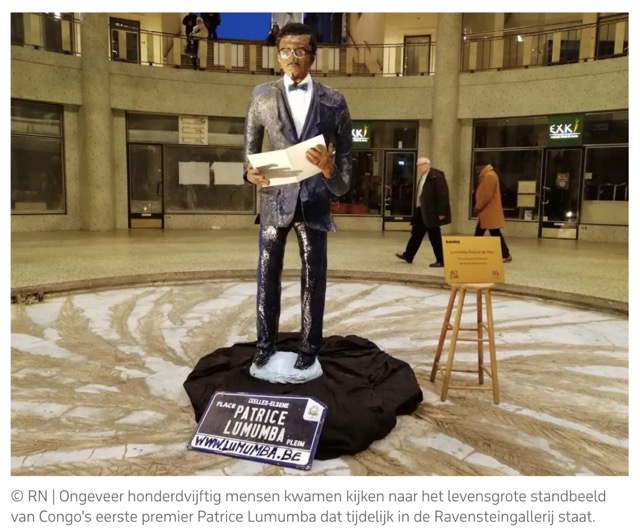
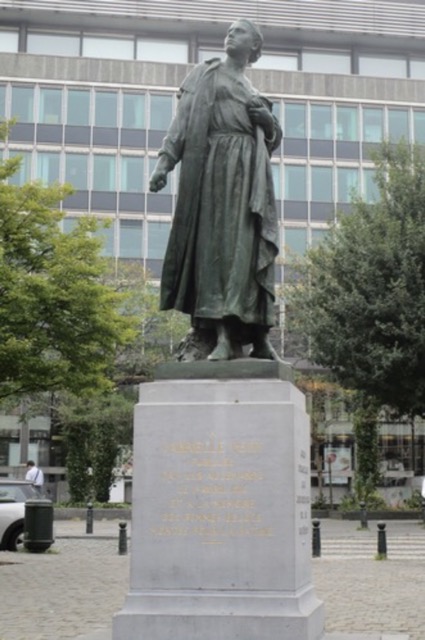
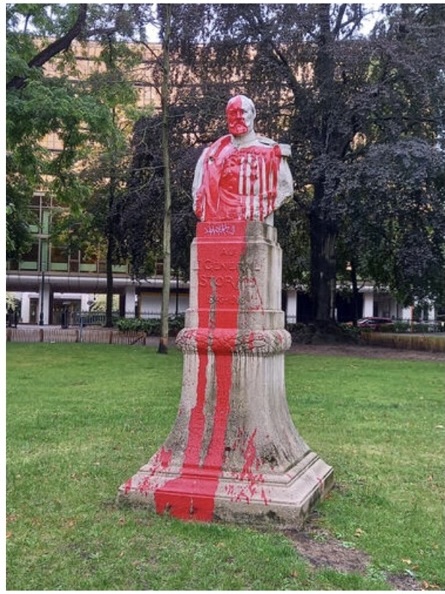
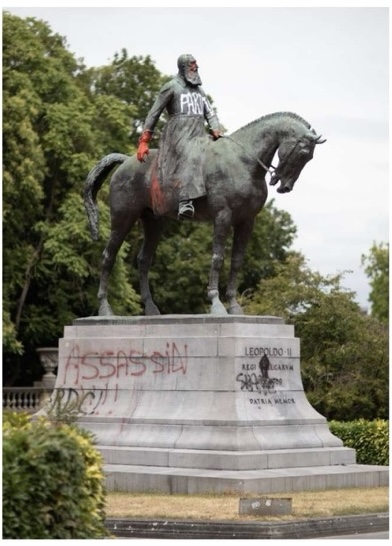
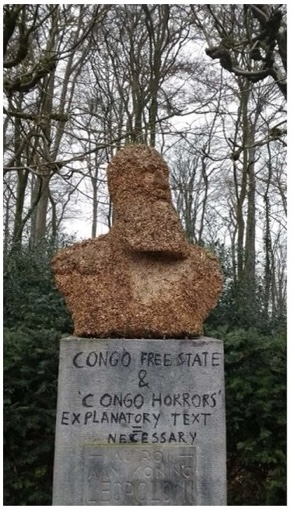
The first from the left is a statue of Leopold II after the Black Lives Matters manifestation in 2020 photo: Igor Pliner; the second is the bust of Leoplod II replaced by a temporary one made of bird seeds photo by Bruzz; Statue of Gabriëlle Petit photo by Urban Brussels. The bottom left shows a temporary mobile statue of Patrice Lumumba, a project by the collective Bamko photo by Bruzz; bottom right shows a painted statue of Emile Storms in Etterbeek photo by Urban Brussels.
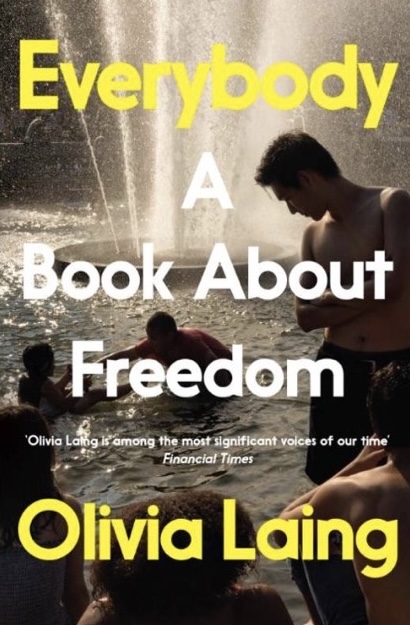
The lecture on Digital Bodies also made me think of the book Everybody: A Book About Freedom by Olivia Laing, which I read a few years ago. In this book, Laing searches for the meaning of bodily freedom in historical and contemporary struggles.
"We’re all stuck in our bodies, meaning stuck inside a grid of conflicting ideas about what those bodies mean, what they’re capable of and what they’re allowed or forbidden to do. We’re not just individuals, hungry and mortal, but also representative types, subject to expectations, demands, prohibitions and punishments that vary enormously according to the kind of body we find ourselves inhabiting. Freedom isn’t simply a matter of indulging all material cravings, Sade-style. It’s also about finding ways to live without being hampered, hobbled, damaged or actively destroyed by a constant reinforcement of ideas about what is permitted for the category of body to which you’ve been assigned."
— Olivia Laing, Everybody: A Book About Freedom
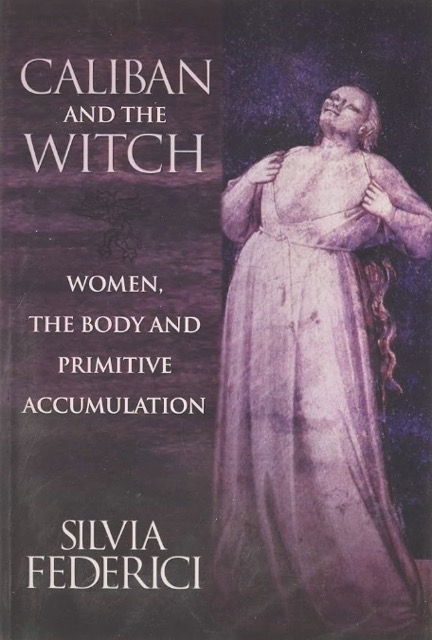
Laing studies the body as a prison where external politics define what it represents. She examines how human bodies can also be a site of protest and a source of hope in the fight for freedom. For a previous artistic project, I did research on the figure of the witch in Western culture and the 16th- and 17th-century witch trials. In my research, I studied the writings of Silvia Federici, who shows how the “enclosure of the commons” (privatizing shared land) went hand in hand with the “enclosure of women.” Women were stripped of economic independence, confined to the home, and forced into unpaid reproductive labour to breed the new workforce for the industrial revolution. Her writings again approach the body as a site of politics.2
Perhaps an interesting path is then to think about bodies that refuse to be classified. A collective as a body of people? A non-human body?
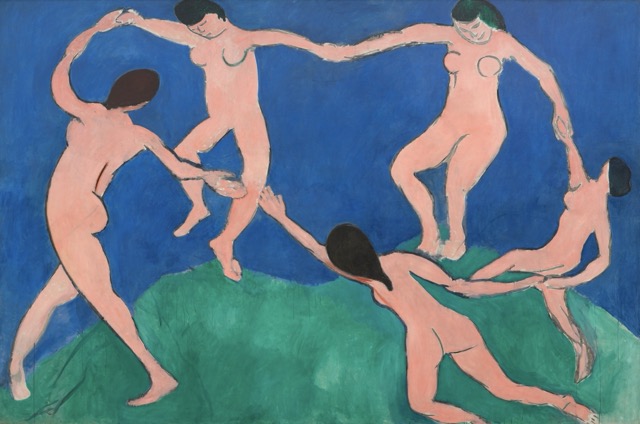
La Dance, Henri Matisse, 1910
How can we compare the bronze bodies of historical figures to digital bodies? In a way, it is more democratic: I installed an app and made myself into a digital 3D body. A 3D body can be distorted, enlarged, compressed, archived or deleted. At the same time, the digital body can also be surveilled, stripping away the right to privacy and ownership of one’s own body. A bronze statue is a sculpture made by a sculptor. With a digital body, the boundary between subject and creator is less clear. A digital body is in this case a 3D render. Who is the author? (In the MakeHuman app, I encountered some limitations in the range of characteristics that can be assigned to the bodies. As other participants have noted, the extension seems to have some limitations in how it represents different racial and gender characteristics.)
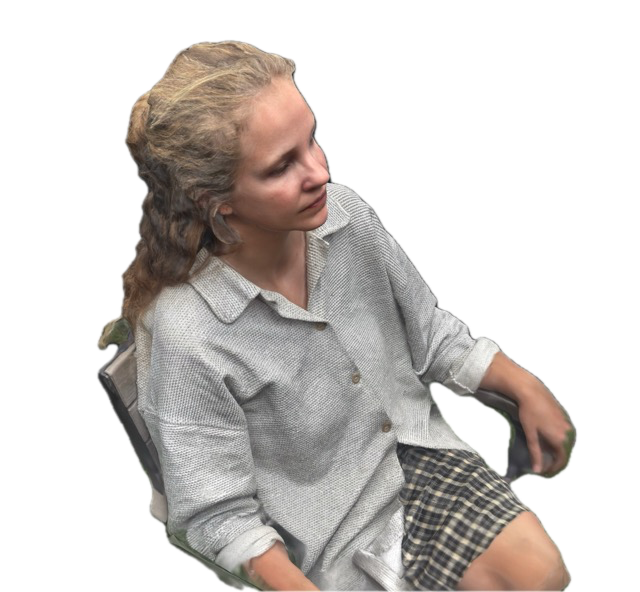
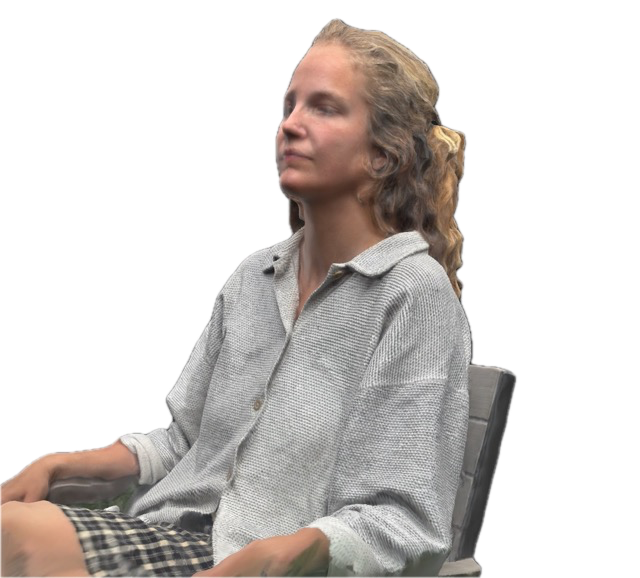
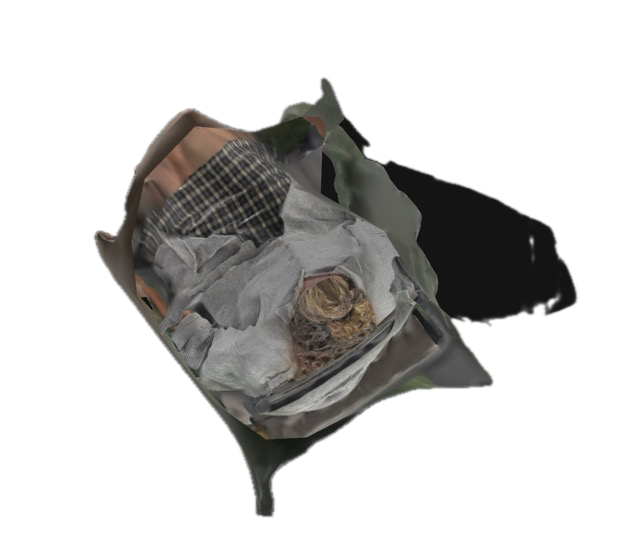
Another path I want to explore is the temporality of bronze statues as opposed to digital bodies. Taking the bird-seed bust as an example, I thought it would be interesting to create a statue that will compost into something new. For my project timegarden, I felted seeds into wool, which then sprouted to become a garden. I thought it would be an interesting idea to make a statue of myself—a freedom that the digital body allows me—but in a material that is decomposable. In this material I will add seeds. The statue becomes temporal and potentially a site for new growth, breaking free from the body altogether.
An artist's work I find very inspirational is Ana Mendieta, a Cuban-American artist known for combining performance, body art, nature, and ritual. Much of her work explores themes of identity, exile, belonging, femininity, and the relationship between the human body and the earth. she was interested in how the body can still be present even when it is physically absent. In her Silueta series, she used her body to create traces and shapes in nature, which she then photographed. The body itself disappears, but the image and the trace remain.
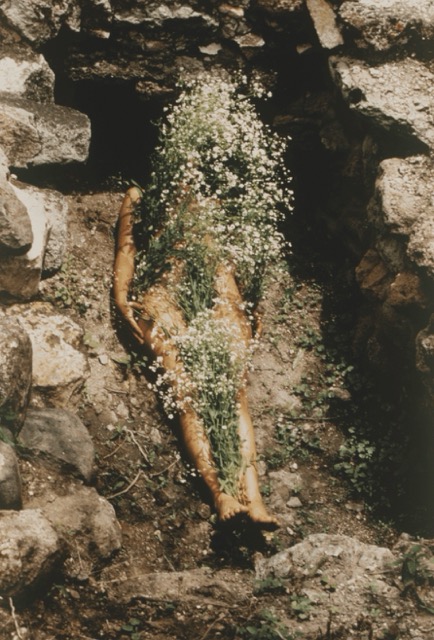
Ana Mendieta, Untitled 1977. © The Estate of Ana Mendieta Collection
Work from predious years I find inspiring: Saskia Helinska , Jeanne Rochedieu Neboit
2. body of people
After Rico's lecture, I took on the challange of making a 3D model of a body of people. I used the Make Human for Blender extension and created many different humans. I rigged them and gave them different poses.
It took me a while to understand that you have to make sure to scale and move both the body and the rig at the same time, otherwise the poses will not work. Because it was quite time consuming, I copied and pasted some models. The model is not perfect, but it gives a good idea of what I can do with Blender.
I also uploaded the 3D scan I made of myself onto Blender, to make it easier to use. I made the initial scan with the KIRI engine app. After some trial and error, I learned it is good to take photo's as fast as possible, so eliminate most chances of movement. When I uploaded the model into Blender, I first added the modifyer 'decimate' which simplified the model a lot. Then I used to 'Sculpting' tool to change some specific elements such as my hair. Here you can see the 'before' and 'after' of the decimate tool:
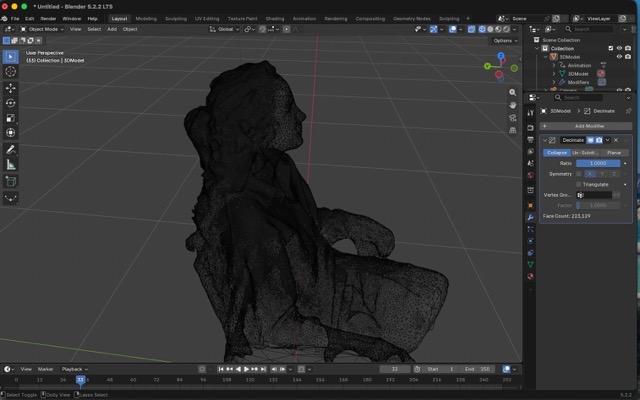
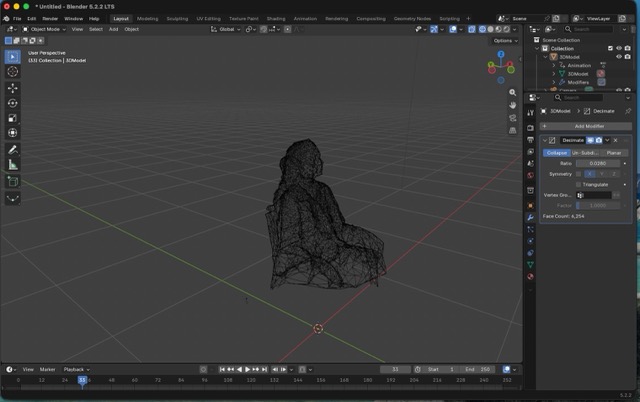
2. statue of flowers
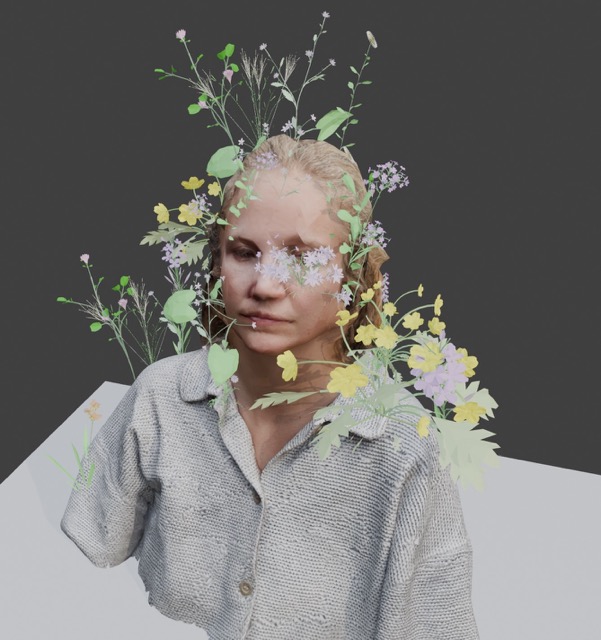
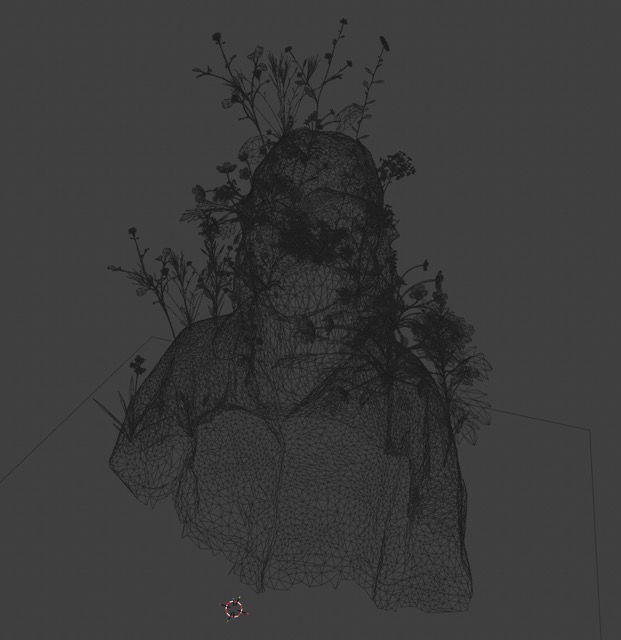
When starting this week's assignement, I wanted to create a material which could hold seeds, which would then sprout and transform the statue into something new, approaching the body as a state of transofrmation and not a static object. I made a model of what I am trying to achieve. Using the plantstudio on Blender, I added plants to the 3D model of myself. This extension is an amazing resource, you can add plants and choose which stage it should be from seed to fully grown. The plants are mostly indigenous to Europe.
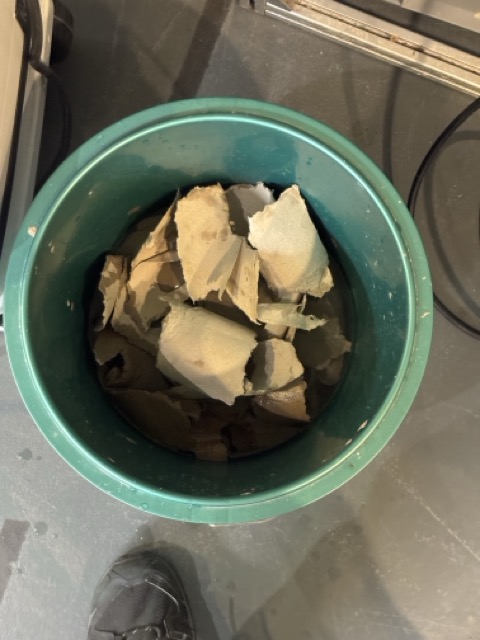
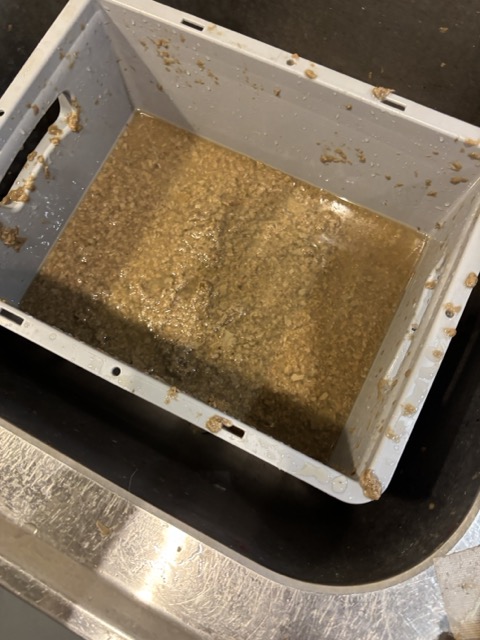
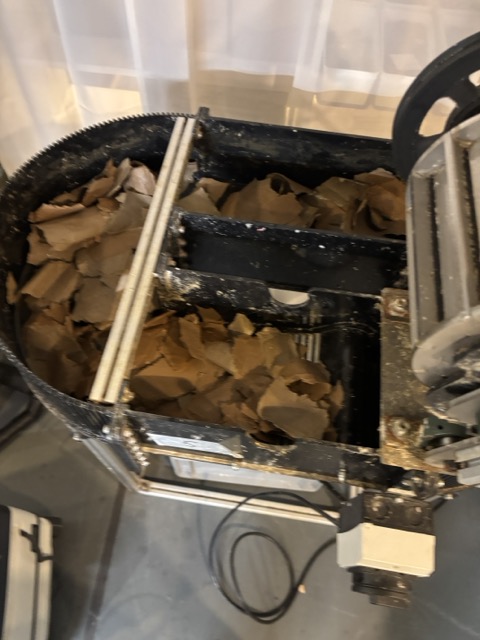
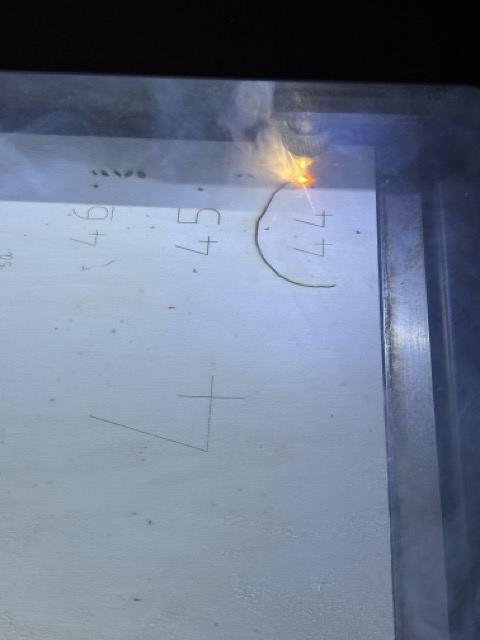
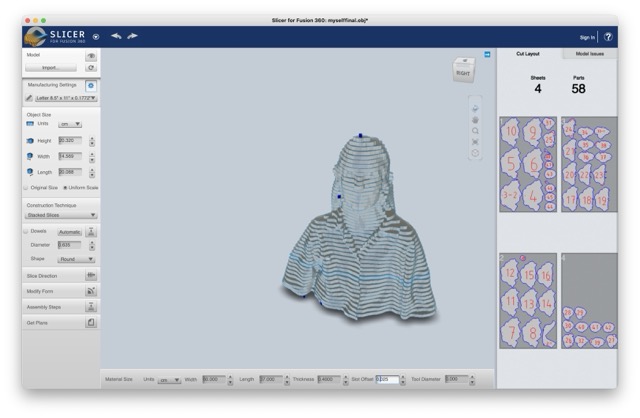
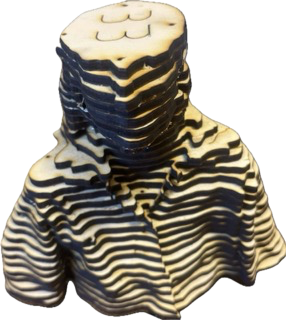
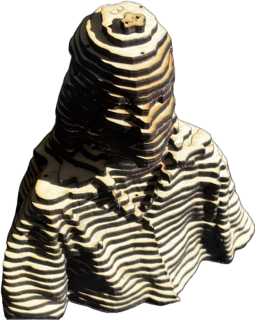
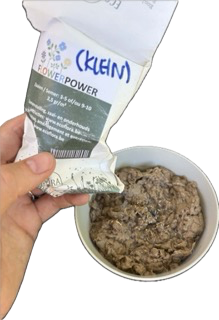
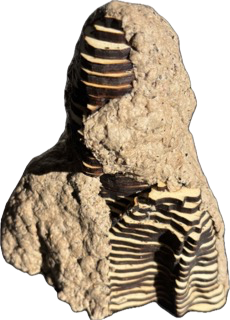
To make the real life model, I started by ripping up cardboard salvaged from old textile rolls. I then put it in the (pulping?) machine which turned it into pulp. In the pulp I mixed some 'flower power' seeds by Ecoflora. I then made sheets of paper and put them in the dryer. It took much longer to dry than anticipated, so I started making a statue of the 3D model of myself using Slicer for Fusion and the laser machine. 3
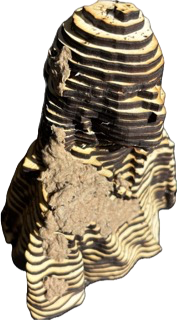
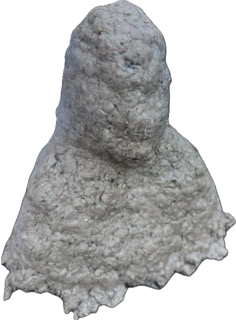
After I put the model together, I thought it was a better idea to use this as a model and out the pulp with seeds around it. Before adding the pulp I added a layer of vasiline to stop the pulp from sticking to the mould. I also realised that the temperature of the dryer I used for the sheets of paper (70 degrees) was probably too hot for the seeds and it would stop them from germinating later on. With this in mind I didn't use a dryer for the pulp on the mould. This meant it took more than 2 days to dry.
List the tools you used
- Blender - for editing 3D files
- Kiri Engine - for making 3D scan
- Make Human - for adding humas to the Belder files
- plantstudio - for plant extensions
- Slicer for Fusion - to make the slices
3. final results
After 3 days of drying I managed to get the model off the mould. It kept it's shape quite well. When I tried putting the two parts back together I realised I needed something more sticky, so I added some arabic gum to the pulp. When adding the soil, however, the model lost a lot of it's shape.
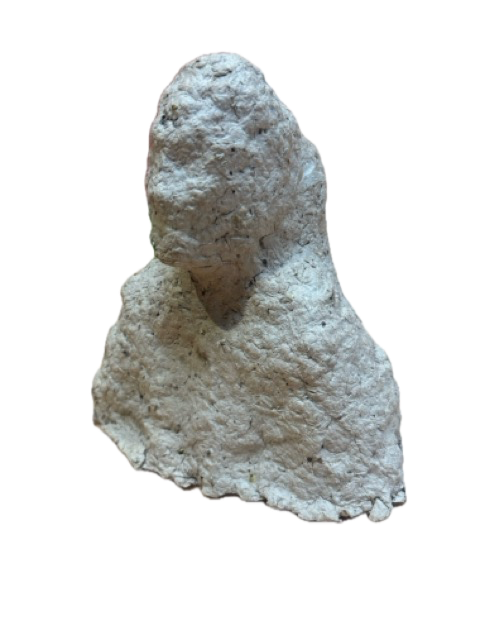
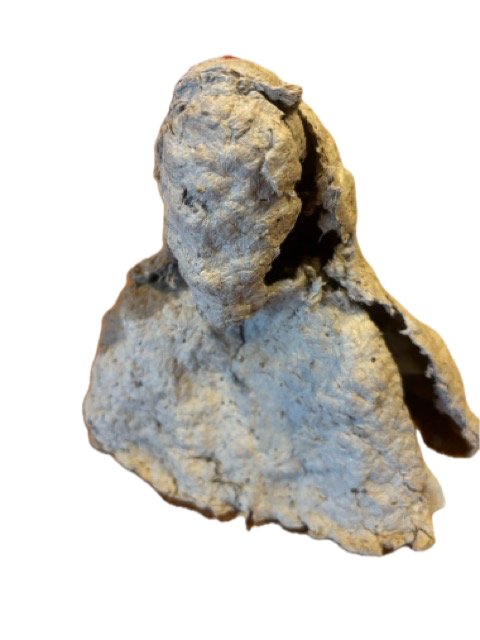
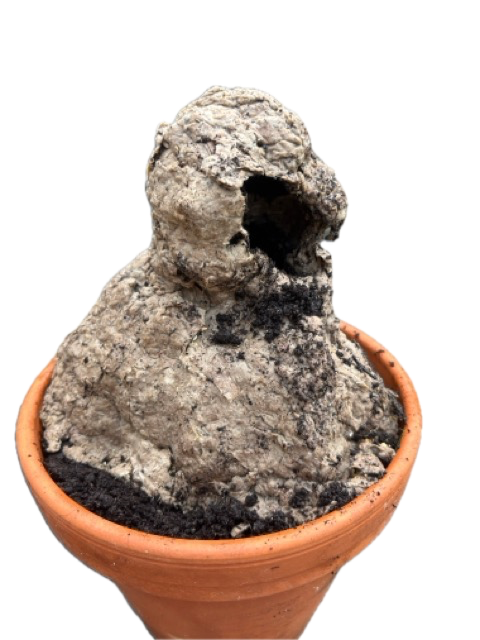
After a few days, seeds in the pulp started sprouting.
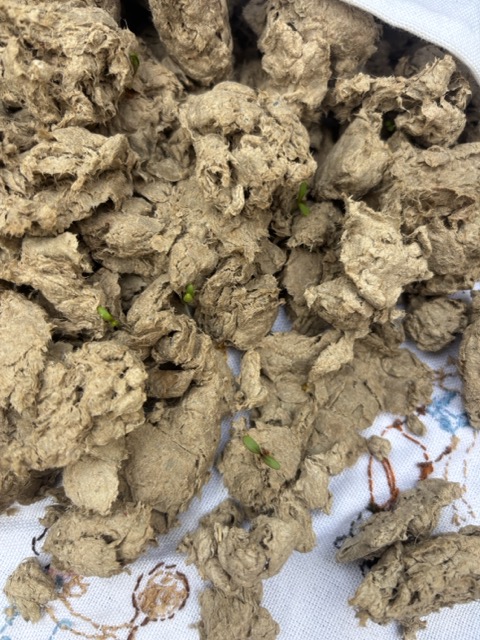
4. thoughts and reflections
In hindsight, it probably would have been better to make the mold out of plastic, and found a way to make the cardboard less fragile, or used a different material alltogether. But I let myself me led by the process, so didn't really plan ahead. It's nice to have the context of this course to be able to experiment without having the pressure of results that are successful. It feels good to have some space to experiment.I am looking forward to seeing if the seeds will eventually sprout. Perhaps I can fine-tune the process in the week of the biomaterials.
-
A report on Decolonising Brussels by Urban Brussels: https://publication.urban.brussels/DECOLONISATION/RapportVoorDekolonisering.pdf ↩
-
Reference: Federici, Silvia. 2004. Caliban and the Witch. New York, NY: Autonomedia. ↩
-
File: laser files ↩