11. Open Source Hardware - From Fibers to Fabric
Research & Ideation
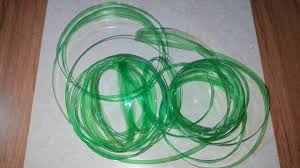
I have always been intrigued by textiles and their material properties. This week, I am exploring the development of a DIY bottle cutter that can be used to generate filament for weaving. This tool is increasingly relevant as designers and manufacturers confront the environmental impact of synthetic textiles and plastic waste. Polyethylene terephthalate (PET), the material used in most beverage bottles—is the same polymer base used in polyester fiber production. By creating a DIY bottle cutter, designers can access and reprocess this material at a local, human scale, transforming post-consumer waste into functional textile filament. From an industry perspective, DIY bottle cutters represent a decentralized approach to material sourcing. Instead of relying solely on industrial recycling systems which can be energy-intensive and geographically limited, designers can prototype closed-loop systems within studios, Fab Labs, and educational settings. This supports localized circular production, where waste generated in a community can be immediately repurposed into new textile forms. This tool also contributes to material literacy and innovation. By physically cutting and manipulating PET bottles into continuous strands, designers develop a first-hand understanding of material behavior, tensile strength, flexibility, and limitations. This hands-on engagement supports more informed material choices and enables experimentation with hybrid textiles that combine recycled filament with natural fibers, biomaterials, or smart textiles. In addition, DIY bottle cutters lower the barrier to experimentation and access. Because the tool can be inexpensive, easily fabricated, and adapted to different contexts, it is especially valuable for emerging designers, students, and under-resourced labs. This democratization of material production aligns with broader shifts toward open-source tools, transparent processes, and equity in design education.
Finally, the presence of DIY bottle cutters signals a cultural shift toward process-driven, value-based design. The act of visibly transforming waste into textile material becomes part of the narrative of the final product, offering consumers a tangible story of sustainability, responsibility, and innovation. In this way, the DIY bottle cutter is not just a tool, it is a catalyst for rethinking how textiles are sourced, produced, and valued. Alongside this work, I am also exploring yarn twisting as a foundational step toward weaving. For this project, I am investigating the idea of creating or hacking a small-scale yarn twisting machine to better understand how yarn structure, twist, and material behavior influence textile performance and aesthetics. Yarn twisting is one of the most fundamental processes in textile production, yet it is often hidden within industrial systems and rarely experienced hands-on at the maker level. My goal is to bring this process into a creative, experimental, and educational context. This exploration is informed by my background in textile science, my interest in material experimentation, and my ongoing work with students in learning environments such as the NCCU Fab Lab. I am especially interested in how a hacked twisting system can function as both a tool and a learning instrument, one that enables experimentation with fiber blends, twist direction, ply structures, and recycled or repurposed materials. At a small scale, the machine becomes a platform for discovery rather than mass production. In this week’s research and prototyping, I am focusing on the basic mechanics of yarn twist and plying; examples of DIY and small-scale twisting tools; how twist level impacts strength, elasticity, and texture; opportunities for novelty or artistic yarn construction; and ways to adapt accessible parts using digital fabrication. Ultimately, my intention is to prototype a simple, adaptable twisting mechanism that encourages experimentation, documentation, and reflection. This project sits at the intersection of textile science, hands-on making, and creative inquiry that aligns with my broader interest in connecting material knowledge, innovation, and student-centered learning.
References & Inspiration
A few years ago, I took students to the MAGIC trade conference in Las Vegas, where I was introduced to REPREVE. REPREVE is a recycled performance fiber developed by Unifi, Inc. that transforms post-consumer plastic bottles and other recycled materials into sustainable polyester yarns and fabrics. These fibers are used globally by fashion, outdoor, and lifestyle brands and are designed to perform like traditional polyester while significantly reducing environmental impact. The concept of a traceable, branded recycled fiber immediately stood out to me, particularly in the context of large-scale textile production.
Later, I learned that Chick-fil-A had incorporated recycled plastic into their employee uniforms. Their red polo shirts are made using the equivalent of approximately 19 plastic bottles, while the blue-and-white striped shirts use about 9 bottles each. This initiative is part of the company’s broader sustainability and recycling efforts aimed at diverting plastic waste from landfills.
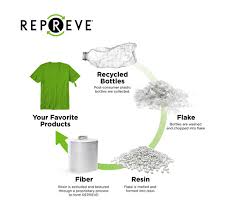
Photo courtesy of REPREVE
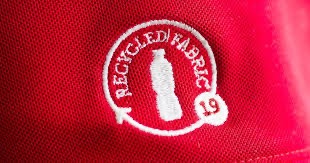
Photo courtesy of Chickfila
Other Major Retail Brands that Uses PET Recycled Bottles for fashion...
Adidas x Parley Adidas has become one of the most visible and influential brands using recycled PET (rPET) in fashion and performance wear, positioning sustainability as a core innovation strategy rather than a niche initiative. A major turning point in this work is its long-term collaboration with Parley for the Oceans, which focuses on intercepting plastic waste before it reaches marine ecosystems and transforming it into high-performance textile materials. Through the Adidas x Parley partnership, plastic waste collected from coastal regions and shorelines is processed into recycled PET yarns that are used in shoes, athletic apparel, and accessories. Many Parley shoes replace virgin polyester entirely with recycled PET, particularly in uppers made from knit or mesh constructions. In some footwear models, a single pair can contain the equivalent of up to 11 plastic bottles, demonstrating how waste can be recontextualized at scale.
Beyond Parley, Adidas has committed to broader sustainability goals, including the transition to 100% recycled polyester across its product lines where possible. Recycled PET is now used extensively in jerseys, training apparel, leggings, and outerwear, proving that recycled fibers can meet the brand’s strict standards for durability, breathability, moisture management, and performance. From a textile innovation perspective, Adidas’s use of rPET is significant because it integrates recycled materials into advanced manufacturing systems, such as knitted uppers, engineered meshes, and digitally optimized designs. This approach minimizes material waste while maximizing efficiency and product lifespan.
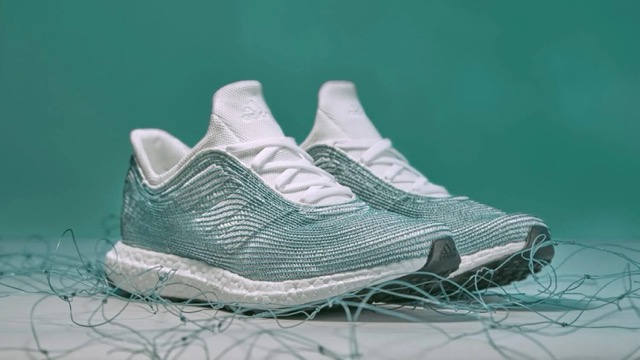
Photo from parley.com
The Northface The North Face is a leading outdoor apparel brand that incorporates recycled PET (rPET) from plastic bottles into a wide range of products, including jackets, insulation, backpacks, and performance gear. By transforming post-consumer bottles into recycled polyester fibers, the brand reduces dependence on virgin petroleum while maintaining the durability and performance required for outdoor use. Recycled PET is commonly used in fleece fabrics, outer shells, linings, and synthetic insulation, where warmth, lightweight construction, and resilience are essential. Many of The North Face’s insulated jackets and backpacks now contain significant percentages of recycled content, supporting the brand’s broader sustainability commitments. From a design and manufacturing perspective, The North Face demonstrates how recycled materials can be integrated into technical, high-wear products without sacrificing function. Their use of recycled bottles shows how sustainability can be embedded into everyday outdoor gear at scale, making rPET a practical and accessible material choice rather than a niche alternative.
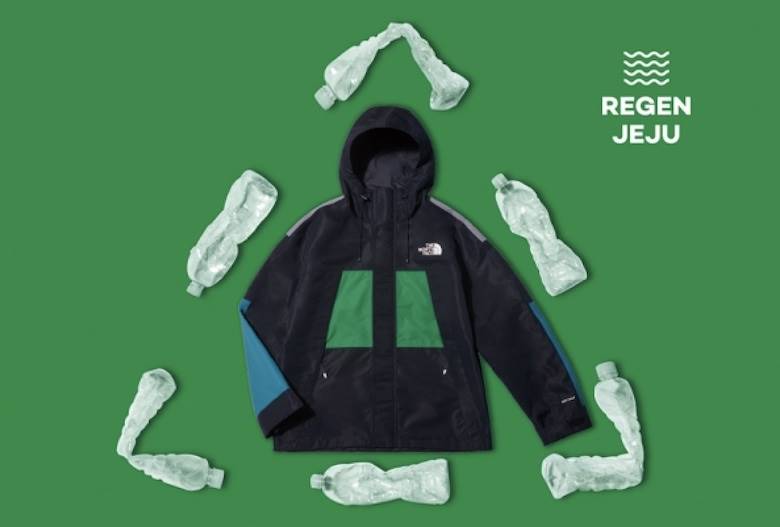
Photo from northface.com
Project Objective
For this assignment, I developed a small-scale PET processing system that transforms discarded plastic bottles into continuous strips and organizes those strips for textile and wearable experimentation.
The system consists of two connected tools:
- A manual PET bottle cutter that produces a continuous plastic strip.
- A digitally fabricated PET strip winder that collects and organizes the strip into a controlled coil.
The addition of the 3D-printed winder moves the project beyond a basic hand-cutting experiment. The digitally fabricated components create a repeatable winding mechanism that can be used in textile-related processes such as wrapping, weaving, twisting, thermoforming, and sculptural wearable construction.
Existing Fabrication Methods and Machines
Industrial recycled-polyester production generally involves collecting PET bottles, cleaning and sorting them, shredding the plastic into flakes, melting the material, and extruding it into polyester filament. Large manufacturers such as REPREVE use this process to produce textile-grade recycled fibers at an industrial scale.
My project explores a small-scale alternative that can be used in a Fab Lab, classroom, or design studio. Rather than shredding and melting the bottle, the bottle is cut into one continuous strip. The strip can then be wound, heated, twisted, woven, or combined with other textile materials.
Existing tools that informed this project include:
- Manual PET bottle-strip cutters
- Filament and yarn winders
- Bobbin-winding mechanisms
- Hand-cranked textile tools
- 3D-printed recycling tools
- Small-scale yarn-twisting devices
These references helped me understand how blade position, feed angle, strip width, spool shape, and controlled winding affect the consistency of the resulting PET material.
Design Concept and Development
My original experiment focused on manually cutting a PET bottle into a continuous plastic strip. Although the bottle cutter successfully produced reusable PET material, the first prototype was primarily assembled from purchased and existing components.
To expand the project into a digitally fabricated tool, I developed a 3D-printed PET strip winding system. The purpose of the winder is to collect the continuous PET strip produced by the bottle cutter and organize the material into a controlled coil.
The complete workflow therefore consists of two connected stages:
PET Bottle → Manual Cutting Mechanism → Continuous PET Strip → 3D-Printed Winding Tool → Controlled PET Coil
The bottle cutter performs the material conversion stage, while the digitally fabricated winder performs the material collection and organization stage. Together, the tools form a small-scale PET processing workflow for textile and wearable fabrication experiments.
Designing the PET Strip Winder
The PET strip winder was developed as a digitally fabricated addition to the original manual bottle cutter. Its purpose is to collect the continuous PET strip and prevent the material from becoming tangled during processing.
The winder consists of a top component and a circular bottom spool. The parts were designed to fit together around a central axis so that the spool could rotate as the PET strip was collected.
During the design process, I considered:
- The width of the PET strip
- The internal opening for the axle
- The diameter of the spool
- The height of the spool walls
- The clearance between the rotating components
- The strength and thickness required for repeated use
- The ease of feeding and removing the PET strip
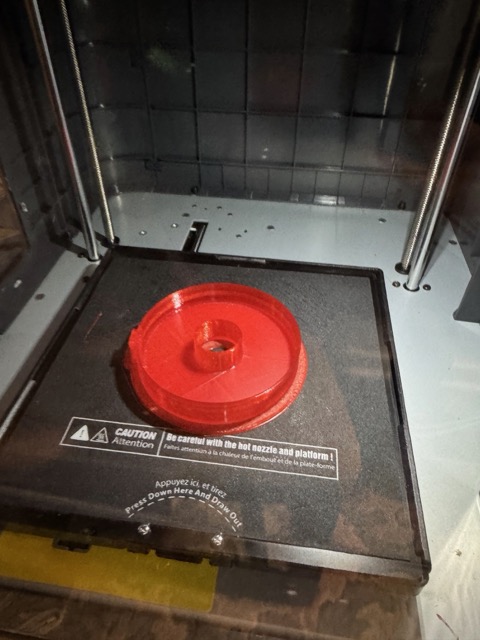
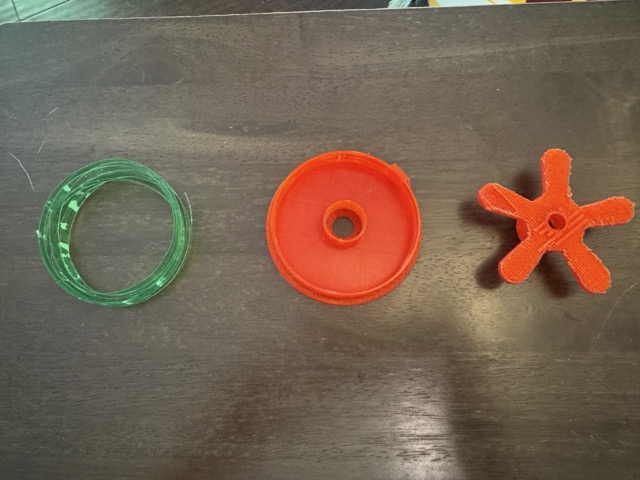
The images below document the development and fabrication of a 3D-printed PET strip winder designed to collect and organize continuous plastic strips produced by the manual PET bottle cutter. The fabrication process began with the 3D printing of the individual winder components, including the top winding component and circular spool base. The parts were printed in red PLA filament using a FlashForge Voxel 3D printer. The printed components were designed to function together as a manual winding system. After the PET bottle was cut into a continuous strip, the strip was attached to the spool and collected through controlled manual rotation. This reduced tangling and prepared the material for later textile and wearable fabrication experiments.
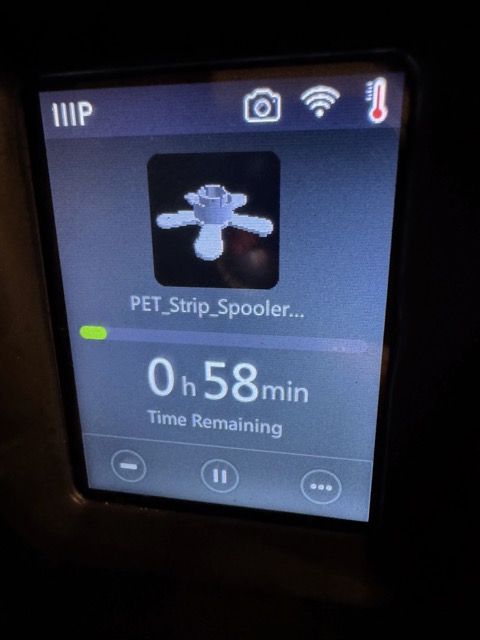
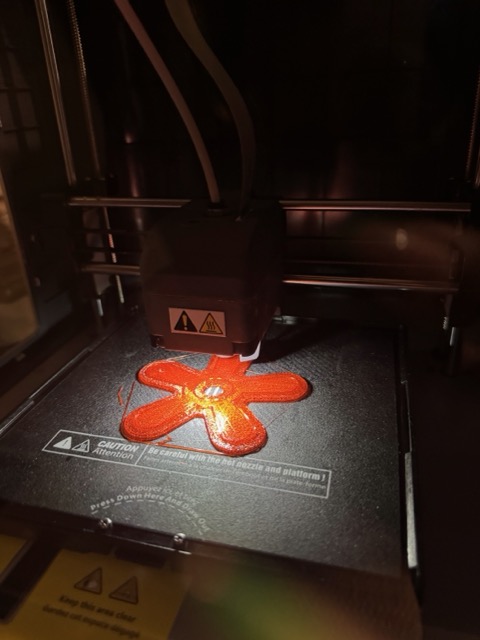
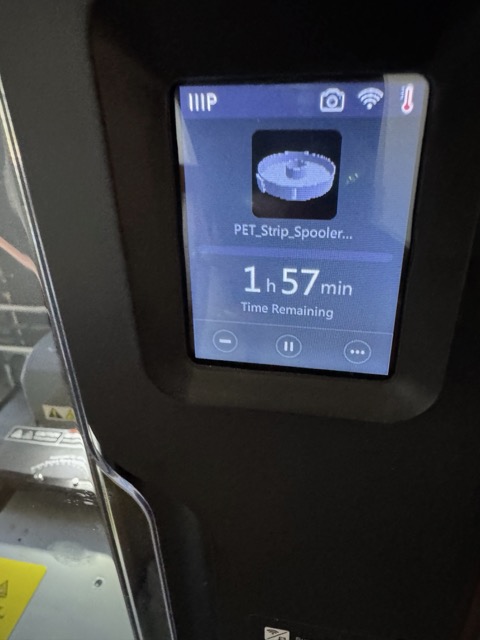
This video demonstrates the operation of the 3D printed PET strip winder used to collect and organize continuous strips cut from recycled PET bottles. The winding system transforms plastic bottle waste into reusable material that can be incorporated into thermoforming, weaving, sculptural construction, and wearable design applications. The project highlights sustainable fabrication practices by repurposing post-consumer plastic into a resource for experimental fashion and digital fabrication.
Once assembled, the completed winder kit consists of a rotating spool, structural support pieces, and a PET strip gathered from a green plastic bottle. The device allows PET material to be wound into controlled coils that can later be used for thermoforming, weaving, sculptural construction, and wearable design applications.
This video documents the PET winding process used to create sculptural forms through heat shaping and controlled material manipulation. The technique explores how PET materials can be wound, formed, and structured to produce lightweight, three-dimensional geometries suitable for wearable design, computational couture, and experimental fabrication.
This tutorial documents the PET winding process, demonstrating how recycled PET bottle material can be heated, shaped, and formed into lightweight three-dimensional structures for wearable and computational design applications.
Bill of Materials (BOM)
The following table documents the materials, components, tools, and equipment used to fabricate the PET bottle cutter and 3D-printed winding system.
| Qty. | Component or Material | Purpose | Fabrication / Source | Approximate Cost |
|---|---|---|---|---|
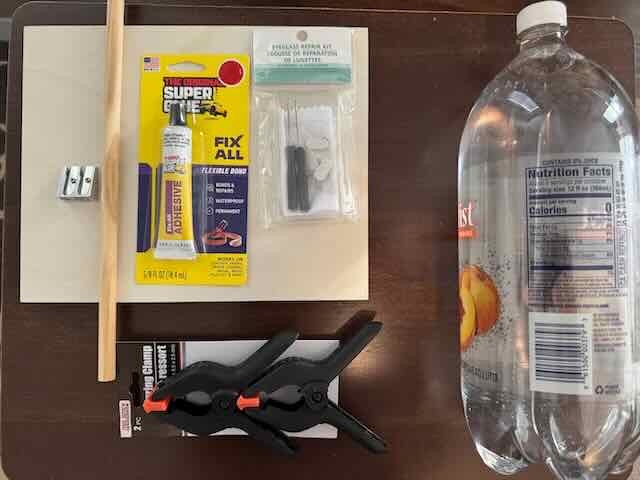
| 1 | Metal pencil-sharpener blade and holder | Cuts the PET bottle into a continuous strip | Purchased component | $2.99 |
| 1 | Wooden block | Serves as the base for the bottle cutter | Purchased material | $3.99 |
| 1 | Wooden dowel | Guides and supports the PET bottle during cutting | Existing material | — |
| 1 | Drill | Creates the hole for the wooden dowel | Existing tool | — |
| 1 | Super glue | Secures the cutting holder to the wooden base | Existing material | — |
| 2 | Two-liter PET bottles | Raw material used to produce the PET strip | Reused waste material | $1.25 each |
| 1 | 3D-printed top winder component | Guides the PET strip during winding | PLA, 3D printed | Based on filament use |
| 1 | 3D-printed bottom spool | Collects the continuous PET strip | PLA, 3D printed | Based on filament use |
| 1 | Central axle, dowel, or fastener | Connects the winding components and provides a rotational axis | Existing or purchased | — |
| As needed | PLA filament | Material used to fabricate the 3D-printed winder components | Fab Lab supply | — |
| 1 | FlashForge Voxel 3D printer | Produces the 3D-printed winding components | Fab Lab equipment | — |
| 1 | FlashPrint slicing software | Prepares the 3D model for fabrication | Software | Free |
Fabrication and Assembly Process
Step 1: Prepare the bottle cutter
The blade was removed from the metal sharpener, turned upside down, and returned to the holder. Reversing the blade orientation allowed the edge to engage the PET bottle during pulling.
Step 2: Attach the blade holder
The blade holder was secured to the wooden block using super glue. The position was selected so that the edge of the bottle could pass beneath the blade.
Step 3: Install the bottle guide
A hole was drilled beside the blade holder, and a wooden dowel was placed in the hole. The dowel stabilizes the bottle and helps maintain its position during cutting.
Step 4: Prepare the bottle
The bottom portion of the PET bottle was removed to create a clean starting edge. The edge was inserted under the blade at an angle.
Step 5: Cut the PET strip
The bottle was rotated and pulled through the blade. This created a continuous PET strip.
Step 6: Print the winder components
The top and bottom winder components were sliced in FlashPrint and fabricated with the FlashForge Voxel 3D printer.
Step 7: Assemble the winder
The printed top and bottom components were aligned around the central axle or connector. The assembled spool was checked to ensure it could rotate freely.
Step 8: Wind the PET strip
The end of the PET strip was attached to the spool. The spool was rotated manually to collect the material into a controlled coil.
Testing the PET Processing System
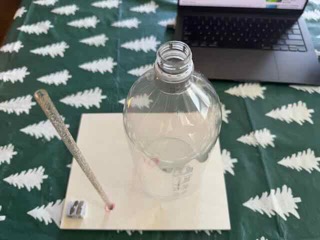
After assembling the bottle cutter and 3D-printed winder, I tested the complete PET processing workflow using two-liter plastic bottles. The bottle was first prepared by removing the bottom section and creating a starting edge. The bottle edge was inserted beneath the cutting blade and manually pulled while the bottle rotated around the wooden guide. This produced a continuous PET strip. The PET strip was then attached to the 3D-printed spool. I manually rotated the winding component to collect the strip. The winder successfully organized the PET material into a controlled coil and reduced tangling during the material collection process.
During testing, I observed that the consistency of the PET strip was affected by the angle of the bottle, the pulling tension, and the position of the blade. Uneven pulling occasionally created variations in strip width. The winding tool also required the PET strip to be guided manually to distribute the material across the spool. These imperfections helped identify opportunities for future development. A future version could include an adjustable blade guide to control strip width, a hand crank for more consistent rotation, and a PET feeding guide to distribute the strip evenly across the spool.
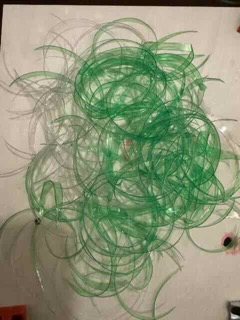 Completed PET bottle cutter and winding system during testing.
Video
From Youtube
PET Winding Tutorial
This tutorial demonstrates how the PET strip is collected, wound, and prepared for later material-forming experiments. The 3D-printed spool allows the continuous strip produced by the bottle cutter to be organized through controlled manual rotation.
Final Outcome: PET Bracelet
As a final material application, I used the processed PET material to create an experimental wearable bracelet. The PET strip was manipulated and formed into a lightweight sculptural structure that could be worn on the wrist. The bracelet was tested by Navy as a wearable sample. The final piece retains some of the imperfections created during the cutting, winding, and forming process. Rather than removing these irregularities, I documented them as part of the material experimentation and prototyping process.
This final outcome demonstrates the complete workflow of the project:
Discarded PET Bottle → Continuous PET Strip → Winding and Material Control → Forming and Manipulation → Wearable Textile Experiment
The experiment helped me understand how post-consumer PET can move beyond waste and become a material for textile, sculptural, and wearable design applications.
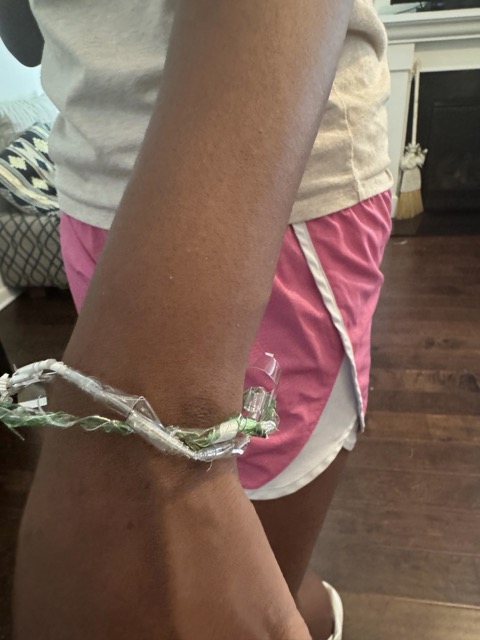
Final experimental PET bracelet worn by Navy.
Fabrication Files
The following digital fabrication files document the 3D-printed PET strip winding system. The STL files contain the printable 3D geometry, while the printer-ready files were generated through FlashPrint for fabrication on the FlashForge Voxel.
Project Reflection
This project developed from a simple manual PET bottle-cutting experiment into a small-scale material processing workflow that combines manual construction and digital fabrication. The original bottle cutter demonstrated that a discarded PET bottle could be converted into a continuous plastic strip. However, the loose PET strip quickly became difficult to organize and control. The development of the 3D-printed winder addressed this problem by creating a dedicated tool for collecting the PET material. Designing and fabricating the winding components allowed me to explore how digital fabrication could improve a manual recycling process and make the resulting material easier to use in textile experiments. Testing the system also revealed several limitations. The PET strip width was not always consistent, and the material still required manual guidance during winding. These observations identified opportunities for future development, including an adjustable cutting guide, a hand-cranked winding mechanism, and a feeding system that could distribute the PET strip more evenly across the spool.
The final PET bracelet demonstrates one possible application of the processed material. Through cutting, winding, heating, and shaping, the discarded bottle was transformed into a lightweight sculptural wearable sample. This experiment expanded my understanding of PET as a potential material for sustainable fashion, textile experimentation, and digital fabrication.