BioChromes
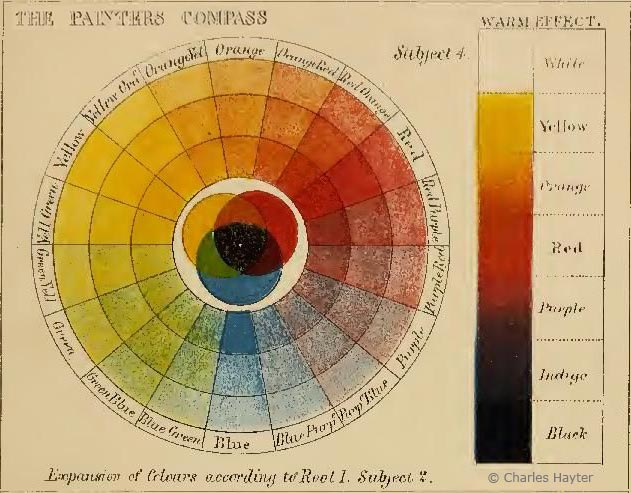
Colors are the children of light. ~ Johannes Itten
The textile industry is one of the most polluting sectors worldwide, particularly its dying processes. This week we explored alternative coloring methods and dying processes that prioritize environmental responsibility and local production using natural and regenerative color sources from plants, insects, bacteria, and soils. We looked to prioritize environmental responsibility and sourcing of dyes and pigments from the immediate environment. As it was a collaborative effort, the process photos are from Myles Lack-Zell, Pam Prapawit Intun, and myself.
1. Inspiration & foraging
My favorite thing about this week is that I have begun to look at my immediate surroundings in a whole new way. What color might these flowers make, are they colorfast (stable) or fugitive (fades)? How about those “weeds,” or the loads of goldenrod and mugwort in my local park already gone to seed? Marigolds, mugwort, and goldenrod are pictured below.

One pioneer I salute is Cecilia Raspanti and the Local Color project. Not only have she and her colleagues advanced the science and craft of biochromes, but she convinced the city of Amsterdam to de-pave parking spots on her block and transformed them into dye gardens. Our local Fab Hub Kendall is already abuzz with the idea of doing the same. Here is an excellent starting point: The Herb Society of America’s Dye Garden Plant List for New England 4
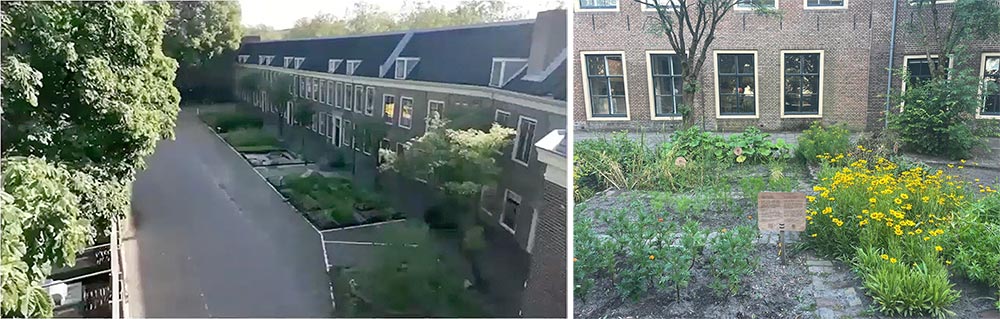
Another inspiration is Svetlana Khachatryan's biochromes journey. I love how it has unfolded over time and in multiple dimensions far beyond her initial project work at Fabricademy — from the science and craft, to the experience design of color.
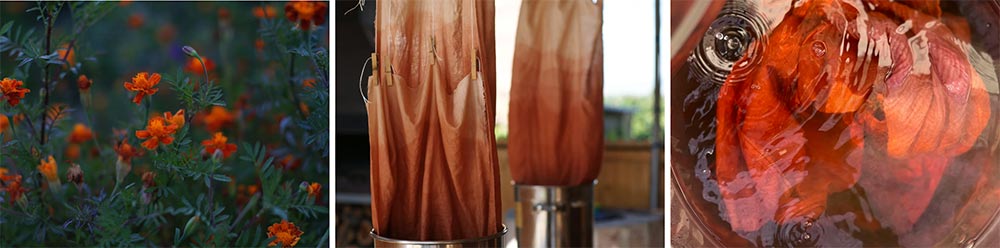
2. Natural dying and the 0-waste journey
Natural dyes, or biochromes, are pigments produced by living organisms such as plants, animals, and bacteria. They are an antidote to the toxic chemical dyes used in the textile industry. Bacterial dyes are also produced by living organisms.
Sustainable, values-driven approaches are locally positive, biobased and compostable, and zero-waste minded:
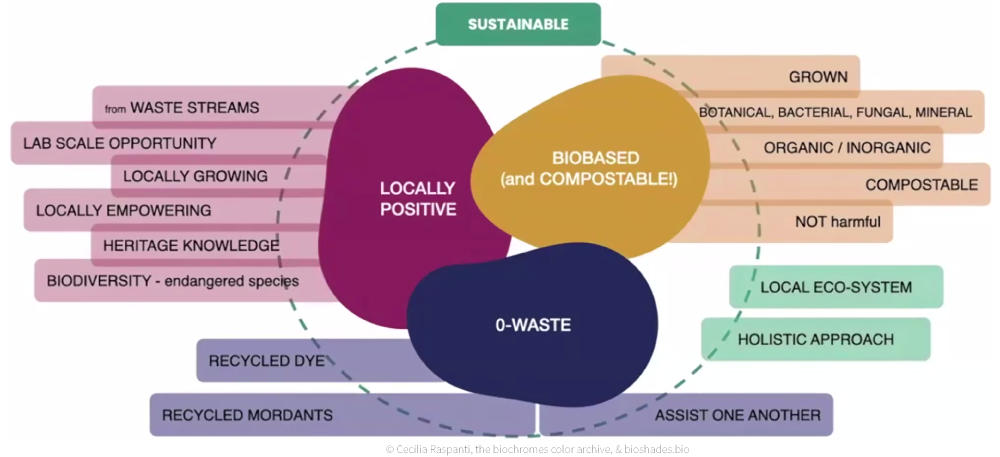
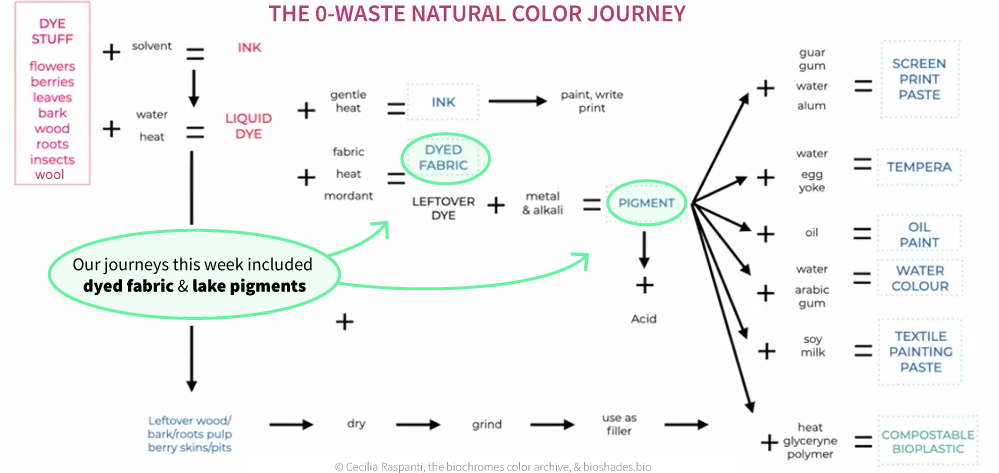
The zero-waste color journey of a natural dying life cycle:
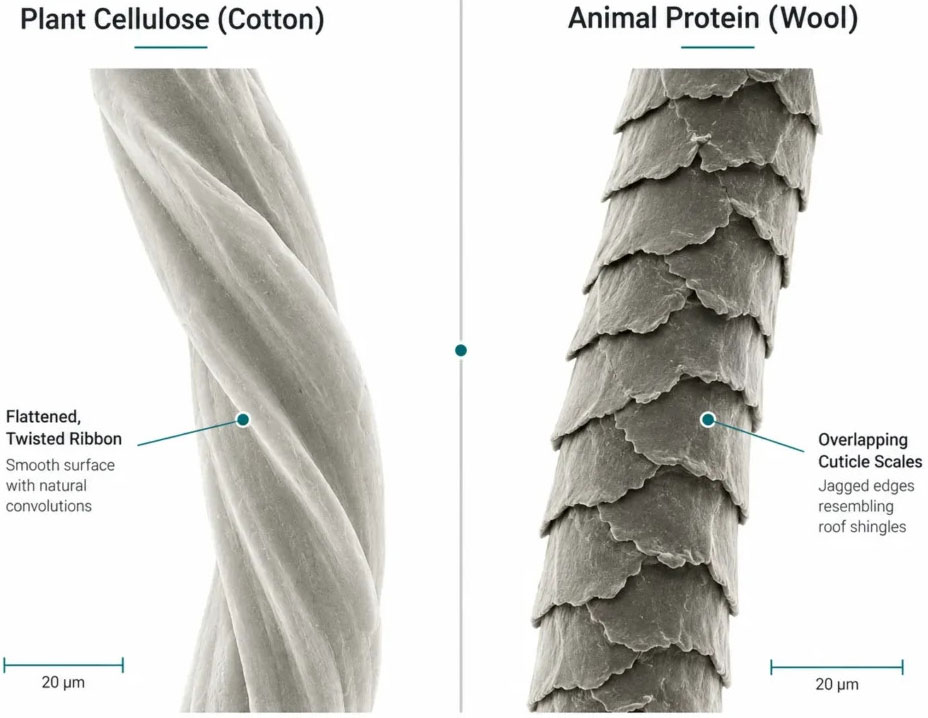
Natural fibers for dying come in all forms, from fabrics to yarns, and are derived from protein (animal) and cellulose (plant) sources. All fibers need to be scoured (cleaned), but only the cellulose must be pre-treated with tannin and mordant baths, as they less readily “grab” the natural dyes than protein fibers. Mahammad Alhinti found this image from Carenova that helps to explain the phenomenon.
The process steps of natural dying include:
- gathering (foraging or purchasing) and extracting natural dye stuff (dye matter),
- scouring fibers to be dyed to remove waxes and oils,
- tanning fibers to enhance the strength of the mordants,
- mordanting the fibers to increase the affinity of the fibers to dyes,
- dying the fibers in a dye pot of the extracted dye matter, and
- modifying dyed fibers with different substances, as desired.
3. Tools
Tools you will need throughout the process
- Clippers and bags for foraging
- Small digital scale
- Stainless steel 2-3 liter dye pots
- Stirring utensils or tongs
- Thermometer
- Strainer mesh
- Funnel
- Coffee filters
- Mortar & pestle
- Jars: 1- and 2-liter jars, quarts, pints, small vessels for lake pigments
- Beakers, pipettes, and petri dishes
- pH test strips
4. Making natural dyes
Working as a group, we considered foraged sources (goldenrod and mugwort) and store-bought dye matter (madder root, woad, and logwood). The woad we were working with turned out to be the wrong form for dying with, so is omitted from this narrative.
4.1 Weigh & prepare fabric
We bundled wool and silk yarns and cut cotton and linen fabric into 10cm x 10cm swatches. Then we determined the weight of the fiber (WoF), which would factor into all of the subsequent steps.
Cut, bundle, weigh, scour, and mordant:
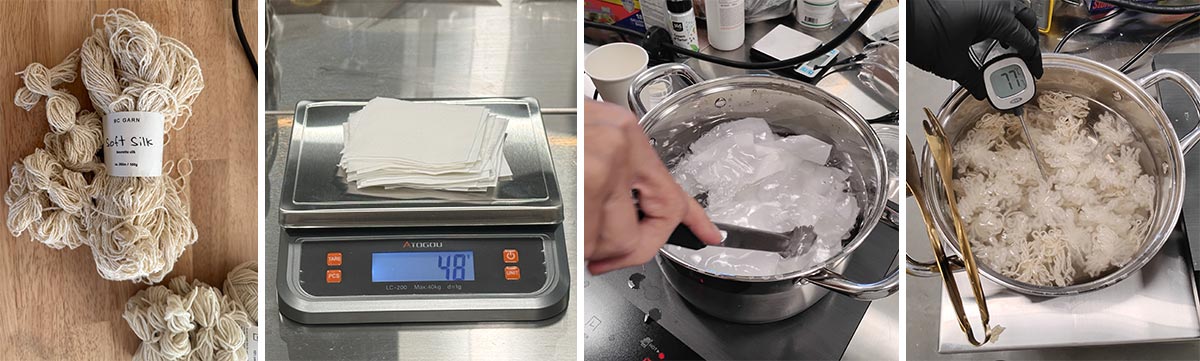
Weigh the fiber:
| Cellulose fibers | Protein fibers |
|---|---|
| Cotton: 48.11g | Wool: 20.47g |
| Linen: 68.00g | Silk: 20.34g |
| Total: 116.11g | Total: 40.81g |
Scour to deep clean the fabric with soda ash (sodium carbonate) for cellulose and dish soap or Woolite for protein fibers:
| Fiber | Weight | % WoF | Directions |
|---|---|---|---|
| Cellulose | 116g | 1%, or 1.2g | Dissolve the soda ash (sodium carbonate) in a bit of water, and add to a pot of ~ 0.5 liters of simmering water. Add the fiber samples to the pot and simmer for 1 hour, stirring gently. Rinse in cold water, and hang to dry. |
| Protein | 41g | A few drops | Gently clean in lukewarm water, avoiding too much friction, heat, and sudden temperature changes. Rinse, squeeze out the excess water, and hang to dry. |
Apply a tannin bath to increase the affinity of cotton to the plant dye, and to help the fiber grab the mordant. We did not have oak gall powder (a tannin source), so skipped this step and hoped for the best.
Apply a mordant bath to lock help lock the tannin and dye to the cellulose fibers. We used alum (aluminum sulfate) as a mordant for 116g of cellulose and 41g of protein fibers.
| Fiber | % WoF | Amount | Directions |
|---|---|---|---|
| Cellulose | 20% | 23g alum | Dissolve alum in a cup of boiling water, then add to a pot of ~12 cups of water. Add the fibers to the pot and slowly bring water to a temperature of 80ºC. Simmer for 45 minutes, stirring occasionally. Briefly cool, remove the fibers, and rinse with room temperature water. |
| Protein | 12% | 5g alum | Dissolve alum in a cup of boiling water, then add to a pot of ~12 cups of water. Add the fibers to the pot and slowly bring water to a temperature of 60-70ºC (cooler than the cellulose, as recommended by Svetlana). Simmer for 45 minutes, stirring occasionally. Briefly cool, remove the fibers, and rinse with room temperature water. |
4.2 Prepare dye baths
Preparing the dye baths was a similar process for each of the dye matters. One of the main things to consider is what proportion of dye matter to use compared to the amount of fiber you are dying. For example, 100% WoF means you are using 100g of dye matter for 100g of fiber. Another consideration is whether the dye matter needs to first be soaked overnight.
Weigh, simmer, strain, and dry discarded dye matter for future biomaterials:

We split up our fiber samples into four sets of 6 pieces for each of the dyeing experiments. The sets of 6 each weighed 32g and broke down as follows: Cotton: 9.6g; linen: 13.6g; wool: 4.4g; and silk: 4.4g. (see handy calculation spreadsheet2 prepared by Myles Lack-Zell). Here are the dye bath recipes for 32 grams of fiber weight:
| % WoF | Weight of dye matter | Directions |
|---|---|---|
| 225% | 72g goldenrod | Submerge goldenrod in ~ 3 liters of water, bring temperature up to 70°C and hold for 45min, stirring occasionally. Cool naturally to room temperature, and remove goldenrod with tongs and mesh filter. |
| 200% | 64g madder | Soak in a pot of water overnight. Bring temperature up to 70ºC and hold for 30 minutes. Strain out madder. |
| 200% | 64g logwood | Soak in a pot of water for at least an hour and as long as overnight.1 Bring temperature up to 70ºC and hold for 30 minutes. Strain out logwood. |
4.3 Dye & modify fabrics
What follows is the process for dying with madder and logwood. You can see the instructions for dyeing with goldenrod on Myles Lack-Zell’s page.
Dyeing with madder and logwood:
- Put wet swatches into cool madder and logwood dye baths, respectively
- Bring up to 70ºc, stir for 1 hour (increased to 1h 15min because temp was cooler because of a broken thermometer). Leave one piece of each fiber type overnight.
- Rinse: Using the same temperature water as your fiber, rinse the dyed goods once or twice, cooler temps each rinse, then wash gently in a neutral liquid soap. Dry away from direct sunlight.
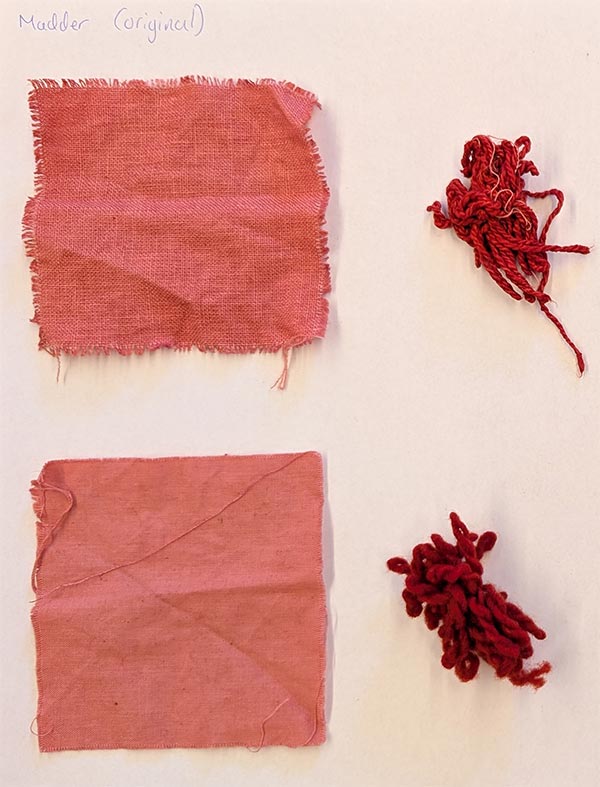
On the right: Fibers dyed with madder.
Prepare modifier solutions:
- Vinegar: Mix in a little bit with water
- Alum (aluminum sulfate): Dissolve 2g aluminum sulfate per 10mL water
-
Iron liquor
a. Place rusty iron into container of equal parts water and vinegar. We used ½ L water, ½ L vinegar, and 0.66 kg iron.
b. Let sit for 1-3 weeks. We used a 1-week solution. 2-4 weeks gives higher iron concentrations, so consider using diluted solution. 4. Baking soda (sodium bicarbonate)
a. Heat 100mL water in a small saucepan (doesn’t need to boil, but should be hot)
b. Slowly add 2.25tsp sodium bicarbonate in increments of 0.25tsp, stirring to dissolve in between pours. (Our final 0.25tsp didn’t fully dissolve, so we recommend trying a total of 2tsp.)
c. Leave out to cool. If sodium bicarbonate starts to precipitate, stir the mixture before use or just take from the clearer liquid.
Decide on modifications through petri dish testing
- Line up and label petri dishes for control, vinegar, alum, iron liquor, and baking soda.
- Measure and pour 5mL of dye bath into each dish.
-
Using a pipette, add modifier solution to the corresponding petri dish, 1 drop at a time, sirring between additions.
a. Wait to see if oxidation changes the color before adding another drop. (We added at least 2-4 drops at a time unless we saw an immediate change after a single drop)
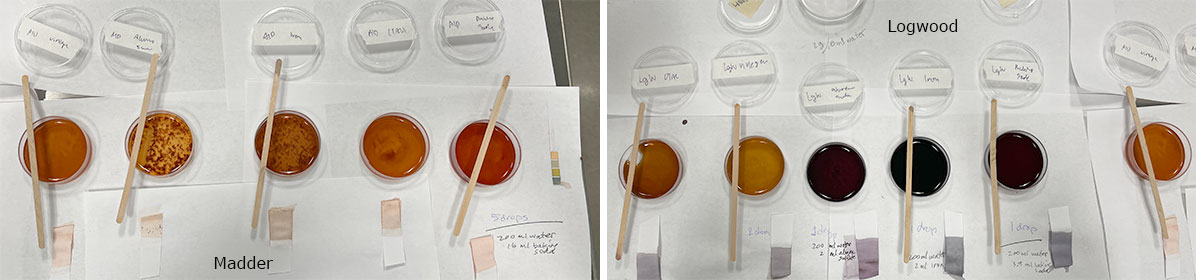
The calculations were difficult, given the vastly different amounts we were working with (e.g. drops in petri dishes vs grams added to a modification bath).
We only saw some variation with baking soda for madder, so didn’t try other modifications. With logwood we tried aluminum sulfate, iron, and baking soda. Note: We had wanted a good strong color with the logwood, so decided to use 200% WoF, but it proved to be an incredibly strong dye matter, making the modification effects difficult to see. Next time, it would be good to try closer to 50% WOF!
Apply modifiers
Below is the process for madder and logwood. YYou can see more about how we chose to modify the goldenrod samples on Myle’s page.
The first step is to prepare larger quantities of decided upon modifier solutions according to the formulas below. You can either divide the used dye baths into separate pots for each modifier, or prepare the modifiers in water. We chose the former for goldenrod, and the latter for madder and logwood.
Madder modifiers:
-
Prepare modification bath (only baking soda gave a meaningful change in petri dish test).
a. 16 ml baking soda + 200 ml water
-
Add fabrics, heat and keep at 70ºc for 30 mins.
-
Rinse and dry.
Logwood modifiers:
-
Prepare modification baths.
a. 2 ml alum + 200 ml water
b. 2 ml iron liquor + 200 ml water
c. 3.9 ml baking soda + 200 ml water
-
Add fabrics, heat and keep at 70ºc for 30 mins.
-
Rinse and dry.
4.4 Results
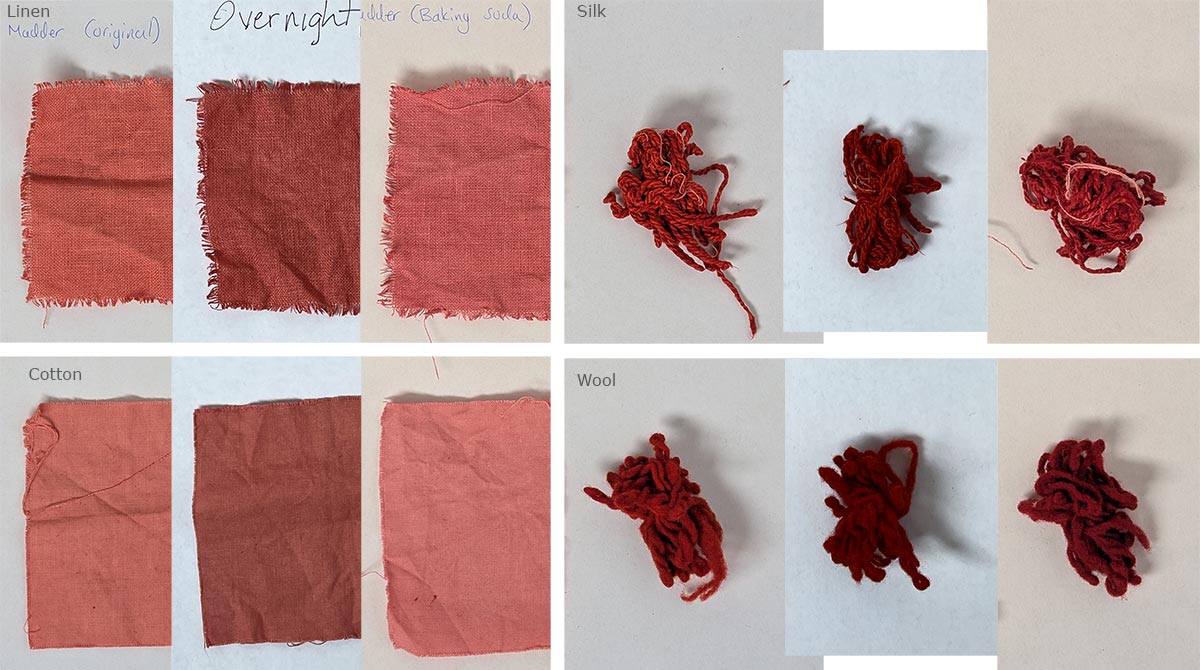
Here are the results for madder on linen and cotton swatches and silk and wool yarn bundles (from left to right: original, overnight, and modified with baking soda). The fibers left overnight gave the most dramatic difference. You can see modified swatch sample results for logwood and goldenrod on Pam and Myles' pages, and a preview below.
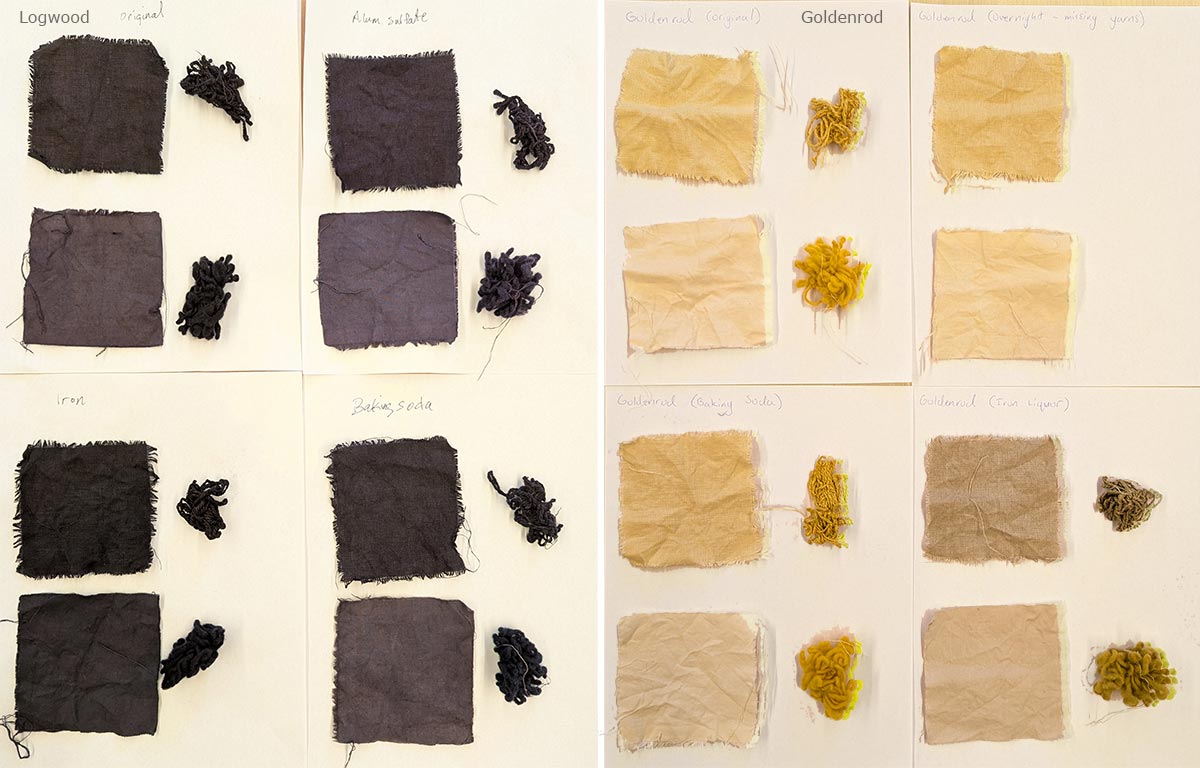
Logwood and goldenrod results on linen and cotton swatches and silk and wool yarn bundles. Logwood swatches (clockwise) show original, alum, iron, and bakiing soda modifications. Goldenrod swatches show original, overnight, baking soda, and iron modifications.
5. Marigolds, start to finish
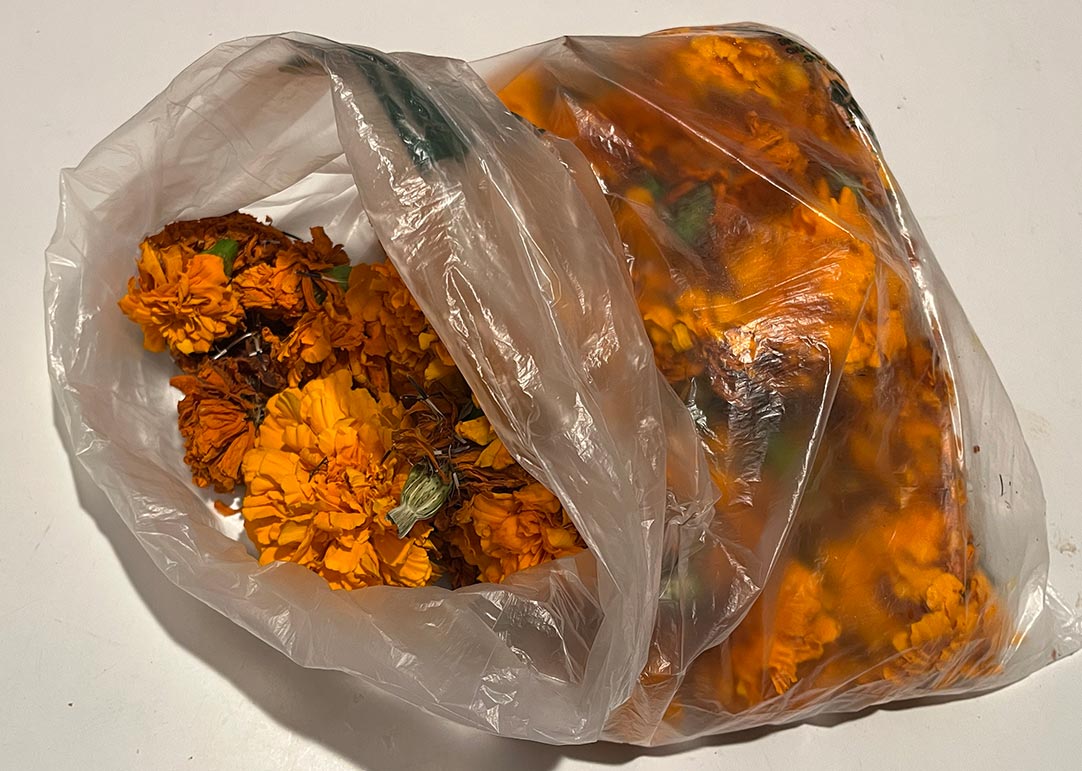
I was gifted a load of freshly-picked African marigolds (thanks to my daughter!), so decided to additionally take them through the entire process as a way to solidify my learning, to try the process with the tannin step included, and out of curiosity as to the colors they would produce. What follows is the condensed process, start to finish.
Weigh & prepare fabric
I chose to use silk (protein) and cotton (cellulose) fabric swatches.
- Weight of fabric: 24.4g (cotton: 16.6g; silk: 7.6g)
- Scour silk: Add 0.08ml of Woolite soap (5 ml soap for each 450g of fibers); heat slowly to 60ºC for 1 hour, turning gently, don’t agitate; cool down slowly and rinse in warm water.
- Scour cotton: Add 0.332g dissolved soda ash to a pot of room temperature water; add wet fibers, slowly bring to 82ºC/180ºF, rotating gently, and hold at temperature for 30 minutes; remove and rinse in cool water.
- Cotton tannin bath: Add 3g powdered oak galls (you can use between 10-50% WoF) to 1 liter of water and simmer for 1 hour; let cool; strain out the oak galls and reserve the liquid for the dyebath; soak damp cotton in a warm or room-temperature tannin solution for 1 to several hours.
- Mordant silk: Dissolve 0.92g alum (aluminum sulfate, 20% WoF) in boiling water and add to a pot of water; add wet fibers and slowly bring water to 60-70ºC; simmer 45 min; let cool naturally; remove fibers and rinse with room temperature water.
- Mordant cotton: Dissolve 3.3g alum (12% WoF) in boiling water and add to a pot of water; add 1.7g cream of tartar (6% WOF) to silk mordant solution; add wet fibers and slowly bring water to 80ºC; simmer 45 min; let cool naturally; remove fibers and rinse with cool water.
Prepare dyebaths: Add 24.4g flower petals (1:1 WoF) to a pot of warm water; bring to a simmer, keep at 70-90ºC for 1 hour; strain out flowers; separate in two dyebaths for silk and cotton.
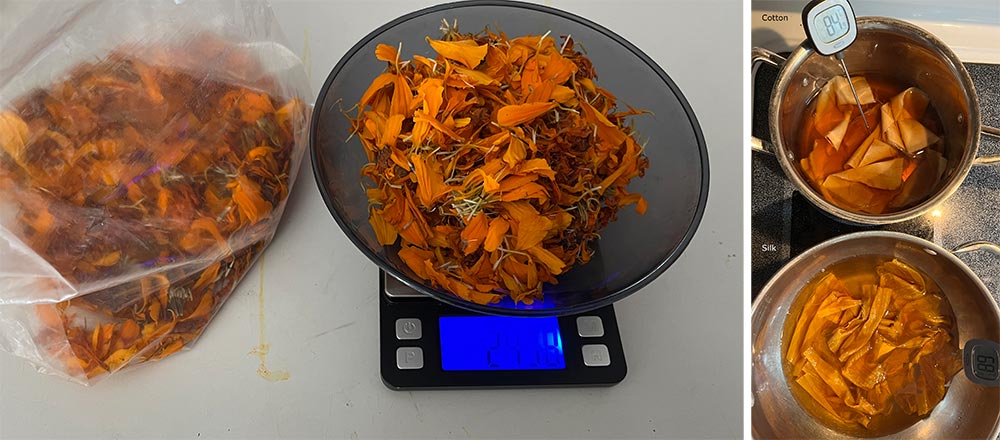
Dye fabric: Add wet fibers to pot, heat and keep at 70°C to 82°C (silk) and 82-92ºC (cotton) for 1 hour; cool and rinse in room temperature water.
Modify fabric (afterbaths in water):
Fiber weights: 1.1g per piece of silk, 1.8g per piece of cotton.
| Modifier | Amount | Directions |
|---|---|---|
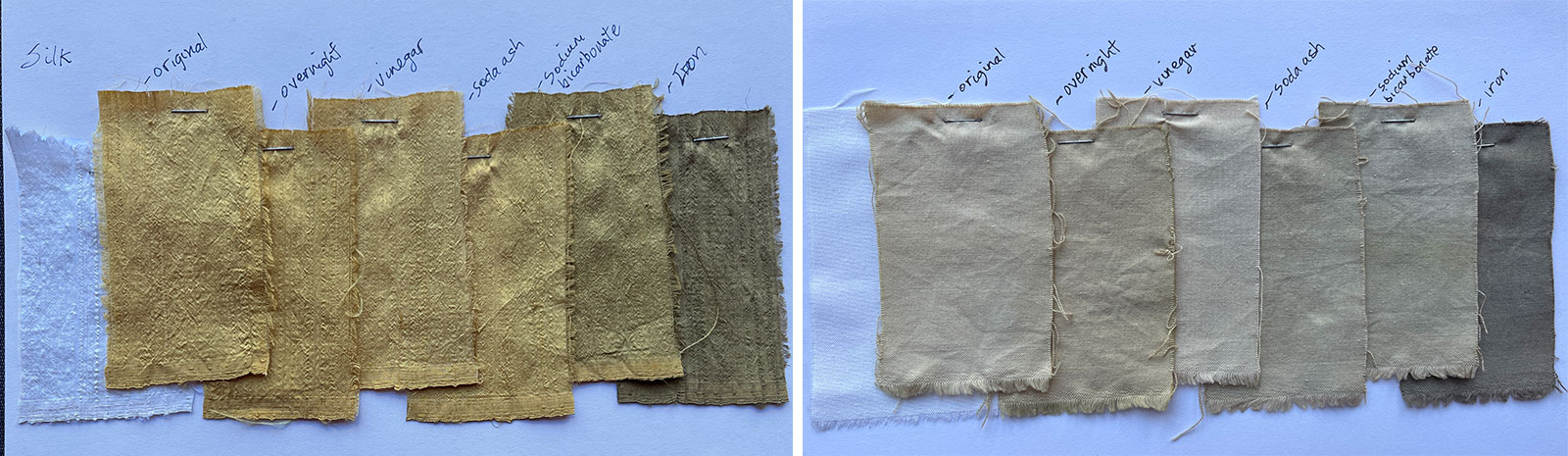
| Vinegar | 120g for every 113g of fiber | Add to bowl of water, stir gently and continuously for 10 minutes. |
| Soda ash | 0.17g (4.8g for every 113 grams of dry fabric) | Dissolve in bowl of warm water, dip wet fabric until desired result. I stopped at 3 minutes for silk, and 1 minute for cotton. |
| Baking soda | 1 teaspoon | Dissolve in warm water, submerge wet fabric, and stir gently for 2-30 minutes (I stopped at 2.5 minutes). |
| Iron liquor | 2 tablespoons | Add to bowl of warm water, dip wet fabric for 30 seconds to 15 minutes (I stopped at 15 seconds). |

Results
The colors came out nicely — more bright and intense for the silks. Alas, no orange color is to be had from marigolds.
6. Making lake pigments
The process steps for making lake pigments: Precipitate > filter & dry > grind & mix.
The first step is to precipitate the pigment out of the liquid dye bath. There is no need to calculate the weight of fiber for lake pigments.
Precipitate
- Pour leftover dye into tall narrow container, fill to half
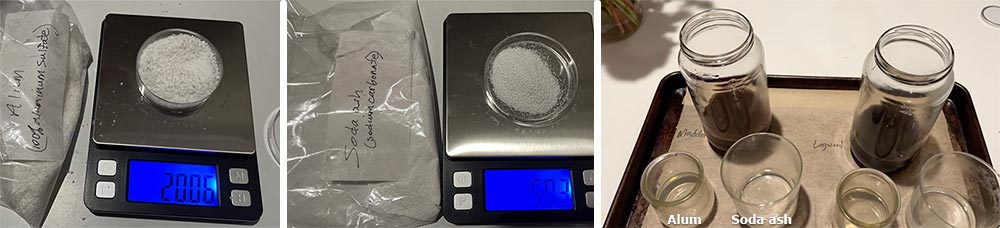
- Alum: Melt 20g in hot water, stir, add water until dissolved
- Soda ash (Sodium carbonate): Melt 5g in hot water, stir, add water until dissolved
- Add alum solution to dye bath
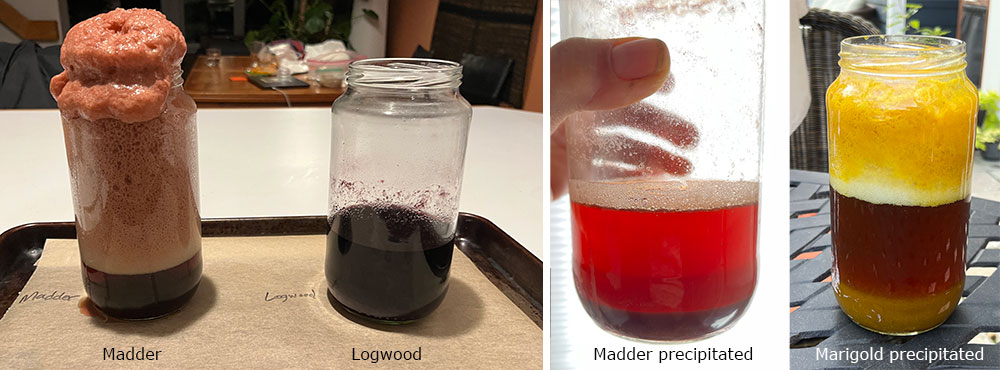
- Add soda ash solution slowly until effervescence stops
Adding the soda ash is a dramatic part of the process!
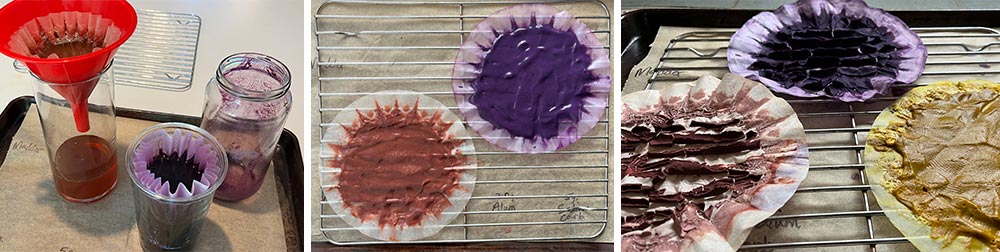
Precipitating the dye baths of madder, logwood, and marigold:
Filter & dry
- Let lake pigment fully separate from leftover water by keeping container still
- Once completely settled, pour out the water without disturbing the pigment.
- Prepare a paper, coffee filter in a funnel or sieve, position over a bottle or bowl to collect liquids.
- Pour the lake pigment onto the coffee filter and slowly drain out all the water.
- Once filtered, place the filter and pigment to dry
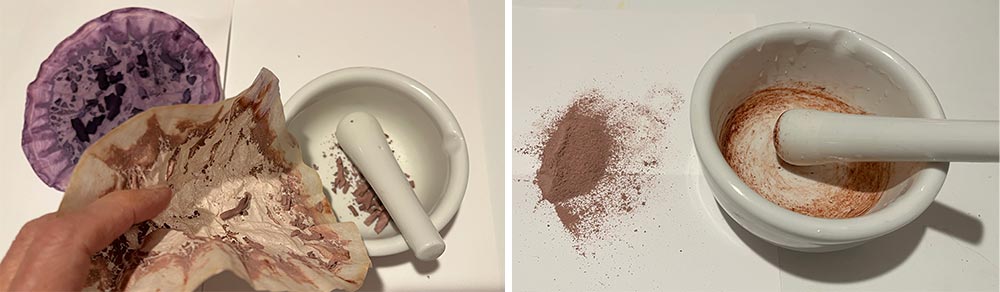
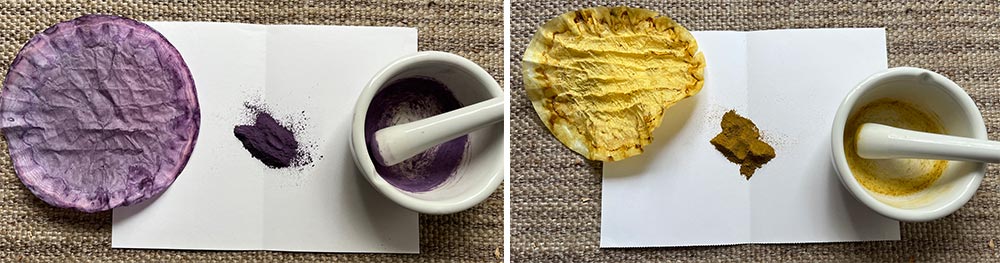
Grind & mix
- Once pigment is dry, carefully scrape it off the coffee filter with a spatula.
- Grind the collected pigment with a mortar and pestle.
- Pigments can be mixed with each other to create clear shades and colors.
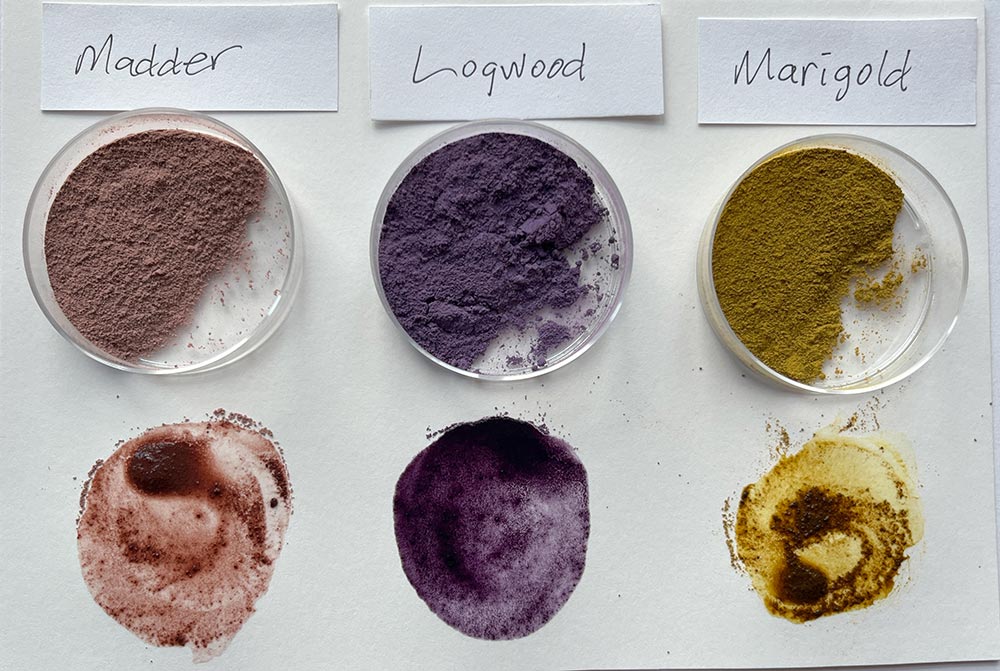
- To create paints and watercolor, mix the pigment with Arabic gum, soy milk, or linseed oil.
Mixed with Arabic gum, these pigments will make fine watercolors!
7. Reflections
- We had wanted a good strong color with the logwood, so decided to use 200% WoF, but it proved to be an incredibly strong dye matter, making the modification effects difficult to see. Although it seemed fine for madder, next time, it would be good to try closer to 50% WoF for logwood!
- Preparing the fabric is a critical, but time consuming part of the process. When wanting to try just one more dye matter (e.g. marigolds), keep this in mind.
- Tannin, which I used for the marigold fabric preparation process, didn’t seem to improve the dye affinity of the cotton. Other factors may have been at play (e.g. rookie moves during other steps in the process), so I won’t fault the oak gall powder, just yet.
- Photo documentation for marigolds was a big challenge. My iPhone kept adjusting the white background color based on the swatches (e.g. blue-ish backgrounds for the silk swatches). I was not able to turn off this "feature" in my settings.
- While we didn't have time this week, I would like to try bacterial dyes sometime soon.
- The local flora in my environment continues to freshly draw my attention to the potential of colors they may produce!