Process
This project developed through a continuous dialogue between material, water and context.
It began with a question around water use in wool processing and evolved into a broader investigation of how water interacts with fiber, not only as a resource but as an active agent shaping transformation.
Throughout the process, initial assumptions were tested, challenged and in some cases redefined. What emerged is not a single outcome but a system of experiments and learnings.
Workflow: project development

Phase 1: Problem Investigation
The project started by looking at water-intensive processes in wool treatment, questioning conventional washing methods and exploring historical practices, such as suint fermentation.
This phase combined research, observation and early hypotheses about water consumption.
Phase 2: Material Exploration
A series of hands-on experiments were conducted to test alternative approaches:
- low-water washing methods
- natural dyeing with reduced water
- felting and fiber transformation.
These experiments revealed possibilities and limitations in terms of material response.
Phase 3: Reframing the Approach
As the experimentation progressed, the focus shifted.
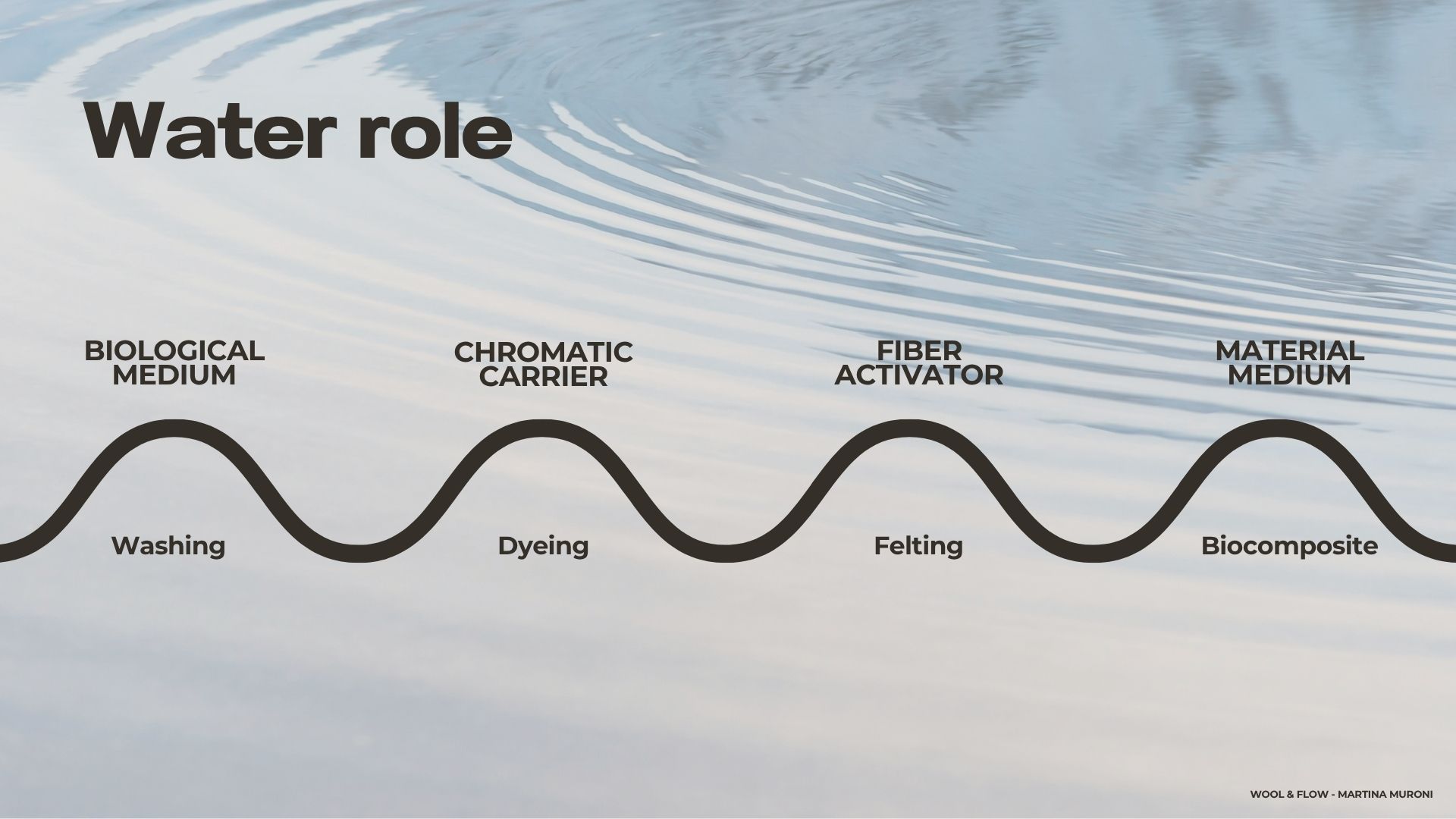
The project began to explore how material behavior changes when water is reduced or rethought. Water was no longer considered only as a resource to minimize but as a transformative element influencing texture, color and structure.
Some initial directions were abandoned, others rethought and became central. Like a river and its tributaries, all paths contribute to the same flow.
Phase 4: System Development
The project evolved into a modular system connecting different stages of wool transformation, breaking the linearity of traditional processes.
While cleaning remains central to allow wool transformation, rustic wool is worked without spinning. Experimental outcomes are connected to traditional methods, opening possibilities for local production and knowledge sharing.
Project outcomes
Washing
Water acts as a biological activator through Suint Fermentation, a traditional method that uses rainwater and the natural suint (salts present in wool) to create a bath with no soap.
The method requires constant warm water and is therefore mainly run in spring and summer.
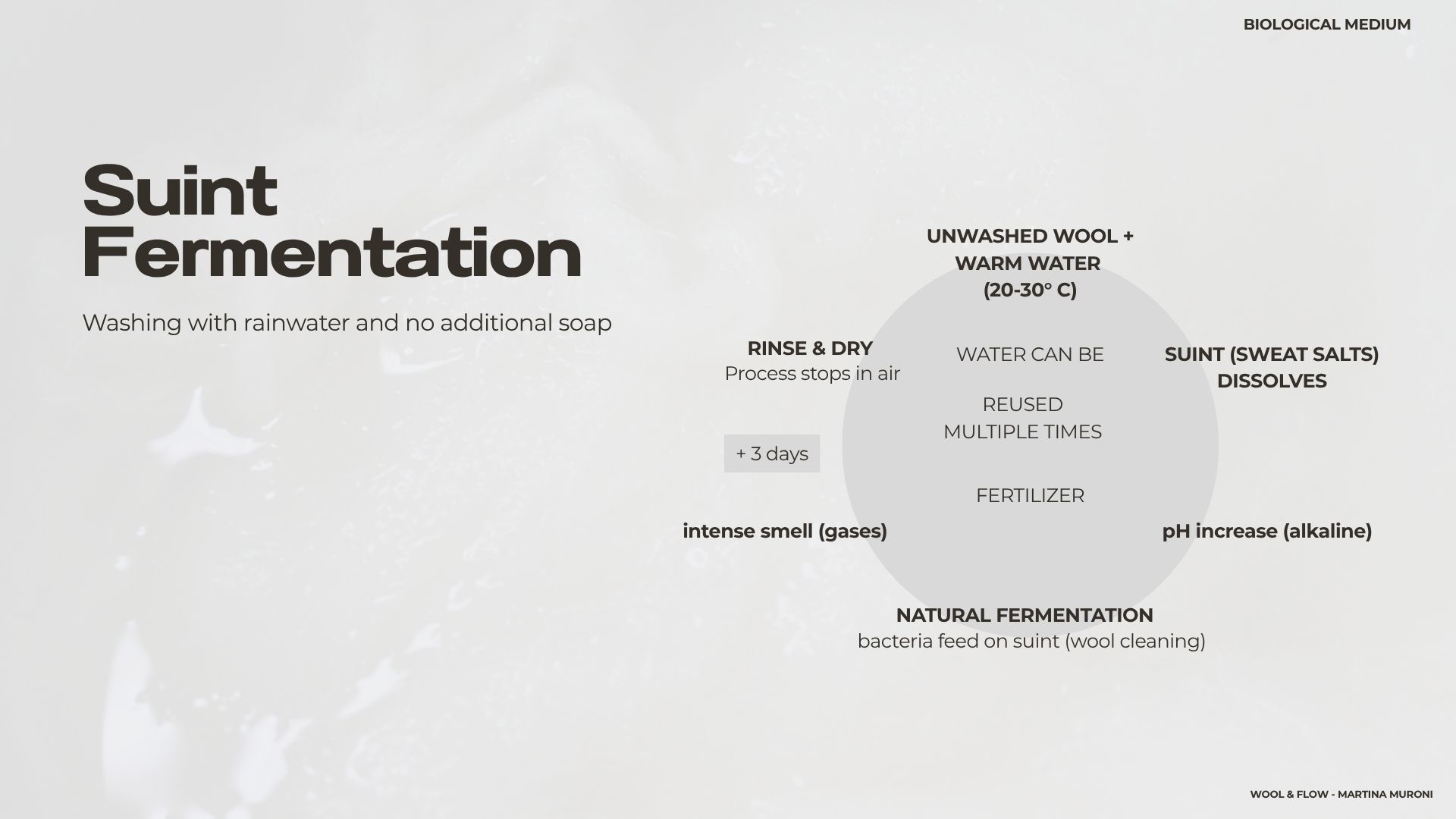
The goal of this project was to adapt the system to work all year round, including winter, creating a reliable and low-impact washing process.
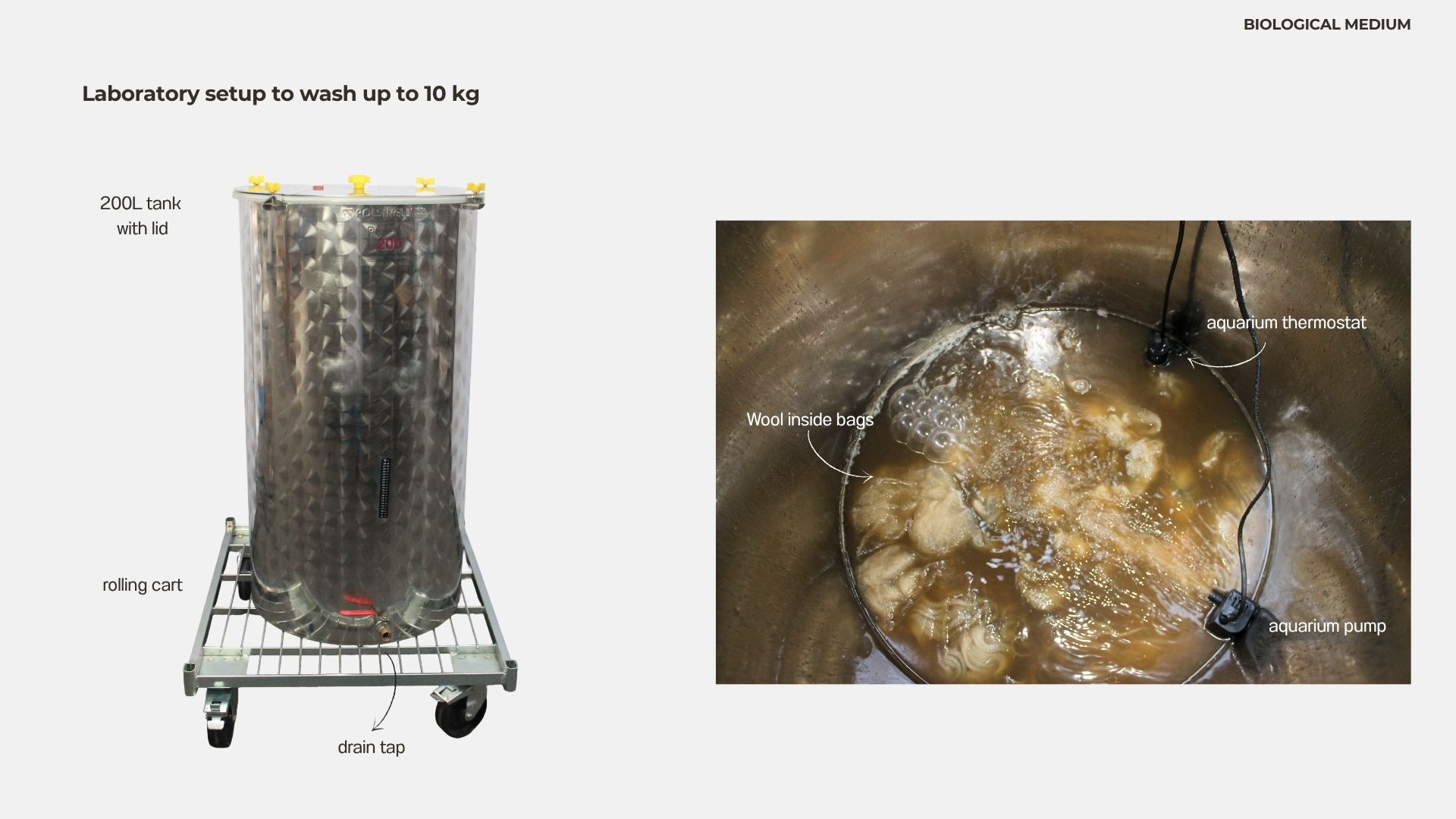
The system works: the wool comes out clean, soft and ready for further transformation.
For complete information on the experiments conducted, visit this page.
Natural Dyeing
Water acts as a chromatic carrier, becoming an active component in the dyeing process. The work is structured around three main directions:
1. Local resources: Territorial water and plant dyes
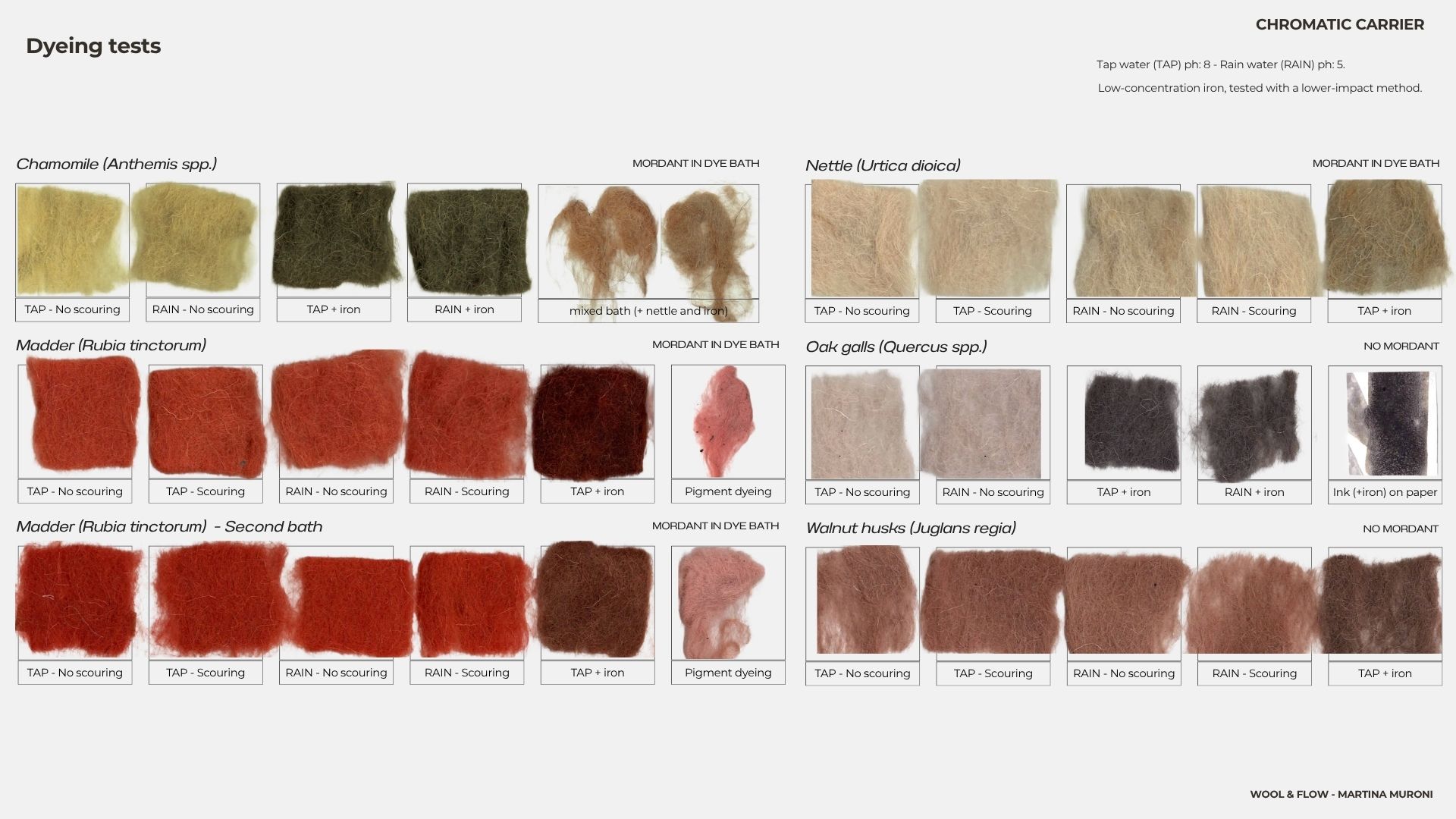
Focus on Alpine dye plants, typical of the countries participating in the Woolshed project, and on local water sources, comparing rainwater and tap water.
While pH variations do not always produce strong differences, in some cases they influence tone and colour development, contributing to context-specific results.
2. Process simplification: no scouring and simultaneous mordanting
Exploration of simplified dyeing processes to reduce water use. Tannin colours are observed without a mordanting step, alongside simultaneous mordanting during dyeing, reducing the number of steps while maintaining effective results.
3. Circular colour: dye bath reuse and pigment extraction
Extension of dye material life through reuse and transformation.
Dye baths are reused across multiple cycles, producing softer tonal variations, while pigment extraction enables further applications, such as on paper or for additional dyeing processes.
The experiments resulted in a varied colour palette:
For complete information on the experiments conducted, visit this page.
Felting
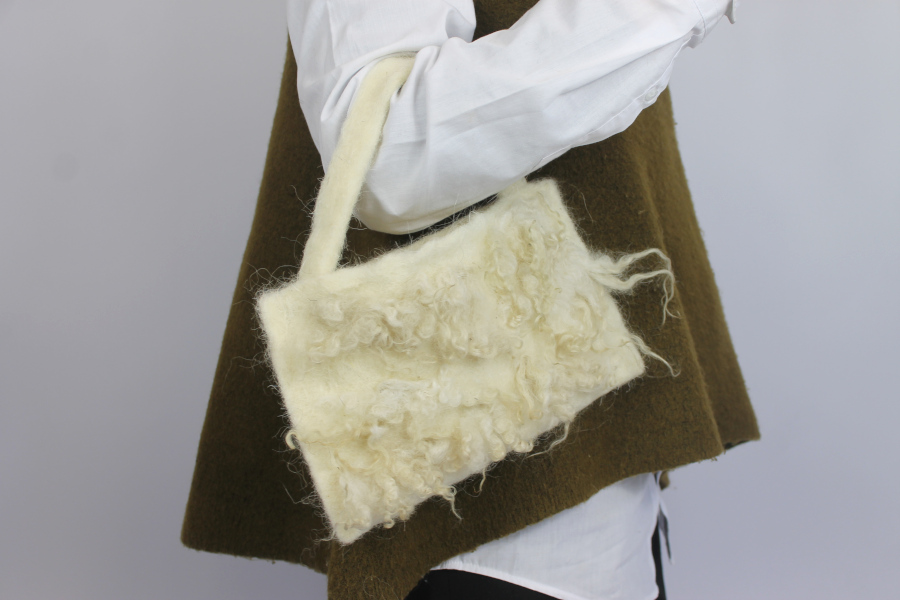
Felting is a traditional technique that transforms wool into dense material. Today, technology can support these techniques, reducing manual effort and expanding creative possibilities.
In this stream, the focus was on the interaction between traditional techniques, both with and without water, and technological support. Water acts as a fiber activator, enabling rustic wool to interlock and create structure, while needle felting engages the material without water.
A range of tools, from low- to high-tech, were tested across both approaches to evaluate their effect on texture and material behaviour.
This experimentation led to the development of two products, demonstrating how different combinations of tools and techniques influence form, structure and design outcomes.
For complete information on the experiments conducted, visit this page.
Biocomposites
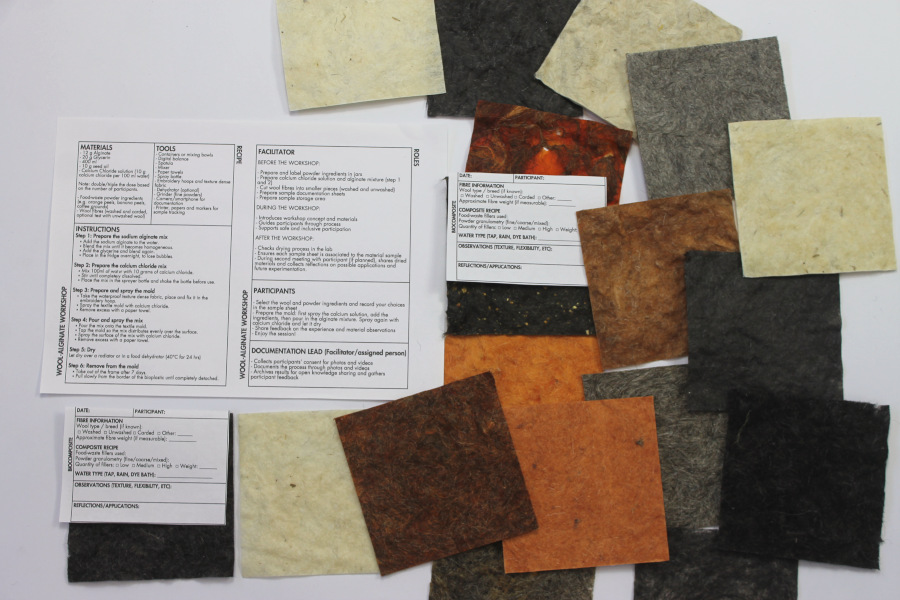
Wool has been explored as part of bio-based composite materials, combined with natural binders, in particular with alginate, to form a flexible and biodegradable composite.
The focus extends beyond material development to collective learning through making. The research takes the form of a workshop, where participants are invited to experiment with the composite, exploring different combinations, textures and outcomes.
More details about the format can be found here.
For complete information on the experiments conducted, visit this page.
Documentation & Knowledge Sharing
This project is documented as an open and evolving resource. All experiments, processes and findings are shared on this platform with the intention of making knowledge accessible. The documentation includes step-by-step processes and material tests.
This body of work will be integrated into the "Woolshed platform", where it will contribute to a network of practices around wool, materials and local production.
I am also engaging in events, workshops and shared moments of exchange, where wool practices are collectively rethought and learnings are openly shared.
What's Next
The project is currently transitioning from experimentation to a deeper understanding of material behavior and potential applications.
Washing: test suint fermentation on different sheep breeds and compare it with multiple washing systems, including quantitative tracking of water and process variables.
Natural Dyeing: further explore water interaction, including fermentation process.
Biocomposites: investigate material behaviour and further test the workshop model.
Felting: develop a knowledge-sharing structure, such as a workshop model.
Images: Martina Muroni unless otherwise stated.