Research Synthesis
I. Aqaba Marine Life
Aqaba, located along the Gulf of Aqaba at the northern tip of the Red Sea, hosts one of the region’s most unique marine ecosystems. Its coral reefs are among the most thermally resilient in the world, having shown remarkable resistance to mass bleaching events affecting other reefs globally. This resilience is partly due to historical adaptation to warmer waters, allowing corals to tolerate higher temperatures. The reefs support rich biodiversity, including fish, invertebrates, and complex coral structures that create vital habitats. However, despite this resilience, they remain vulnerable to local pressures such as coastal development, tourism, and pollution. Protecting Aqaba’s reefs is critical, as they represent a rare example of coral systems that may withstand future climate conditions.
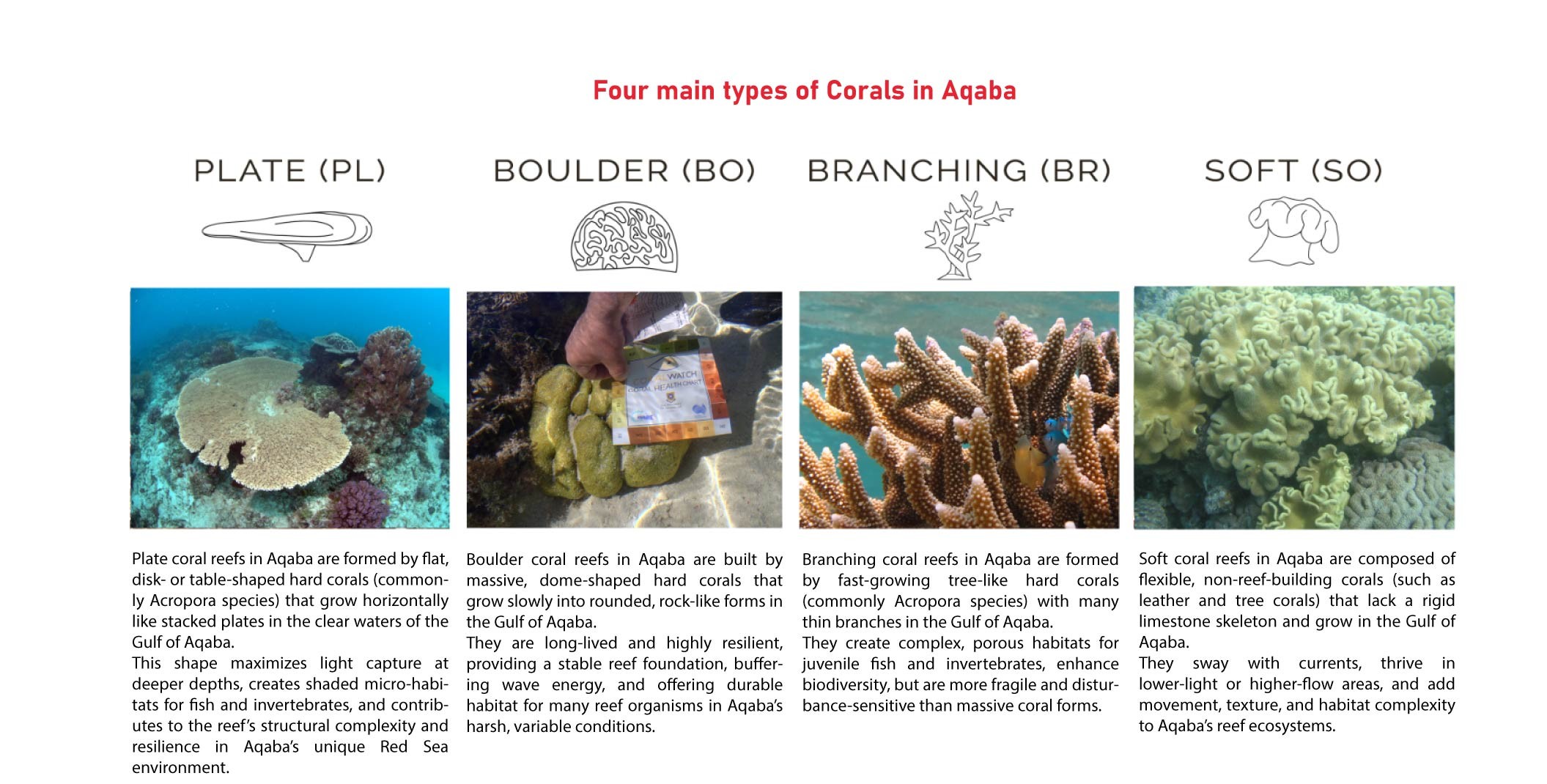
Main Coral Types
Coral reefs in the Gulf of Aqaba are composed of several structural coral types that shape the reef ecosystem and provide habitats for marine life. The following overview presents the four primary coral formations found in Aqaba and their ecological roles.
Initiatives and Campaigns
Existing initiatives focused on monitoring and protecting Jordan’s coral reefs, such as efforts by JREDS through Coral Watch. Despite these actions, coral bleaching remains a critical challenge, where environmental stress disrupts the relationship between coral and algae, leading to loss of color and increased vulnerability. This context emphasizes the urgency of developing alternative approaches that support reef resilience and regeneration.
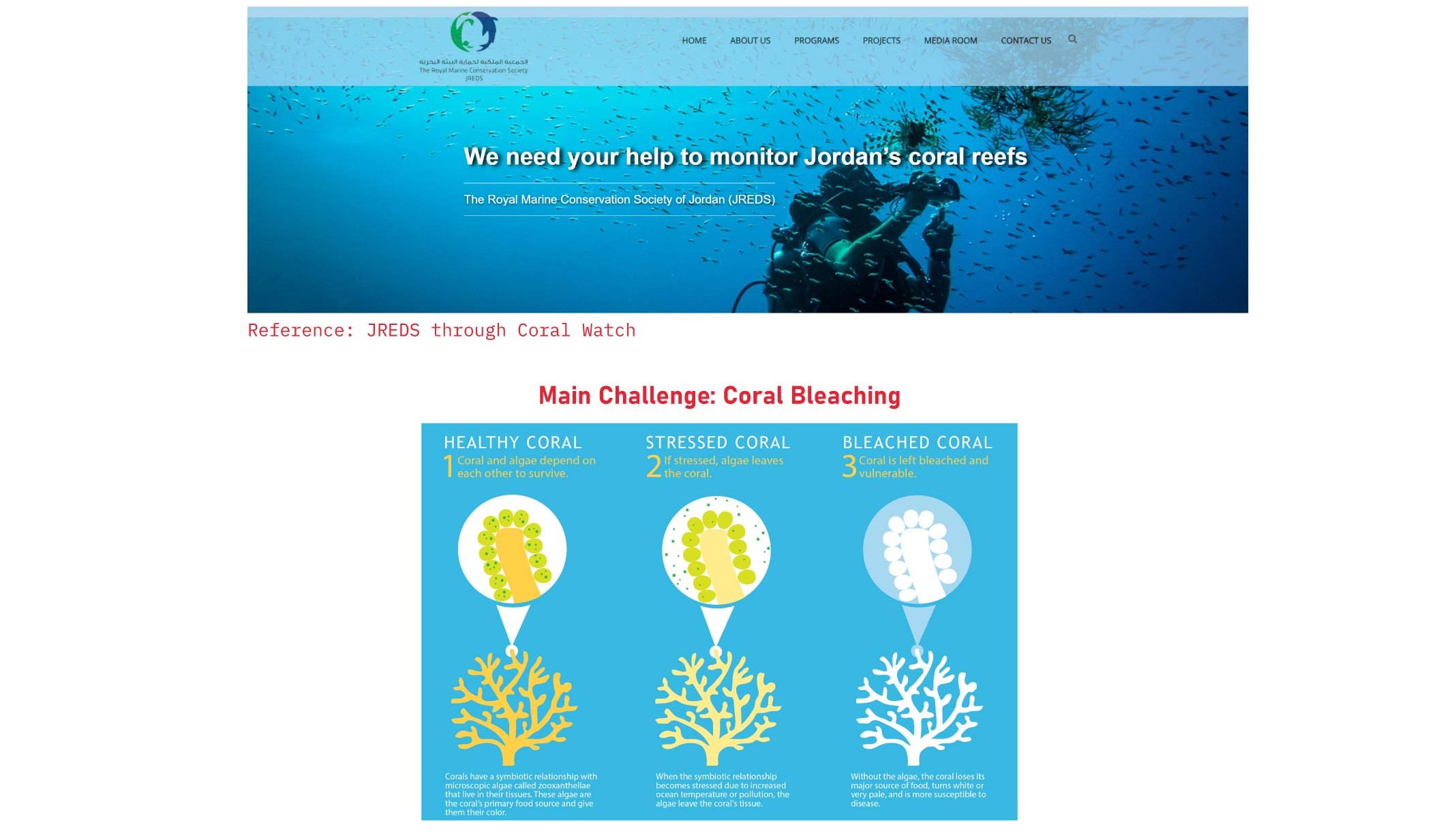
The Coral Watch methodology was instrumental in developing an informed understanding of coral diversity in the Gulf of Aqaba. By using standardized color reference charts to assess coral health and bleaching levels, it enabled a systematic reading of variations in coral pigmentation, which often correlate with different species and stress conditions. This framework supported a more analytical interpretation of observed corals, moving beyond visual appreciation to measurable indicators of vitality and diversity. As a result, it provided a reliable basis for comparing coral conditions across sites and informed the material and morphological decisions within the project, particularly in aligning surface textures and forms with ecologically responsive design strategies.
II. Material Research
Material research focused on clay as a viable medium for mimicking coral reef systems due to its mineral composition and porous structure when fired. Similar to coral skeletons, fired clay acts as an inert scaffold that supports biological colonization rather than replacing living organisms. Its rigidity, stability in saltwater, and capacity for controlled porosity make it suitable for hosting marine life, positioning it as a material capable of transitioning from a designed object to an ecological substrate.
Understanding Coral Growth
Coral growth occurs through a combination of vertical extension and lateral thickening, balancing expansion with structural stability.
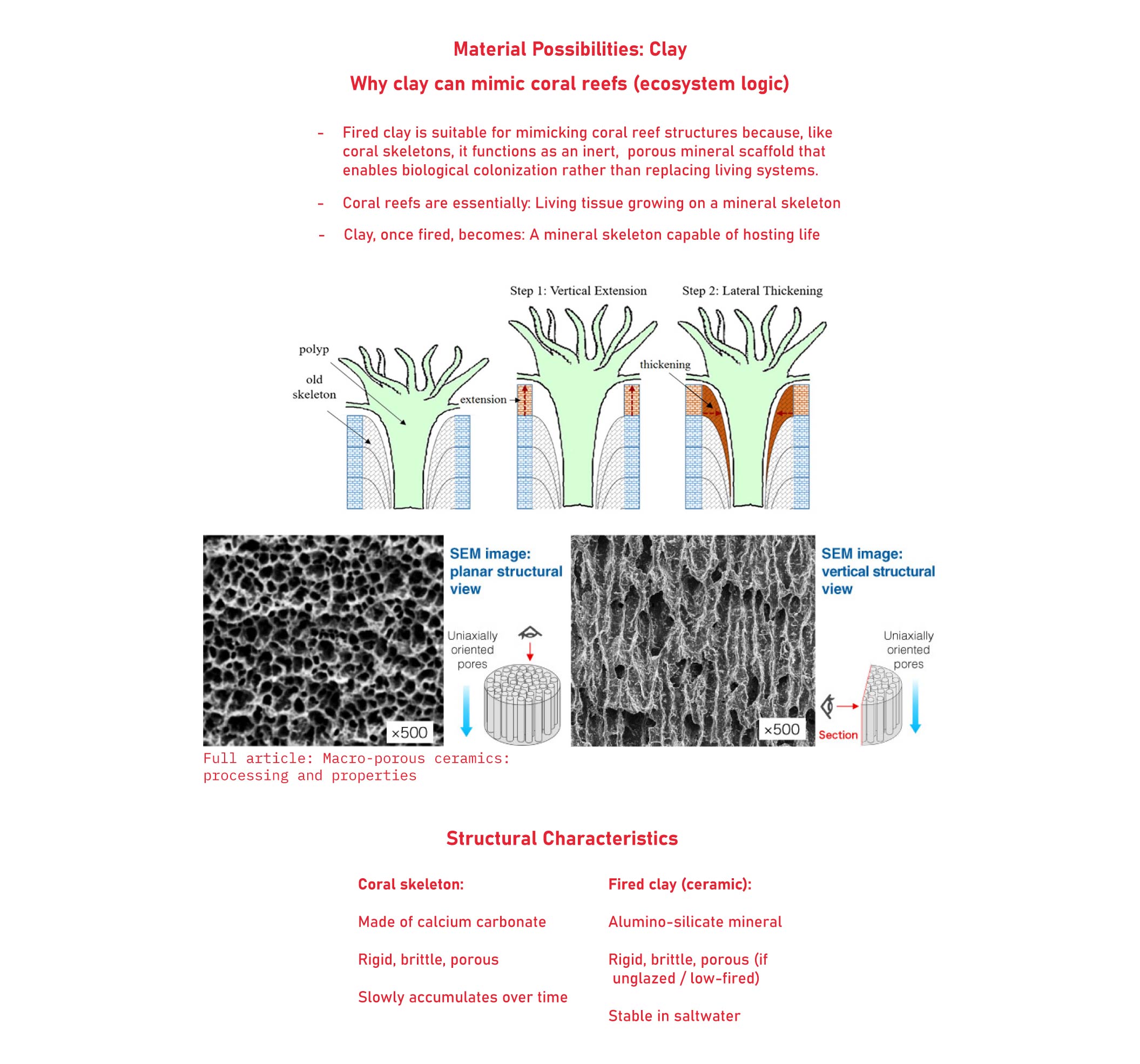
- Vertical extension (Step 1)
The coral polyp (living tissue at the top) builds upward.
It secretes new calcium carbonate skeleton beneath it.
This results in height growth, allowing the coral to access more light.
- Lateral thickening (Step 2)
After growing upward, the coral thickens its existing skeleton sideways.
Additional material is deposited along the sides.
This increases structural strength and overall mass.
What the parts represent:
- Polyp (green): the living organism responsible for building the skeleton
- Old skeleton (blue/grey): previously formed structure
- New growth (orange/red): recently deposited skeletal material
- Arrows: direction of growth (upward and outward)
Porosity
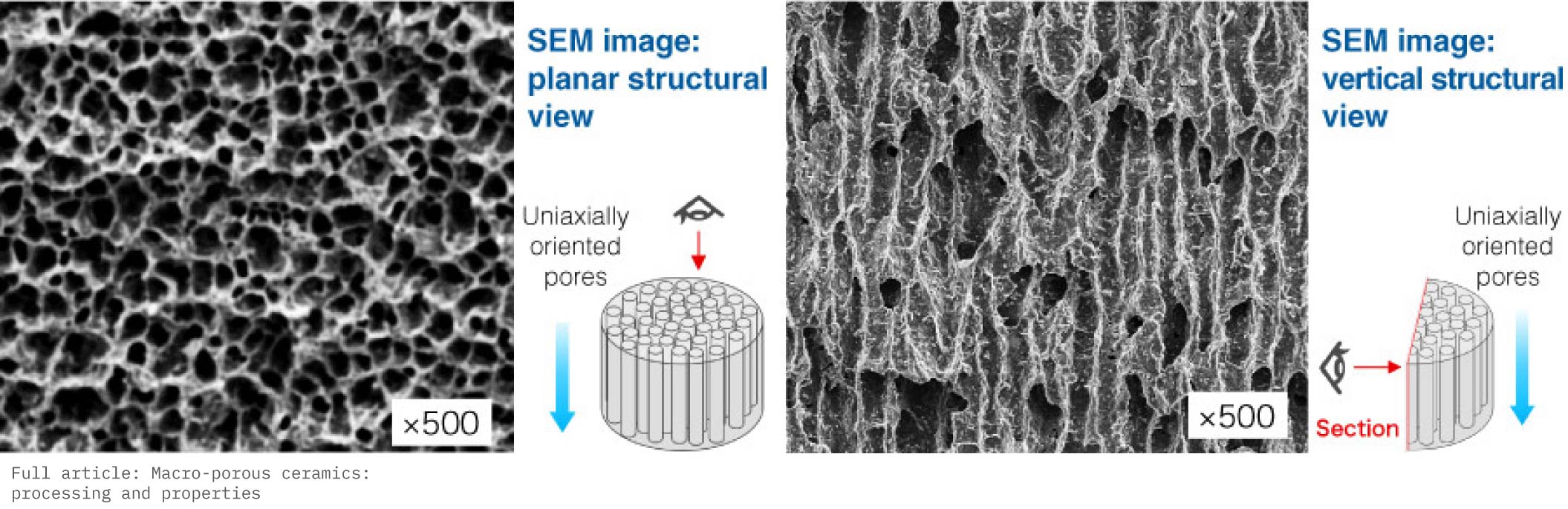
The structure shown aligns with macro-porous ceramics described in Macro-porous ceramics: processing and properties by T. Ohji and M. Fukushima, where uniaxially oriented porosity is achieved through processes such as freeze casting. In these materials, a planar view reveals dense surface pores, while the vertical section shows elongated, channel-like structures that enable directional flow. A similar but biologically evolved porosity exists in corals: coral skeletons exhibit hierarchical pore systems, ranging from micro-pores to larger interconnected voids that support water circulation, nutrient exchange, and larval settlement. In comparison, fired clay can replicate aspects of this behavior through controlled porosity, but its pore network is typically less hierarchical unless intentionally engineered. While coral porosity is optimized through growth and biological processes, clay relies on material composition and fabrication methods to approximate similar functional characteristics.
III. Geometry Research
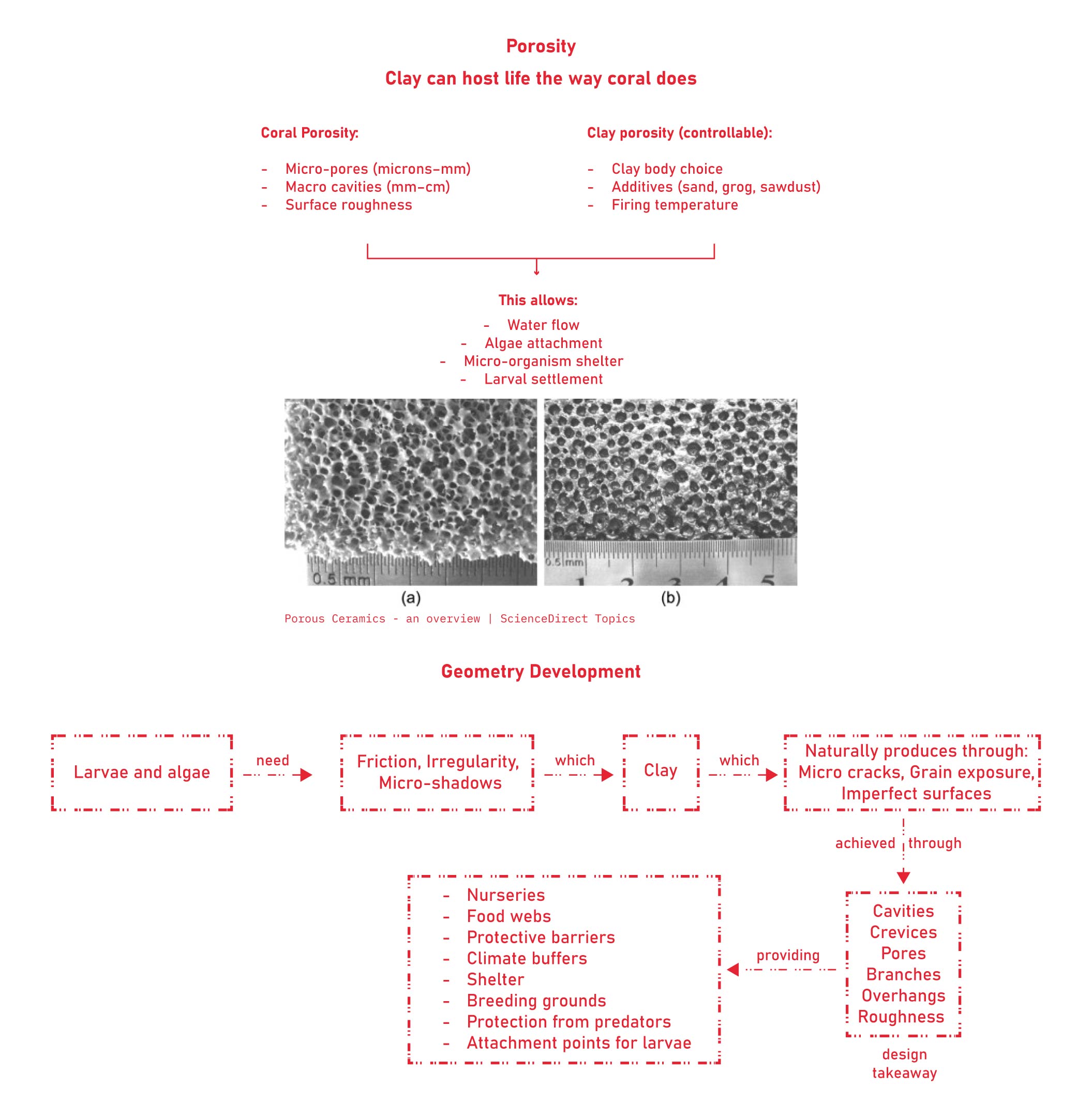
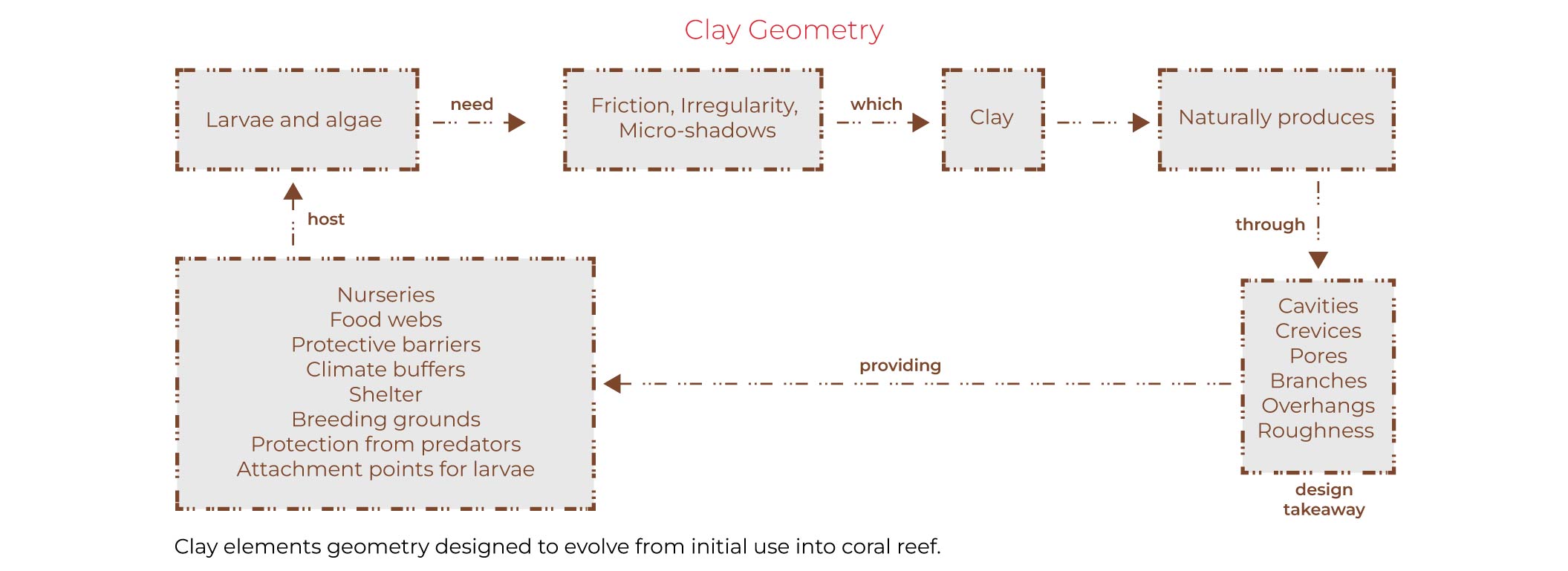
Geometry research focused on porosity and surface complexity as key factors in enabling clay to host marine life similarly to coral reefs. By controlling pore size, texture, and material composition through clay body selection, additives, and firing conditions, the geometry can support water flow, algae attachment, and larval settlement. The resulting forms incorporate cavities, crevices, and irregular surfaces that create microhabitats, fostering ecological functions such as shelter, protection, and breeding grounds.
IV. Artificial Reef
This phase focuses on understanding the integration of life into the designed reef system by aligning with natural coral reproduction processes. Coral larvae, or planula, represent a critical stage for reef formation, as they settle onto suitable surfaces and grow into new colonies. By providing appropriate conditions for attachment and growth, the designed structures can support this natural cycle. This approach enables scalability, allowing small interventions to develop into larger reef systems over time.