State of the art, project management and documentation
Inital thoughts
I started this journey as a new chapter, or rather a continuation in a rethought way. My last year, 2025 was a big up and down: I gave birth to my sunny boy, and several months later I lost my mother. It was dramatic... I was in a survival mode. I started to recover slowly, first being present for my 7 months-old baby. Then, started to think more clearly; I started to question the meaning of absolutely everything, and I found my answer in change within. Everything that happens to us is a chance for us to bring some change within. Fabricademy is also a great journey and a chance for acquiring skills, but also letting me flow and allow the change within me.
Research - Ideation
For around six years now I have been studying the Armenian carpet and rug patterns as a documentation of cosmic events, natural phenomena, life and death cycles, the meaning of colors. Meanwhile, I was drawn to the ancient world of Mesopotomia, archeological finds, and what information the cuneform tablets give to us.
I took knowledge from Dilijan and I shared mine with Dilijan.
I moved to Dilijan from Yerevan, learned carpet weaving techniques, one typical to this region, the shulal weaving, specific patterns in the carpets and rugs in this region.
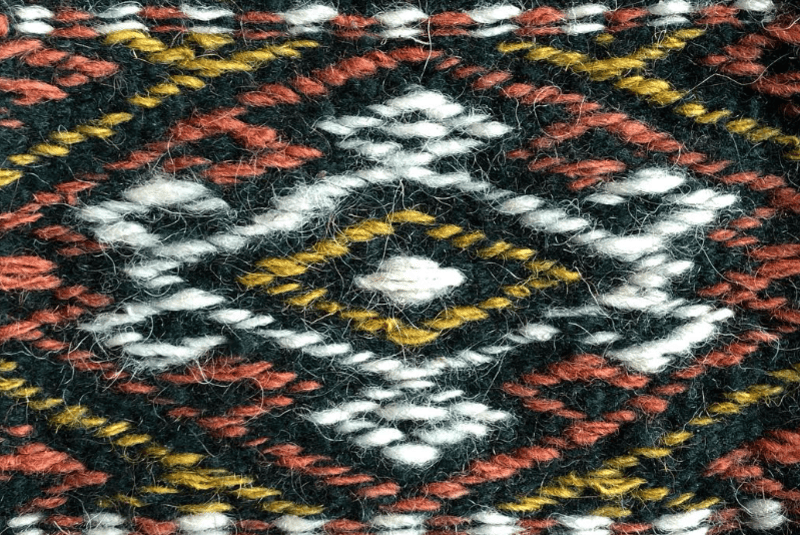 Shulal carpet made by Luiza Naslyan
And I brought to Dilijan my experience in folk dances at Karin dance school, founded by Gagik Ginosyan and re-imagined ancient games. Over 2 years I have been sharing my knowledge with the community here on voluntary basis.
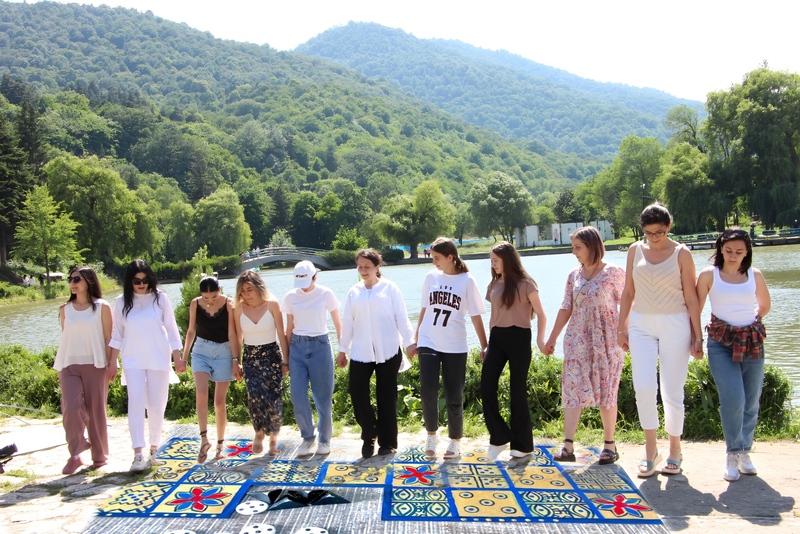 Lord's dance at public festival
All the knowledge I acquired during various periods of my life puzzled up in re-imagining the Sumerian table game, the Royal Game of Ur, with my own authentic dice.
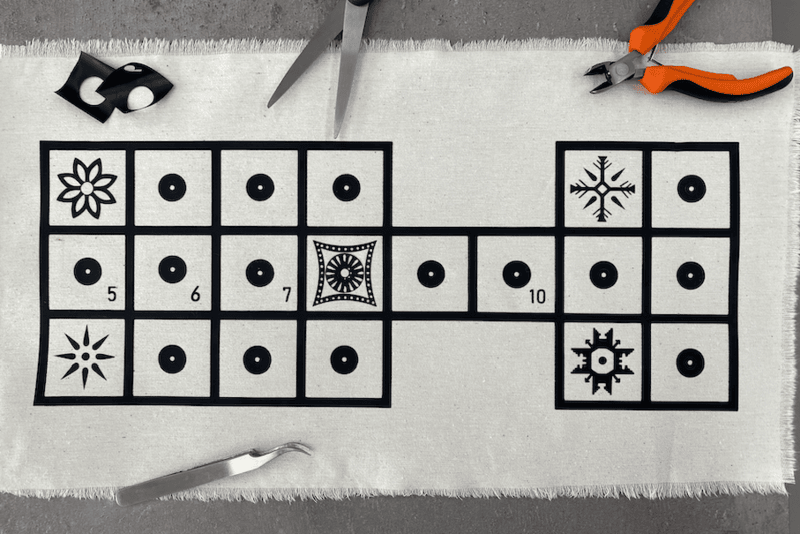 Vinyl cut game by Luiza Naslyan made at Fab Lab Armenia in Dilijan
Hence, I am inclined to experiement weekly knowledge in making various prototypes of the game re-imagined by me based on correlations and parralels between Sumer and Ararat kingdom/ Armenia.
And for the final project, I want to make an innovative carpet: Dance-Carpet! Here I will use the 3 different weaving techniques to weave a carpet, and incorporate some special ornaments or symbols with sensors that will play the specific fragments of a dance music upon touching them. The ornaments or symbols are designed by me based on the orbits of some Armenian folk dances and carpet patterns that surprisingly coincide in composition, colors and meaning.
Inspiration - References
“Originalitiy is going back to the ORIGINS” once Gaudi said, as was quoted on our first online meeting. It made me think of what is our origin as humans? Shapes? Colors? Meanings behind shapes and colors which were attrbuted to them since the dawn of civilizations? Folk dances and songs to mark each cosmological event?
And who are we BEYOND our names and family names, our nationality, our jobs…?
Knowing the traditional, bring back ancient knowledge with a modern touch, with an intention to find similarieites between people, cultures, countries is my biggest motivation! Here are the traditional and ancient knowledge that inspired and gave meaning to my future work:
| Author(s) | Title / Subject |
|---|---|
| Serik Davtyan | “Armenian Carpet” |
| Flora Grigoryan | “Armenian Taraz” |
| Nazik Awagyan | “Armenian National Taraz” |
| Arakel Patric | “Armenian Taraz” |
| Lilia Avanesyan | “Ornament” |
| Narine Manukyan & Diana Melikjanyan | “Rug weaver” |
| A. Sh. Mnatsakanyan | “Armenian Ornaments” |
| Narineh Poghosyan | Basics of carpet making |
| Anush Hakobyan | Basics of felt and Shulal carpet making |
I delved into ancient cultures, cuneiform, the folk tell-tales encoding ancient knowledge on astronomy, astrology, medicine, and so much more.
Irving Finkel onsite lectures
Irving Finkel online lectures
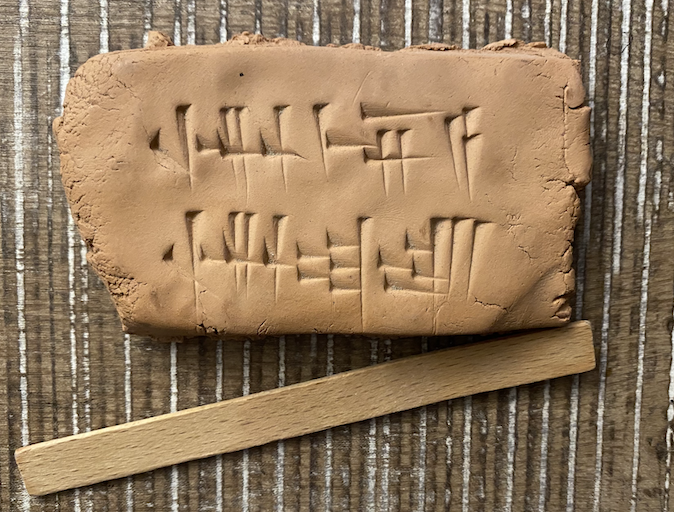 Made at cuneiform lesson by Irving Finkel at Erebuni museum
Thanks to my teachers, I learned about ancient Armenian dances, their ritual significance on each step. Later on, I studied kinetograms or kaqavagir, the notation system to record dance moves.
Jenya Khachatryan - “Ritual dance among Armenians”
Srbuhi Lisitsyan’s invention: Kaqavagir
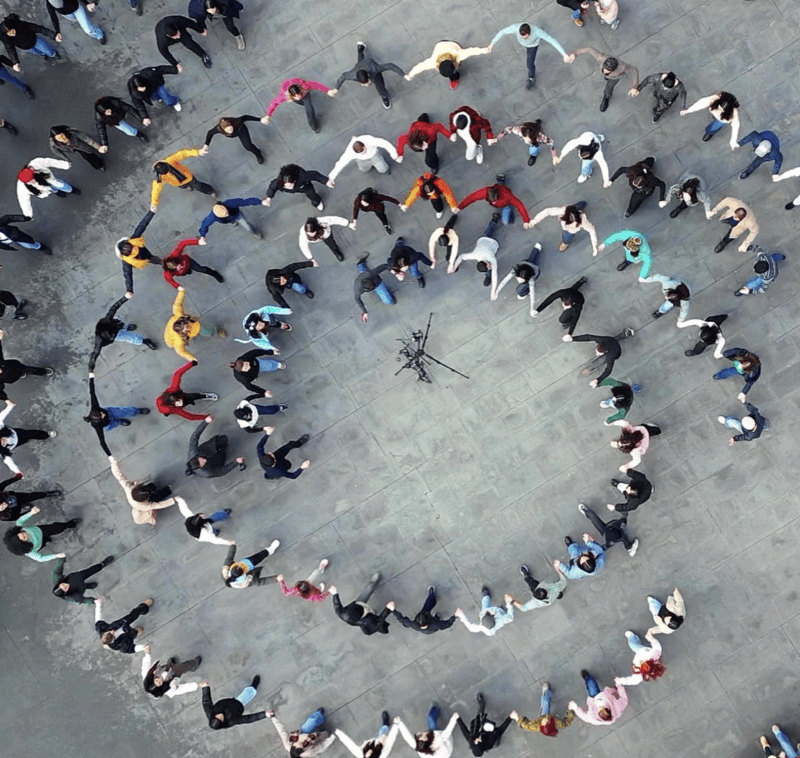 Photo by Tigran Madoyan
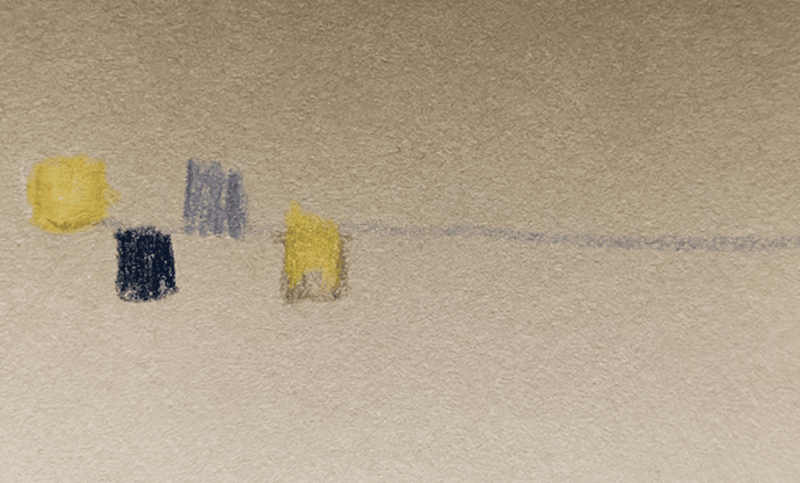 Photo is taken by Luiza Naslyan
To overcome the doubts and uneasy feelings of learning a totally new 'language', the coding, "survive" the load of studies at Fabricademy with my baby son, I checked out some alumni documentations, and specifically helpful for me were Carlotta Premazzi, Svetlana Khachatryan and Anoush Arshakyan. Thank you guys!
Tools
- resize images
- navigate Gitlab with the help of Markdown
- make a free style collage via InShot phone app
- make amendmants in my website via Gitlab
- help for color codes, fonts: HTML , Zensical
Process and workflow
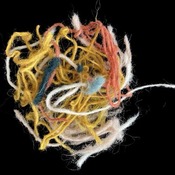
My first week at Fabricademy was both exciting and confusing. It's truely exciting to understand the scale of the knowledge I will get at the end of the course. Meanwhile, it was challenging to encorporating my schedule of being a full time mother with that of a freshman. I made a collage with excess yarns from my carpet weaving: it depects an intangled yarn from which eventually a white line / clear understanding starts to derive.
Learn
The fisrt online meeting was a big challenge for me. My son was not used to have me away in the evenings, and our meeting was in the evenings in Armenian time, so, I kept going to him, soothe him and give my attention to him. I did not really have the chance to try editing my website with everyone else. It got stressful for me the next days to encorporate this new change in my schedule. The next days the recording of the meeting was very useul and slowly, I started getting confidence in coding and making time for my studies better. I used other online resources too to find solutions when my commits failed and I could no longer edit my website. Markdown cheatsheet were quite helpful to get on track and start pasting the text I prepared separately from Gitlab. Once I pasted, pushed COMMIT. I regulary had the preview of my page on the right side of my screen, as well as I refreshed my documentation page to see changes in a more real way. My textile academy page looked quite poor at the beginning, but with the help of workshop recording I worked on my website step by step, Anoush was extremly helpful both on the phone and onsite.
Some process photos:
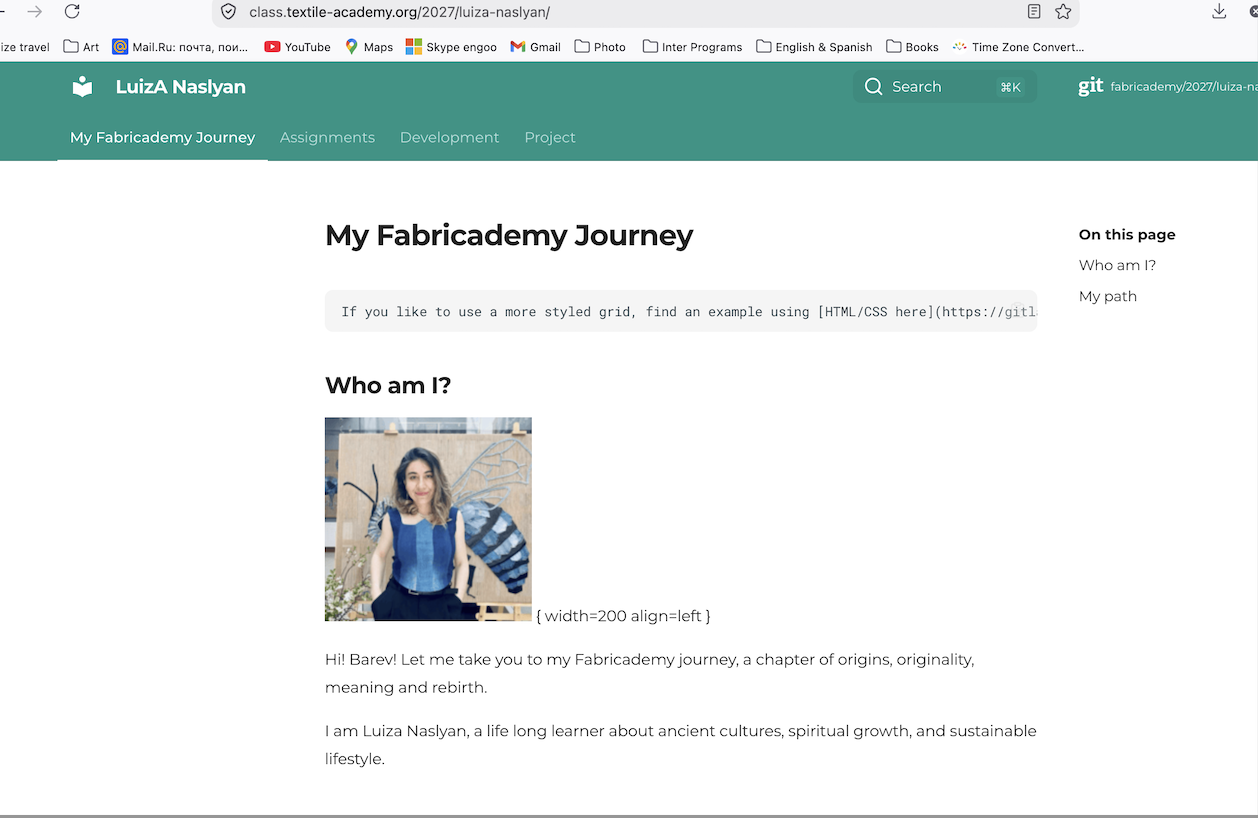
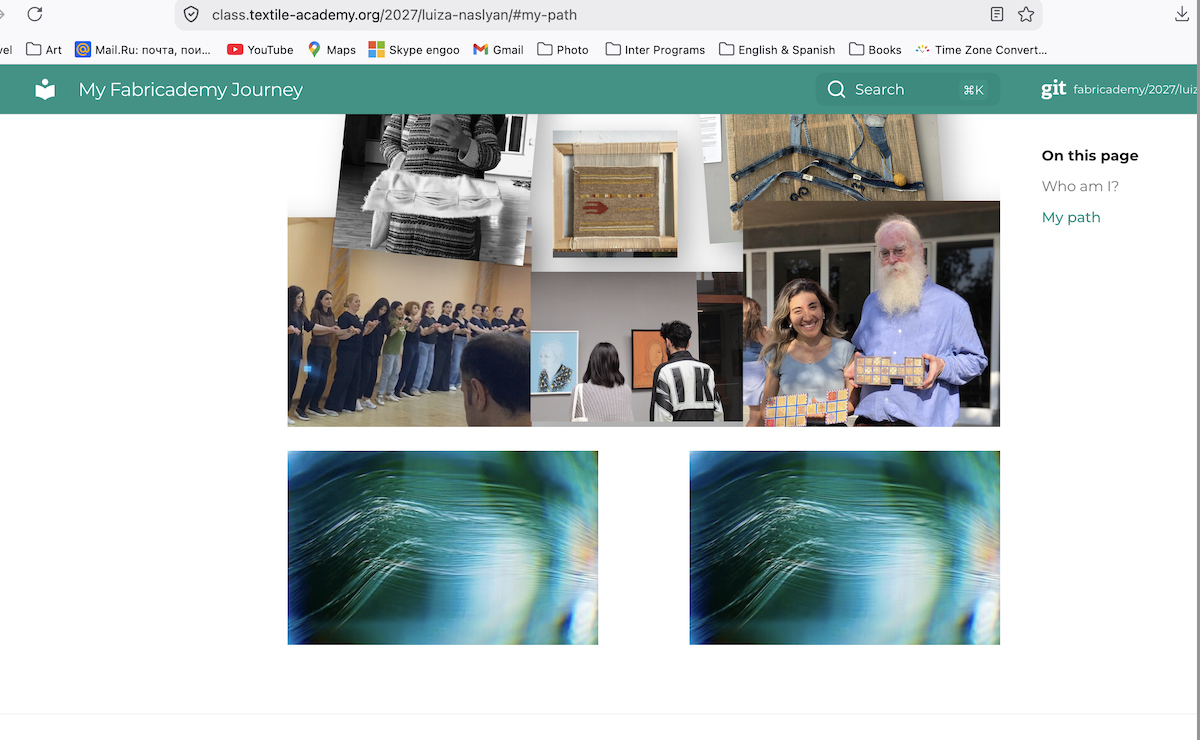
but eventually, my website became better!
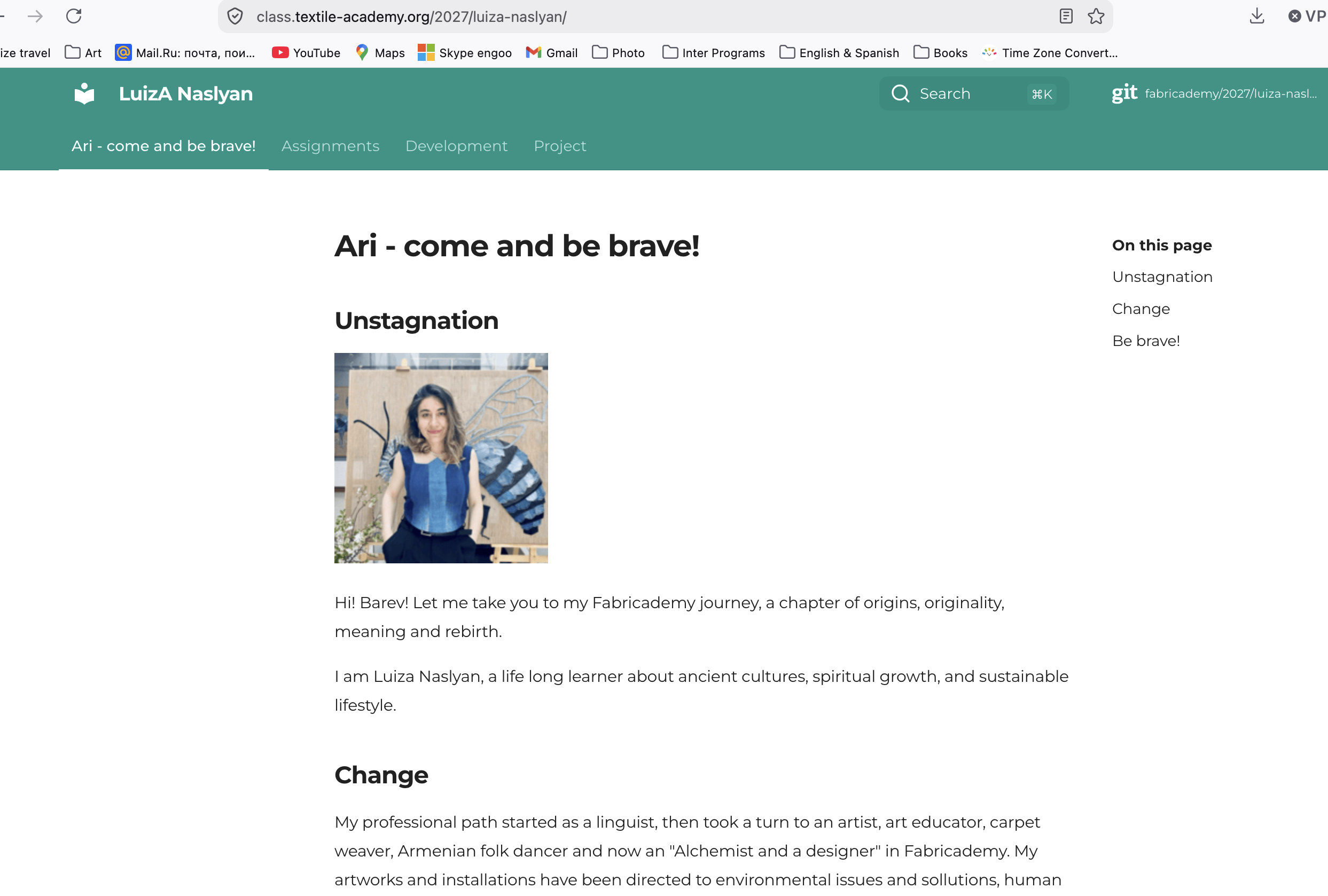
Zensical
Zensical is the space to individualize the website by changing the site name, fonts, colors, logo etc. The whole website, specifically Zensical, includes many helpful links to explore and learn more about coding and apply it to the website.
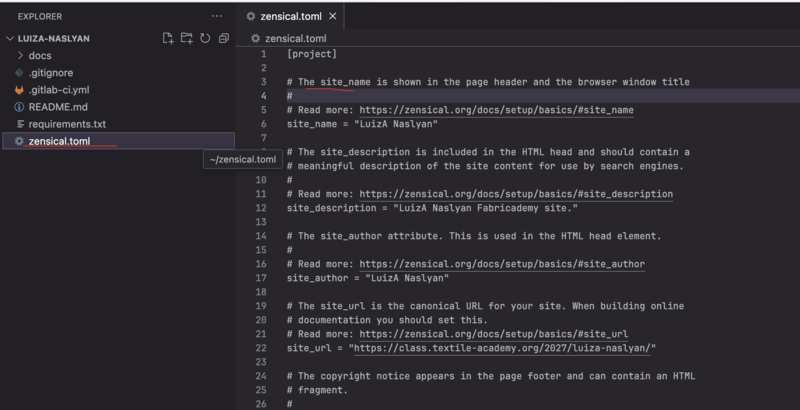
For a complete beginner, it was like learning a totally new language from the alphabet. I checked the links, however, even info on the links were hard for me to understand, imagine and apply. I tried a lot and failed, too.
What can cause a failure?
In my experience, if in Zensical you change but the path to the intended file change is wrong, or the image size does not correspond to the parameters, it results a pipeline failure. And after that, any valid change can not be commited.
The solution? Revert the change that caused the failure.
Let me walk you through my failure and solution.
I wanted to change my logo. So, I did some research and resized my image. Uploaded it into my week01 images. I went to Zensical, then searched "Logo" by Ctrl+F:
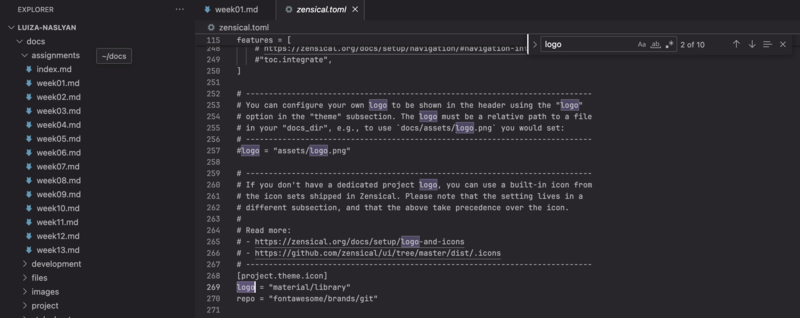
I found the "Logo = " where the initial icon is written "library".
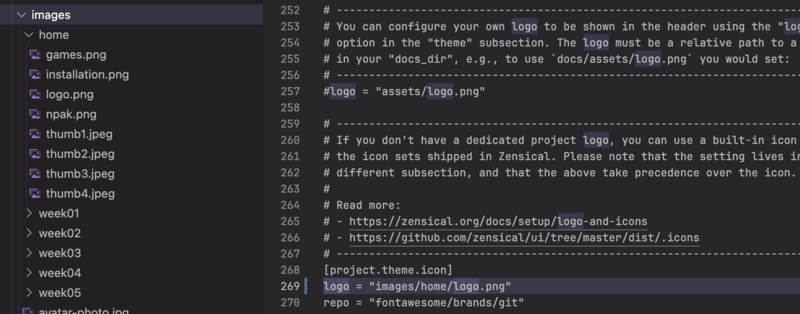
Then I replaced the "Library" with my "Logo" file. Commited. Then I did other changes in my IDE and checked for the changes in my Fabricademy page ... there were no changes even after several hours. I checked the Commits in Gitlab Fabcloud and saw this red sign:

I clicked on the title of the error and saw the details: pipeline failed:
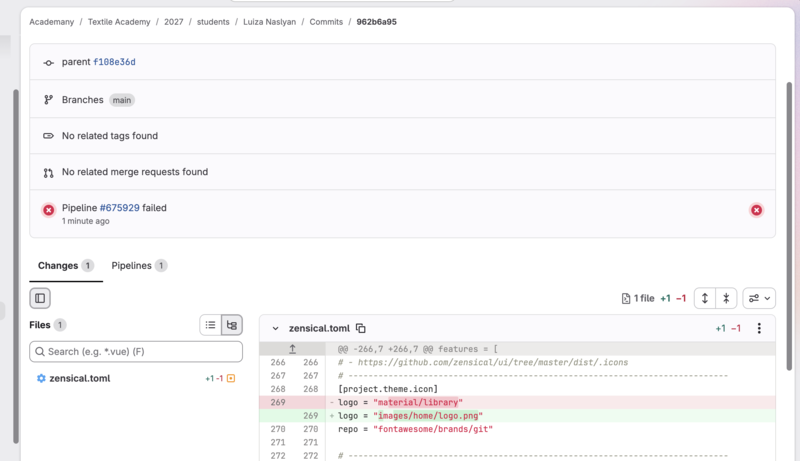
The solution here was to go back to my IDE, and revert the 1st error, then the pipeline was fixed.
Index
There are two Index sections, one is a subsection under the docs section, the other is a subsection under the docs -> assignments -> index.
Here I am refering to the first one: Index under the docs section.
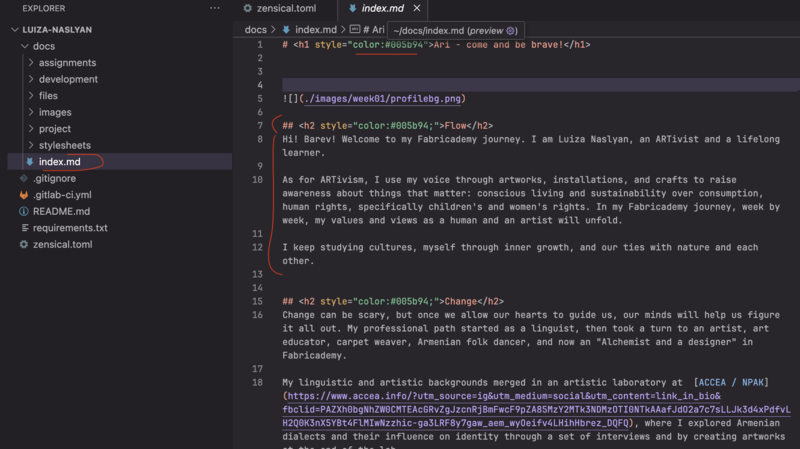
This section enables us to change the very first page of the website: add information about us, upload photos and collages, change the color and fonts of headers, etc.
Change images of the Assignments section and a trick for large images
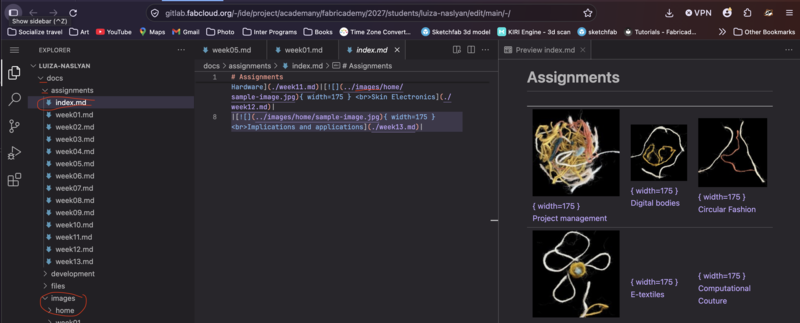
I managed to change the assignment page pictures according to my understanding of the weekly topic. To change the assignment page thumbnail pictures, you need to:
take pictures -> resize them in 175 px -> upload them in Gitlab Images Home -> Go to docs -> assignments -> index -> and delete the sample images from the image line and continue ../ -> once you press ../ it will suggest folders, choose images, then home and the picture you want for that specific week.
I checked also for online tools apart from the recommended ones, and I found ones that I found more precise and comfortable to work with. I mentioned those in the Tools section.
This week sometimes I forgot to resize images due to my slow web skills and time pressure. I still was going through re-organizing my life around my son and my studies, so I did not have time left for my documentation. I uploaded images and screenshots right away withough resizing them. Later on, I managed to organize my time better and resized the same images with the same name. Then uploaded them to week01 and pressed REPLACE. And it autometically not only replaced the old big image with this new resized image, but also changed it autometically in the text.
Final thoughts
- Personally, I learned about myself a little bit more: my resilience, my stress resistence, my changes and the features I still need to work on.
- Skill-wise, I learned coding a bit, new tools, new techniques.
- Both personal and technical awareness helps me to visualize my final project better in terms of possibilites and solutions.