8. Soft robotics
Initial thoughts
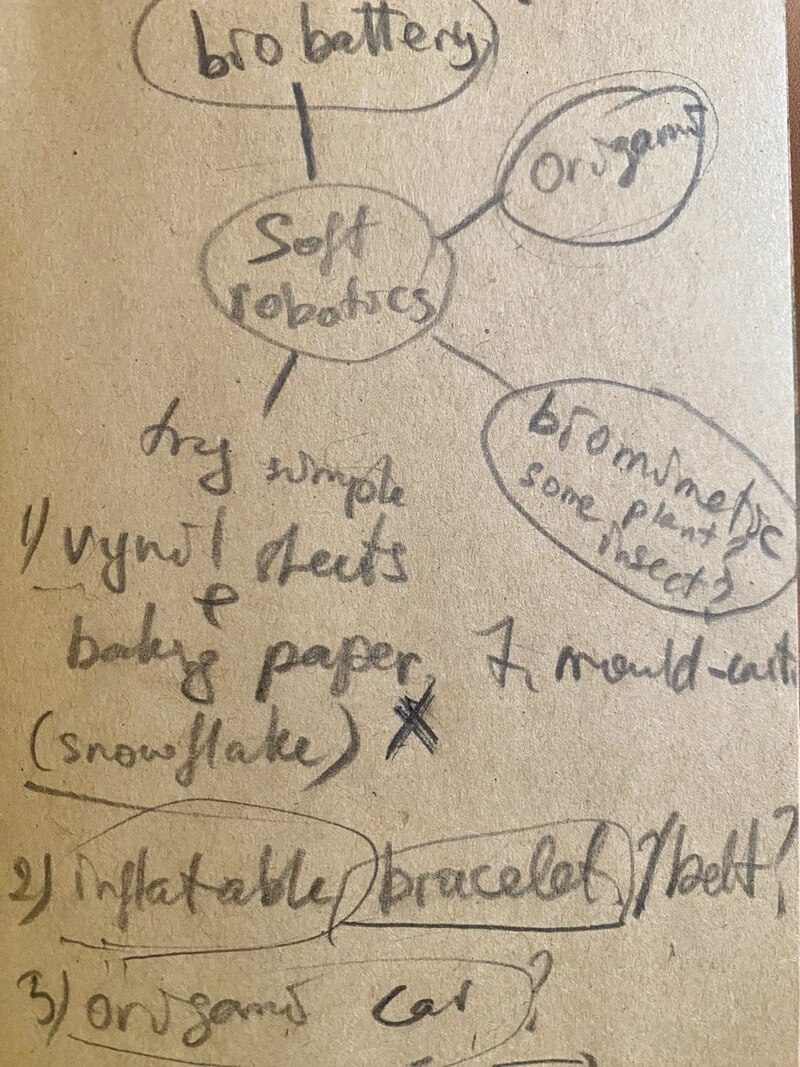
Soft robots are another exciting subject that I wish I had more time to delve deeper and learn more. Soft robots inspired me to think of a hundred ways to make actuators for my baby son, how he would enjoy playing with them, exploring and discovering them by breaking them apart. But I have time pressure, so based on the online lecture on soft robotics, my research and discussion with my local instructor, I set the following goals:
-
make an origami inspired paper actuator;
-
make a heat press vinyl actuator;
-
cast a silicon mold;
-
draw the files for the vinyl actuator and silicon mold;
-
take photos and videos;
-
document everything.
Research and inspiration
Soft robot and art
While researching soft robotics, I discovered a lot of talented people with wonderful projects, concepts, and a new vision. Here I chose to present two of them.

Anna Schäffner is a designer and artist who combines engineering and human emotions, approaching soft robotics through the lens of art, material behavior, and sculpture in contrast with traditional robotics. Schäffner constructs soft silicone and air-filled sensory membranes to encase cold, rigid industrial robotic arms.
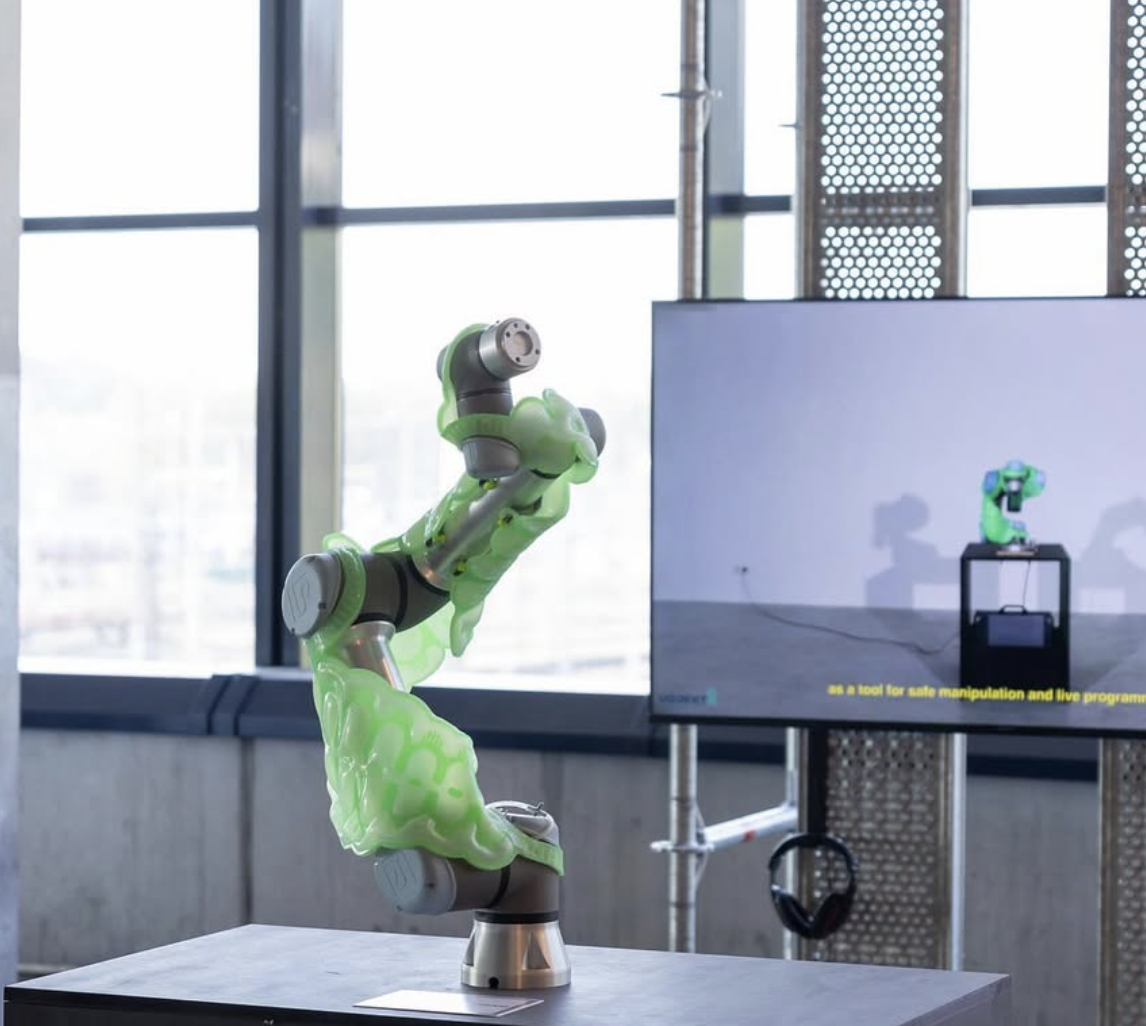 Her Soft Collision artistic project reimagines the interaction and the sense between humans and robots. She envelops a rigid robotic arm in an air-inflated silicone skins, and strips away the machine’s cold nature. As pneumatic pressure shifts within the organic cells, the hard robotic core expands and deforms into a gentle, caterpillar-like entity, making a deeply expressive dance with human partners.
Origami and biology
The next inspiration is Dr. Wenzhong Yang who is an assistant professor designing autonomous folding robots inspired by origami and biology. He built an insect-scale, light-powered jumping robot capable of leaping continuously while carrying 1,700 times its own structural weight.
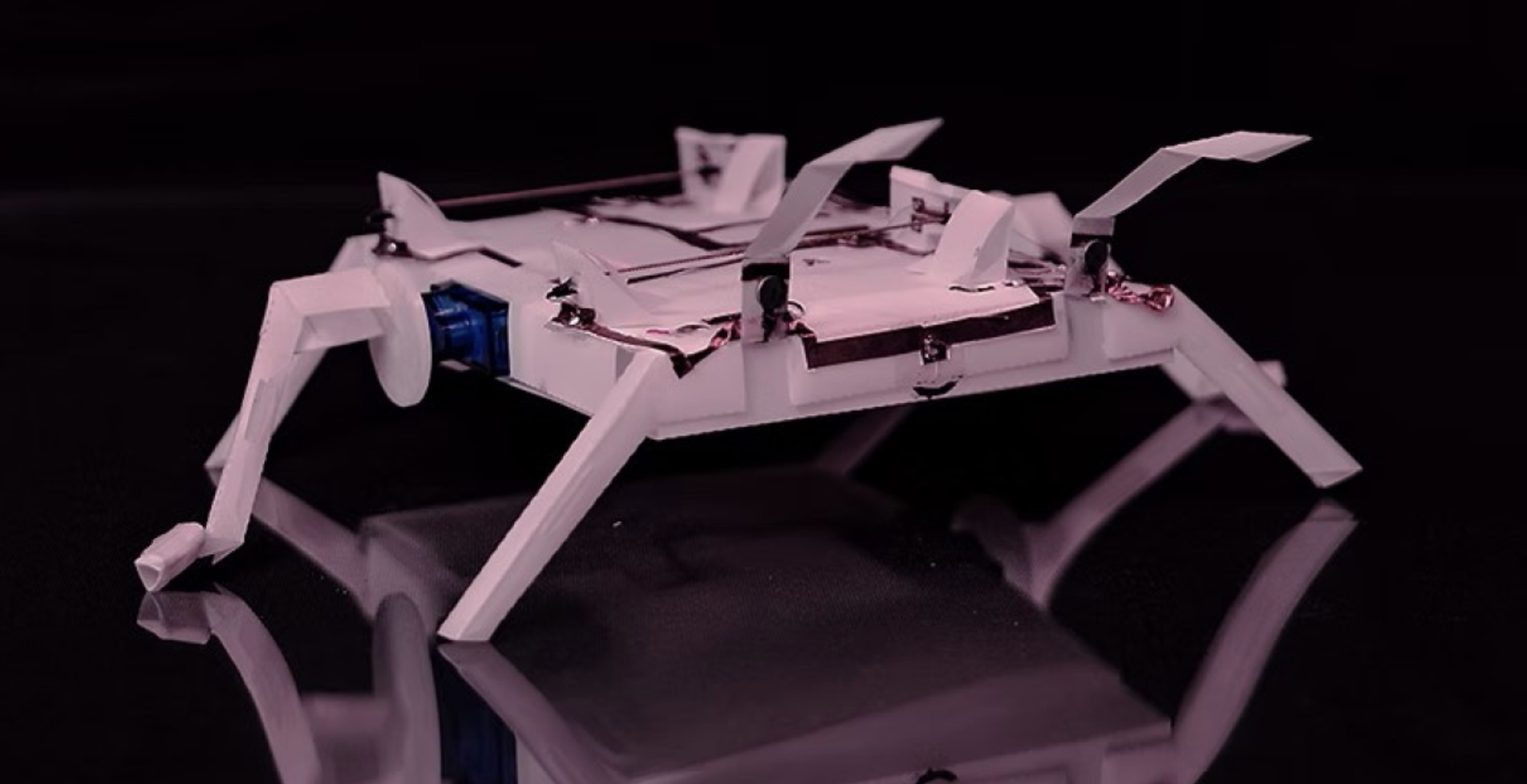
“It pulls together my interests in biology and animals and machines and creating machines like animals,” he said. “In the future, I will try to create a robot like a human or like animals that is very robust and can do useful things.”
Yang's leaping robot that carries that much weight reminded me of the small, black, insect-like creatures or the SootballsSusuwatari in Spirited Away who could carry extremely heavy objects regardless of their tiny complection.

Machines
-
Vinyl cutter (Roland GX-24)
-
Laser cutter (Kimian 60-40)
-
Heat press (iron)
-
Manual air pump
-
Automatic air pump
Tools
-
Thermo-adhesive vinyl
-
Highly non-stick Baking paper
-
Acrylic sheet (3 mm and 5 mm thick)
-
EcoFlex A1 (silicone A and B components)
Sources
Process and workflow
Getting to know
Soft robots are constructed entirely or primarily from highly flexible materials—such as silicone, rubber, hydrogels, and smart fabrics—rather than traditional rigid components like metals and hard plastics. Soft robots are inspired by natural organisms (caterpillars, human muscles, etc.), and their adaptability allows them to deform, stretch, and bend, relying on fluid dynamics, material chemistry, and structural physics to move. Hence, we can categorize them by:
• Actuation systems: They are commonly inflated by pumping air or fluid into internal chambers to cause specific bends or expansions, or by materials that contract when exposed to heat or electricity;
• Biomimicry: Their movement patterns replicate biological systems, mimicking crawling, squeezing, and tentacle-like grasping;
• Infinite degrees of freedom: Instead of rotating around a fixed set of mechanical joints, a soft structure can bend or twist at virtually any point along its body.
There are interesting examples of soft robotics from previous Fabricademy alumni in the Fab Lab Armenia in Dilijan. With Anoush's guidance, I got to know those soft robots and tried to inflate them by myself.
The first way to inflate the soft robots was using a hand air pump with a needle on one end and the hand pump on the other. The second way to inflate the soft robots was using an automatic air pump.
I explored soft robot molds that were cut with the laser cutter or were 3D printed. In both types of molds, silicone mixture was poured and cast into inflatable soft robots.
Origami actuator
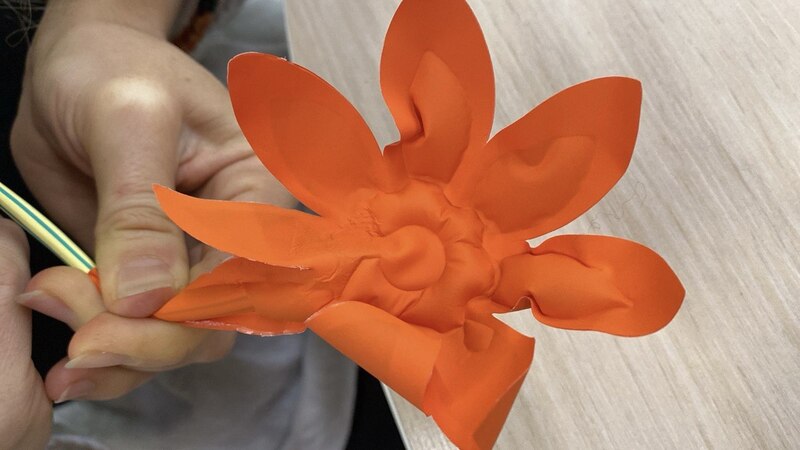
Since childhood I used to make simple origami and it always fascinated how a flat paper can turn into various objects. It is exciting that origami that is inflatable is actually a soft robot. So, I decided to make an origami soft robot first.
I tried an inflatable origami tulip, for detailed instructions, follow this link
To explore geometric folding algorithms, I highly recommend this course on OpenCourseWare.
Thermo-adhesive vinyl (failure and success)
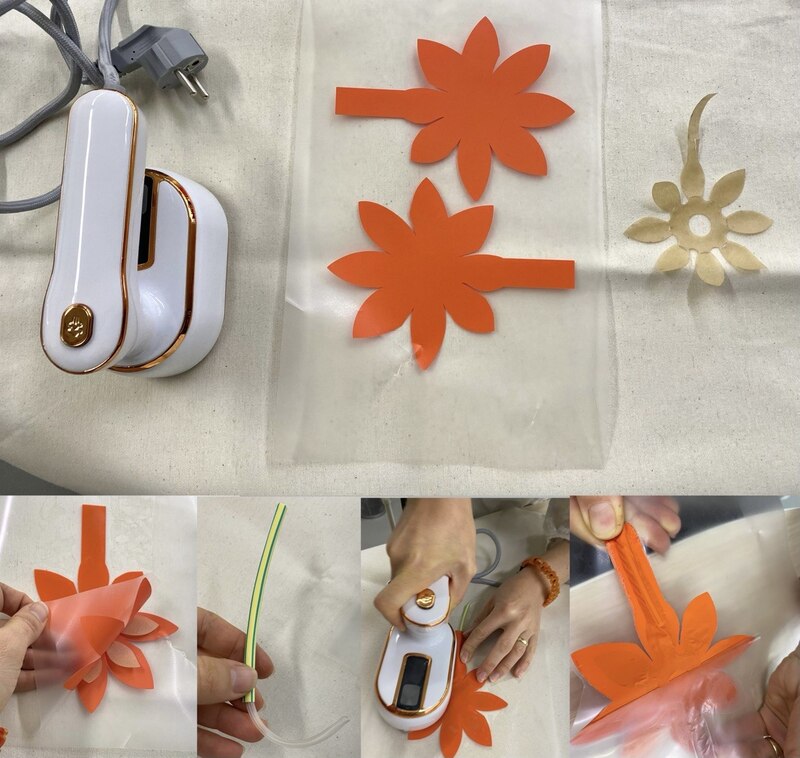
Next I created a soft robotic actuator by heat pressing two thermo-adhesive vinyl vinyls back to back having a baking paper in between. Baking paper insures the pumped air flows and inflates the vinyl. Here are the steps in details:
- recreated the pattern of 18-petal rosette from the Royal game of Us in Coral draw, copy-pasted, and mirrored to have 2 sides of the actuator;

Rosette from the Royal Game of Ur

Pattern for heat press vinyls
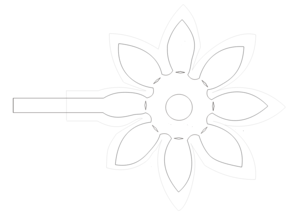
Pattern for baking paper
-
explored bending mechanism and chose the first narrow diamond shape from this chart that I saw in Fabricademy alumni Mariam Baghdasaryan's Soft Robotics week;
-
cut 2 heat press vinyls with the vinyl cutter Roland GX-24 using a force of 160 mm;
Vinyl Cutter Specifications
| Feature | Specification |
|---|---|
| Cutting Width | Max. 584 mm |
| Material Width | 50 - 700 mm |
| Maximum Cutting Speed | 500 mm/s |
| Cutting Force | 30 - 250 gf |
| Repetition Accuracy | ±0.1 mm or less |
| Interface | USB, Serial (RS-232C) |
| Power Supply | 100-240V AC, 50/60Hz |
| Dimensions (W × D × H) | 860 × 319 × 235 mm |
- cut the inner pattern with the non-stick baking paper with the Kimian 60-40 laser cutter using the following parameters:
- speed - 200 mm
- power - 20-30
Laser Cutter Specifications
| Feature | Specification |
|---|---|
| Country | China |
| Model | Kimian 6040 |
| Controller | RDC6445GZ |
| Laser Type | CO₂ |
| Laser Power | 80W |
| Work Area | 600mm x 400mm |
| Max Cutting Depth | 8mm - 9mm |
| Supported Materials | Wood, Acrylic, Leather, etc. |
| Max Speed | 500mm/s |
| Cooling System | Water |
| Software Compatibility | RDWorks, Lightburn |
| File Formats | SVG, DXF, AI, PDF, etc. |
| Connectivity | USB, Ethernet |
| Power Supply | 220V |
Note: both vinyl and laser cutter specifications are taken from Fabricademy alumni Mkhitar Evoyan.
-
placed one of the cut vinyls, then placed the baking paper, then the straw, then the 2nd vinyl;
-
ironed and tried to inflate;
My first attempt did not turn out well because the vinyl melted and stuck on the baking paper. I used a lab iron which did not have an adjustable heat control button. Here you can see the melted areas:
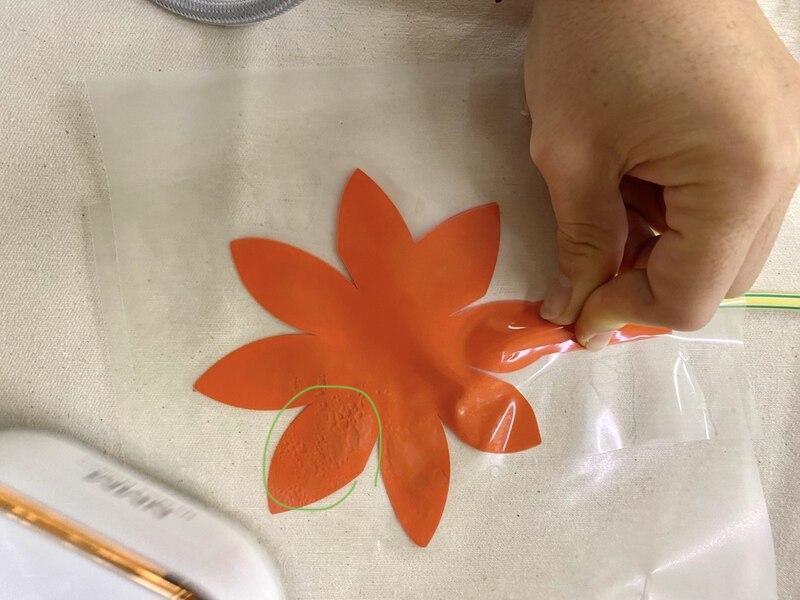
But I tried again, already figured out how to iron to avoid melting the vinyl. I repeated all the steps as mentioned for the first one. My second attempt was a success!

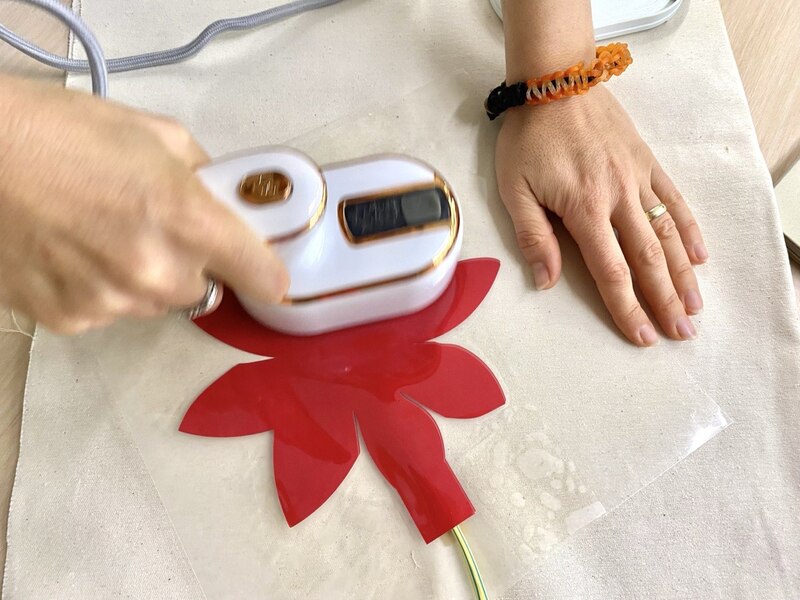
Here you can see how it inflates and bends beautifully:
I paid extra attention to ironing quickly, and only iron several more times on the sides only to avoid melting the vinyl:
Biomimetics and Casting silicone
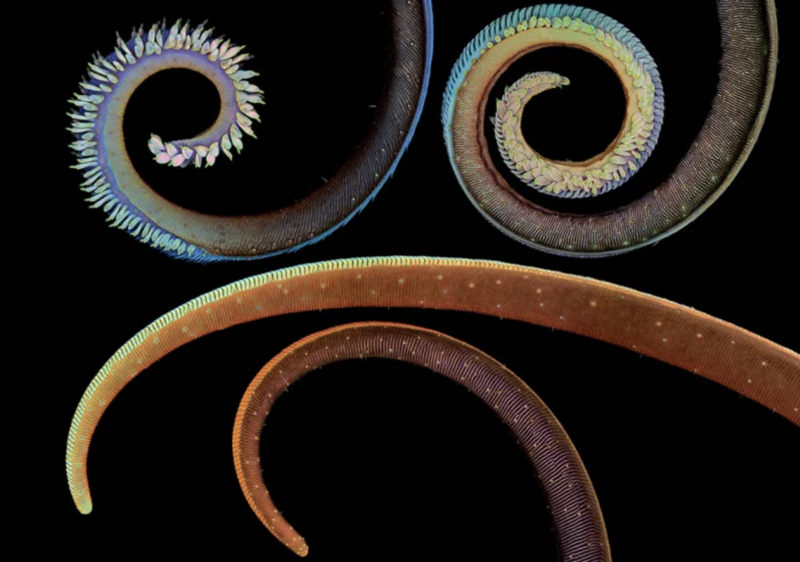
Finally, I decided to cast a silicone mold of a robot that is based on biomimetics. While researching ideas and inspiration for biomimetics, I came across this course, which is informative and can be inspiring: Biomimetic Principles and Design. I learned that to make soft robots based on biotechnology, it is crucial:
-
not to focus on replicating animals or organisms, but rather replicating their performance;
-
to classify the information regarding that animal or organism and exclude the unrelated functions;
-
to use an existing relevant technology for the imitation of nature, or invent a new one in case the function cannot be met or performed by current technology;
I did some research and finally decided on making a soft robot that will imitate the butterfly proboscis function of curling and uncurling with airflow. I found this meticulous study of butterfly proboscises in the New Scientist. The study was conducted by Jan Michels after a series of microscopical observations on butterfly proboscis types, their functions, and movements.
- After exploring other soft robots like bracelets and grippers, their patterns, and functionality specifications, I designed the pattern of the 3proboscis soft robot in CorelDraw;
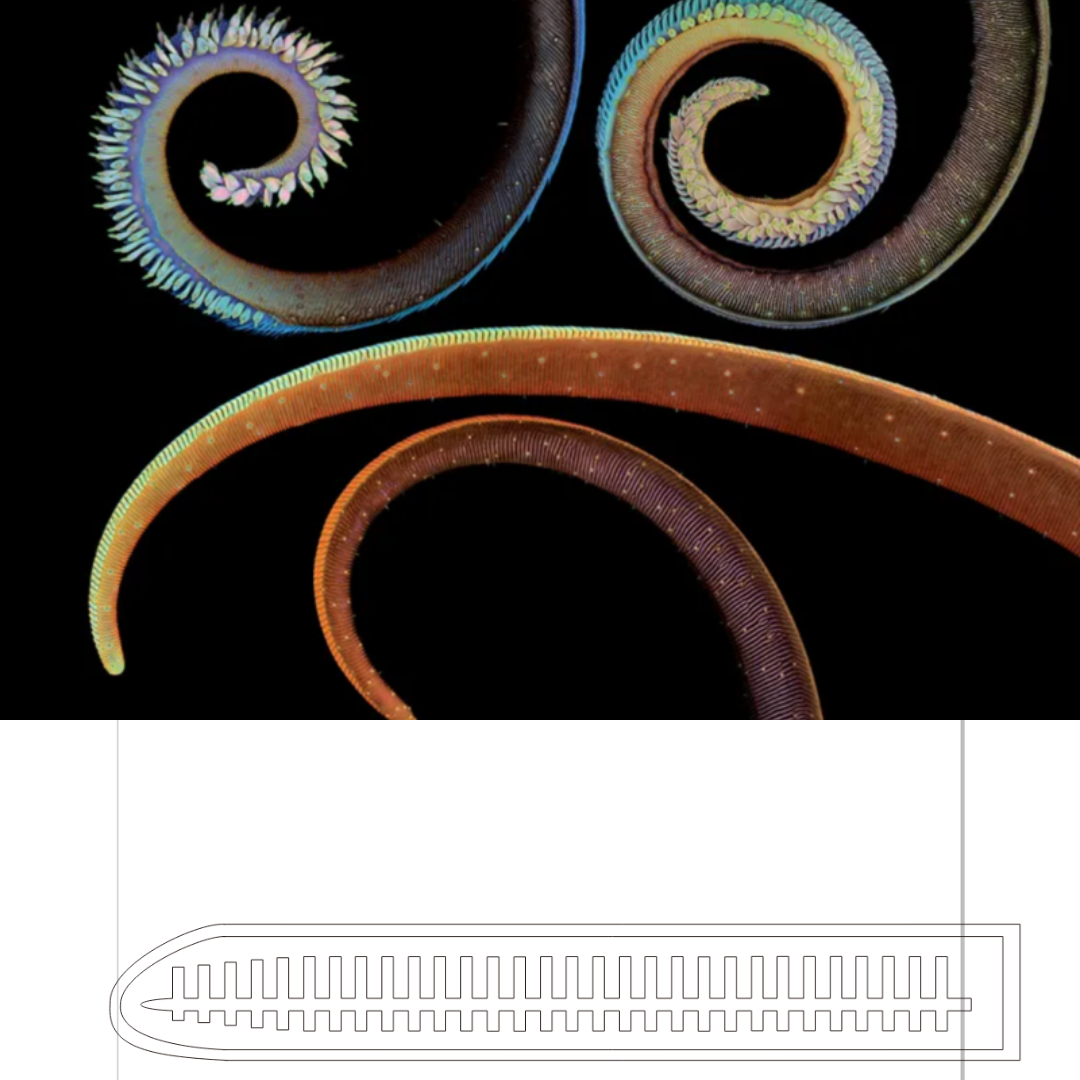
It is crucial to design it long and narrow, not merely for the sake of replicating the natural form of a proboscis but for functionality. So, I drew the walls near the airway inner pattern:
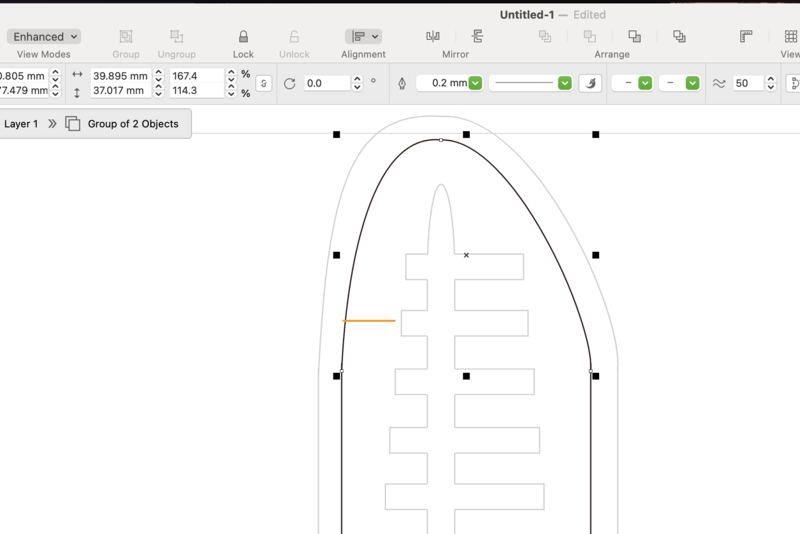
Another important aspect to consider is the distance between the airway segments: they should not be very far from each other; otherwise, it will be hard for the airflow to curl the robot and achieve the effect I intended.
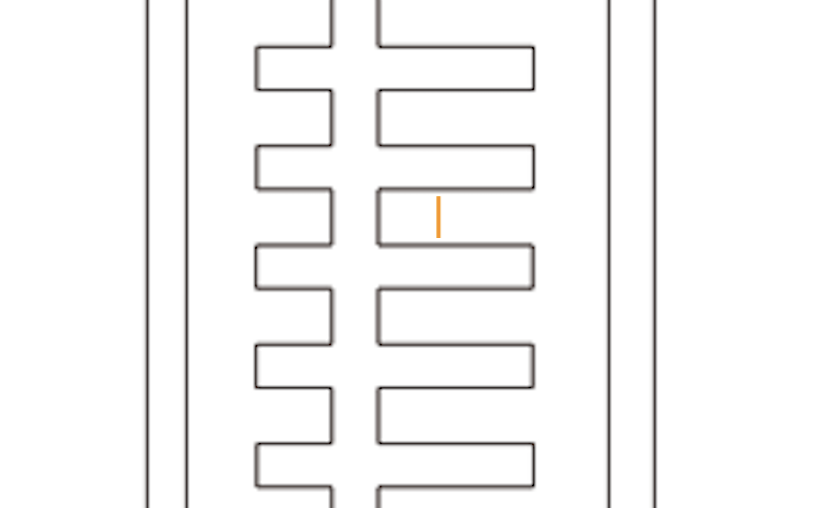
- Then I chose leftover acrylic sheets to laser cut the mold;
In total I had:
-
2 walls
-
2 frames (1 cut from 3mm and the other from 5mm acrylic sheet)
-
1 pattern for the air chambers.
-
I used glue to fasten the frame.
I used Kimian 60-40 laser cut with these parameters:
for the 3mm acrylic sheet: * speed - 12 mm * power - 90-92
for the 6mm acrylic sheet: * speed - 6 mm * power - 95-98
The results were satisfying. However, I had a small part still attached after laser cutting the 6mm acrylic sheet. My instructor explained that due to the transparency and reflection properties of the acrylic sheet, the laser may have difficulty finding the upper surface well, thus cannot focus the beams well. She gave advice to place simple white paper on top of the acrylic sheet before laser cutting.
-
When the parts were attached, the mold was ready. I mixed both A and B components of EcoFlex A1 slowly, without lifting the stick up in the air while mixing to avoid bubbles getting into the mixture.
-
I poured the silicone mixture into the molds;
-
Then, I removed the hardened silicone and glued delicately the two parts with more silicone mixture.
-
The mold was ready and I could not wait to try it!
Results
My successful results are the following three soft robots/actuators:
-
Paper origami:
-
Thermo-adhesive vinyl actuator based on the ancient game pattern:
- Silicone cast actuator based on a butterfly proboscis:
Weekly reflection
- This week was among the hardest and inspiring weeks for me, since I used to know me as an artist and craftswoman far from technology. I am highly inspired by this new skill and I want to encorporate soft robots in my future art projects.
- I would try the heat actuator with fishing line, too.
- This gives me insights of incorporating movement to my final carpet not only sound and light.