Circular Open Source Fashion
Introduction
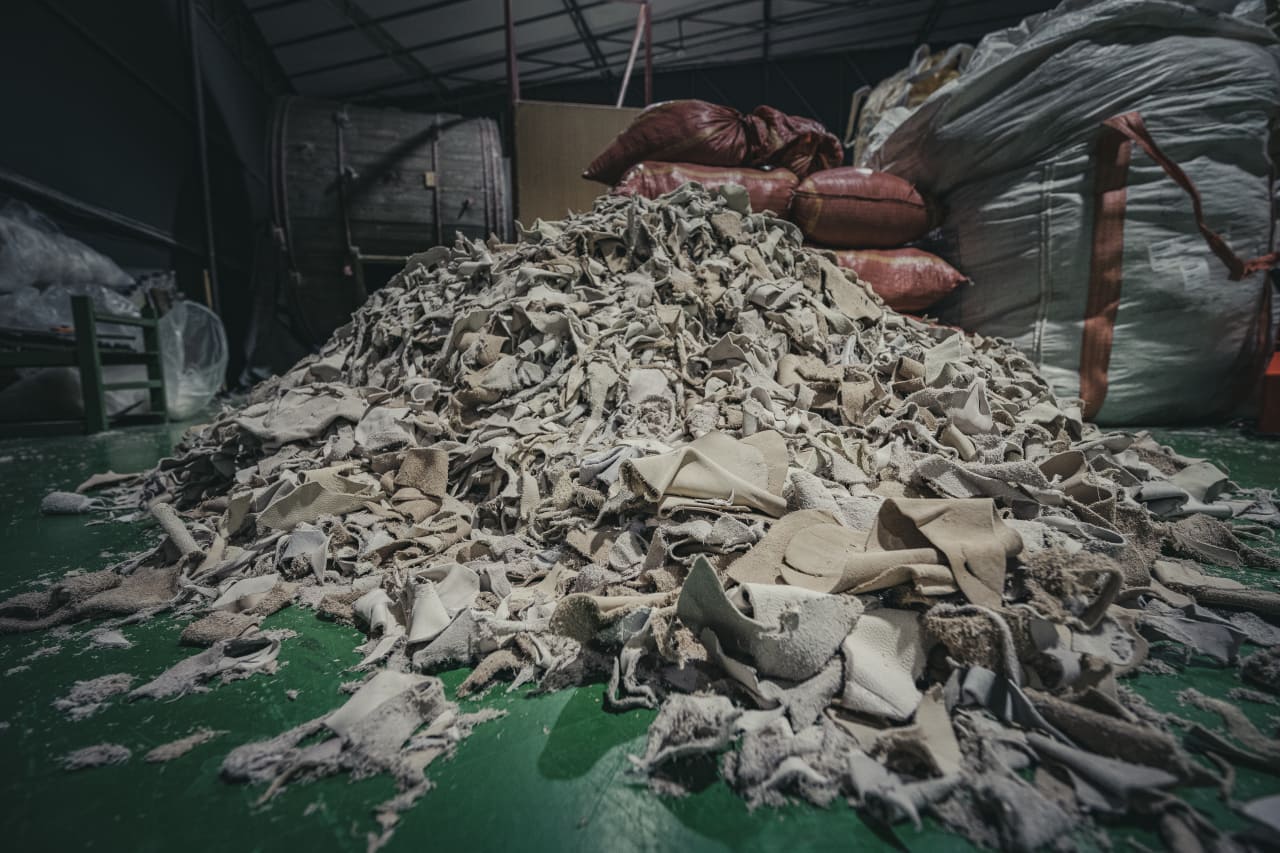 This image taken from The korea herald
Leather waste is one of the most important waste types related to the leather industry, and it is produced during many stages, from raw hide processing to cutting, manufacturing, and finishing. A scientific review published in The Journal of Industrial Ecology (Here) in 2024 estimates that producing 1 m² of finished leather uses about 7.4 kg of salted cowhide, while the finished leather weighs only about 1.5 kg, meaning that more than 75% of the raw material’s mass is not converted into finished leather and instead appears as various types of waste and byproducts during processing. The study estimates that the global leather industry produces approximately 4 million metric tons of solid waste annually.
Research
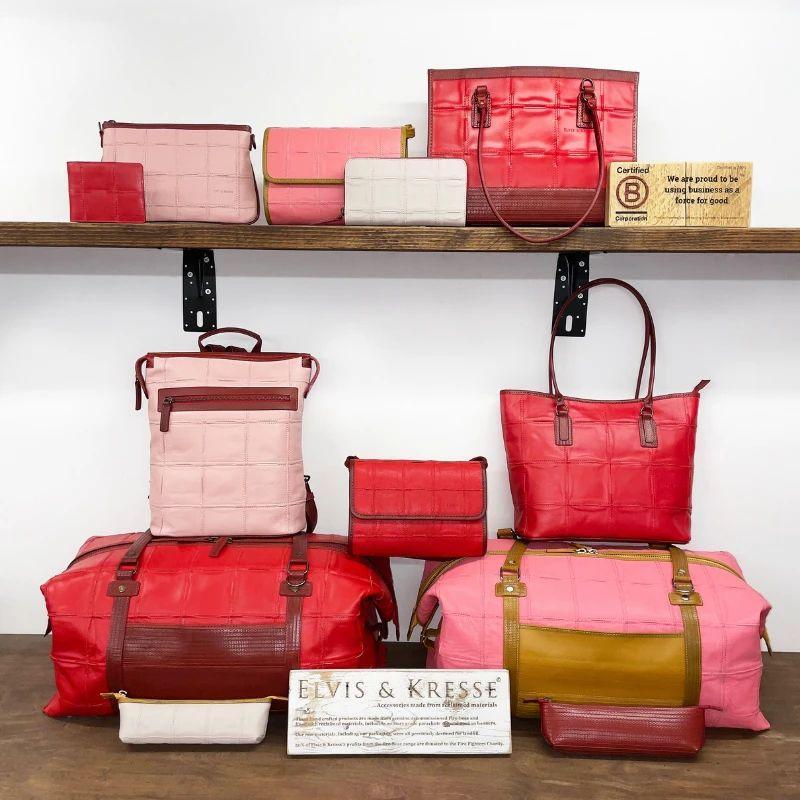
Elvis & Kresse is a leading example of applying recycling principles to the design of fashion and accessories; it transforms small pieces into parts that can be gathered and woven by hand, piece by piece, to create a new leather surface, allowing them to use pieces of various shapes and sizes that would normally be wasted because they don’t fit traditional cutting processes.
This process can be summarized in three main stages:
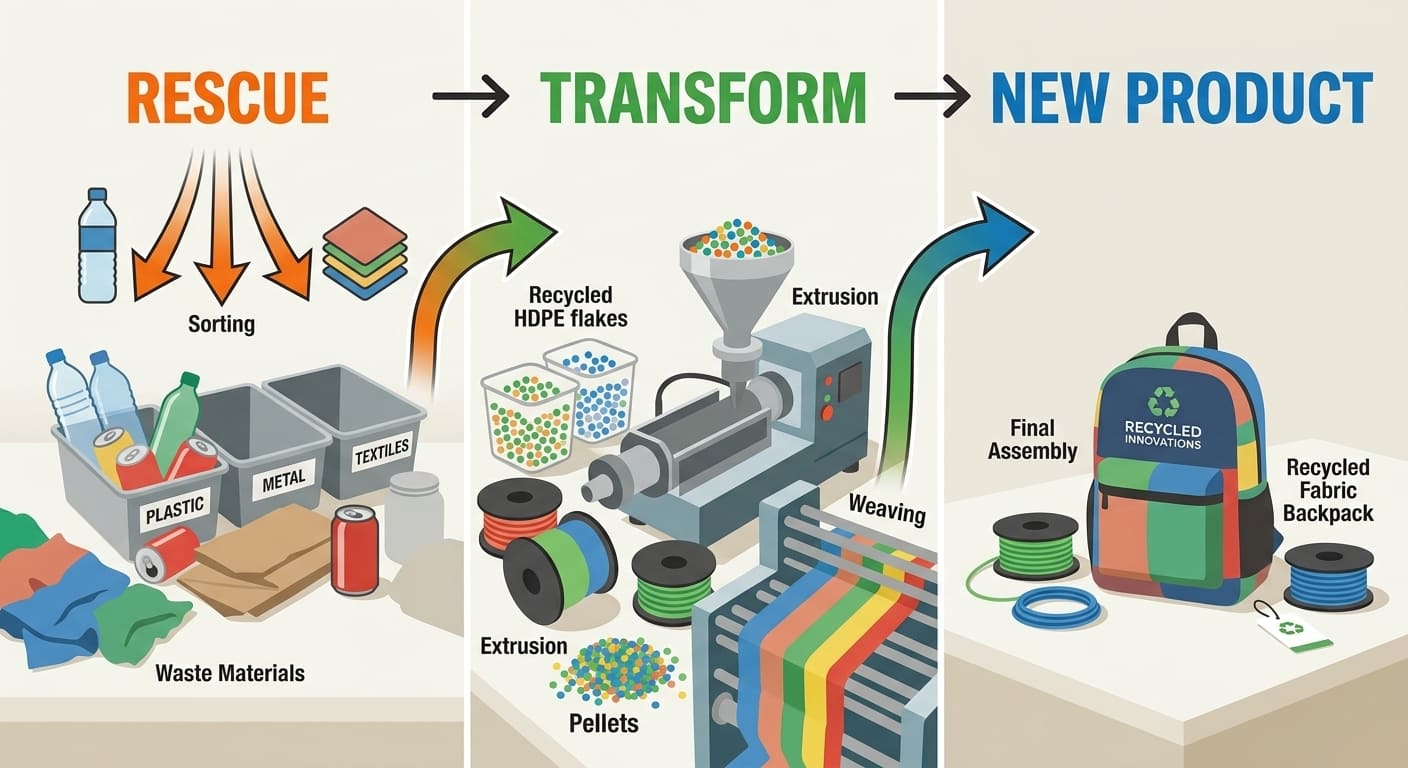 This image created by Gemini
And the company uses this recycled material to produce bags, wallets, belts, accessories, and home goods. The brand is also currently collecting leather samples from Burberry and Rolls-Royce and integrating them into some products with recycled fire hoses.
NASH'A
Introduction
NASH'A comes from the idea of a new beginning; “nash'a” means the appearance of something new and its creation from a starting point, which is directly linked to the project’s concept of Circular Modularity. The products are based on the use of leather waste and its recycling within a design system that allows the material to transition from one use to another, and from one form to a new one, rather than ending up as waste.

Therefore, NASH'A does not refer to a single product, but instead to an idea of continuous reconfiguration and transformation; leather pieces and components can be combined, separated, or rearranged to create different functions and products. The concept of “NASH'A” has become the link between material and design: a material that already exists enters a new cycle, giving rise to new possibilities.
NASH'A (Hand Harness)
Step 1: Inspiration & References
Translated with DeepL.com (free version)
weekly assignment
Check out the weekly assignment here or login to your NuEval progress and evaluation page.
2. References, research & inspiration
2.1 Quick how-tos
remove chapter 2.1 after use
Uploading images
-
Remember to credit/reference all your images to their authors. Open source helps us create change faster together, but we all deserve recognition for what we make, design, think, develop. Use the caption and reference system examples you see in the template.
-
Resize and optimize all your images. Images are optimised in size with resolution 72dpi, a good max width for full screen is 800px and passed through tinypng for final optimisation.
-
Remove tips when you don't need them anymore!
How-to use footnotes for references or fabrication files
-
Fabrication files are a necessary element for evaluation. You can add the fabrication files at the bottom of the page and link them as a footnote. This was your work stays organised and files will be all together at the bottom of the page. Footnotes are created using 1 (without spaces, as shown in Step 1 & 2, and referenced as you see at the bottom of this page) You can reference the fabrication files to multiple places on your page.
-
Referenced footnotes are important for crediting work of others, within your documentation.
-
If you are using footnotes for both, make sure to not mix them up, work with the numbering to keep things organised
How-to compress a PDF BEFORE uploading it:
Use a compressor when uploading a PDF, you can use online tools such as ilovepdf or smallpdf
How-to encode a VIDEO BEFORE uploading it:
Use a video encoder when uploading a video it needs to be well compressed, you can download tools such as Handbrake or online tools such as this Video Converter
How-to ZIP/compress a large Fabrication file:
To zip a file on Windows, right-click the file or folder, select "Show more options," choose "Send to," then "Compressed (zipped) folder." watch On a Mac, select the file or folder and choose "Compress" from the context menu. watch
get inspired!
Check out and research alumni pages to betetr understand how to document and get inspired
-
0-waste modular dress - Stephanie Johnsons - TextileLab Amsterdam
-
Modular balaclava - Mina Mayo Smith - FabLab Kamakura
-
Modular jewellery - Shefali Desai - Somaya
-
0-waste garment - Ruby Lennox - FabLab Bcn
-
0-waste garment - Alve Lagercrantz - FabLab Bcn
-
Assembly instructions & embedded message - Jessica Stanley - TextileLab Amsterdam
"Lorem ipsum dolor sit amet, consectetur adipiscing elit, sed do eiusmod tempor incididunt ut labore et dolore magna aliqua. Ut enim ad minim veniam, quis nostrud exercitation ullamco laboris nisi ut aliquip ex ea commodo consequat. Duis aute irure dolor in reprehenderit in voluptate velit esse cillum dolore eu fugiat nulla pariatur. Excepteur sint occaecat cupidatat non proident, sunt in culpa qui officia deserunt mollit anim id est laborum. Lorem ipsum dolor sit amet, consectetur adipiscing elit, sed do eiusmod tempor incididunt ut labore et dolore magna aliqua."
Caption for the left image
Caption for the right image
-
Download references Links to online reference files, PDF, booklets
-
or embed your own PDF as:
- Video references: Vimeo (only when not yours)
Sound Waves from George Gally (Radarboy) on Vimeo.
- Video references: Youtube (only when not yours)
3. Tools
4. Process and workflow
"Lorem ipsum dolor sit amet, consectetur adipiscing elit, sed do eiusmod tempor incididunt ut labore et dolore magna aliqua. "
How-to use footnotes for fabrication files
Fabrication files are a necessary element for evaluation. You can add the fabrication files at the bottom of the page and link them as a footnote. This was your work stays organised and files will be all together at the bottom of the page. Footnotes are created using 1 (without spaces, as shown in Step 1 & 2, and referenced as you see at the bottom of this page) You can reference the fabrication files to multiple places on your page.
4.1 Step 1
This model 3 was obtained by.. Lorem ipsum dolor sit amet, consectetur adipiscing elit, sed do eiusmod tempor incididunt ut labore et dolore magna aliqua.
4.2 Step 2
The laser cut nesting 2 was created using.. Lorem ipsum dolor sit amet, consectetur adipiscing elit, sed do eiusmod tempor incididunt ut labore et dolore magna aliqua.
4.3 Step 3
...

5. Results
Results & documentation
- Don’t forget to document the outcome including:
- Upload the photos & files on oscircularfashion
- Final result
- Photos from different stages
- Videos of movement or interaction, show how a material moves, something was assembled or the interactive
- Include measurements or a reference object to give a sense of size
- Describe the (material) properties or what you made
- Comparison between attempts, if you did multiple experiments or generated multiple files before fabricating / deploying. You can use a table as shown in week 4
6. Weekly reflection & critical thinking
- What did I learn? What did I personally find interesting or surprised me?
- What would I do differently? If something "failed" do I know how else to tackle it now?"
- How does this connect to my final project or my learning trajectory?
- What are implications and possible applications, think also from the ethical or environmental aspect, how it could connect to your practice and project?
NuEval — final step
Go to NuEval and fill in the checklist, when not complete notify your instructor.