Research
Species count by family (top families)
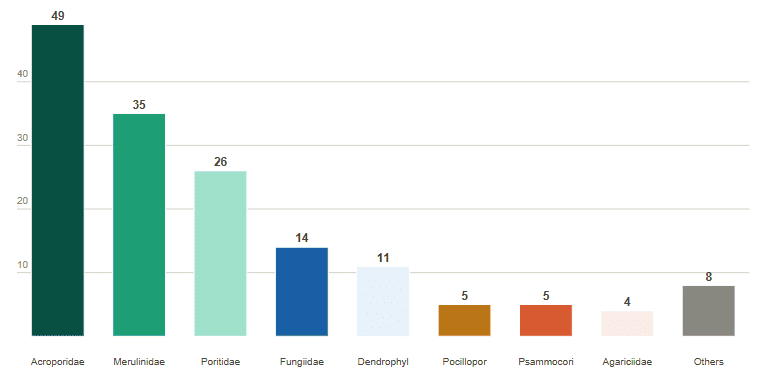
Family Acroporidae dominates with ~49 species, followed by Merulinidae (~35 species, which includes the brain corals) and Poritidae (~26 species). These three families account for over 70% of all hard coral species in the Gulf of Aqaba.
Depth Distribution & Bleaching Sensitivity
Jordan's reef is a fringing reef with a narrow flat and vertical drop-off. Acropora dominates shallow crests (2–10 m); Pocillopora occupies reef flat to 30 m; Platygyra (brain coral) is found throughout all depth zones from crest to 30 m.
Relative bleaching sensitivity — genus comparison
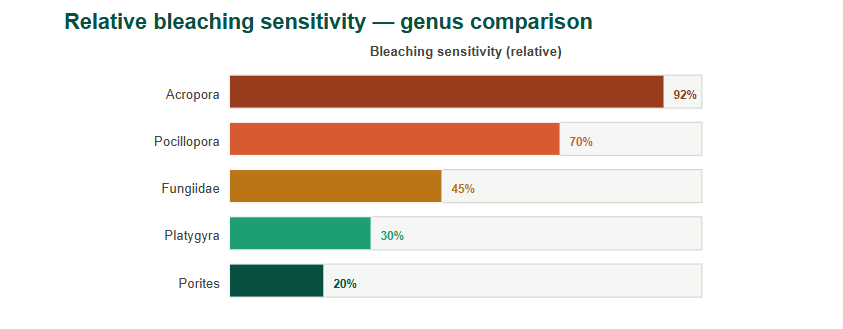
Acropora is the most bleaching-sensitive genus and acts as an early warning indicator of thermal stress. Massive corals such as Platygyra and Porites are significantly more stress-tolerant. This gradient directly informs restoration priorities: Acropora fragments need the most structural protection — precisely what Murjan's clay reef substrate is designed to provide.
Colony growth forms in Aqaba
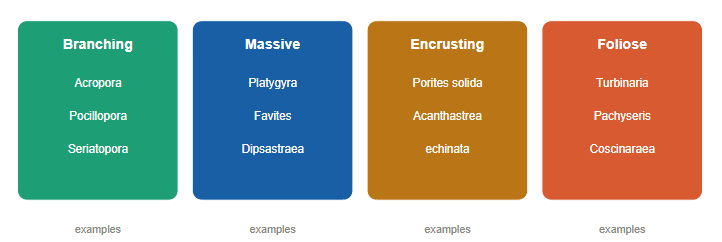
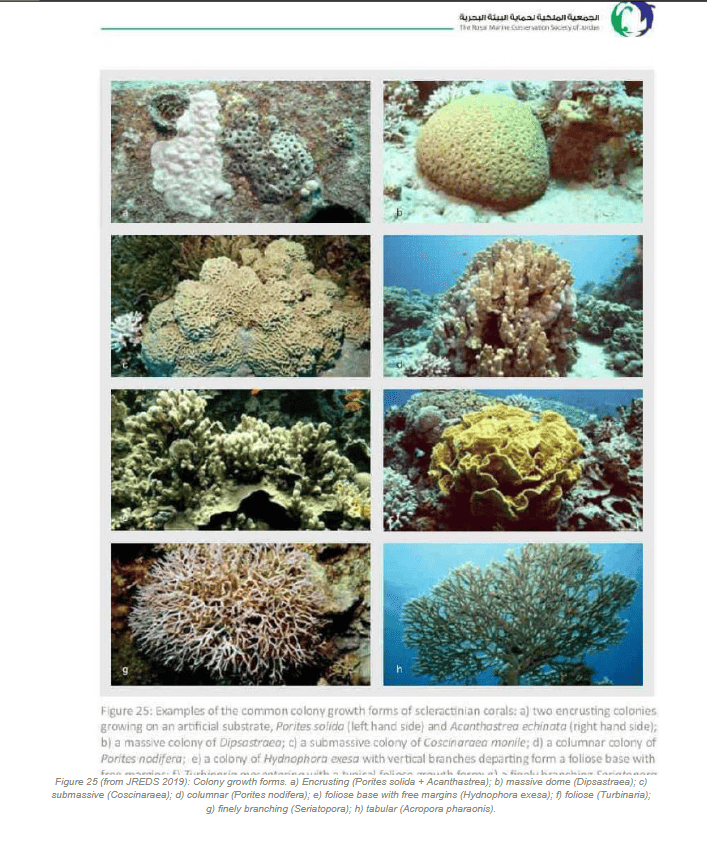
Hard corals in Aqaba express four principal growth forms. Branching corals (Acropora, Pocillopora) build complex three-dimensional habitat. Massive corals (Platygyra, Favites) form the reef's structural backbone. Encrusting and foliose forms create surfaces and shaded microhabitats — all of which Murjan's clay prototype aims to replicate
Coral Biology & Morphology
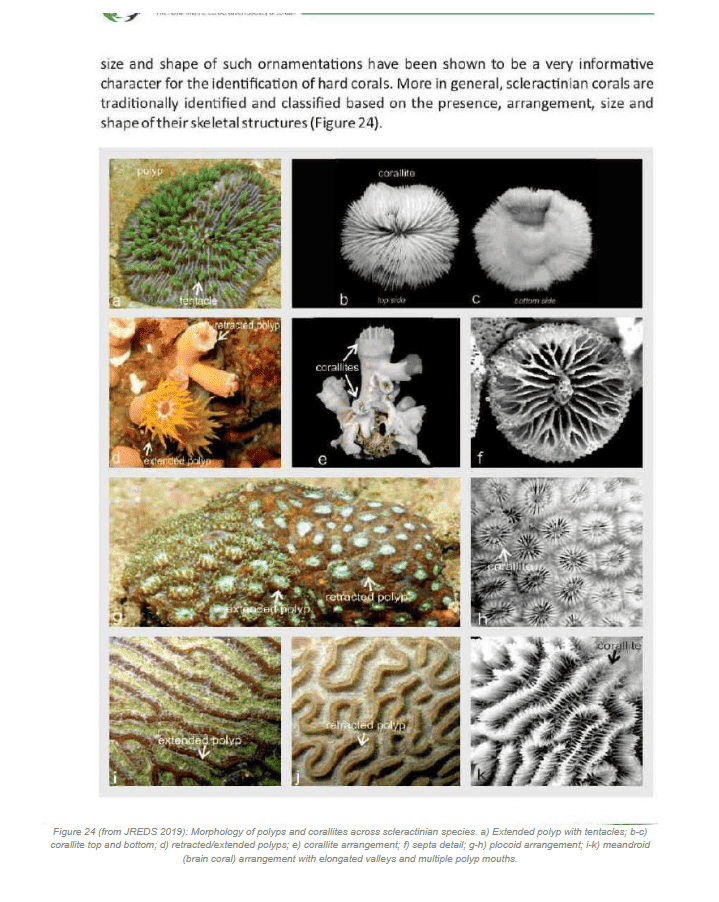
Hard corals (Order Scleractinia) are colonial animals that secrete calcium carbonate skeletons. Each individual animal is called a polyp — it has a mouth surrounded by tentacles and sits in a cup-shaped skeletal structure called a corallite. The arrangement, size, and shape of corallites is the primary basis for species identification.
Acropora
Family Acroporidae · Branching reef-builder · Most dominant genus in Aqaba
Morphology
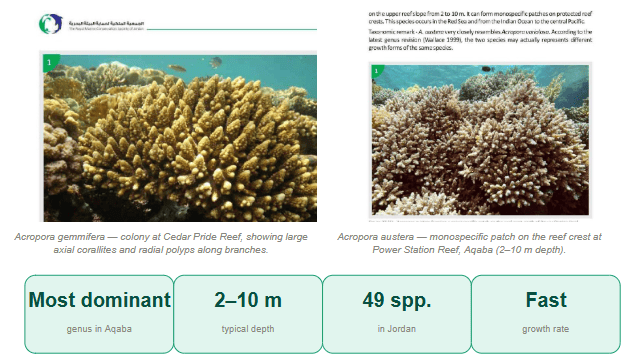
Acropora has a unique dual-polyp morphology: one large axial corallite at each branch tip surrounded by smaller radial corallites crowded along the branch sides. This arrangement is the genus's most recognisable feature underwater. Branches grow in tufts or tree-like (arborescent) forms reaching 2–4 mm axial corallite width at the tip.
In Aqaba
Acropora is the most abundant coral genus in the Gulf of Aqaba. 49 species are documented in Jordan. A. gemmifera (dark yellow to brown, thick branches) is restricted to reef flats and crests in shallow habitats. A. austera forms monospecific patches on protected reef crests at 2–10 m. Colonies range from dark yellow to brown; polyp mouths may show light blue or purple tissue.
Sensitivity & relevance
Acropora are the first genus to bleach under thermal stress — they are critical bioindicators of reef health. Their fast calcification rate produces complex three-dimensional habitat for hundreds of fish and invertebrate species. As the dominant framework-builder of Aqaba's reef, Acropora recovery is the primary ecological goal of projects like Murjan.
| Growth Form | Type | Bleaching Sensitivity | Depth Range |
|---|---|---|---|
| Branching / arborescent | Reef-building | High bleaching sensitivity | 2–10 m depth |
Pocillopora
Family Pocilloporidae · Cauliflower coral · Common across Aqaba's reef
Morphology
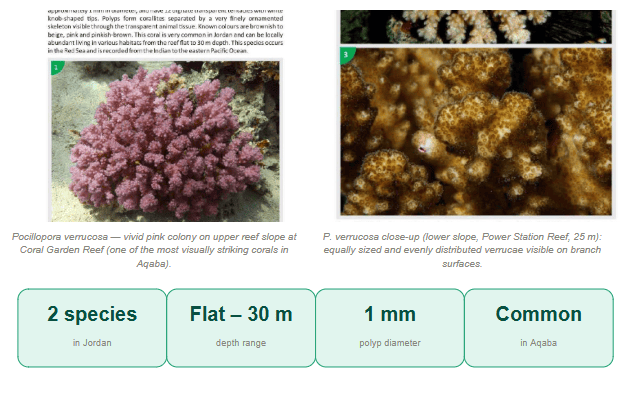
Pocillopora forms branching colonies of robust, cylindrical branches with rounded ends. The defining feature of P. verrucosa is its verrucae — wart-like skeletal protuberances 2–4 mm in diameter, equally sized and evenly distributed across the entire colony including branch tips. Polyps (1 mm diameter, 12 transparent tentacles) are always fully extended in daytime. The skeleton is finely ornamented and visible through transparent tissue.
In Aqaba
Two species are documented: P. verrucosa is very common in Jordan — locally abundant from reef flat to 30 m depth, living in various habitats. P. damicornis is less frequent, observed below 10 m, forming more thinly branching colonies in low-light environments. Known colours include brownish-beige, pink, and pinkish-brown. P. verrucosa can appear vivid pink or purple in well-lit shallow conditions.
Ecological role
Pocillopora provides complex branching habitat for small fish and invertebrates, and is a key prey item for corallivorous species. Its plasticity across depths and habitats makes it one of Aqaba's most ecologically successful coral genera. Its relatively stocky branching architecture (compared to Acropora) makes it a useful morphological reference for designing clay reef structures.
| Growth Form | Habitat Range | Distribution |
|---|---|---|
| Branching / cauliflower | Reef flat – 30 m | Common in Jordan, Red Sea + Indo-Pacific |
Brain coral — Platygyra
Family Merulinidae · Maze coral · Structural backbone of Jordan's reef
Morphology
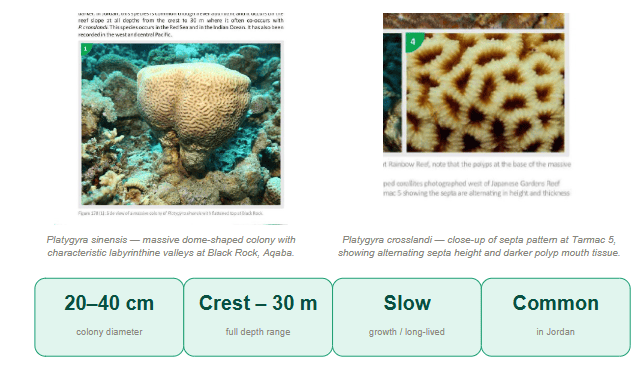
Brain corals are massive, dome-shaped or flattened on top, circular in cross-section. Unlike solitary corallites, the polyps form continuous series — elongated valleys 3–10 mm wide with fused walls. Within each valley, 2–5 polyp mouths can be found. Septa are short and straight, alternating in height and thickness. Polyps are always retracted in daytime. Colonies are beige, yellow, or yellowish-brown; tissue around polyp mouths often darker.
Species in Aqaba
Multiple Platygyra species are recorded in Jordan. P. sinensis forms massive domes 20–40 cm in diameter, common throughout all depths from reef crest to 30 m, often co-occurring with P. crosslandi. P. crosslandi forms longer series (valleys) than P. sinensis and tends toward lighter brown or yellow colouration. Both are found in the Red Sea, Indian Ocean and central Pacific. Several Platygyra species are Red Sea endemics.
Relevance to Murjan
Brain corals are among the most structurally resilient corals on the reef — slow-growing, long-lived, and significantly more thermally tolerant than branching species. Their massive calcium carbonate skeletons create the complex microhabitat architecture (shaded overhangs, sheltered pockets, varied surfaces) that smaller organisms depend on. The labyrinthine surface geometry of brain corals is a direct morphological inspiration for the clay reef prototypes in the Murjan project.
| Growth Form | Habitat Range | Stress Tolerance | Distribution |
|---|---|---|---|
| Massive / dome-shaped | Reef crest – 30 m | High stress-tolerance | Red Sea endemic spp. present |
Referances
Visualizations and data graphics created using information from the JREDS field guide. All coral photographs extracted from the original publication for academic and conservation reference only under fair use for non-commercial educational purposes