02 process
Process
Ideation & Sketches
Concept: Ecological Memory Through Wearable Sensing
This wearable project explores the relationship between the body, vegetation, and environmental perception. Inspired by the concept of environmental generational amnesia, the project investigates how urbanization progressively disconnects humans from ecological systems.
The wearable was developed as a speculative and interactive interface capable of translating vegetal signals into bodily sensations. Inspired by biological adaptability and distributed sensing systems found in nature, the project combines biomimicry, environmental sensing, wearable electronics, and responsive feedback.
The system detects signals associated with vegetation — such as green intensity, chlorophyll reflectance, and environmental conditions — and transforms them into:
- Light pulsations
- Soft body vibrations
- Breathing-like luminous responses
The more vegetation surrounding the user, the more "alive" the wearable becomes.
This first ideation phase focused on imagining how the body could become an expanded ecological interface, capable of sensing environmental presence through wearable technology.
Electronic Prototyping & Connectivity
To create real-time interaction between the environment and the wearable, I prototyped a distributed electronic system using ESP8266 WiFi modules, environmental sensors, NeoPixels, and haptic actuators.
The wearable system allows:
- Environmental data transmission in real time
- Modular sensor scalability
- Distributed body feedback through light and vibration
The system architecture includes:
- ESP8266 communication modules
- Environmental sensing nodes
- NeoPixel feedback systems
- Vibration motors for haptic response
- Wearable power management systems
The goal of this stage was to create an interactive wearable capable of translating environmental conditions into immediate bodily experiences.
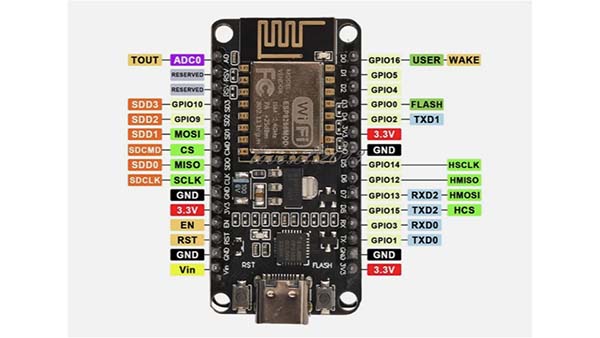
Figure 2: ESP8266 communication module.
ESP8266 Setup
Open Arduino IDE and configure the ESP8266 board manager by going to:
File → Preferences
Then paste the following into the Additional Boards Manager URLs field:
http://arduino.esp8266.com/versions/2.3.0/package_esp8266com_index.json
Next, go to:
Tools → Board → Board Manager
Search for:
ESP8266 by ESP8266 Community
and install it. Then select:
NodeMCU 1.0 (ESP-12E Module)
under Tools → Board → ESP8266 Modules, and finally select the correct serial port.
You can now upload code to the ESP8266 module successfully.
Wireless Communication Between Environmental Sensors and Wearable
The wearable uses WiFi communication to exchange environmental data between sensing modules and wearable feedback systems.
Environmental conditions detected remotely are translated into:
- Color changes
- Body vibration
- Environmental feedback loops
This creates a real-time relationship between ecological sensing and bodily perception.
Table. Cost of Electronic Components Used in the Wearable Prototype
| Component | Unit Cost (MXN) | Quantity | Total Cost (MXN) |
|---|---|---|---|
| ESP8266 NodeMCU | 149 | 1 | 149 |
| TCS34725 RGB Color Sensor | 85 | 1 | 85 |
| WS2812B NeoPixel Module | 22 | 1 | 22 |
| Coin Vibration Motors | 60 | 5 | 300 |
| Total | 556 |
Table Y. Electrical Characteristics of the System Components
| Component | Operating Voltage | Typical Current | Function |
|---|---|---|---|
| ESP8266 NodeMCU | 3.3 V | 70–170 mA | Microcontroller and data processing |
| TCS34725 RGB Color Sensor | 3.3–5 V | 0.2–0.6 mA | Color detection and measurement |
| WS2812B NeoPixel | 5 V | Up to 60 mA per LED | Visual feedback through color |
| Coin Vibration Motor | 3–5 V | 60–100 mA | Haptic feedback |
Estimated Maximum Current Consumption
| Device | Quantity | Maximum Current |
|---|---|---|
| ESP8266 NodeMCU | 1 | 170 mA |
| TCS34725 RGB Color Sensor | 1 | 1 mA |
| NeoPixel LEDs | 5 | 300 mA |
| Vibration Motors | 2 | 200 mA |
| Total | 671 mA |
### Where to buy components
ESP8266 TCS34725 RGB Color Sensor NeoPixel LEDs Vibration Motors